Paula Hayes’s First Public Garden Is 36 Minutes From Grand Central


Lyndhurst sits on a hill above the Hudson in Tarrytown, 36 minutes by train from Grand Central. Helen Gould, who ran the estate from 1892, built an overlook there around 1905 that Lyndhurst still calls her “treehouse,” a raised deck wrapped around a white birch, and it was gone by the 1960s. When Lyndhurst rebuilt the deck, Paula Hayes, the sculptor and land artist known for her terrariums and for the Gazing Globes that glowed in Madison Square Park in 2015, planted a pollinator garden of native grasses around it, laid out as a mandala and set with three Gazing Globes, a purple birdbath and a bronze gnome. It is the first landscape she has made that anyone can visit, and she calls it “a continuation of her care for this site, made in a vocabulary only available a hundred years later.” We asked her how it came together, ahead of the Sunset Soirée at the overlook on September 10.
Helen Gould’s Treehouse at Lyndhurst
Helen Gould built the overlook here around 1905, what Lyndhurst still calls her “treehouse,” a raised deck wrapped around a white birch. Why couldn’t the birch come back, and what did that decide for the garden around it?
Paula Hayes: Betula papyrifera (paper birch) are not being planted in the Northeast because of bronze birch borer, birch leafminers, and shorter lifespans due to heat intolerance (climate change). We decided that the planting around a larger wood observation deck could have the magic of moving leaves, changes in the seasons, gathering, observing the river and the house, and getting the kids out of the house as Helen Gould wanted to do pre-AC, in Victorian time—plus the inclusion of my sculptural works that guide the public toward different ways of moving through the landscape and experiencing points of view in physical and internal ways.


The clover is doing the real work underneath, low to the ground, drawing the bees in while the bluestem and switchgrass do their thing above it.
From the path the garden looks like a meadow. You only see the mandala once you climb up to the overlook. Was that the plan from the start?
Hayes: Absolutely—I wanted the enjoyment of the garden to be experienced from many vantage points, and discoveries—like, as you say, being able to see a larger form by being perched in the overlook, the viewing platform—getting a view like the treehouse of the Victorian time.
Paula Hayes on the Bees and the Bluestem
You planned the planting with landscape architect Andrew Moore. How did you choose the plants, and which ones are the bees going for?
Hayes: The bees are moving through the landscape and love many of the plants—right now they love the white clover we seeded beneath the grasses. Andrew and I wanted the grasses for their movement and their seasonal color, but the clover is doing the real work underneath, low to the ground, drawing the bees in while the bluestem and switchgrass do their thing above it. Earlier in the season it’s the dogwood and magnolia at the edge of the site pulling them in, and by fall the grasses themselves will seed out and the bees move on to whatever’s left blooming nearby—so the planting is really feeding them in shifts across the whole year, not all at once.
The “Gazing Globes,” the Birdbath and the Gnome
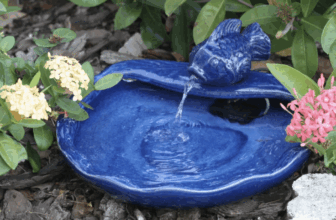
The birdbath is the same one that stood in MoMA’s sculpture garden, tinted purple this time to match the grasses. What made you bring it here, and why purple?
Hayes: Purple is a dominant color of the little bluestem, and an underlying color in many plants throughout the garden—so tinting a birdbath let it settle into the palette rather than stand apart from it.
You write that the Gazing Globes “become whatever arrives at them,” light, weather, a passerby’s reflection. They first stood in Madison Square Park in 2015, in the middle of the city. What is different about them in a garden above the river?
Hayes: In Madison Square Park they were reflecting the city back at itself—traffic, buildings, crowds moving past. Here they’re holding the river, the sky, the change of weather over the Hudson, and whoever comes to the overlook. The globes don’t have all the content on their own; they become whatever arrives at them, so moving them from a plaza to a meadow changes almost everything about what they show, without changing the object at all.
It’s a deployed symbol, planted into a landscape that’s otherwise asking to be taken literally. I like that friction.
Tell us about the gnome.
Hayes: Mine isn’t a garden gnome so much as an abstraction of one—a suggestion. It reads as something emerging from the ground, a plant form, blended with a gnome’s hat, perhaps, so you’re not quite sure where the vegetal ends and the figure begins. I don’t think of it as ornamental, even though it borrows the vocabulary of ornament—the same way the gazing globe does. It’s a deployed symbol, planted into a landscape that’s otherwise asking to be taken literally. I like that friction. It’s part of the “casual ceremonies” thread I’ve carried since 1991—bringing something familiar and almost kitsch into a space of real attention, so the whole experience isn’t exactly solemn. The gnome is watching, the same way the birdbath and the globes are watching, and half-grown from the earth itself, though partly industrial, and all human-hand made.

For a New Yorker who takes the train up this September, what should they look for that they would have missed in June?
Hayes: By September the little bluestem is turning, and that purple that’s underneath so many of the plants all summer starts to surface—you’ll see it echoed in the birdbath now. The meadow reads differently once the grasses go warm and coppery instead of green, so the mandala from the overlook has a completely different color logic than it did in early summer. And the bees will be on different plants than they were in June, so it’s worth watching what’s actually being visited now versus what seems intended as purely decorative.

“The Paula Hayes Garden” is permanent and open daily with a grounds pass at Lyndhurst, 635 South Broadway, Tarrytown, New York, 9:30 a.m. to 4:30 p.m. The grounds close for the season at the end of December and reopen in April. The Sunset Soirée at The Overlook takes place Thursday, September 10, 6 to 8 p.m., rain or shine, with live jazz from The Kat Gang Band, wine and hors d’oeuvres, and a garden-themed gift from Paula Hayes. Tickets are $55 plus fees, ages 21 and over, at lyndhurst.org. Hayes also leads a Garden Conservancy walking tour of the Overlook garden on Saturday, October 3, 10 a.m. to noon, $40, or $30 for Conservancy members. From Grand Central, Metro-North’s Hudson Line reaches Tarrytown in about 36 minutes, and Lyndhurst is a short cab ride or a walk from the station. Walkers can also enter the grounds free from the Old Croton Aqueduct and Westchester RiverWalk trails. More info on the Friends of the Old Croton Aqueduct website.