
- Details
- Written by Nicholas Breeze Nicholas Breeze
-
Published: 09 May 2026 09 May 2026
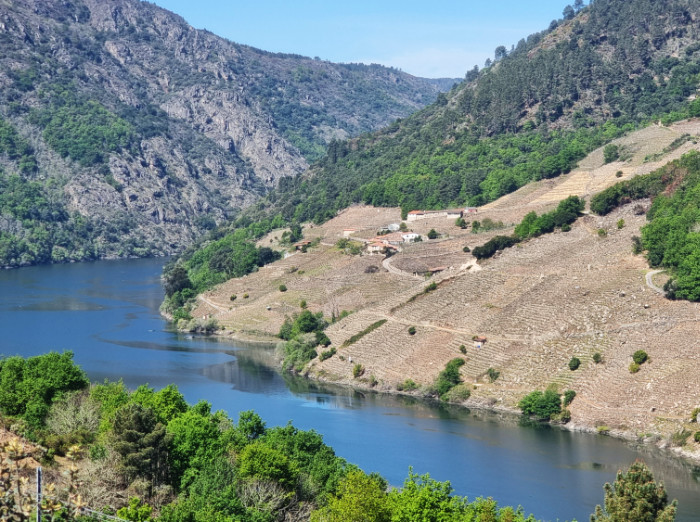
We rolled out the rug on a small patch of grass etched between the steep cascade of Roman terraces, with neat lines of vines both rising above us and falling away to the tranquil water below. Between each vine, the ground was covered in shrubs, flowers and buzzing insects. The panoramic view across the Sil Canyon, in this stretch of Ribeira Sacra, with tins of sardines in olive oil and a makeshift salad, offer a rustic experience of sublime dining.
The vineyard terraces here are so steep they are part of a wider category known as heroic viticulture. They date back to the Romans and were subsequently maintained by monks across the centuries after the Roman’s demise.
 Steep vines in the Cañon Do Sil, Ribeira Sacra
Today most of the grape pickers at harvest time are over seventy years old, adding to concerns about the sustainability of this region. Vines require hand harvesting, temperatures are rising due to climate change and young people, less inclined to extremely hard manual work, are leaving, no matter how heroic it might be.

Antique models London at hatchwell Antiques
It was Easter weekend and the temperature was already touching thirty degrees celsius. The previous day we had walked twenty-five kilometres (15.5 miles) along a designated route signposted as the Camino de Nature. Along the way we saw a ghostly Benedictine monastery and passed through ancient Tolkien-esque chestnut forests perched over 500metre gorges that took (what was left of) our breath away. Descending through the woods, wondering if we were still on the right track, we came across the first glimpse of untrained vines in this part of the Cañon do Sil. Green shoots were starting to show, breeding new hopes of refreshment out of a cold tough winter.
Conditions are changing here. The last winter winter was 1.3ºC warmer than the typical average, since records began here in 1961. In January, rainfall was measured at 324 litres per square metre, 125% above normal. The implications are profound for both biodiversity and erosion of the landscape. As conditions continue to warm up, winter vine health, especially the resting state of the vine, where it enters a period of vegetative dormancy, will be affected.
Continuing below we arrived at a small beach on the river Sil and, with our legs begging for reprieve, collapsed into the cool water. A quick check of the route showed that we were barely halfway round and the pathway back was entirely uphill.
 Raw beauty of the Cañon Do Sil
The consolation for embarking on this heroic camino was the raw beauty of the landscape. Buzzards glided overhead inspecting all intruders and we marched on through abandoned hamlets and old stone mills. At the top, with only a few kilometres left to go, a small bar was busily serving their guests in the evening sun. We ordered two glasses of Godello, a treasured white grape of this region, and, with a plate of succulent green olives, entered a state of euphoric exhaustion.
The next day, following our picnic in the vines, we visited the nearby Bodega Ronsel do Sil, a boutique winemaker producing around 40,000 bottles a year from both their own vines and from parcels spread across the canyon.
Bodega Ronsel do Sil

When the two architect owners, María José Yravedra and Felipe Pérez-Somarriba, bought the property, it was a stone ruin on the waters edge. It has been developed to sit in comfortable balance in the landscape where María is in charge of crafting minimal intervention wines from indigenous varieties. The red grape Mencia is emblematic of the Ribeira Sacra region and makes up a greater percentage of the production here. However, varieties such as Brancellao are new to me, as is their field blend of red varieties that encapsulate the geologic and aromatic characteristics of the canyon, especially at this time of year when everything is bursting into life.
Felipe serves all the wines in large Wings Cabernet Sauvignon glasses made by Riedel, accentuating the aromatics and showing off the nuanced character of both the whites and the reds.
Treixadura is grown widely in Galicia and often blended with Godello, Albariño and other indigenous varieties but here it is a single variety wine, made from vines over 85 years old with spontaneous fermentation, aged in French oak on the lees for six months. The result is a wine with floral and exotic fruit aromas, rich on the palate with a long cool finish. It is infinitely sip-able. During the ageing process there is no stirring of the lees (dead yeast cells), preserving the purity of the fruit character but still adding depth to the wine.
Godello is my white Galician variety of choice with potential to deliver great complexity and enormous pleasure. Here at Ronsel Do Sil, the Godello grapes are fermented naturally and aged in French oak barrels on the lees but with no stirring. The result is sensational. The herbaceous and floral aromas combine on the palate with a gorgeous mineral/stoney character that gives the wine structure and class. I’ll be ordering more of it from their website. My fellow taster and I were seduced.
For the reds, the Mencia is the place to start. I drink a lot of Mencia and find it a charming variety. It can be aged in oak or served young and fresh with aromas of violets, rose petal, and cherry, held together in the mouth by a vivacious acidic structure. Another plus point I find with many Mencia wines is that they maintain a lower alcohol level at around 12-12.5% ABV, thus minimising negative side effects and maximising enjoyment.
Felipe pours us a Val’Uveyra 2016 Mencia, which has had a year in French barrel before bottling. The vines are between 30-60years old and grown on granite soils. The aromas are red currant, a slight touch of the violet, with a note of coffee bean. To taste it is a mellow and maintains some stoney character. At ten years old it is very much alive and enjoyable. A great example of the often unsung Mencia.

The next wine we taste is the Pórtico da Gloria which, as anyone who has completed the Camino De Santiago will know, is the celebratory gate for pilgrims reaching the Cathedral plaza. In this case it is a gateway to a new sensation of tasting Brancellao, a rare variety growing here on schist and slate soils and aged in French oak. It is blood red in the glass and has attractive dark fruit aromas. To taste, the rich fruity flavours are coupled with a vivacious zing that makes me lick my lips. Fine tannins and good length make Brancellao a fascinating discovery.
The final bottle tasted was a field blend of the indigenous reds made in honour of the International celebration of Rural Women on October 15th. Felipe emphasises that it is Maria who is the winemaker, making this a fitting tribute. It is a limited edition wine made with predominantly Mencia grapes but also with others that are still cultivated in the surrounding area. The alcoholic fermentation is spontaneous and the wine is aged for eight months in French oak barrels. The results are complex aromas of dark fruits, a wisp of roses and lilac that translate the landscape of of the Sil valley into a sensational sensory experience. A fitting tribute to the all the women involved in the heroic endeavour of viticulture in this incredible landscape.

After the tasting we drive to a nearby swimming point and once again throw out the blanket. The afternoon is at peak heat and a siesta in the shade of large trees at the waters edge is beckoning. Not far from our heads two frogs are mating with a look of sublime satisfaction. Out of respect I postpone my swim and doze off while observing a long legged insect skating across the surface of the water.
El Gaiteiro: The bagpiping natural winemaker
Departing the Sil, we take the route up through Castro Caldelas, cutting in and out of the zigzagging contours of the steep slopes, terraced in places and forested in others. As we cross to the north side of the Sil river, the road starts to narrow with steep sided drops from the road. The vineyards here are dramatic against the sun dipping in the west. As the road twists and turns we pass a spot with curious tasting signs and a few parking spaces. It is our last chance to imbibe the landscape so we dump the car and walk up a track cut into the rock.

Well manicured terraces range around us in all directions. There is a small house with a balcony at the top of the track and man comes out with long blond hair down to the middle of his back. We are back in Tolkien territory. After an exchange of words that translates roughly as “Do you have wine?” followed by “Yes, I do!”, we are on the balcony taking in the vast sweep of the vista, the undulating vines, crazy etched terraces, the river somewhere far below and a feeling that despite the beauty, life here has been – and will always be –underwritten by tough toil.
Our host, Breo, brings us glasses of his red Mencia, a deep red wine with notes of strawberry, cherry and currants, with ground black pepper. He emerges again with a plate of chorizo and cheese. Breo is like his wine, energetic and engaging. The next time he emerges he has fulfilled the apparition of the timeless Gallego, the Gaiteiro, or piper. A few others arrive to join us on the terrace and as the sound of his bagpipes carry down the valley, we are again seduced by the ancient spirit of this place; the sacred river banks.