If you live in an HOA, you’ve probably already formed an opinion about whether your fee is fair, and so has your board. In my experience, after years on the property management side, that opinion is built on gut feelings and complaints, and whatever the number happened to be the year someone moved in, not data. For years, people treated an HOA fee like a property tax: a fixed cost you plan for once and mostly stop thinking about.
That’s worth fixing because the trend of numbers tells us a different story. Let me start by giving you an example. A townhouse owner near Rochester, New York, closed in 2021 with a $235 monthly fee. By this year, it had topped $385, which is a 60% increase on what was supposed to be one of the more predictable parts of their housing costs. In 2024, the median HOA fee hit $135 a month, up 8% year-over-year and well above 2019’s $108.
That’s outpaced inflation by a wide margin, which is exactly why “the average HOA fee” has become such a slippery number to pin down. Three things drive most of the real variation: geography, property type, and building age. In this guide, I’ll walk you through the average cost of HOA fees, show you how each one of these factors determines HOA fees, what your fee is paying for, and what to do about it.
What an HOA fee pays for

Strip it down, and an HOA fee is the cost of maintaining shared property, split across every household so it doesn’t land on one owner. What counts as “shared” depends on the property type: a condo fee reaches inside the building itself, such as the roof, hallways, and sometimes the structural bones of the property, while a single-family HOA’s responsibility stops at the property line. For most communities, none of this is optional. Buy the home, and you’re a member with dues included.
The money generally lands in three buckets. Common-area upkeep, such as landscaping, snow removal, and exterior maintenance, takes the biggest slice. Amenities cover whatever the community offers, from a pool to a fitness room. Administration covers the liability insurance every association carries, management fees, and bookkeeping.
Now, not every dollar you pay this month is meant to be spent this month. Associations are expected to run two separate accounts: an operating fund for this year’s ordinary expenses, and a reserve fund set aside for the high, infrequent costs still years off, like a new roof or a repaved parking lot. Well-managed associations usually direct 15% to 40% of their annual budget toward reserves. If the association underfunds that account, the shortfall shows up later as a special assessment, which we’ll get to.
Average national HOA fees
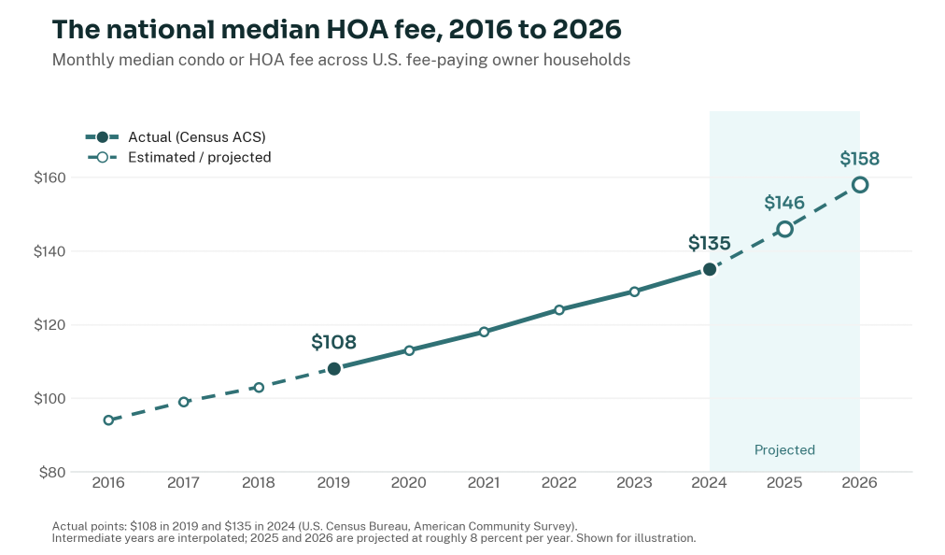
Depending on which data set you use, you’ll land on two very different and equally defensible answers. The Census Bureau’s 2024 American Community Survey found that of 86.6 million owner households nationwide, 21.6 million pay some kind of condo or HOA fee, with a median of $135 a month. That midpoint hides a wide range: roughly a quarter of fee-paying households pay less than $50 a month, while nearly 3 million pay $500 or more.
Compare that to the figure the Foundation for Community Association Research, the research arm of the industry’s trade group, CAI, calculates: an average of $390 a month, or roughly $4,700 a year, with 43 states landing in a fairly tight $300-$400 band. Neither number is wrong. They’re answering different questions.
The Census figure counts every fee-paying owner household in the country, which means the huge base of bare-bones single-family HOAs, the kind whose only real job is mowing a common strip of grass, dominates the number. The Foundation’s figure only counts actual community associations, and within that narrower group, higher-fee condo and townhome associations, the ones carrying elevators and structural reserve obligations, pull the average well above the Census median.
Zooming out to the industry level puts the total scale in perspective. The Foundation for Community Association Research counts 78.1 million Americans currently living under some form of community association. Its most recent detailed accounting shows those associations collectively billed homeowners $124.2 billion in assessments in 2025, covering everything from professional management and insurance to landscaping and capital repairs.
Run the simple math on those two figures (this isn’t a published number, just my own back-of-envelope calculation) and you land at roughly $4,196 a year, or about $350 a month, per housing unit across the 29.6 million units the Foundation counts inside community associations nationally. That sits very near to the industry-sourced average of $390. The practical takeaway: figure out which population you actually belong to before deciding whether a number sounds high or low. That’s exactly what location and property type are for.
Average HOA fees by state
We’ve already established the top-line number: a $135 median nationally. I can tell you that this exact number is what gets people into trouble. They see a national figure, hold it up against their own bill, and walk away either falsely relieved or falsely alarmed. Geography alone shifts your fee by hundreds of dollars.
In Nevada, Arizona, and Florida, somewhere between 44% and 51% of homeowners pay some form of HOA or condo fee, and the highest rate in the country. At the metro level, the highest average fees are in New York City ($558/month), Honolulu ($526), and Bridgeport, Connecticut ($424). On the flip side, you have lows of roughly $42 to $48 a month in Fayetteville, Little Rock, Tulsa, and Oklahoma City. That’s a swing of more than $500 a month, depending purely on where you live.
Property type matters just as much, and the logic is simple: whatever part of the building you don’t personally own, the association still has to maintain, and that cost shows up in your fee. A single-family HOA usually carries no maintenance obligation for individual homes, so its budget stays lean. A condo association owns and insures the building’s shared structure. Rough industry benchmarks: single-family dues fall between $100 and $250 a month, townhomes between $200 and $400, and condos between $600 and $900.
One thing worth knowing before you assume a building’s appearance tells you anything about its fee structure: whether a property legally counts as a “condo” comes down to zoning, not looks. A detached house that looks exactly like a standalone single-family home can still carry condo-level HOA obligations if that’s how the underlying land is zoned. Check the legal classification and the CC&Rs rather than judging from the curb.
And lower dues don’t automatically mean lower costs. They just relocate where the cost shows up. A single-family homeowner without a shared reserve fund isn’t avoiding the cost of a future roof or a failed sewer line; they’re self-insuring it, and that only works if they’re disciplined enough to actually set money aside for years without touching it.
Median monthly HOA fee by state (2024)
| State | Median Monthly Fee |
|---|---|
| New York | $739 |
| District of Columbia | $505 |
| Hawaii | $470 |
| Massachusetts | $376 |
| Connecticut | $351 |
| New Hampshire | $316 |
| Rhode Island | $314 |
| New Jersey | $300 |
| California | $278 |
| Minnesota | $269 |
| Illinois | $237 |
| Florida | $230 |
| Vermont | $221 |
| Wisconsin | $184 |
| Maine | $169 |
| North Dakota | $157 |
| Pennsylvania | $148 |
| Alaska | $135 |
| Utah | $135 |
| Iowa | $128 |
| Michigan | $125 |
| Ohio | $124 |
| Virginia | $123 |
| Maryland | $104 |
| Colorado | $99 |
| Georgia | $99 |
| Arizona | $98 |
| Nevada | $95 |
| South Carolina | $94 |
| Oregon | $88 |
| South Dakota | $86 |
| Delaware | $85 |
| Washington | $82 |
| North Carolina | $79 |
| Tennessee | $79 |
| Texas | $76 |
| Kentucky | $70 |
| Kansas | $65 |
| Idaho | $61 |
| Indiana | $61 |
| Louisiana | $61 |
| New Mexico | $61 |
| Missouri | $54 |
| Nebraska | $54 |
| Mississippi | $53 |
| Montana | $53 |
| Alabama | $52 |
| Wyoming | $52 |
| Oklahoma | $48 |
| West Virginia | $48 |
| Arkansas | $47 |
Why HOA fees keep rising every year
Beyond location and property type, a handful of factors do most of the remaining work. Amenities are usually the biggest single lever. For example, a pool or fitness center adds real, recurring costs that a bare-bones community never has to budget for.
Community size and density work backward: smaller communities tend to pay more per household, not less, because the same fixed expenses get divided among fewer owners. And building age matters on its own. Older properties need more frequent repair work, which is what a reserve study is built to quantify.
Florida’s case study
Now, age matters most, though, when it collides with regulation, and nowhere does that show more clearly than in Florida. On 24th June 2021, a section of the Champlain Towers South condominium collapsed in Surfside, Florida, killing 98 people. The investigation found years of deferred maintenance and inadequate reserves behind it. In response, Florida passed a series of laws requiring condo buildings three stories or taller to complete structural inspections and fully fund reserves for major components like roofs, plumbing, and load-bearing walls.
Critically, as of December 31, 2024, associations can no longer waive or partially fund those structural reserve contributions. Buildings that had kept dues artificially low for years by skipping them are now catching up all at once. The result is stark. Miami-Dade’s median condo fee rose from $567 to $900 a month between 2019 and 2024, a 59% jump in five years. Tampa Bay saw fees climb 17.2% in a single year, the sharpest spike of any U.S. metro.
Insurance is doing much of the damage: Florida condo premiums now run roughly 181% above the national average, on top of construction costs running 20% to 30% higher than in 2020. At a handful of buildings catching up on decades of deferred maintenance, special assessments have reportedly reached $130,000 to $400,000 per unit.
Florida is the extreme case, but it’s a preview, not an anomaly. Nationally, 91% of associations report being blindsided by cost increases they hadn’t planned for, insurance chief among them. In fact, the industry’s own forecast for 2026 puts the typical HOA insurance premium climbing another 8% nationally.
How boards determine HOA fees
If you’ve assumed your board just picks a figure that sounds reasonable, the real process is considerably more disciplined. Most boards start budgeting three to six months before the new fiscal year, checking actual spending against last year’s projections, updating line items for current pricing, and splitting the total between operating costs, reserve contributions, and a contingency cushion.
The reserve portion isn’t a guess as well. It’s built from a reserve study, where a qualified professional walks the property, catalogs every major shared asset such as the roof, elevators, and pool equipment, rates its current condition, and forecasts both its remaining lifespan and what it will cost to replace. These studies are refreshed every three to five years.
The figure worth knowing, whether you’re a board member or homeowner, is “percent funded”, which is the share of the reserve account that’s actually funded relative to what the study recommends. Industry guidance generally treats 70% as the line for financial stability. If you fall below 30%, you’re in the range most likely to end in an unplanned special assessment. If you’re house-hunting, this is the number worth asking for, not just the current monthly fee. A community charging $300 a month with reserves at 30% funded is a bigger long-term risk than one charging $400 at 85% funded.
How much of this process state law actually mandates varies widely. For example, California’s Davis-Stirling Act requires a reserve study at least every three years, with the funding percentage disclosed to owners. That regulation gap is a big part of why two similar-looking communities in different states can land on very different dues. Once the total budget is set, your individual bill comes from one of two formulas: an equal split across all units, or a percentage tied to your unit’s square footage or assessed value.
Special assessments
The average special assessment in 2025 came to $1,100, and it’s becoming a routine budgeting tool rather than a rare emergency measure. Nearly one in ten U.S. HOAs levied one that year, up from 7.8% in 2021. That median hides the worst cases, though. When a genuine structural problem is behind it, as some Florida buildings have shown, assessments can run super high. And buyers can inherit one simply by purchasing into a community with an underfunded reserve. The problem doesn’t have to be theirs to become theirs.
A well-funded reserve doesn’t lower the total cost of maintaining a community; the roof still needs replacing either way. What it changes is how that cost gets paid – gradually, through budgeted contributions spread across years, instead of all at once through a bill nobody saw coming. Despite that, a review of more than 100,000 reserve studies found 74% of U.S. HOAs are currently underfunded, the highest rate on record.
There’s a financing consequence, too. Fannie Mae and Freddie Mac won’t back conventional loans in a condo community unless at least 10% of the annual budget goes toward reserves. If you miss that threshold, the building can be labeled non-warrantable, making units harder to sell for every owner in the building, not just the ones behind on payments.
Are HOA fees tax-deductible?
For your primary residence, no. The IRS treats HOA dues the same way it treats a utility bill – a personal living expense, not a deduction, and you won’t find it on a Form 1098, since that form exists for mortgage interest, not association dues.
But there are two real exceptions. If the property is a rental, the fees are a legitimate deductible expense, fully deductible if the unit is used exclusively as a rental. If you’re self-employed and maintain a qualifying home office, a proportional share of your dues may be deductible too, but only if you file a Schedule C. W-2 employees don’t qualify, even with an identical home setup.
Special assessments follow their own rule. If one funds a capital improvement, you can’t deduct it in the year you pay it, but it gets added to your property’s cost basis, which lowers the capital gains tax you’ll owe when you eventually sell.
What happens if you don’t pay HOA fees
If you miss a payment, a late fee kicks in within 15 to 30 days, with interest layering on top based on your governing documents and state law. What catches most owners off guard is the next step: a lien attaches to the property automatically. Your association doesn’t need to sue you or win a judgment first. That lien becomes a “cloud on title” – you can’t sell or refinance with a clear title until it’s resolved, whether or not the situation ever actually reaches foreclosure.
Also, your association’s ability to foreclose has nothing to do with your mortgage. It can proceed even if you’re current on your home loan, or if you own the property outright with no lender involved at all. Depending on the state, that foreclosure is either judicial (the HOA sues and wins a judgment first) or non-judicial (the HOA follows a legally required notice process with no judge involved).
On the credit reporting side, things can be inconsistent. Many associations are too small to bother registering with the credit bureaus directly, so a missed payment can go unreported at the HOA level. But if the account is sent to collections, or it reaches judicial foreclosure, which is a matter of public record, it will surface on your credit report regardless. Bankruptcy offers only partial relief: Chapter 7 discharges HOA debt owed before you filed, but any assessment billed after that date stays fully collectible as long as the property is still yours.
This is my all-time advice: if you know a payment is going to be late, call your board or management company before it reaches the lien stage. Most boards would rather set up a payment plan with an owner going through a rough patch than spend the community’s money pursuing collections or foreclosure. That path is expensive and unpleasant for everyone, including the association.
How technology helps HOAs control costs and improve fee collection
Insurance markets and state mandates are pressures a board has to absorb, not eliminate. Collection costs and delinquencies are shaped almost entirely by the systems a board chooses to run. For example, a mailed paper check costs a community roughly $4 to process once labor, postage, and bank fees are counted, against about $0.28 for the same payment made electronically. Electronic payments also post instantly rather than taking the three to seven days a check needs to clear.
Then autopay solves the more common problem underneath most delinquency: forgetfulness. Automating the payment removes that failure mode. And there’s a financing stake in getting this right, separate from convenience. Freddie Mac caps conventional financing eligibility at 15% of units that are 60-plus days delinquent. If you cross that line, every owner in the building, including those current on their dues, can lose access to conventional purchase loans and refinancing.
So, my recommendation is for the association to invest in a purpose-built platform that supports autopay. That way, the association cuts administrative costs and reduces delinquencies.
Final thoughts
An HOA fee isn’t just one number. It’s the visible tip of a longer chain of amenities and building age, insurance markets and state reserve law, a board’s budgeting discipline, and how efficiently the association collects what it’s owed. Two communities that look identical from the street can land on very different dues, and the reason almost always traces back to one of these factors.
If you’re a homeowner, evaluate a fee by what’s behind it, not just the sticker price. Ask about the reserve study, the percent funded, and what’s driven any recent increases. If you’re falling behind, reach out to your board immediately. If you’re on a board, the things you actually control are transparency and discipline in collections, which you can achieve with an automated system.