The Curious Life of Cecilia Payne: Discovering the Stuff of Stars

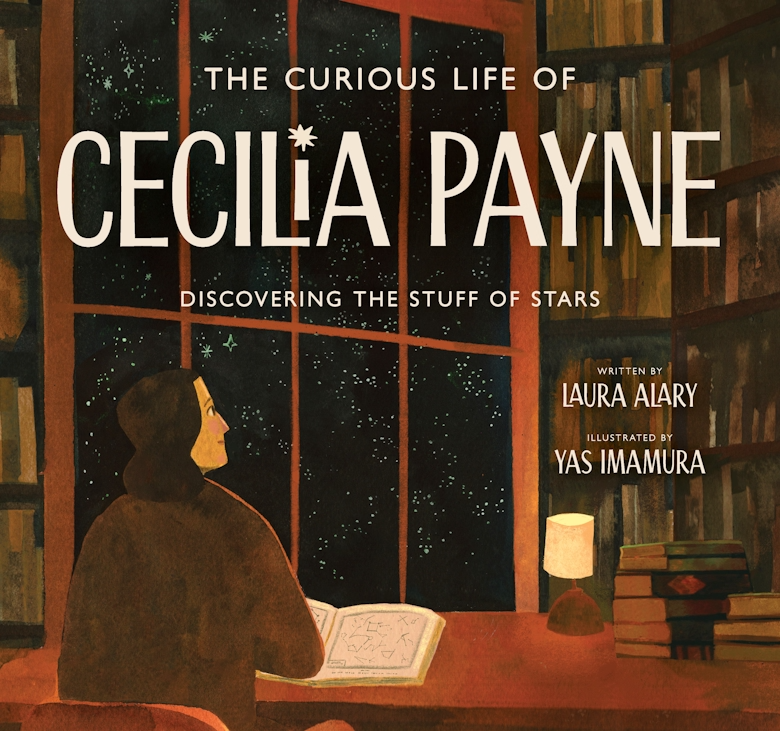
It is my pleasure to introduce you to Laura Alary and her fascinating biography of Cecilia Payne. I read many picture book biographies sent to me for review, and this one immediately stood out. I was impressed with the clear takeaway message and the accessible way in which Laura presents complex concepts to young readers and listeners as she tells of Cecilia’s lifetime accomplishments and personal triumphs. Laura’s answers to my questions are among the most thorough and heartfelt I have ever received for this blog. Please enjoy getting to know Laura and her books!
Judy Bradbury: Tell us about this project: What seeded its creation? How did you conceive of the themes of curiosity and trusting yourself as the foundation of this picture book biography?
Laura Alary: The seed of this book was an episode of Cosmos which included an animated segment about Cecilia Payne. I was struck by the magnitude of her discovery and the fact that she partially retracted her conclusions under pressure from senior astronomers but was later vindicated. I wanted to know more about her, so I started with her autobiography. That’s where I encountered the young Cecilia.
When Cecilia was a child she found a flower called a Bee Orchid growing near her home. She recognized it from drawings in books and examined it carefully to be sure. Her mother told her she must be mistaken, because the Bee Orchid doesn’t grow in England. But Cecilia knew what she had seen—and she was right! [See illustration from the book, above.]
It takes a lot of self-confidence for a child to trust the evidence of her own eyes and memory when an experienced adult tells her she must be wrong. Cecilia later said that was the moment she knew she was a scientist. She was already patient, curious, observant, and precise. She just needed to develop these powers and combine them with a good scientific education.
I loved the idea of her looking back on that memory and recognizing her eight-year-old self as a scientist, not just a little girl who might one day become one. As I describe in the book, she even dug up the Bee Orchid and planted it in her own garden as a reminder always to look carefully and have confidence in her own abilities. So it was really Cecilia herself who pointed me toward the themes of curiosity and trusting yourself.
JB: Tell us about a challenge you faced in the creation of The Curious Life of Cecilia Payne, or provide a memorable (or humorous!) anecdote related to the writing of the book.
LA: The biggest challenge for me was understanding the science behind what Cecilia discovered, then expressing it simply. It still blows my mind that she was able to look at those tiny dark smears (the spectra of stars) on glass photographic plates and use them as evidence to figure out the chemical composition of stars.
This might not be funny to anyone but me, but I had to laugh at how much I forgot between writing the story (ten years ago) and the release of the book in 2025. As we got closer to publication, my editor, Kathleen, kept coming up with wonderful new suggestions for back matter, and I panicked because I could only recall a fraction of what I had read when I was first researching the story! One summer I sat down and devoted my spare time to getting my head around things like the development of atomic theory in the late 19th and early 20th century. I have a sneaking suspicion I will forget it in another ten years, though.
Another funny moment was when the final art started coming in and the blackboard and notebooks were blank. Kathleen asked if I could advise Yas on what should be written on them. I had no clue! Fortunately, we found some helpful archival photographs to use for reference.
JB: What is one unexpected joy that came from the creation of The Curious Life of Cecilia Payne?
LA: One of the biggest joys (though not unexpected) was seeing my words interpreted by Yas Imamura. I’ve admired her work since I first saw it in The Very Oldest Pear Tree and The Gravity Tree and I am thrilled to have had the chance to collaborate with her on The Curious Life of Cecilia Payne.
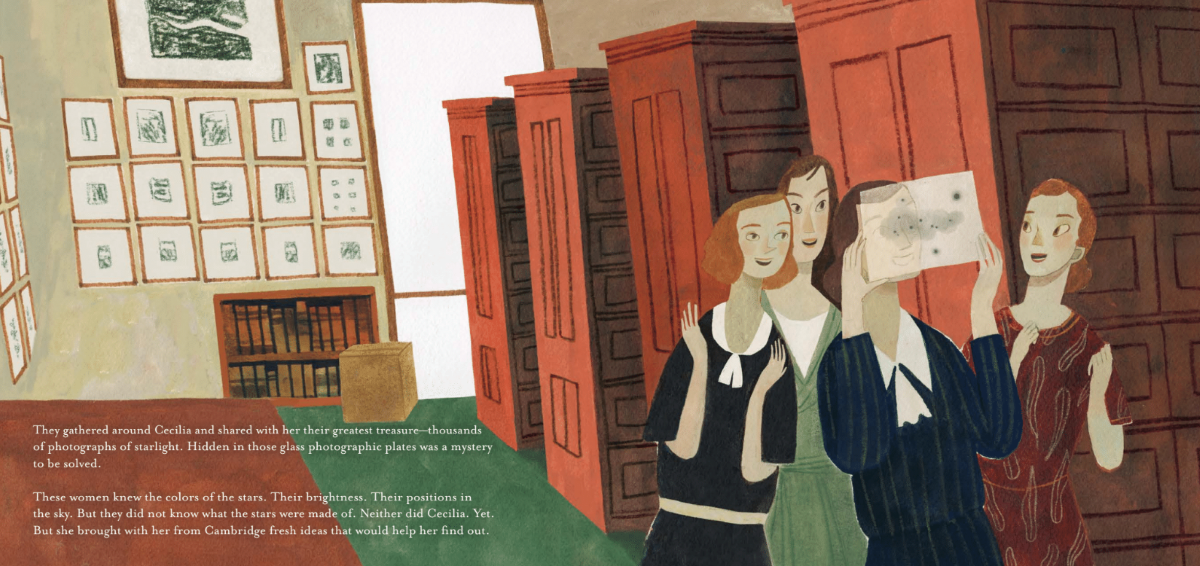
Illustration © Yas Imamura
Another joy (this one unexpected) was connecting with Dr. Katie Mack of the Perimeter Institute for Theoretical Physics. I needed an expert to fact-check an advance copy of the book for accuracy, but I wasn’t sure where to look for a willing astrophysicist! I already followed Katie on social media and was familiar with her book The End of Everything. The fact that science education is an important aspect of her own work made her a perfect choice, but I figured she might be too busy to accept my request. To my delight, she said yes and even signed my copy.
JB: What is your favorite illustration in the book? Why?
LA: There are so many, I don’t think I can narrow it down to one. I really love the first illustration of Cecilia lying on her tummy in the grass, examining the Bee Orchid [See above.]. There’s something peaceful and calming about all the green, and the way little Cecilia is so absorbed in examining the flower.
I also really like the final spread that depicts her “tough climb up a steep hill” and shows the amazing view. That one is a great example of how Yas has taken a metaphor (science as a climb) and rendered it visually in a more-than-literal way.
Another favourite is the spread where Cecilia first arrives at Cambridge. She’s striding along in a way that suggests she is confident and going somewhere. Her eyes are wide open and she is looking around, taking in everything. Surrounding her are symbols of past and present research, including the silhouettes of earlier scientists. This single spread says so much about Cecilia and about the human search for understanding—and how exciting it was for her to step into that flow!
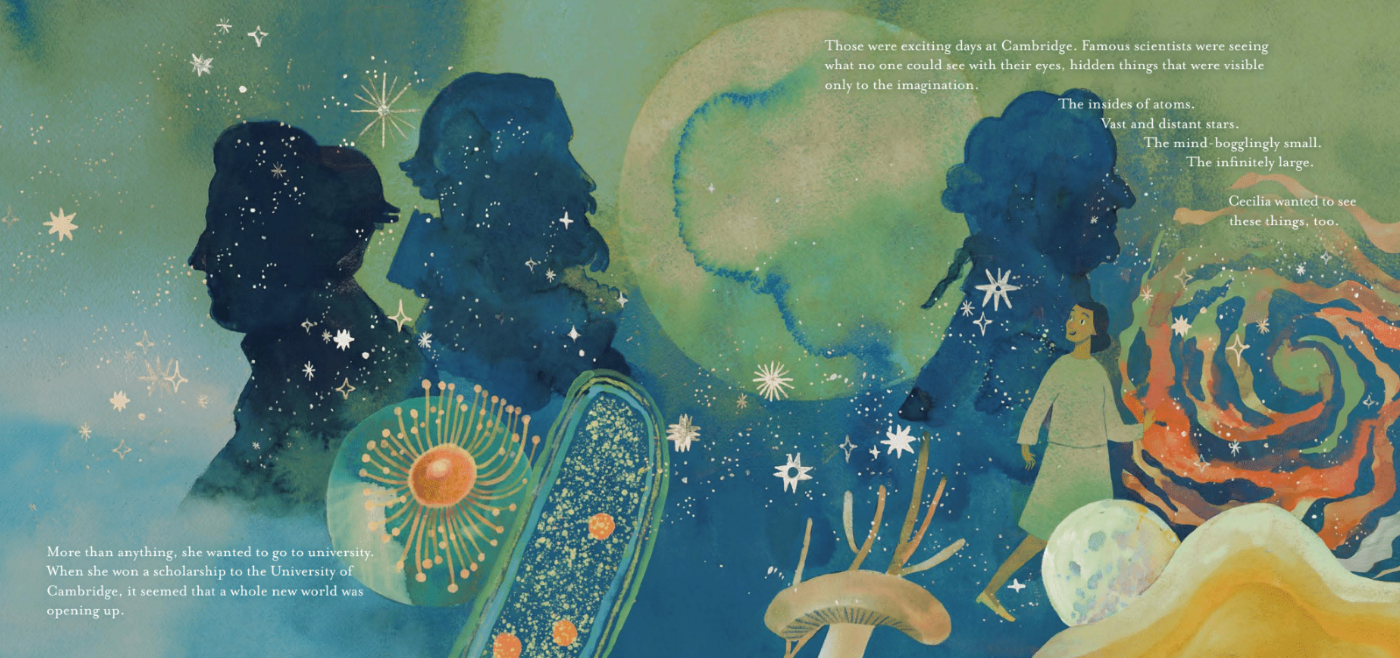
Illustration © Yas Imamura
JB: What would surprise readers to learn about you or about the writing of The Curious Life of Cecilia Payne?
LA: Some readers might be surprised to learn that my background is in arts and humanities, not science (let alone astrophysics). All through school I loved science, but as I moved into higher grades I began to struggle with math. At a certain point, the numbers and equations just didn’t make sense to me. That made it impossible for me to go further in subjects like physics too, so I felt shut out of the sciences.
My way back in turned out to be storytelling. As an undergraduate I studied Classics. Along the way I became intrigued by how ancient Greek thinkers like Eratosthenes and Aristarchus used their powers of observation in combination with their imaginations to figure out the answers to questions like: What is the circumference of the Earth? How far is it to the moon?
Learning about science in the ancient world sparked my interest in the history of science more generally and how we know what we know. I really enjoy learning about ideas, concepts, events, and people—especially ones who have been overlooked. Sharing those stories with young readers is a way for me to feel part of the world of science, and to share in its spirit of curiosity and enquiry, even if I am still much better with words than numbers!
JB: Who do you perceive your target audience to be and why?
LA: The answer to this question varies from one book to the next, but in the case of The Curious Life of Cecilia Payne I would say my target audience is elementary school-aged kids who, like Cecilia, are curious about the world—and the universe—and want to know more about how people find answers to their big questions.
I’ve always been a quiet person, and I tend to write quiet stories. That is, my books aren’t fast-paced or wildly exciting or laugh-out-loud funny. They appeal to kids who like to take their time, be drawn in, and go deep. I always leave space for wondering and reflection, so young readers who are drawn to my books tend to be very questioning and even contemplative.
JB: What do you hope young listeners / readers will take away from The Curious Life of Cecilia Payne / What need(s) does this picture book biography satisfy?
LA: As an author I always have ideas about what I want to say in a book, though what readers find is not always what I thought I put there! That’s part of the excitement and mystery of reading and writing. There needs to be room for listeners/readers to figure out what meaning they find and what is important to them.
Having said that, I do have hopes.
I hope that The Curious Life of Cecilia Payne shines some light on a woman who should be much better known. I hope it sketches a bigger picture of the history of science and lets young readers see that women have made substantial contributions to it. I hope it affirms for all kids that women belong “in the world of stars and atoms” or wherever else their curiosity takes them.
Just as important as the science is what this story shows about Cecilia as a person. She is persistent in the face of obstacles (both external and internal). When she makes a mistake, she gets up again, keeps going, and learns from it. She works well with others and is always aware that her efforts are part of a much bigger story of learning and discovery. Despite moments of self-doubt and feeling like an outsider, she manages to find her place, her people, and confidence in her own abilities. So I hope that kids who feel this way too will find encouragement in Cecilia’s story.
There is one thing about the book I want to clarify. I have heard a few people comment that this story teaches kids to trust their intuition. While intuition can be valuable, what gave Cecilia confidence throughout her life was learning to trust her own expertise, which she gained through hard work. There is a place for intuition in science, but it needs to rest on the solid foundation of thorough research. When Cecilia told her students to trust themselves, she meant: Do your work well so you know what you are talking about, then have confidence.
JB: How do you see The Curious Life of Cecilia Payne connecting to curriculum or being used in learning settings?
LA: There are lots of curriculum connections to science: botany, chemistry, physics, geology, astronomy (and math, of course). At the elementary level, that would include topics like plants and photosynthesis, changes in matter, light, and space. While some of the science in the book will be over the heads of younger readers, there are still connections to be made to things within their reach, like how prisms split sunlight into its component colours.
Seeing Cecilia as a child spending time exploring the outdoors invites kids to do their own exploring, observing, and measuring. The book shows her examining rocks, getting to know trees up close, learning the names of constellations, experimenting with chemicals, and drawing pictures of plants. All these things could inspire some fun elementary science lessons.
Older elementary kids could dig into the back matter, especially the timelines. Maybe they could choose a question (What is the smallest unit of matter? How does a telescope work?) and create their own giant timeline, showing how different people contributed to answering the question. They could also look more closely at some of the other players in the story, like the Harvard Computers.
The Curious Life of Cecilia Payne would also be good for social studies classes, especially those that deal with the place of women in history (including science and education). For example, I think kids would be startled (and hopefully appalled) to learn that even though she did all the work required, Cecilia was not awarded her undergraduate degree because at that time the University of Cambridge would not grant degrees to women!
I think it could be interesting to set students loose to learn more about Cecilia Payne’s life and times, and how being a woman affected how she was treated and the opportunities she had. Maybe while they’re at it, they could choose some of the other women mentioned in the back matter and learn about them too.
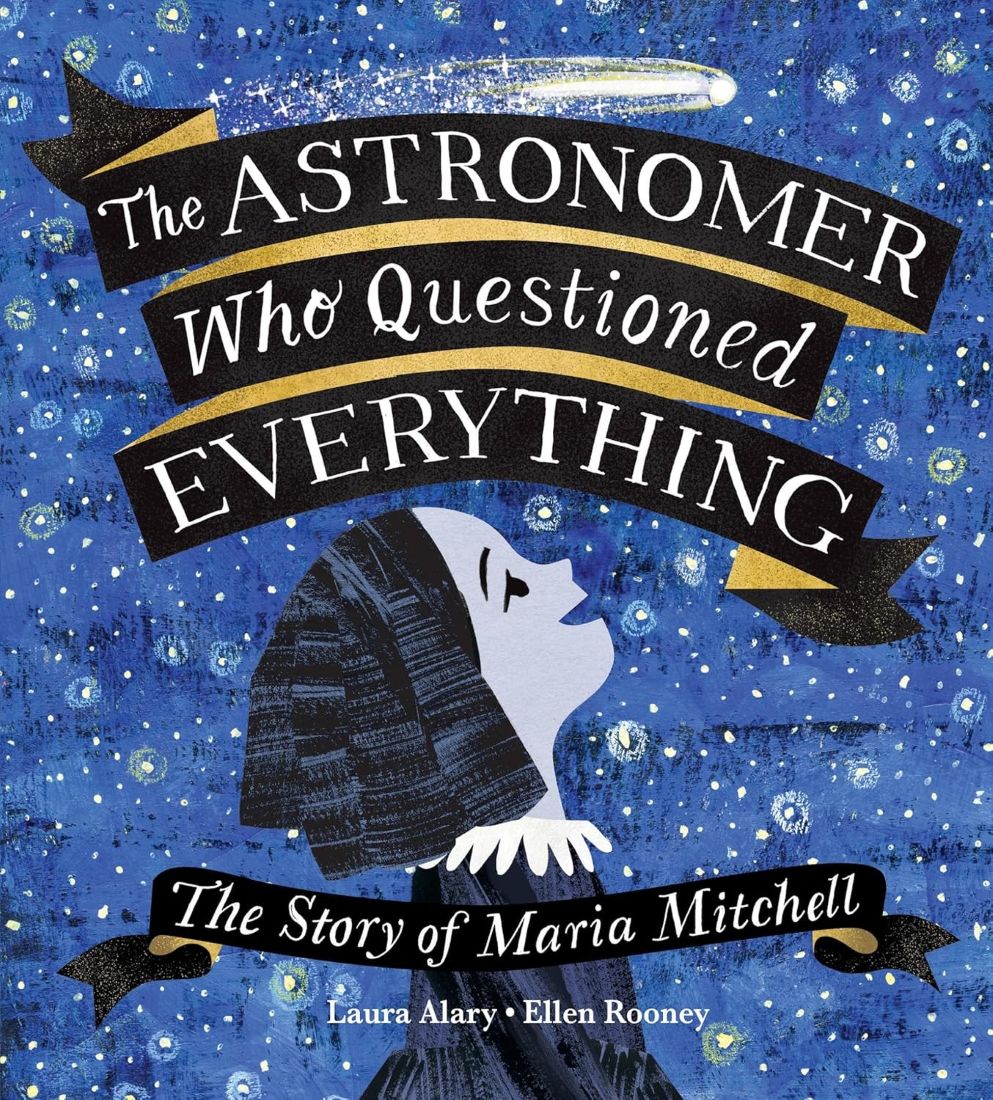
JB: You also have written a picture book biography about astronomer Maria Mitchell, The Astronomer Who Questioned Everything, illustrated by Ellen Rooney. [Cover featured above.] Compare these STEM-related SEL picture book biographies about women astronomers and tell how they are related in themes.
LA: I’m glad you pointed out that both books combine STEM and SEL. The science is always fascinating, but equally intriguing are the women themselves, the obstacles they faced (and often overcame), and the character traits that helped them do it.
Both Maria Mitchell (in the 19th century) and Cecilia Payne (in the 20th) encountered limitations because of their gender. Both had the experience of being shut out (sometimes literally) of scientific spaces, or being paid less for the same work, simply because they were women. On the other hand, both had the good fortune to be born into families where education was valued and both boys and girls were encouraged to learn, read, and explore. As children, both Maria and Cecilia spent a lot of time roaming around outdoors, which is clearly a great way to nurture a budding scientist.
By nature, both Cecilia and Maria were curious and full of questions. Both books emphasize these qualities. The Astronomer Who Questioned Everything focuses on Maria as a collector of objects, questions, and ideas, and how they become part of her search for a path that will allow her to see beyond the relatively small world in which she grew up. The Curious Life of Cecilia Payne emphasizes Cecilia’s desire to see beneath the surface of the material world and understand what things are really made of.
Both books share themes of curiosity, questioning, freedom, intellectual courage, and honesty—the search for truth even if it rattles comfortable assumptions.
JB: If you could ask your young audience a question, what would it be?
LA: What are you curious about? What unsolved mysteries about the Earth and the universe would you like to have answers to?
JB: What project(s) do you currently have on your desk?
LA: I have quite a few projects at various stages of completion, including two more books coming out in 2026. The first, Around the Circle, is a journey through the seasons of the church year for young children. The second, whose title has not yet been announced, is a story about friendship and communication, set in Newfoundland in 1901 (there’s a historical event in the background that involves science and technology).
I’m also working on another STEM book that will be a companion to my earlier books Sun in My Tummy and Sea in My Cells. Like those, this new one looks at a particular cycle in nature and shows how it is part of a child’s own body.
There are others, but it’s too early for me to say much about them yet. One thing is certain: I will keep writing picture book biographies, especially about people who want to understand the world around them and the cosmos to which we all belong.
JB: What is one question you wish I had asked, and what is your answer?
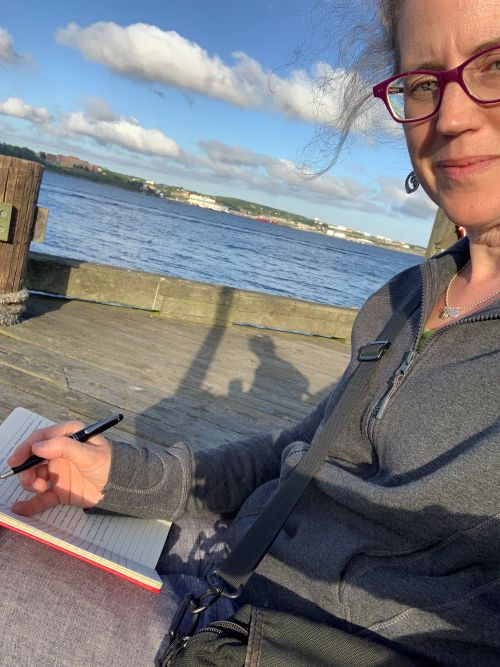
LA: Your questions were thoughtful and thorough, so I’m not sure what I would add. If you had asked me where I like to write, I would have said anywhere there is good natural light and a quiet atmosphere. No background music for me! A view of water is ideal. Sometimes I take my pen and notebook and go sit by the lake. That’s one advantage of being an old-school, write-by-hand sort of person. I can go wherever I want and never have to plug anything in!