

Artificial intelligence has matured so quickly that many of the terms surrounding it have become interchangeable. Ask ten business leaders to explain the difference between data annotation, model evaluation, human feedback, reinforcement learning, or AI supervision, and you’ll often hear variations of the same answer. To many organizations outside the AI industry, they’re all simply different names for people helping machines learn.
That assumption made sense five years ago. It doesn’t today.
The AI industry has quietly divided what was once considered a single discipline into several highly specialized functions. Data annotation remains one of the foundational building blocks of machine learning, but it is no longer the entire story. Modern AI systems require continuous supervision, evaluation, calibration, and refinement long after the initial training data has been labeled. The organizations building the world’s most advanced models are investing as heavily in supervising model behavior as they are in creating the datasets that trained those models in the first place. Companies such as OpenAI, Anthropic, and Google DeepMind have all emphasized evaluation, alignment, and human feedback as core components of modern AI development rather than optional post-processing activities.
This distinction matters because organizations entering the AI market often underestimate the operational complexity required to maintain high-performing models. Training an AI system is not the finish line. In many cases, it is the beginning of an ongoing operational process that includes quality assurance, human evaluation, red teaming, reinforcement learning, and continuous supervision. AI is becoming less like traditional software and more like an employee that requires coaching, monitoring, and performance reviews throughout its working life.
We explored this broader shift in our cornerstone article, Human Judgment: The Missing Ingredient in AI, where we argued that competitive advantage is moving away from simply collecting more data and toward building better human feedback systems. Understanding the distinction between data annotation and AI supervision is one of the clearest examples of that transition.
Data Annotation Gives AI Its Foundation
Every AI model begins with data.
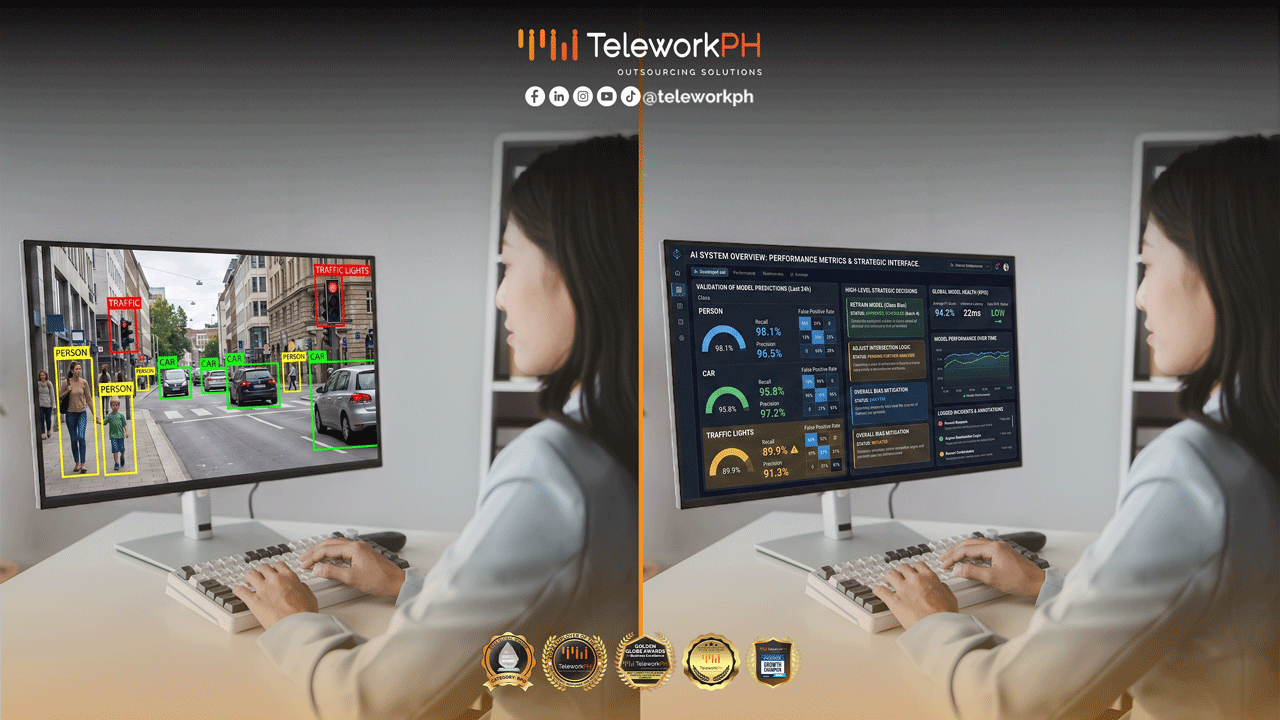
Before a computer vision model can identify pedestrians, someone must tell it what a pedestrian looks like. Before a language model can recognize sentiment, someone must classify thousands of examples as positive, negative, or neutral. Before a recommendation engine can learn purchasing behavior, it must analyze historical interactions that have already been organized and labeled by people.
That work remains indispensable.
Without carefully prepared training data, modern artificial intelligence simply would not exist.
Data annotation transforms raw information into structured information that machines can understand. Images receive bounding boxes. Documents receive classifications. Audio recordings become transcriptions. Text receives sentiment labels, intent classifications, entity recognition, or topic categorization. The objective is consistency. Every annotation becomes another example from which the model learns statistical relationships between inputs and expected outputs.
Because annotation is foundational, discussions surrounding AI often stop there. The assumption is that once enough high-quality data has been collected and labeled, model performance naturally improves.
For earlier generations of machine learning, that assumption was often true.
Large language models changed the equation.
Modern generative AI systems are no longer evaluated solely on whether they recognize information correctly. They are evaluated on whether they reason effectively, communicate appropriately, avoid harmful outputs, acknowledge uncertainty, and produce responses that align with human expectations. Those objectives extend far beyond the traditional scope of annotation.
Teaching a model what something is and teaching a model how it should behave are fundamentally different challenges.
That distinction has created an entirely new category of work.
AI Supervision Begins After Training Ends
One of the biggest misconceptions surrounding modern AI is that supervision happens only when a model fails.
In reality, supervision has become a continuous operational discipline.
Once an AI model enters production, organizations begin asking very different questions than they asked during training.
Does the model remain accurate as customer behavior changes?
Has performance drifted since deployment?
Are hallucinations becoming more frequent?
Has a recent update introduced unintended bias?
Are users discovering prompts that bypass safety mechanisms?
Can reviewers explain why one response is preferable to another?
None of these questions can be answered simply by labeling additional data.
They require people capable of evaluating model behavior within real-world environments.
This is where AI supervision enters the picture.
Rather than preparing data for training, AI supervision focuses on observing, measuring, and improving model performance after training has occurred. Human reviewers compare outputs, investigate failures, document edge cases, validate reasoning, identify safety concerns, and provide the feedback required to improve future model behavior. According to research from Google DeepMind, systematic evaluation has become one of the defining requirements for deploying frontier AI systems responsibly because capability alone does not guarantee reliability.
The distinction resembles the difference between educating an employee and managing one.
Education provides knowledge.
Management develops performance.
An employee may complete exceptional training and still require coaching once they begin interacting with customers, adapting to changing priorities, and solving problems independently.
Artificial intelligence follows a remarkably similar pattern.
Training teaches capability.
Supervision develops reliability.
Modern AI Requires Continuous Human Feedback
One reason AI supervision has become so valuable is that artificial intelligence operates inside environments that never stop changing.
Customer expectations evolve.
Regulations change.
Products are updated.
Languages shift.
Cultural norms evolve.
Business priorities change.
The model itself may remain technically identical, yet the environment surrounding it changes every day.
Static datasets cannot keep pace with dynamic businesses.
Human supervision can.
This is one of the primary reasons reinforcement learning from human feedback (RLHF) has become central to the development of large language models. Rather than assuming the model’s initial behavior is sufficient, organizations continuously gather human preferences, compare competing responses, and use those judgments to refine future behavior. Researchers consistently describe human feedback as one of the most effective mechanisms for aligning model outputs with human expectations because many qualities that users value—clarity, usefulness, tone, safety, and contextual appropriateness—cannot be measured through traditional accuracy metrics alone.
Increasingly, AI systems are judged not only by what they know, but by how consistently they apply that knowledge across thousands of different situations.
That consistency is built through supervision.
Why Data Annotation and AI Supervision Work Together
Although data annotation and AI supervision serve different purposes, they should never be viewed as competing disciplines. They are complementary functions within the same AI lifecycle. One provides the foundation upon which models are built. The other ensures those models continue to perform as expected once they begin interacting with the real world.
Consider an autonomous vehicle. Before it can recognize pedestrians, traffic signs, or lane markings, millions of images must be accurately annotated. That annotation teaches the model to recognize objects. Once the vehicle is operating in real-world conditions, however, new situations inevitably emerge. Unusual weather, unfamiliar road layouts, temporary construction zones, and unpredictable human behavior all introduce variables that may never have appeared in the original training data.
At that point, supervision becomes essential.
Engineers review failures, analyze edge cases, update evaluation datasets, and use human feedback to improve future model behavior. The objective is no longer simply teaching the model what an object looks like. The objective is ensuring the model continues making appropriate decisions as its operating environment evolves.
Large language models follow the same pattern.
Training data teaches grammar, facts, and language patterns. Human supervision evaluates reasoning, factual accuracy, safety, helpfulness, tone, and consistency after deployment. Every interaction becomes another opportunity to identify weaknesses, improve evaluation benchmarks, and refine future behavior.
Modern AI depends on both disciplines.
Without annotation, models never learn.
Without supervision, models stop improving.
AI Supervision Is Creating a New Operational Discipline
Perhaps the most significant implication of this evolution is that AI supervision is no longer viewed as an occasional quality assurance exercise. It is becoming an operational discipline with its own workflows, performance metrics, quality standards, and specialized roles.
Organizations developing advanced AI systems now maintain dedicated evaluation teams responsible for monitoring model behavior, designing benchmark tests, investigating failure patterns, validating new model releases, and documenting areas where additional human feedback is required. These teams operate continuously because AI systems operate continuously.
This represents a fundamental departure from traditional software development.
Software engineers typically fix bugs that can be reproduced consistently. AI evaluators investigate behaviors that may appear only under specific prompts, unusual combinations of context, or rare edge cases. The challenge is rarely identifying a single defective line of code. It is determining why a probabilistic system behaved differently under changing conditions and whether that behavior represents an isolated anomaly or a broader pattern requiring intervention.
That work demands structure.
Evaluation guidelines.
Reviewer calibration.
Escalation procedures.
Consensus scoring.
Quality assurance.
Documentation.
Performance monitoring.
In many organizations, AI supervision has become as operationally complex as software development itself.
This growing discipline also explains why demand for AI evaluators, quality reviewers, and subject matter experts continues to expand across the industry. As models become more capable, expectations surrounding reliability increase as well. Enterprises deploying AI into customer-facing products, healthcare, finance, legal services, and enterprise software cannot rely exclusively on benchmark scores. They require operational systems capable of maintaining quality over months and years—not just during model training.
What This Means for AI Companies
For organizations building AI products, the distinction between annotation and supervision has practical consequences.
Budgeting changes.
Hiring changes.
Project management changes.
Client expectations change.
Many companies begin AI initiatives assuming their largest workforce requirement will be annotation. Increasingly, organizations discover that long-term operational costs shift toward evaluation, quality assurance, reviewer management, and continuous improvement. As AI products mature, the need for structured supervision often grows faster than the need for additional training data.
That shift changes the conversation from simply acquiring people to building operational capability.
How quickly can new reviewers be trained?
How is evaluator consistency measured?
What processes detect reviewer drift?
How are disagreements resolved?
What escalation paths exist when reviewers encounter uncertain cases?
How frequently are evaluation guidelines updated?
These questions rarely appear in discussions about model architecture.
They dominate discussions about AI operations.
For organizations supporting AI development, the opportunity extends well beyond providing people. Increasingly, clients require partners capable of designing repeatable operational systems that produce consistent results across large distributed teams. That includes workforce management, quality frameworks, documentation standards, reporting structures, reviewer training, and continuous process improvement.
As AI systems become more sophisticated, operational excellence becomes a competitive advantage in its own right.
The organizations that understand both annotation and supervision will be better positioned to support the next generation of AI than organizations focused exclusively on one discipline.
AI Needs Both Teachers and Coaches
One of the easiest mistakes to make in artificial intelligence is assuming that once a model has been trained, the hard work is finished.
Modern AI tells a different story.
Training teaches a model how to recognize patterns.
Supervision teaches it how to perform reliably in the real world.
Those are related objectives, but they are not the same discipline.
The future of AI will depend on organizations capable of doing both exceptionally well.
Data annotation will continue providing the structured information that allows models to learn.
AI supervision will ensure those models continue improving long after deployment through evaluation, human feedback, quality assurance, and continuous refinement.
Together, they form the operational backbone of modern artificial intelligence.
For readers interested in the broader forces driving this transformation, our cornerstone article, Human Judgment: The Missing Ingredient in AI, explores why human expertise is becoming one of the AI industry’s most valuable competitive advantages. You may also enjoy our companion article, Why AI Still Needs Humans: Understanding Human-in-the-Loop AI, which examines how organizations integrate human expertise directly into enterprise AI workflows.
As AI systems continue moving from research labs into real-world business environments, one conclusion is becoming increasingly difficult to ignore.
Building an intelligent model is an engineering achievement.
Operating one successfully is an operational discipline.
The companies that recognize the difference will be the ones shaping the next generation of artificial intelligence.
Give Your AI the Human Support It Needs at Every Stage
Reliable AI requires more than accurately labeled training data. It also needs continuous human evaluation, quality checks, and feedback to maintain strong performance in real-world situations.
Telework PH supports AI development through human-reviewed data annotation and AI supervision services designed to help models learn accurately, perform consistently, and continue improving after deployment.
Build smarter, more reliable AI with Telework PH. Book a call with our team today.
Google DeepMind – Evaluating Frontier AI Systems
https://deepmind.google/discover/blog/evaluating-frontier-ai-systems
IBM – What Is Human-in-the-Loop AI?
https://www.ibm.com/think/topics/human-in-the-loop
Anthropic – Core Views on AI Safety
https://www.anthropic.com/research
OpenAI – Reinforcement Fine-Tuning and Model Alignment Research
NIST AI Risk Management Framework
https://www.nist.gov/itl/ai-risk-management-framework
European Commission – AI Act (Human Oversight)
https://ai-act-service-desk.ec.europa.eu/en/ai-act/article-14


