(August 4, 2026) – For the first time in the Hot 100’s 68-year history, country music owns the entire top five. It accomplished this with Ella Langley’s “Choosin’ Texas” – now at No. 1 for its 16th non-consecutive week (a non-holiday record for female solo acts) – followed by Morgan Wallen’s new single “Been by Now” debuting at No. 2. Taylor Swift’s return to country – “I Knew It, I Knew You” – slips to No. 3 after leading the chart in June; the Langley/Wallen duet “I Can’t Love You Anymore” holds at No. 4; and newcomer Stella Lefty’s “Boston” is at No. 5 (falling from its No. 3 peak).

While this domination is a first for country music, other genres have pulled off top five sweeps before – rock, disco and R&B/hip-hop among them – and individual superstars have famously done it by themselves. Still, the achievement is remarkable for country music – a format that has been around since before the Hot 100 was inaugurated in 1958, and one whose popularity has been cyclical in the past but has been on a steady upward trend in the 2020s.
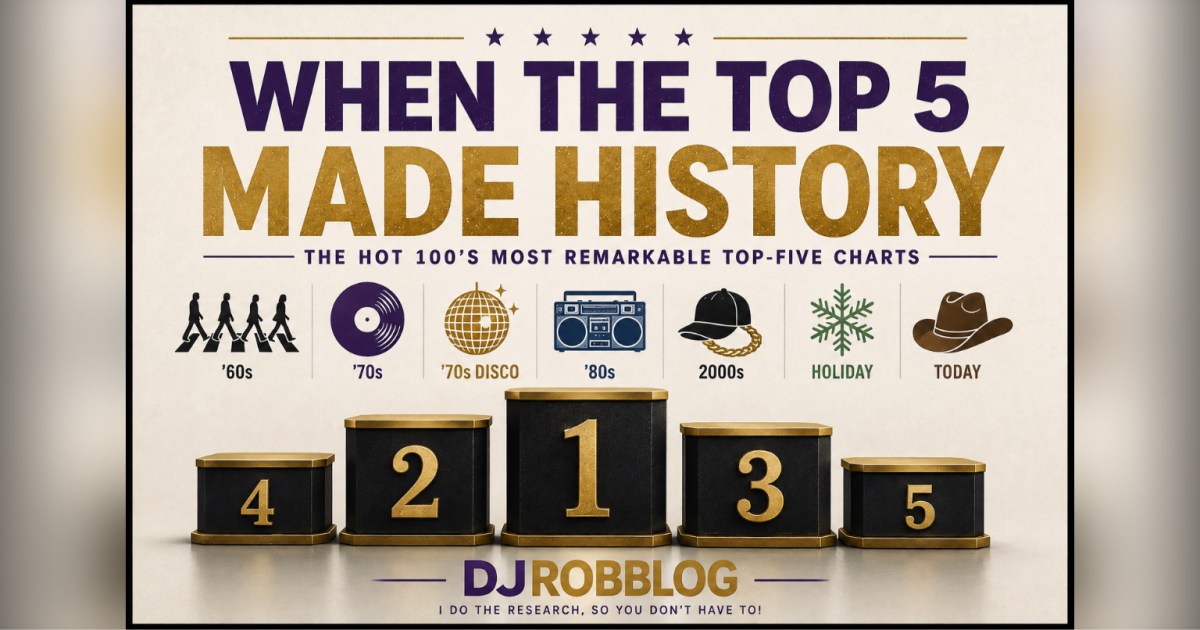
To commemorate this remarkable feat, DJROBBLOG thought it would be interesting to explore some other historic top five charts in Hot 100 history, not limited to artists or genre achievements, but including some unusual statistical feats that chart geeks cherish. This recap begins, of course, with the first time any act occupied all five of the top spots in the same week. (All chart graphics are courtesy Ultimate Music Database, umdmusic.com.)
Beatles Domination – April 4, 1964

The granddaddy of all history-making top five lists happened in April 1964 when the Beatles occupied all five of the top positions. It was solidified when their latest single, “Can’t Buy Me Love,” catapulted from No. 27 to No. 1 (then a historic leap into the top position) while their prior top five hits all maintained that status. Of course, no other act would duplicate this feat in the pre-streaming age, while Drake, Taylor Swift, and Kendrick Lamar have done it since.
The Soul Train Effect? – May 5, 1972

Music by Black musicians had long been a vital part of the rock-and-roll era and before. But it wasn’t until May 1972 when Black artists finally occupied each of the top five positions on the Hot 100, which included big hits by the Queen of Soul, Aretha Franklin, and the future King of Pop, Michael Jackson. This wasn’t an anomaly; many soul hits crossed over to the top ten of the Hot 100 throughout 1972 and beyond. The timing is intriguing. Don Cornelius’ Soul Train had begun national syndication only the previous year, giving unprecedented weekly television exposure to many of the Black acts increasingly crossing over to pop audiences in the early to mid-1970s, like the Staple Singers, the O’Jays, Al Green, and the Spinners. This blogger believes the program was one important accelerant of that crossover.
The Order of Things – June 4, 1977

While there were several top five charts in the preceding years totally occupied by past, present and future No. 1 hits, never had there been one where the No. 1 song was followed in succession by the next four weeks’ No. 1 records – in the exact order they ruled – until June 4, 1977. Stevie Wonder’s “Sir Duke” was nixed the following week by K.C. & the Sunshine Band’s “I’m Your Boogie Man,” which in turn was replaced at the top by Fleetwood Mac’s “Dreams,” then Marvin Gaye’s “Got to Give It Up,” and finally Bill Conti’s “Gonna Fly Now (Theme from ‘Rocky’).” Those tunes all followed the same single position climb each week until they reached No. 1. This unusual pattern was broken when Foreigner’s debut hit, “Feels Like the First Time,” inched its way into the top five and peaked at No. 4. This kind of sequencing hasn’t been repeated since.
RSO and Barry Gibb – well, almost – March 18, 1978

File this one in the category of two near-misses combining to make for an otherwise historic week in March 1978. Four of the top five were RSO singles. Four of the top five had a direct Gibb connection. But they weren’t the same four. First, the Bee Gees were obviously dominating with the top two songs (“Night Fever” and “Stayin’ Alive”). Meanwhile, their fingerprints were all over Samantha Sang’s No. 3 hit, “Emotion,” which they wrote and sang backup on, as well as little brother Andy Gibb’s No. 5 single – the former No. 1 “(Love Is) Thicker Than Water,” written by Barry Gibb. The only song not directly affiliated with the Bee Gees was “Lay Down Sally,” by their labelmate Eric Clapton. Thus, “Emotion” was the lone RSO exception, having been released on the Private Stock label after it was passed over for inclusion in the Saturday Night Fever soundtrack.
Disco Didn’t Suck on the Chart – March 17, 1979

Exactly one year after the Bee Gees’ phenomenal week on the Hot 100, disco’s domination of the Hot 100 culminated with the top five songs on the chart dated March 17, 1979, including classics by Gloria Gaynor, the Bee Gees, Rod Stewart, Donna Summer, and Peaches & Herb. Disco’s domination of the first half of 1979 was notorious, but the only other week in which the entire top five consisted of disco songs was July 21, 1979, just days after the infamous Disco Demolition Night at Comiskey Park in Chicago (July 12), in which thousands of disco records were blown up in an explosion sparked by the “Disco Sucks” movement. In other words, just nine days after thousands gathered in Chicago to declare disco dead – rather explosively – disco still owned America’s top five.
All Women, No Problem – June 30, 1979

Just before that infamous disco demolition, songs by genre Queen Donna Summer continued to rule the chart. But in one June week, she was joined by Anita Ward, Sister Sledge, and blues-rock singer Rickie Lee Jones to combine for a historic chart in which – for the first time – all five of the top songs were by women. On that same chart, Summer became the first woman to own two of the top three singles with “Hot Stuff” and “Bad Girls,” a feat she would repeat later in 1979 with “Dim All the Lights” and “No More Tears (Enough Is Enough)” (a duet with Barbra Streisand). A little-known fact is that Rickie Lee Jones’ hit would join the others on Billboard’s Hot Soul Singles (yes, “Chuck E.’s In Love” made the soul chart) the following week – where it peaked at No. 79 – making for an unusual reverse crossover scenario.
Historic Stagnancy – August 28, 1982

Sometimes chart history is made because everything moves. In August 1982, history was made because practically nothing did. The Hot 100 chart had slowed considerably in 1982 compared to other years. Songs would attain and hold their peak positions for weeks on end, tying 1982 with three earlier years for the fewest No. 1 singles (15) during a calendar year in the pre-SoundScan era. But the chart’s slow turnover was epitomized in August when the top five songs all held their positions for four consecutive weeks, something that had never happened previously. The stalemate ended in September when Steve Miller Band’s “Abracadabra” leapfrogged two spots to become the new No. 1 single. Meanwhile, Fleetwood Mac’s “Hold Me” established a then-record for most consecutive weeks at a position other than No. 1 with seven weeks at the No. 4 spot.
Hip-Hop Hoopla – March 13, 2004

In a year in which R&B/Hip-Hop dominated the Hot 100 in historic fashion, another historic first occurred when, on the chart dated March 13, rappers were credited on each of the top five hits in either a lead or feature role. Ludacris and Lil Jon were guests on Usher’s No. 1 “Yeah!,” while Chingy, Twista, Kanye West, OutKast, and J-Kwon followed. The entire top ten that week were by R&B/Hip-Hop acts, including three more by rappers at Nos. 6, 8, and 10. The only non-rap entries: Beyoncé’s “Me, Myself and I” at No. 7 and Ruben Studdard’s “Sorry 2004” at No. 9. And this wasn’t merely a great week for R&B and hip-hop. Every song that reached No. 1 during the entire calendar year of 2004 came from that musical universe.
All Prior Number Ones – July 19, 2008

Normally a top five contains songs at different points in their chart journey – some rising toward No. 1, others falling away from it. While previous top five lists (including the one from June 1977 highlighted above) contained mixtures of past and future No. 1 singles, not before 2008 had the top five consisted entirely of songs that had already been to No. 1. Having all five already crowned means the upper echelon was unusually clogged with former proven leaders. This first occurred on the chart dated July 19 when Katy Perry’s then-No. 1 “I Kissed a Girl” was joined in the top five by four prior chart toppers from Rihanna, Lil Wayne, Leona Lewis, and Coldplay. This feat would be repeated several more times, including in 2011, with Katy Perry again at the top (“Firework”) while other former No. 1s by Bruno Mars, Ke$ha, Rihanna, and P!nk jostled for position in the top five. The June 13, 2020, chart took it a step further when the entire top six consisted of current and former No. 1s.
Christmas Takeover – January 2, 2021

The advent and popularity of streaming platforms has made the Hot 100 return of holiday songs an annual occurrence during December and early January each year. While the tradition had been growing since 2018, it manifested in holiday songs’ first-time domination of the Hot 100’s top five spots on January 2, 2021. That week, Mariah Carey’s perennial chart topper “All I Want for Christmas Is You” was joined by faves from Brenda Lee, Bobby Helms, Burl Ives, and Andy Williams. Carey’s classic has since taken the crown for the longest No. 1 run with 22 nonconsecutive weeks and counting, although Ella Langley – the artist who leads this week’s historic country top five – has that record in her sights.
For now, country music owns a piece of Hot 100 history it had never claimed before. And Langley has another piece in her sight: Carey’s 22-week No. 1 record.
Whether she gets there before Christmas music inevitably comes calling is another chart story entirely.
And you know DJROBBLOG will be watching.
DJRob
DJRob (he/him) is a freelance music blogger from the East Coast who covers R&B, hip-hop, disco, pop, rock and country genres – plus lots of music news and current stuff! You can follow him on Bluesky at @djrobblog.bsky.social, X (formerly Twitter) at @djrobblog, on Facebook or on Meta’s Threads.
You can also register for free by selecting the menu bars above to receive notifications of future articles.
Related