Tiny-Home ‘Matchmakers’ Are Helping Connect Residents With Landowners

Ron Murray knew he wanted to live in a tiny home, but there was a problem—where would he put it?
The Canadian tiny home enthusiast was right to worry about that first. While tiny homes offer sustainability advantages and are a viable option for managing the housing affordability crisis, you can’t just plunk one anywhere you want.
Finding the right place to live tiny is one of the bigger issues for people deciding to downsize their lives, and the search is often complicated by local ordinances and municipal requirements for tiny homes.
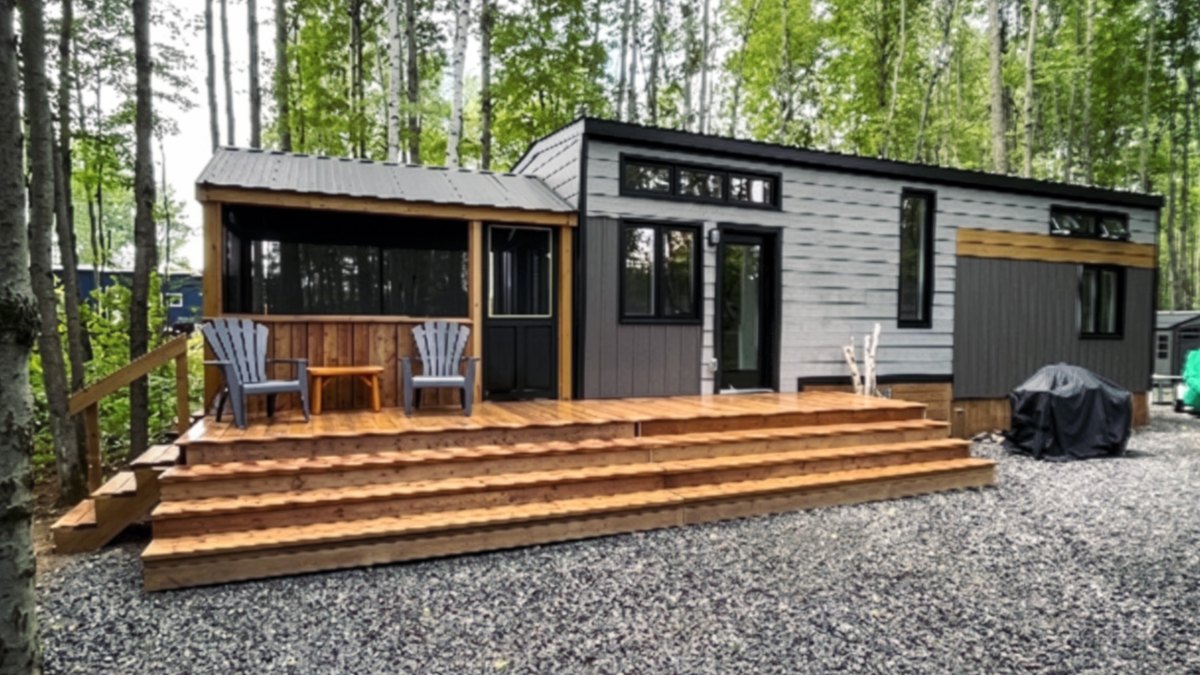
Luckily, Murray met an unofficial tiny home “matchmaker” through the company he was considering contracting to build his tiny home, who helped Murray find a piece of land to lease in Dunrobin, Ontario, about a mile away from the border of Quebec.
“We had to figure out where to put it before we purchased it,” says Murray, who now owns and lives in a 650 square-foot tiny home with his wife on a tree-filled parcel of land that he has leased for five years. “We were fortunate to make the right connection quickly, but I know it is an issue for a lot of people to find the right property. “
Fortunately, there are some savvy services stepping in to make finding the right land match easier. And with the right match, the setup can be a win-win for both landowners and tiny-home dwellers.
The challenge of finding land for tiny homes
For the uninitiated, it might seem like you could just order up a tiny home, put it on a piece of land in the middle of nowhere, and live happily ever after. However, to truly live in a tiny home long term, you’re still going to need things like water and electricity, which complicates the search.
This lack-of-suitable-land quandary is part of what led Chris O’Connell to venture into purchasing a farm that is now subdivided to host several tiny homes as well. It also led him to co-found TinyConnect.homes, a new “matchmaking” service created to help tiny-home buyers find landowners with properly zoned property to spare.
“Infrastructure is one of the biggest hidden barriers,” says O’Connell. “If a property isn’t on municipal water and sewer, which most rural and farm land isn’t, the landowner needs a well and a septic system with enough capacity for the additional occupants.”
Though some tiny homes are configured with compost toilets or solar power for more off-grid flexibility, the best long-term setup is a traditional hookup into water, sewer, and electricity.
New septic systems can run well into the tens of thousands of dollars, however, and getting an individual pad ready and hooked up to those services typically runs $5,000 to $10,000. But because suitable land is genuinely hard to find, most tiny-home owners are willing to absorb that cost themselves, or split it with the landowner.
Bridging the gap between tiny homes and perfect plots
In 2022, O’Connell, a New Hampshire native who was living in Miami for his work in the tech field, started looking into the idea of investing in real estate, but traditional models didn’t excite him. After connecting with a business partner who had been working in the tiny home space for a while; however, the idea of building a tiny home community started to come together.
“At the time there really wasn’t much momentum in the starter-home and tiny-home market, but done well, we realized it could be a win for investors, farmers, landowners, tiny home owners, and society more generally,” says O’Connell. And that sparked his interest.
It took two years to find the right property, but in 2024 O’Connell closed on a farm near Ottawa, Ontario (he has dual Canadian citizenship) with zoning that worked perfectly for a tiny home community.
“Once the infrastructure was in place, we filled every available space within weeks,” says O’Connell. “Farm zoning in many jurisdictions allows mobile homes, usually for farm workers, which is where the garden plots come in not only to be more self-sufficient in food production and help local farmers, but also to match up with zoning ordinance and bylaws.”
However, that’s also when the real problem became obvious. “People we had to turn away once we were full would ask, ‘Where else could we go?'” says O’Connell. “We didn’t have a good answer for them.”
O’Connell tried to assist where he could, and one of his business partners actually helped place Murray on his current property. But beyond that, people were relegated to searching localized tiny home Facebook groups and relying on word of mouth to find suitable parcels of land to lease.
Eventually, this led O’Connell and his business partners to develop TinyConnect.homes as a way to help landowners and prospective tiny-home dwellers make successful matches.
“We’ve tried to keep it as simple as possible, thinking of it like a dating site where a would-be tiny-home owner creates a profile and a landowner or a tiny-home builder does as well,” says O’Connell. “It’s free for tiny-home owners, and free for our first 100 landowners.”
After that, landowners will be asked to pay something to have their land listed. On top of that, once a match is made, TinyConnect.homes will split the first month’s land-lease revenue with the landowner so the site’s owners “can monetize the site at some point and reinvest in it.”
How tiny home and land-lease matchmaking can benefit everyone
TinyConnect.homes grew out of the idea that it could serve as a matchmaker between people seeking a place to host their tiny home and landowners looking to lease unused land.
When these matches are successful, it becomes win-win for all parties involved. However, it can be especially helpful for people with extra land but limited means.
“Helping farmers hold onto their land has been a big driver for us,” says O’Connell. There are about 190,000 farms in Canada today, and that number has been shrinking steadily for the last 20 years. The U.S., with nearly 2 million farms, is on a similar trajectory.
“When you look at cash crop yield per acre, a farmer might net somewhere around $700 to $1,000 per acre per year, depending on the crop,” says O’Connell. “On that same acre, you could fit four or five tiny home pads, each leasing for $550 to $650 a month—so roughly $2,000 to $2,500 in additional monthly income, or somewhere in the neighborhood of $24,000 to $30,000 a year, from land that would otherwise produce a fraction of that.”
For a farmer who’s just getting by, that can be the difference between keeping the farm and having to sell. “And you don’t need prime cash cropping land to do this—our pads [on Melody Place Farm] are about 2,500 square feet, so even marginal or unproductive acreage that can’t support a good crop can be repurposed to generate real income,” says O’Connell.
Right now, TinyConnect.homes has the most options on the coasts in Ontario, Quebec, and British Columbia. In the U.S. it extends all throughout the northeast down to Pennsylvania, and on the west coast, Washington and Oregon have been popular as “the local regulations really allow for this kind of model.” However, the service is hoping to soon spread throughout the entire United States.
At the end of the day, however, regardless of location, O’Connell says the most important thing is making good matches.
“That’s why we run an extensive application process to make sure landowners end up with the right community and the right people on their land,” says O’Connell. “Really, we’re hoping to get the word out on what we’re building, so tiny living becomes more of a standard option not just an afterthought.”