This post may contain affiliate links. Please read our disclosure policy for more information.
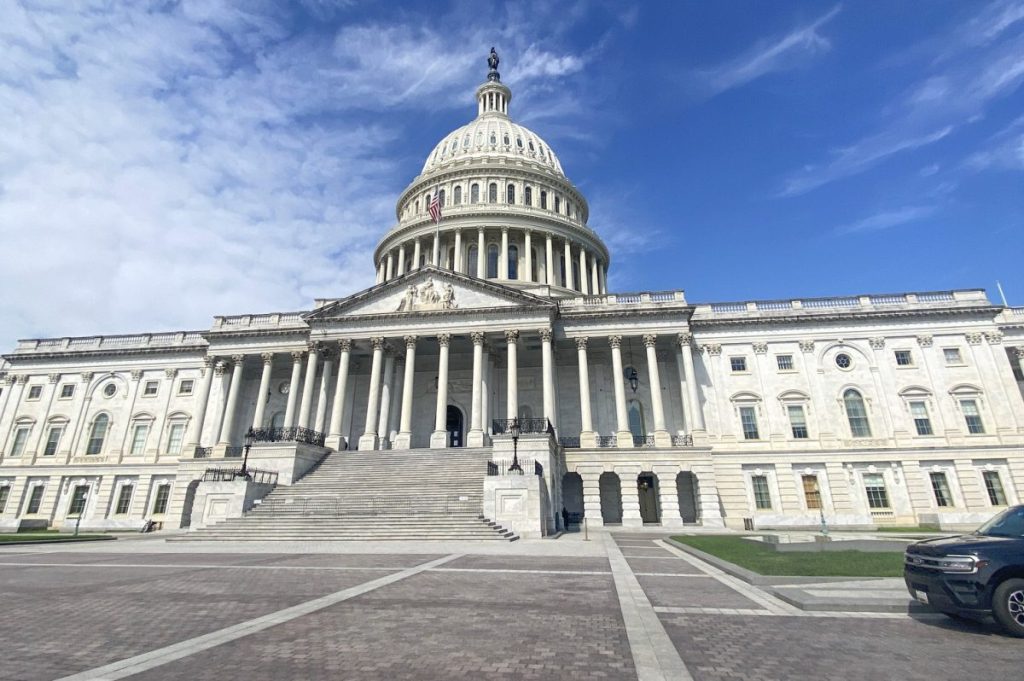
One highlight of our road trip in 2023 was visiting the U.S. Capitol. This road trip was our longest to date, filled with non-stop adventures and experiences. Among those adventures was our three days in Washington, D.C.

Landing a Capitol Tour Given by an Intern
You can take a general public tour pretty easily by showing up to the Capitol the day of. To be safe, you may want to book ahead of time, especially during peak travel times. I don’t know that it’s truly necessary to book before you go for the general tour; we saw plenty of people booking their timed entry on the morning of our visit.
If you want a special tour given by an intern from your representative’s or senator’s office, there are a few steps involved. It’s in your best interest to apply 90 days out if you can. If you are less than 90 days out, I would still try. Also note, it’s easier to get a special tour of the Capitol than it is to get entry into the White House. And yes, if I didn’t get a tour through my representative, I would still do the public tour. Just being in the building is pretty amazing.
When you apply, you’ll need to go to the House of Representatives page or the Senate page to look up your state’s congressperson. We happened to use our representative, so I will outline the process we used. Once you pull up your representative, you will navigate their personal page and locate a place to click to apply for a tour. You apply for White House tours and FBI Headquarters tours in the same place.
We applied for the White House and the Capitol at the same time; we opted not to go to the FBI Headquarters this trip. We were granted a tour of the Capitol rather quickly; we didn’t find out we’d be going to the White House until about two days before it happened. Of course, we were on our road trip when we got the email, and we had to make some adjustments. But it was worth it. To read about our White House experience, click here.
Arriving for the Tour

On the morning of the tour, Jeff dropped Kristin and me off near the public entrance on the East Front Plaza while he parked the car nearby. You will walk to a lower level to get inside. Also, you’ll notice Capitol Police patrolling the area, and it can be alarming to see the weapons they have. This is no time for joking. Also, be aware that there is a list of items you can’t take inside that is found on their website. You aren’t allowed to bring in food or drink, but there is a cafeteria inside. If you have special needs, you will need to contact the Capitol Visitor Center ahead of time.

Once inside, you’ll have a bird’s-eye view of the visitor center main floor. This is where you can get time entry tickets for the general tour or one of several specialty tours they have that focus on specific aspects of the Capitol or issues in American history.

We had some confusion about what we were supposed to do to link up with our representative’s intern, but after a quick call to our representative’s office, we were told to wait by the large Statue of Freedom. It’s pretty easy to spot.

You may want to check in with your representative the day before for instructions on where to go for your tour.
While we waited, we looked around the main floor of the visitor center. One of kept an eye for our intern while the other snapped pictures.

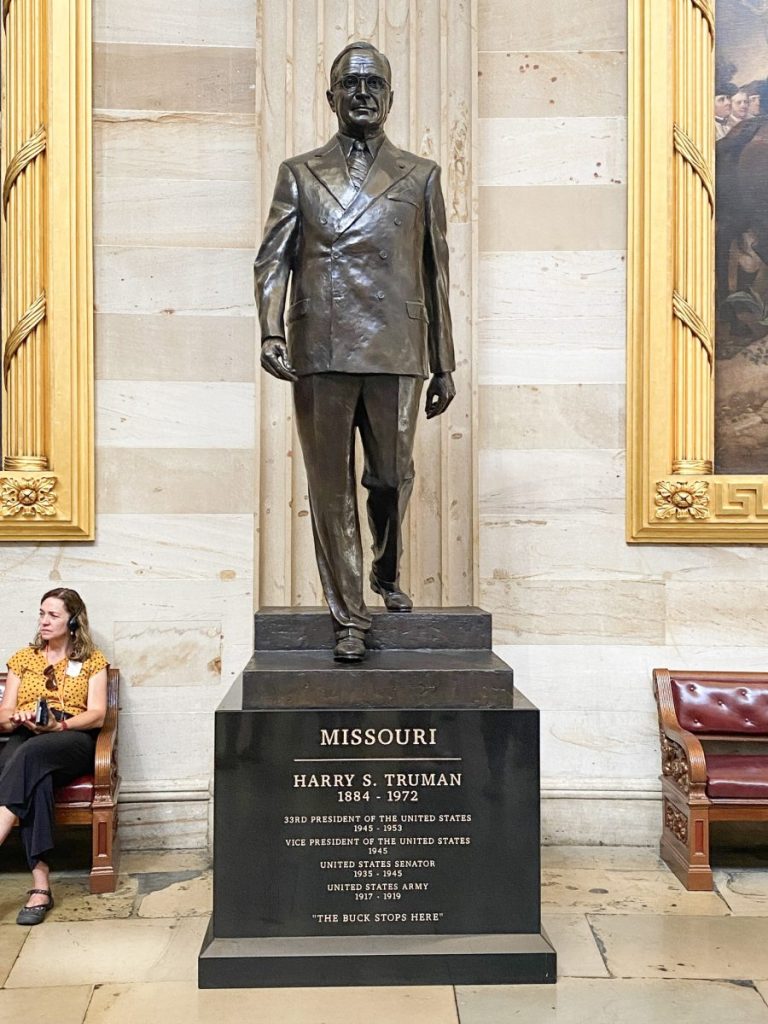
We learned on our tour that each state contributes two statues for the Capitol. They can be found in various places in the building, like the one above in the visitor center. Thirty-five are found in the National Statuary Hall, while others are found in the visitor center, the Crypt, or the Hall of Columns.
The U.S. Capitol Crypt
Soon, our tour guide arrived. She was an intern from Nixa, Missouri, which is a little over an hour from Joplin. One of the best parts of the tour is that our group consisted of only the guide and our family. It’s pretty laid back, and you can ask questions easily. Later, you’ll see how large the general tour group is.
We began our tour in the Crypt.

This floor is original to the Capitol. There is a place beneath the floor that was intended to be the burial site for George and Martha Washington, but they are buried in Mount Vernon. To date, no one is buried in the Capitol. Statues from the thirteen original colonies are placed in the Crypt.
The marble star below shows the center of the Capitol and divides Washington, D.C., into its quadrants: Northeast, Northwest, Southeast, and Southwest.

You’ll also find a replica of the Magna Carta in the Cyrpt.

Samuel Adams’s statue, one of the thirteen, stands guard in the Crypt.

Here is another view as we moved on to the next part of the tour.

The Senate Wing
We checked out the ground floor of the Senate Wing next. Here is where you’ll find the Old Supreme Court Chambers that was used from 1810 to 1860.

The room has had several uses over the years, including no use at all, until it was restored to its original look in 1975. Chief Justice John Marshall was the first Chief Justice to preside in this space. His bust, along with the three other Chief Justices who comprise the first four of our nation, looks on from the back of the room. Note, however, that the bust shown below is not Marshall, but rather, Chief Justice John Rutledge.
The relief sculpture above the clock depicts Justice uniquely unblindfolded.

Below you can see where the justices sat.

Walking Toward the Rotunda
As we continued our tour, our guide pointed out some markings on a pillar in the Crypt. She noted that these were bullet holes and damage from the War of 1812.
As I began to write this post, I looked for information on these markings. It seems the “bullet hole” story is a myth. According to the article, “A Mob Stormed the Capital in the War of 1812,” in Business Insider by Talia Lakritz, these marks are the result of the fire in the building. The sandstone pillars contained natural iron deposits, and when the iron was heated from the fire, the iron expanded, causing the markings.
I find this pretty fascinating, even if these spots aren’t bullet holes. Remarkably, you can still see evidence of the fire that we read in our history books

Small House Rotunda
Soon, we headed upstairs.

This area is known as the Small House Rotunda.

Architects of the U.S. Capitol
Historically, these steps and the Small House Rotunda led to the Hall of the House, now known as the National Statuary Hall. It’s worth noting that the Capitol building had four main architects for its original conception, though others also had contributions. Here is a simplified version of how it happened with the main architects.
Dr. William Thornton won a contest in 1793 for his design. Chosen by President Washington, the initial design included the dome in the center with two outer wings.
Benjamin Harry Latrobe was appointed by Thomas Jefferson in 1803 to work on the south wing. When that was completed, he worked on the north wing until funding changes ended his employment in 1810. However, after the War of 1812, Latrobe was rehired to work on the reconstruction of the Capitol. We have Latrobe to thank for the oldest parts of the building, including the National Statuary Hall (former Hall of the House), the Old Supreme Court Chamber, and right above it, the Old Senate Chamber.
Charles Bulfinch continued restoration efforts on the Capitol, beginning his work in 1818. He designed the building with the dome in the center of the complex, and he also designed the grounds and terraces.
Thomas Ustick Walter oversaw extensions to the Capitol, beginning in 1851. The additions included marble wings and the new cast-iron dome that we know today. The dome is one of the oldest examples of this cast-iron structure in the world.

The Capitol Rotunda
The Capitol Rotunda is certainly awe-inspiring. Two presidents have been inaugurated here: President Reagan in 1985 and President Trump in 2025. Twelve presidents have lain in state here, along with other individuals, including the first person to lie in state, Senator and Speaker of the House Henry Clay.
Also, some people have lain in honor in the Capitol Rotunda. The difference is in the duties of the deceased: if the person was a government official or in the military, they lie in state guarded by the military; private citizens lie in honor and are guarded by the U.S. Capitol Police.

The Rotunda was delayed by funding issues and the War of 1812, but it was finally completed in 1824 ahead of the visit of the Marquis de Lafayette.
The architecture and artwork are a perfect example of neoclassicism. The band of decoration along the base of the inner dome, known as a frieze. Though it looks like a relief sculpture, it is actually fresco, like the eye of the dome at the very top. It’s painted using techniques that resemble sculpture, including using shades of brown to show depth.
The story told in the frieze begins with America’s discovery, then Spanish exploration, the Revolution, and ends with the Gold Rush in California. Work on the frieze did not begin until 1877 and was somewhat complete in 1889, though 31 feet would not be finished until 1953, adding the Civil War, the Spanish-American War, and the beginnings of flight.
The eye of the inner dome is known as “The Apotheosis of Washington.” This painting was completed in the new dome after the Civil War. It shows Washington ascending to heaven with Liberty and Victory/Fame by his side. Around the edge, six ideals with a corresponding Roman god or goddess are depicted.
The Rotunda does contain relief sculpture above the enormous paintings and doorways. Some depict scenes from U.S. history, and some are busts of explorers.

Probably the first thing you notice when entering the Rotunda is the large paintings. There are eight total, but you would’ve only seen four if you’d have visited in 1824. The painting above is called “Declaration of Independence” by John Trumbull.
Below is “Discovery of the Mississippi by De Soto” by William Henry Powell. It was the last painting to be added to the Rotunda, making it part of the second group of four paintings added between 1844-1855.

It was in the Rotunda that we encountered tour groups with the general tour. It was kind of loud and chaotic in there, so it makes sense that those touring in the groups are given headphones to hear the guide’s microphone better.
It’s kind of fun to look for the statues from your state. I’ll talk more about that in the next section, but we found President Truman in the Rotunda.
Below is a wider picture of the Rotunda. The space is pretty massive. With our intern guide, we were able to look at things at our own pace and somewhat away from the crowds. I’m not sure we got as much information as maybe the general tour gets. A good strategy may be to do both tours.

After the crowds thinned a little, we walked toward the National Statuary Hall. This little passageway takes you to the House Wing of the Capitol.

We got a glimpse of then Speaker of the House Kevin McCarthy’s office entryway. Apparently, this is the ceremonial office used for press conferences, meeting foreign dignitaries, and such. There is another office closer to the House Chamber.

The National Statuary Hall
This is another impressive room in the Capitol. The National Statuary Hall, originally the Hall of the House, was completed in 1807. In 1814, the Hall was severely damaged and had to be rebuilt. It was completed in 1819, but immediately there was a problem. The structure of the elliptical ceiling made communication difficult due to sounds bouncing around the room, making speeches almost impossible to hear.
This bouncing of sound caused the Hall to be known as the “Whispering Gallery.” Legend has it that John Quincy Adams was able to hear his political opponents plotting against him from across the room. Though this is unlikely, the echoes were a problem. In 1850, work began on a new hall for the House. The present chamber the House occupies was completed in 1857.
This Hall has a remarkable history. Five presidents were inaugurated here. The Marquis de Lafayette addressed the House here in 1824. After Congress moved to the new chamber, the space was open for a new use. After some debate, the Hall became a gallery. Congress invited each state to provide two statues of notable citizens for the new gallery. These statues were displayed in the Hall until there were simply too many as new states were added to the Union. Now the statues can be found in various places in the Capitol, as we have seen.

Still, the National Statuary Hall houses 35 statues, so there are plenty to see in this room. The details in the Hall are amazing. These Corinthian columns were carved in Italy.

James Buchanan is one of eight presidents who served in the House before becoming president. Each of them has a plaque on the floor.

The statue below, “Liberty and the Eagle” by Enrique Causici, is one of two statues original to the Hall. The red drapes were added for the Bicentennial in 1976 as part of a preservation project. The idea for the drapes stems from the historic 1822 painting, “The House of Representatives.” The drapes were probably added at that time to help with the echoing, though they were unsuccessful.

Below is the second statue original to the Hall. The “Car of History” by Carlo Franzoni shows Clio, the Greek Muse of History, looking at the past over her shoulder as she stands in her chariot, or car. The wheel of her chariot is a clock. The sculpture includes many symbols, including Washington’s face, Nike, and the three Zodiac signs of when Congress is in session.

It’s always cool to catch a glimpse of the regular goings-on of our government.

But there was one more place we did get to see, all courtesy of our representative-arranged tour.
House Chamber
At this point in our tour, our guide contacted our representative’s office, and a staffer came over to the Capitol for something really special. We soon realized that we were about to go into the House Chamber.
Luckily for us, Congress was in recess while we were in D.C. This enabled our staffer to sign us into the Chamber. This area was more secure, so a record is kept of who goes in and out, and not everyone can grant permission for a tour group to enter.
We also had to leave our phones and any other electronics on a table outside the Chamber, so we have no pictures of our experience there. It’s also worth noting that because our tour was arranged through our representative rather than a senator, we had access to the House Chamber but not the Senate Chamber.
After we were checked in, our guide led us into the Chamber. We were on the ground level of the Chamber, and we could walk around freely. This area, of course, is known as the House Floor. Our guide explained that there isn’t assigned seating, but there certainly is seating by norms, with Democrats traditionally sitting on the Speaker’s right and Republicans on the left. To vote, representatives place their vote card into a voting station and then press the appropriate button for their vote.
This chamber became the House Chamber at the end of 1857. Tiers of desks and chairs face the Speaker of the House’s rostrum. Behind the podium are four black marble pillars; an American Flag hangs in the center, while bronze fasces, traditional Roman Republic symbols featuring bundles of twigs tied together, represent the thirteen colonies and their growing strength through unity. The room also features an upper-level gallery for visitors and the press.
Originally, the room had stained glass skylights and fans near the ceiling, but these were removed when the ceiling was renovated with plaster, a perhaps safer alternative. The marble rostrum was replaced with walnut, and 23 marble relief sculptures showing those from history who helped shape America’s vision of law were installed.
Our guide also showed us the bullet hole in the drawer of the Halleck-Arrends desk, the desk shared by those representatives, due to Puerto Rican activists shooting from the visitor’s gallery onto the House Floor. Five representatives were wounded, but all recovered. The activists supported Puerto Rican independence.
Refreshments and Wrap-Up
After visiting the Chamber, our tour came to a close. We found our way to the Capitol Cafe back on the lower level of the visitor center. We tried the popular Capitol Dome dessert and grabbed some drinks.

After a quick snack, it was time to head on to our next adventure, but not before taking one last look at the magnificent U.S. Capitol building.

If you’re visiting Washington, D.C., I would definitely say that a visit to the Capitol is a must-do. There is so much to see and do in our nation’s capital, but catching glimpses of history through the buildings that witnessed so many important moments should be a priority. Everyone should see the Capitol at least once.
Sources:
Lakritz, Talia. “The Last Time a Mob Stormed the Capitol Was during the War of 1812. Here’s What Happened When the British Invaded Washington.” Yahoo News, 7 Jan. 2021, www.yahoo.com/news/last-time-mob-stormed-capitol-203807272.html. Accessed 1 July 2026.
“U.S. Capitol Building | Architect of the Capitol.” Aoc.gov, 2026, www.aoc.gov/explore-capitol-campus/buildings-grounds/capitol-building. Accessed 1 July 2026.
Other experiences on our 2023 East Coast Road Trip:
Independence Hall and the Liberty Bell
Plymouth Rock and Plimoth Patuxet Museums
Ghosts and Gravestones: Boston