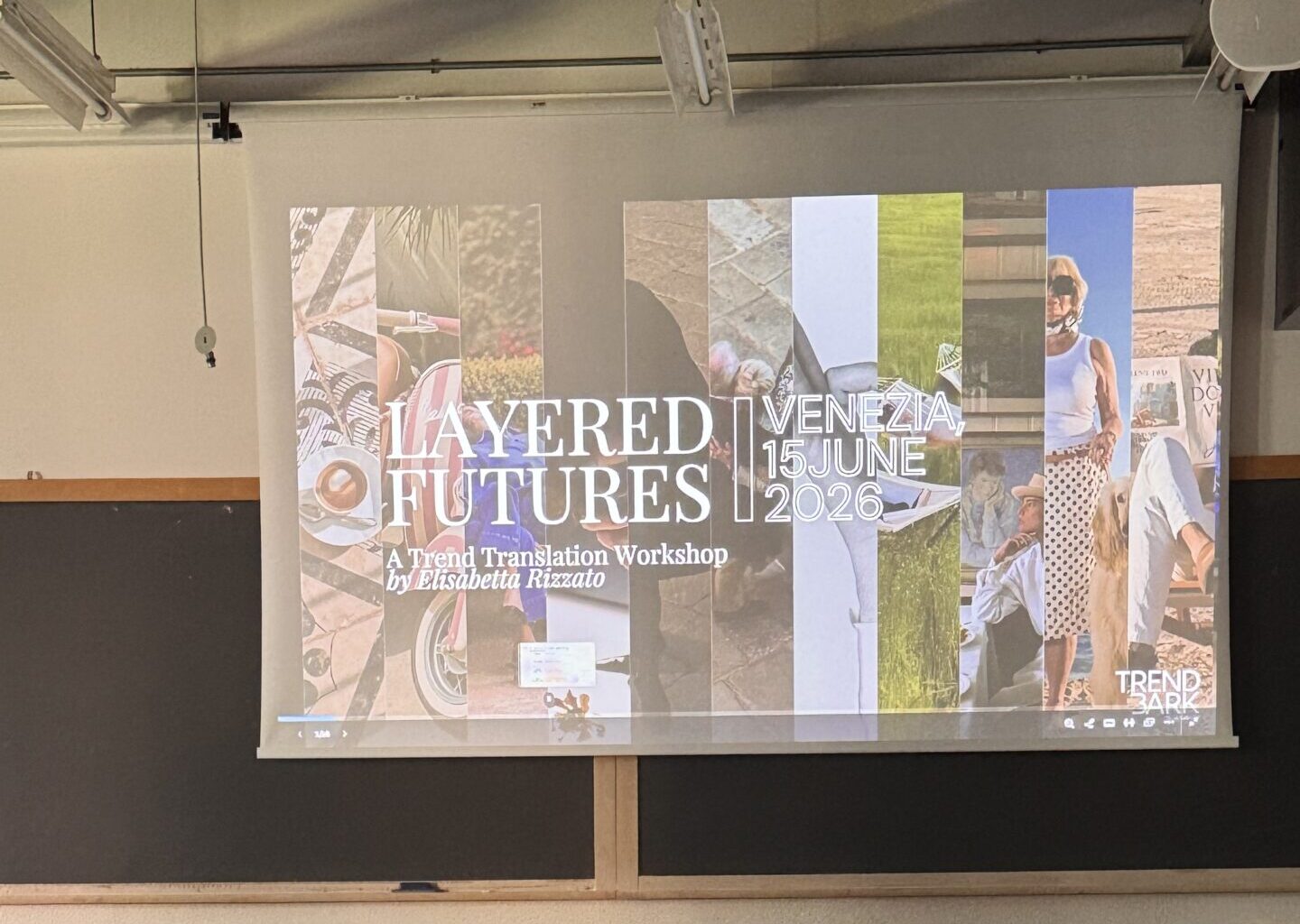
Last month, I returned to Venice to lead a workshop with postgraduate Interior Design students from RMIT University Melbourne, who were travelling through Italy as part of a programme titled Design in Time: Tracing the Past, Designing the Future.
The experience had a particular meaning for me because Venice is where I studied architecture, long before my work moved towards trend strategy, colour research and the study of how changes in culture and behaviour become visible through interiors, materials and design. Returning there to discuss the future, in a city built through centuries of adaptation, memory and accumulated layers, felt unexpectedly connected to the way I have learned to approach this work.
The workshop began from a question I often return to in my practice:
how can signals observed in an international design context be translated into future scenarios that feel specific, meaningful and relevant somewhere else?
We started from directions I had identified during Milan Design Week, looking at emerging colours, materials, atmospheres and spatial ideas across the fair and the city. Recognising signals is an important part of trend research, but it is only the beginning. The real work starts when we ask why something is appearing, what wider change it might represent and how its meaning shifts when it enters another context.
.

.
Global trends do not create global design
The expression “global trend” is used constantly across design, marketing and consumer research, often as though the same aesthetic direction could simply travel from one country to another without changing.
I increasingly find this idea so disconnected from the reality of how design works.
Because macro forces can certainly be global. Climate anxiety, ageing populations, digital acceleration, loneliness, economic uncertainty and the search for connection affect people across many different cultures and markets. These are large directions of change that can influence behaviours, priorities and expectations internationally.
But their expressions, however, are never completely global.
Every direction is filtered through local climate, architecture, history, material availability, social habits, cultural memory and the way people actually live. A shared concern can therefore produce very different colours, objects, spaces and atmospheres depending on where and for whom a project is being developed.
This distinction is fundamental. It is also what separates serious trend work from the circulation of visual formulas and marketing shortcuts.
A direction observed in Milan does not arrive in Melbourne unchanged. It encounters a different relationship with light and weather, another understanding of indoor and outdoor life, different social rituals and another design culture. What appears sophisticated, warm or intimate within one context may need to become lighter, more informal, more open or more adaptable within another.
This does not mean that one interpretation is more correct than the other. It means that design becomes meaningful through translation rather than repetition.
.

.
From visual inspiration to contextual relevance
Over the past decade, access to visual inspiration has become almost unlimited. Designers in different parts of the world increasingly see the same projects, fairs, references and images through Instagram, Pinterest, digital magazines and, more recently, AI-generated search and visual tools.
This has created extraordinary possibilities for research, but it has also produced a growing confusion between access and understanding.
Seeing the same image does not mean sharing the context that created it. A material may carry one cultural meaning in Italy and a completely different one in Australia. A spatial solution may respond to a specific climate, building tradition or social habit that disappears when only its visual appearance is copied. A colour may feel contemporary in one market and already overexposed in another.
When this context is removed, design can quickly become generic: recognisable, polished and globally familiar, but disconnected from the place and people it is supposed to serve.
This is why I do not see trends as ready-made inspiration, nor as a list of elements to apply to a project. They are directions of change that require interpretation. Their value lies not in showing designers what to copy, but in helping them understand what is shifting and decide what that change could mean within their own work.
The students from RMIT were not asked to reproduce an image of Milanese or Italian design, but encouraged to consider how the directions we discussed might take on a different character when viewed through their own experience of Australian interiors, lifestyles and environments.
The most interesting ideas emerged precisely where the original references began to change.
.

.
What the students revealed me about future interiors
Several aspects of the workshop surprised me.
/ The first was how naturally the students returned to hand drawing. Despite working within an increasingly digital design culture, they used drawing not simply to represent a finished idea, but to explore and think through it. The sketches allowed concepts to remain open, imperfect and still in development, rather than immediately turning them into polished visual outcomes.
/ The materials table also became one of the most active parts of the room. Students repeatedly returned to it, touching, comparing and discussing samples while their ideas developed. Physical materiality was not an additional decorative layer added at the end; it became central to how they understood atmosphere, contrast and spatial experience. This felt particularly relevant at a moment when design research is becoming increasingly screen-based. Images can communicate an aesthetic very quickly, but they cannot fully convey temperature, weight, reflection, texture or the relationship between different surfaces. Material understanding requires another kind of attention, and it remains fundamental to interior design regardless of how sophisticated digital visualisation becomes.
/ What struck me most, however, was the recurrence of one theme across many of the projects: connection.
The students were working with different design directions and developing different visual languages, yet many of their concepts eventually became concerned with how people meet, share space, observe one another, feel part of a community or connect with the everyday life of a place. This was not something imposed as the theme of the workshop. It emerged through their interpretations.
Perhaps this reflects how strongly younger designers are responding to loneliness, social fragmentation and the increasingly mediated character of daily life. It also demonstrates how a broad cultural condition does not have to produce one predictable aesthetic. The same need for connection can be expressed through many different spatial choices, atmospheres and narratives.

.
Teaching makes professional intuition visible
The workshop also reminded me of something about my own practice.
For years, my work has moved between interior architecture, design fairs, colour, material culture, consumer taste and broader shifts in the way people want to live, gather, rest and feel. Much of this involves constant comparison: observing what appears, but also what is disappearing; recognising what is temporarily loud and what is becoming structurally important; connecting visible aesthetics with changes that are not yet being discussed as design trends.
Part of this process is analytical, while part of it develops through experience and becomes intuitive over time.
Teaching does not mean revealing or reducing that work to a simple formula. It does, however, force you to become more precise about the difference between showing someone a trend and helping them think critically about its relevance.
It also makes clear how much expertise lies in editing.
Today, the problem is rarely a lack of information. Designers are surrounded by images, forecasts, reports, content and constant claims about what is coming next. The more difficult task is deciding what deserves attention, what is relevant to a particular sector and what should be ignored.
This is why I believe the role of trend forecasting is changing, as providing more inspiration is no longer enough. The real value lies in interpretation, context and the ability to connect broad changes to meaningful design decisions.
.
Design futures require specificity
The future of design will not be created by accelerating the circulation of the same ideas across more markets.
The more our digital environments push us towards shared references and instant visual familiarity, the more valuable specificity becomes: the detail that belongs to a particular place, the material that carries a local history, the spatial behaviour shaped by climate or ritual, the idea that could not have been developed in exactly the same way somewhere else.
This is not an argument against international exchange. Design has always travelled, borrowed and transformed. The Melbourne café culture itself, as I explored in a recent essay that you can read on my Substack Travelling Taste here, grew partly from Italian immigration and then evolved into something with a character and ritual of its own.
The interesting part is precisely the transformation: ideas become culturally relevant not when they remain intact, but when they meet another reality and change through it.
For companies and designers, this also has a strategic value. A project developed through genuine contextual understanding is more difficult to imitate because it is not based on a visible trend alone. It connects a broader direction with a particular identity, material knowledge, audience and way of working: that is where trends can support originality rather than undermine it.
.
LAYERED FUTURES™
LAYERED FUTURES™is the trend translation workshop I have developed through TRENDBARK for companies, creative teams, schools and institutions.
The format is designed for organisations that want to move beyond passive trend inspiration and explore how wider directions of change can become relevant to their own products, materials, spaces, markets and design challenges. Mail to : [email protected] for more information.