by Michael Keany
August 3, 2026
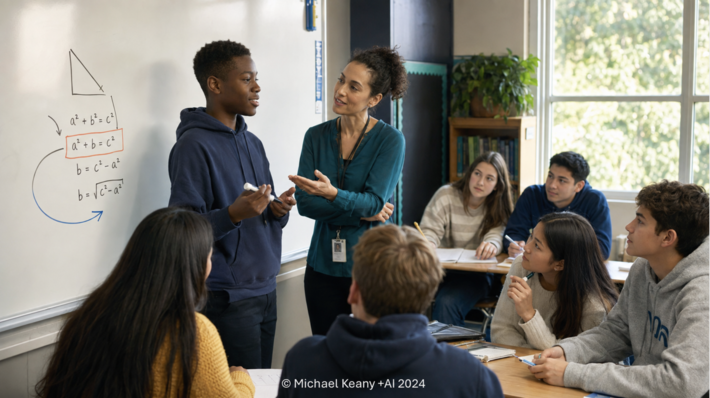
A student offers an answer. It is wrong. For a few seconds, the teacher’s response will communicate far more than whether the student understands the content. It will tell everyone whether this classroom is a place where uncertainty is safe, thinking is valued, and mistakes can lead to learning.
Great teachers do not ignore errors or disguise them with empty praise. They respond in ways that protect dignity while making the thinking visible.
1. They pause before judging
The strongest first response is often a brief pause. Teachers frequently answer students almost immediately, but Mary Budd Rowe’s research on “wait time” showed the value of allowing silence after a student speaks. A pause gives the student time to reconsider and prevents the teacher from reacting with a facial expression or abrupt “No.”
Instead of rushing to correct, a teacher might say, “Take another look,” or “Let’s stay with that idea.” The tone is calm and genuinely curious.
2. They ask the student to explain
An incorrect answer does not reveal why the student is wrong. The student may have misunderstood a word, applied a reasonable rule in the wrong situation, made a calculation error, or possessed a deeper misconception.
Great teachers ask, “What led you to that answer?” “Can you show us your first step?” or “Which part of the text supports your thinking?” These questions turn an answer into evidence. They allow the teacher to diagnose the misunderstanding and help classmates examine the reasoning rather than merely await the correct response.
3. They preserve the useful thinking
Many incorrect answers contain something worth retaining: an accurate observation, a sensible strategy, or a connection that almost works. Great teachers identify that productive element precisely.
They might say, “Your first step is appropriate; the difficulty comes when the variables are combined,” or “You found relevant evidence, but it supports a different conclusion.” Raffaella Borasi described errors as potential “springboards for inquiry.” When teachers investigate errors, students learn that mistakes are information—not proof that they lack ability.
4. They invite participation without humiliation
A teacher can open the question to classmates without making the original student feel exposed: “Who can build on this?” “Where did our reasoning take a turn?” or “Compare this approach with the one beside it.”
The goal is not to recruit another student to announce the right answer. It is to create collective reasoning. Teachers should avoid sarcasm, public scorekeeping, or phrases such as “Who can help him?” that position one student as deficient. The class examines the idea, while the student remains a respected participant.
5. They provide feedback that points forward
After diagnosing the error, great teachers offer enough information for the student to take the next step—but not so much that the teacher does all the thinking. Hattie and Timperley’s review of feedback emphasizes helping learners understand the goal, their current progress, and what they should do next.
A useful prompt might be, “Recheck the denominator and try again,” or “Return to paragraph three and test your claim against the author’s words.” Then the teacher circles back and asks the original student to revise, restate, or apply the idea to a similar problem.
The best response to an incorrect answer is not a clever phrase. It is a disciplined sequence: pause, investigate, preserve what is useful, involve others respectfully, and return the thinking to the student. In classrooms where teachers respond this way, accuracy still matters—but being wrong is no longer the end of participation. It becomes part of learning.
References
-
Borasi, R. (1994). “Capitalizing on Errors as ‘Springboards for Inquiry’: A Teaching Ex….” Journal for Research in Mathematics Education, 25(2), 166–208.
-
Hattie, J., & Timperley, H. (2007). “The Power of Feedback.” Review of Educational Research, 77(1), 81–112.
-
Rowe, M. B. (1986). “Wait Time: Slowing Down May Be a Way of Speeding Up!” Journal of Teacher Education, 37(1), 43–50.
——————————
Prepared with the assistance of AI software
OpenAI. (2026). ChatGPT (5.2) [Large language model]. https://chat.openai.com