

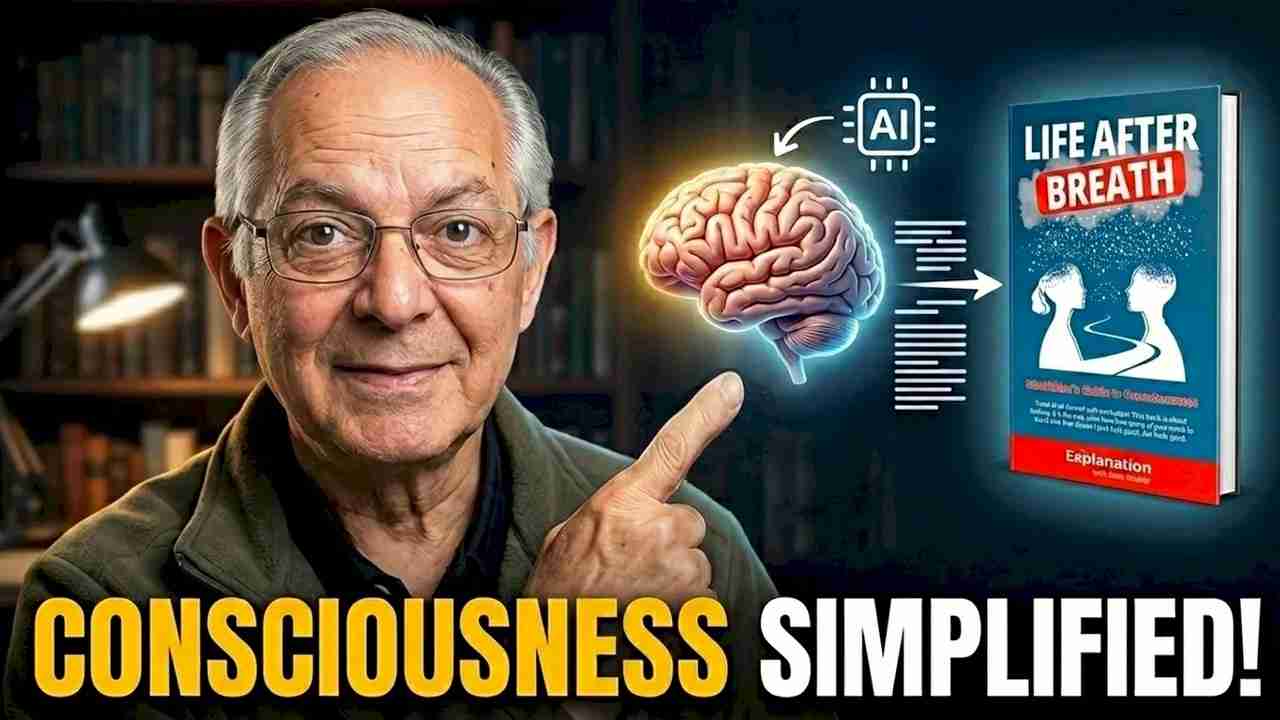
This is the Preface for our journey through Life After Breath: A Hitchhiker’s Guide to Consciousness — a new weekly series from The Explanation. Every Tuesday, a new chapter lands here with a video on YouTube and a note in your inbox.
What does the Bible say about consciousness? It’s a question philosophers, scientists, and theologians have circled for 450 years without landing on an answer — because nobody could agree on how a non-physical mind (your thoughts) interacts with a physical brain. Sam Kneller’s answer starts in a different place entirely: not in a lab, and not in tradition, but in the original Hebrew of Genesis 2:7.
Here’s why that question isn’t just academic. Nearly a billion people worldwide are struggling with their mental health right now, according to the World Health Organization — and we’re trying to treat that crisis without agreeing on what “consciousness” or “mind” even means.
Life After Breath is Sam Kneller’s accessible, narrative telling of that answer — the same original research as his 100,000-word original, Mind-Body Problem Solved, rewritten in plain language and shorter chapters so anyone can follow it. Below is how the book itself introduces that answer, in Sam’s own words.
Need to Know Before You Start
This book is special from many points of view. The following points are written by Sam Kneller himself, not by AI:
- I wrote a 100k-word book entitled Mind-Body Problem Solved. It is very scholarly and intense, making it hard to read. I wanted to make it more accessible, so I thought of using AI to rewrite it using vernacular language and shorter chapters. AI added the italic and bold emphasis, which I left untouched. I decided to add a few diagrams for clarity.
- All the material in Mind-Body Problem Solved is my original writing. So what you’re reading is original. AI only summarized the original and changed the style. I wasn’t satisfied with some of AI’s renditions, and I modified the prompt or simply edited the AI summary in a very few cases, to reflect the original ideas.
- For all the details, web links, Bible verses, Strong’s references, diagrams, and indexes, please refer to the original Mind-Body Problem Solved, available from your local bookstore or your favorite online store.
A Bold Claim
From the book’s Preface: “Mind-Body Problem Solved. A Bold Claim”
Let’s be clear from the start: the title of this book is not a marketing trick. It’s a fact. We are going to solve a puzzle that has stumped the smartest people on earth for 450 years.
It all started with a French philosopher named René Descartes and his famous line, “I think, therefore I am.” He kicked off a huge debate by saying the mind and the body are two completely separate things. Ever since, scientists, philosophers, and religious leaders have been arguing about how a non-physical mind (your thoughts) can interact with a physical body (your brain).
Nobody has found an answer. Until now.
But this isn’t just some academic game for intellectuals. This is the most important health crisis of our time. Mental health. Anxiety, depression, addiction, and suicide are skyrocketing. The World Health Organization says nearly a billion people are struggling right now.
Here’s the insane part: we are trying to treat mental health without even agreeing on what the “mind” is. That’s like a mechanic trying to fix an engine without knowing what a carburetor does. It’s never going to work.
So why has this problem stayed unsolved for so long? Because everyone is stuck in their own little box.
Science only wants to measure physical things. It’s great at studying the brain but hits a wall when it tries to find your thoughts in a petri dish.
Religion often relies on ancient traditions and feelings, which can be all over the map.
Philosophy is just people using their own brainpower to imagine answers, which leads to a bunch of smart-sounding but conflicting ideas.
The answer isn’t in any one of these boxes. The solution is outside of them.
This book is going to do something totally different. We’re going to start with a simple list of things we can all observe and agree are true:
- The physical world exists (rocks, water).
- Life exists (plants, flowers).
- Animals exist.
- Humans exist.
- Brains exist.
- Minds exist.
That’s it. No fancy theories. We’re going to build from there.

Click here to learn more
I need to warn you: reading this might be frustrating. This solution does not follow the way the world normally thinks. You might disagree with parts of it along the way. That’s okay. But you have to see the whole picture before you decide if it’s right or wrong. Imagine looking at a few puzzle pieces and saying the whole puzzle is ugly. You have to see all the pieces fit together into what I call “coherent completeness” before you can judge it.
And one more thing: this isn’t about me. Don’t get distracted by the author. This is about the ideas. If you have a problem with the message, that’s fine. But focus on whether the solution makes sense, not on the messenger.
We are going to finally answer the questions: What is the mind? What is its relationship to the brain? And most importantly, why do you have one, and how are you supposed to use it?
The answer to the mind-body problem is the key to unlocking your mental peace. Let’s find it.
What Does the Bible Say About Consciousness: The Breakthroughs
According to the preface, answering what the Bible says about consciousness provides groundbreaking insights that disrupt established fields:
From Theology:
- Moves beyond tradition: The solution is found not in religious tradition or doctrine, but in a direct, linguistically accurate retrieval of the “God-intended meaning” of Scripture, specifically the original Hebrew.
- Reinterprets foundational texts: It offers a definitive interpretation of previously misunderstood key verses like Genesis 2:7, providing clear answers to questions about the soul, spirit, and breath of life that have divided theologians for centuries.
- Unifies purpose: It answers the profound “Why?” questions of human existence — why the mind exists, why humans have one, and its ultimate purpose — which religion has often addressed through faith alone.
From Psychology & Mental Health:
- Addresses the root cause: The book posits that the global mental health crisis is fundamentally linked to our collective misunderstanding of what the mind is. Answering what the Bible says about consciousness is presented as the essential first step to addressing this crisis, not just treating its symptoms.
- Redefines the self: By defining the mind’s origin and purpose, it provides a new framework for understanding human consciousness, identity, and our place in the universe — one that could revolutionize therapeutic approaches.
FAQ
What does the Bible say about consciousness?
Life After Breath argues the Bible’s answer starts at Genesis 2:7, in the Hebrew word neshama (“breath of life”) — not in a proof text quoted in isolation, but in a full word study across every Old Testament occurrence, laid out as evidence for you to weigh yourself.
Is the mind-body problem actually solved, or is this just a theory?
The book lays out the evidence and asks you to weigh it yourself. It’s not presented as an opinion to accept, but as a case built one piece at a time until it forms what the book calls “coherent completeness.”
Do I need to be religious to read this book?
No. The book works for believers and skeptics in the same sentence — it’s built to be judged on whether the evidence holds up, not on whether you already believe.
How is Life After Breath different from Mind-Body Problem Solved?
Same original research and ideas, written by Sam Kneller — but reframed as a shorter, narrative, “detective story” read instead of a dense, scholarly one. If you want the full scholarly detail, links, and indexes, start with the original.
How do I follow along each week?
Subscribe to the weekly email to get each new chapter as it is released, or catch the video version on YouTube (@theexplanation).
What’s Next
This is the Preface of Life After Breath. Next week: spiritual or secular? It doesn’t matter; the answers are somewhere we all have access to, but we read them wrongly. This book will put us all on the right track.
Want the full, scholarly original now instead of waiting a week at a time? Get Mind-Body Problem Solved. Want a free copy of Life After Breath in exchange for an honest review? Here’s how.
Dig Deeper into The Explanation
Online Study Courses to Uncover the Mystery of Adam and Eve’s Nakedness… with no fuss. Free video mini-course revealing the God-intended meaning of Scripture via Biblical Hebrew. It’s so easy, it’ll blow you away. Join now and add new motivation to your Bible study.
Join The Explanation Newsletter to stay informed of updates. and future events. No obligations, total privacy, unsubscribe anytime, if you want.
The form you have selected does not exist.
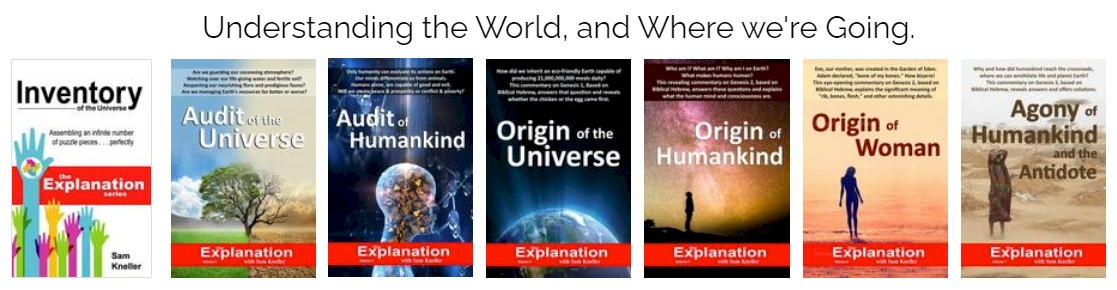
The Explanation series of seven books. Free to read online or purchase these valuable commentaries on Genesis 1-3 from your favorite book outlet. E-book and paperback formats are available. Use this link to see the details of each book and buy from your favorite store.
Since you read all the way to here… you liked it. Please use the Social Network links just below to share this information from The Explanation, What Does the Bible Say About Consciousness?


