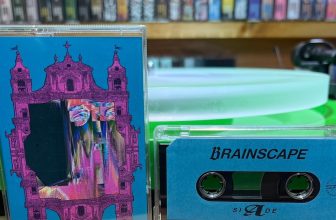
On a recent listen through Richard Bégin’s Déjà Vu, one of my young-adult kids joined me for a few minutes. They commented on the music’s dark and cinematic tone, and mentioned that it might have made a fitting soundtrack to a psychological horror video game, such as Omori. Strangely, the themes of Omori and Déjà Vu dovetail nicely. In the game, a teenage boy navigates dreamlike worlds that slowly unravel into darker memories. And déjà vu, of course, is the feeling that a new experience is strangely familiar. Both address how our present perceptions can be imperfect and disorienting echoes of the past.
As a composer and sound artist, Bégin draws from a rich palette of synthesized chords, field recordings, and sonic manipulations. Static-like sounds and echoing patterns take on an outsized role. Often, these elements are combined in a manner that results in an ominous tension.
Case in point, Delvau‘s field recordings of children at play and a dog barking is coupled with undulating synth lines. Waves of static are added to this vertiginous mix as the children become quiet – as if something horrible removed them from their carefree environment. This chilling transition exemplifies Bégin’s knack for transforming the mundane into an uncanny soundscape where innocence and dread collide.
G5, 1 also exemplifies horror cinematics, with quiet layers of brooding resonance giving way to multifaceted walls of sound. C7, 1 takes a similar approach but with a handful of alien sounds that are almost of a playful nature. If anything this grotesque whimsy only adds to the album’s lurking unease.
Soirées de Saint-Pétersbourg concludes the effort with the rattling noises and creaking of ancient machinery accompanied wobbling drones. While windswept and random at first, the piece self-organizes into clearly discernible melodies and rhythms. Thus, Déjà Vu ends with a retro / Kosmiche soundscape – albeit one that decomposes into chaos in its final few seconds.
Ultimately, Déjà Vu serves as more than a mere collection of eerie soundscapes – it feels like an aural journey through fractured recollections. That persistent undercurrent of uncanny familiarity mirrors the struggles that we all have to reconcile contemporaneous experiences with our subconscious encodings of the past. The album beckons the listener into a dreamlike space where every familiar sound can hide a darker truth.