A key element of any successful strategy is prioritizing the tactics that make sense for the specific, short-term context.
I can’t stress enough how some tactics, in the short term, might seem to move entirely in the opposite direction of the long-term strategy.
I love Airbnb’s example. In its early days, Airbnb sold cereal boxes to stay afloat temporarily.
Around the time of the 2008 election, the co-founders raised $30,000 by selling limited edition cereal boxes featuring Barack Obama and John McCain.
To make ends meet, or as they call it in startup lingo, “bootstrap the company,” Airbnb’s founders had the idea to sell limited edition cereal boxes.


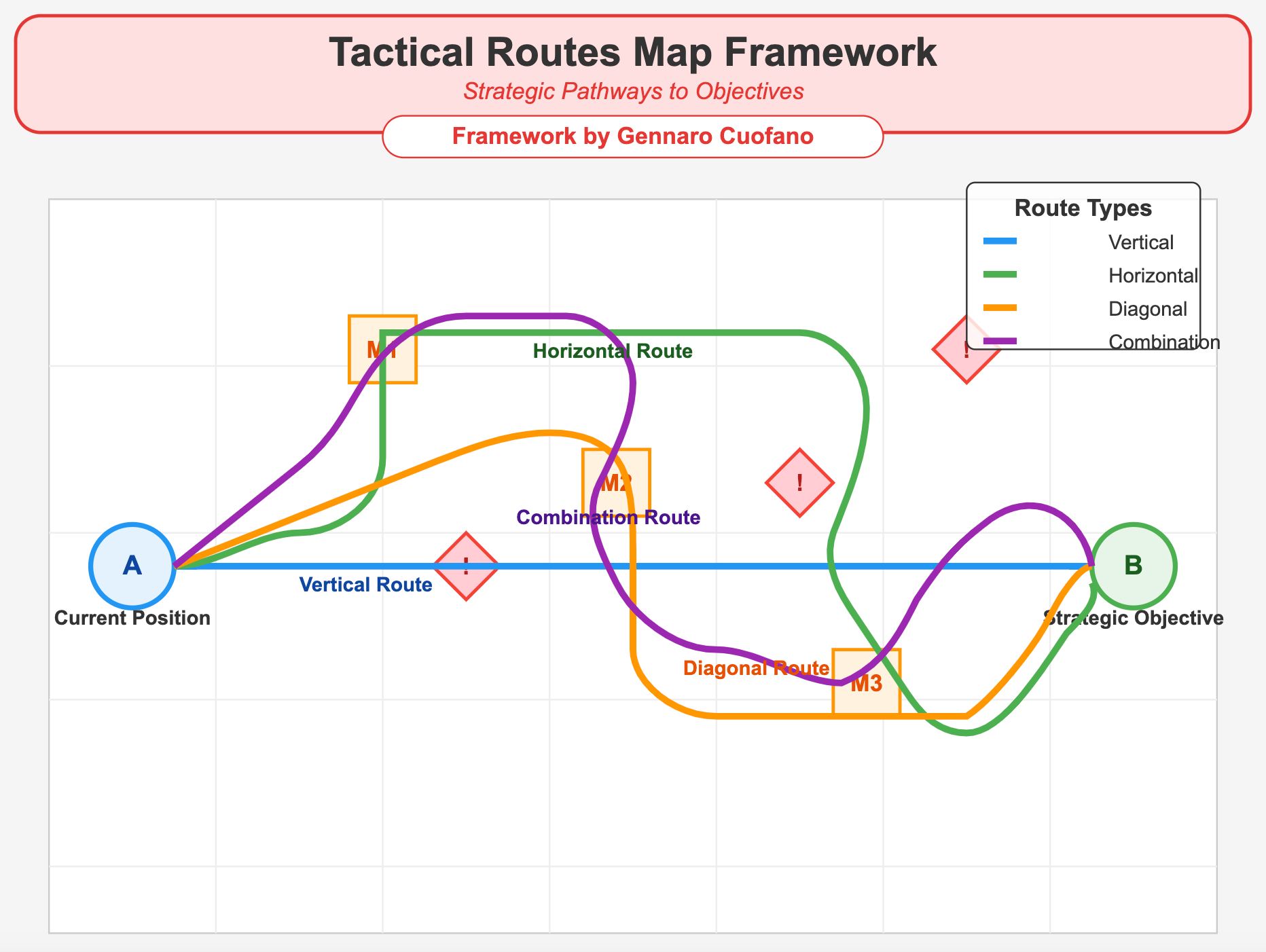
However, the key point is to survive long enough to follow the map.
Thus, even a brief “reroute” is enough to get back on track.
In other cases, context will allow you to take vertical routes or those that, while working in the short term, still align pretty well with a long-term strategy.
We’d always take vertical rather than diagonal routes in a perfect world.
But in the real world, you might be surprised that diagonal routes often work for long-term success.
Let’s get to the prioritization framework now.
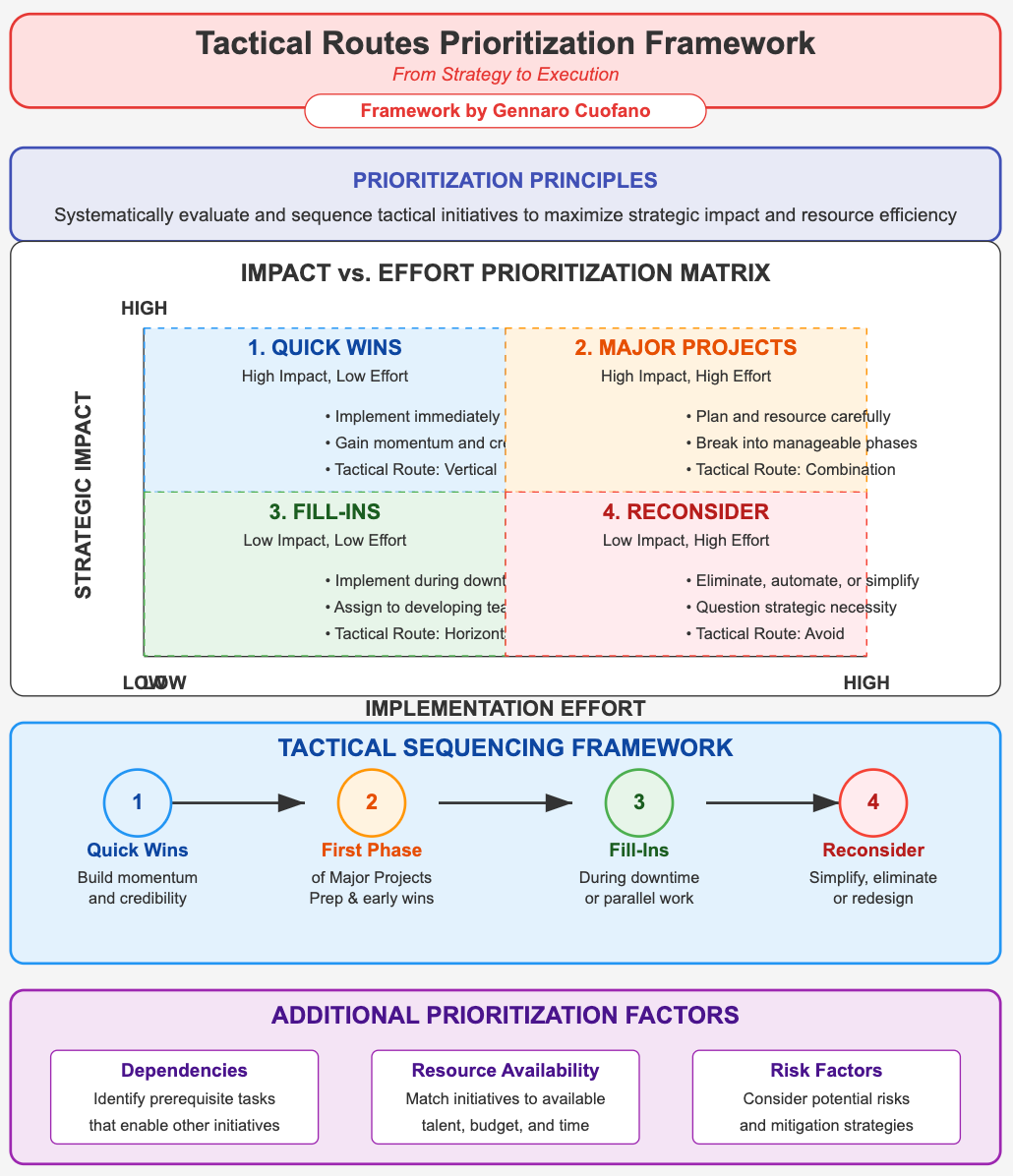
I’ve designed this framework to systematically evaluate and sequence tactical initiatives, maximizing strategic impact and resource efficiency.
This framework helps in translating strategy into actionable steps, focusing on prioritization and execution.
Indeed, a key ingredient is to sequence for implementing tactical initiatives into four main blocks:
-
Quick Wins: Build momentum and credibility by focusing on initiatives that deliver immediate results.
-
First Phase of Major Projects: Begin preparation and achieve early wins for major projects to establish a solid foundation for larger efforts.
-
Fill-Ins: Utilize downtime or parallel work to complete low-effort tasks.
-
Reconsider: Simplify, eliminate, or redesign initiatives that are resource-intensive but offer a low strategic impact.
While also prioritizing based on resource constraints and risk factors:
-
Dependencies: Identify prerequisite tasks that enable other initiatives, ensuring a logical sequence of actions.
-
Resource Availability: Match initiatives to available talent, budget, and time to ensure feasibility.
-
Risk Factors: Identify potential risks and develop effective mitigation strategies to manage uncertainties effectively.
From there, we can map out the actions to take vs. those to hold for now.
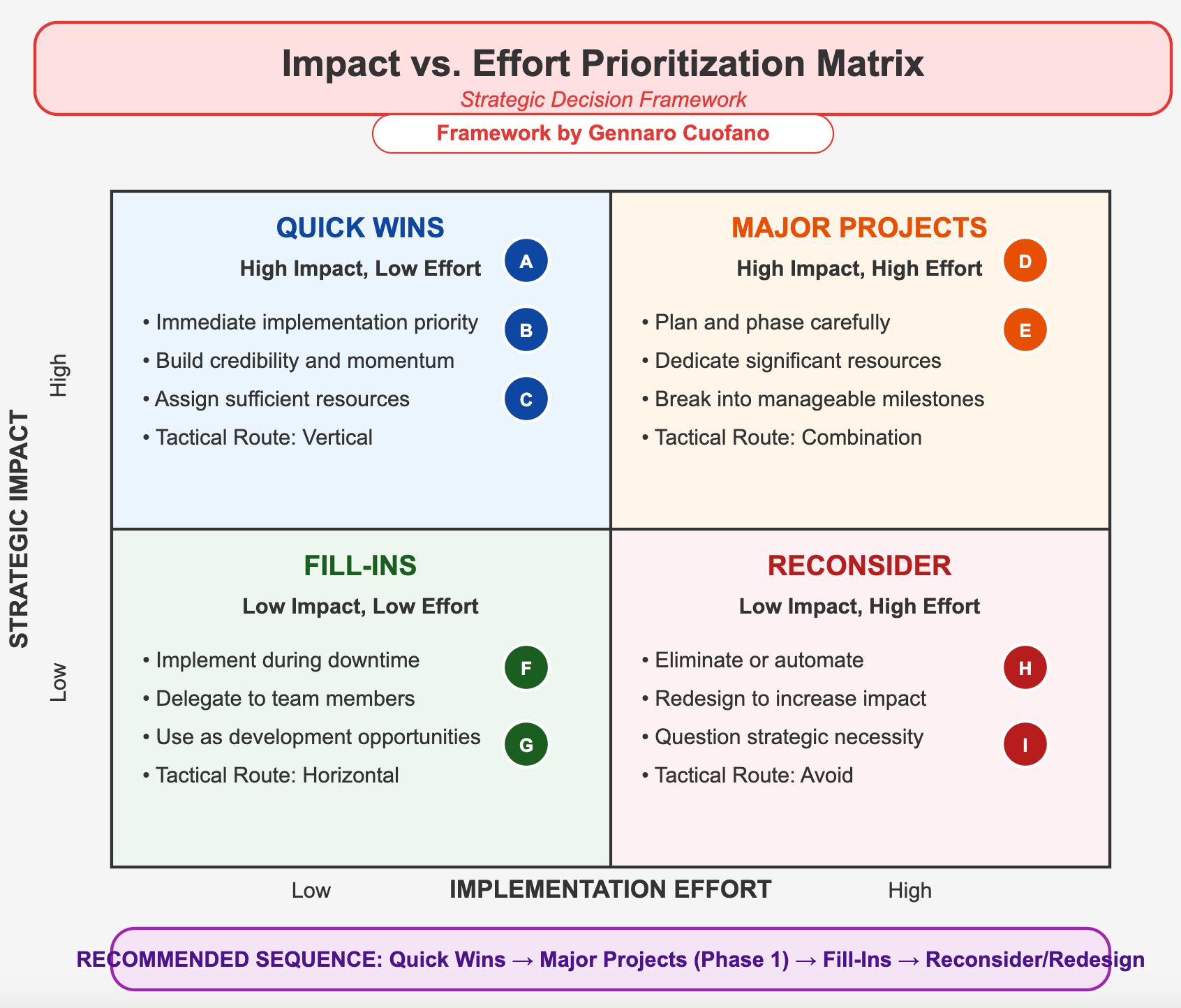
The framework centers around a classic Impact vs. Effort matrix with four quadrants:
-
Quick Wins (High Impact, Low Effort)
-
Major Projects (High Impact, High Effort)
-
Plan and resource carefully
-
Break into manageable phases
-
Often employs Combination tactical routes
-
-
Fill-Ins (Low Impact, Low Effort)
-
Implement during downtime
-
Assign to developing team members
-
Usually leverages Horizontal tactical routes
-
-
Reconsider (Low Impact, High Effort)
-
Eliminate, automate, or simplify
-
Question strategic necessity
-
Generally best to avoid these initiatives
-
The diagram also includes a sequencing model that recommends the optimal order of implementation:
-
Start with Quick Wins to build momentum.
-
Move to Major Projects (Phase 1) for significant impact.
-
Handle Fill-Ins as they arise.
-
Reconsider or redesign tasks that have a low impact but require a lot of effort.
-
Short-term tactics may seem misaligned with long-term strategy but are crucial for survival.
-
Example: Airbnb sold cereal boxes in 2008 to raise funds—seemingly unrelated but necessary for long-term success.
-
Diagonal routes (unexpected tactics) can work when needed to sustain operations before following the strategic map.
-
Quick Wins: High-impact, low-effort initiatives that build momentum and credibility.
-
First Phase of Major Projects: Lays the foundation for larger strategic efforts.
-
Fill-Ins: Low-priority tasks completed during downtime or in parallel.
-
Reconsider: Resource-heavy initiatives with low impact—eliminate or redesign.
-
Dependencies: Identify prerequisite tasks that enable other initiatives.
-
Resource Availability: Align with available talent, budget, and time.
-
Risk Factors: Assess risks and plan mitigation strategies.
-
Start with Quick Wins → Gain momentum and credibility.
-
Move to Major Projects (Phase 1) → Begin larger strategic shifts.
-
Handle Fill-Ins → Utilize downtime efficiently.
-
Reconsider & Redesign → Remove low-value, high-effort tasks.
-
Prioritize tactics that sustain short-term survival while aligning with long-term success.
-
Adapt when necessary—diagonal routes can be effective in the right context.
-
Sequence execution to maximize impact and resource efficiency.
-
Eliminate or delay tasks that consume too many resources with minimal return.
With massive ♥️ Gennaro Cuofano, The Business Engineer