Furniture is a necessity of human life but beyond its functionality, furniture design also reflects the social life of objects and has symbolic capacities. Design objects convey cultural, social, and ideological meaning. They can also be performative—given their intimate connection to the body, they shape how we relate to space and to one another.
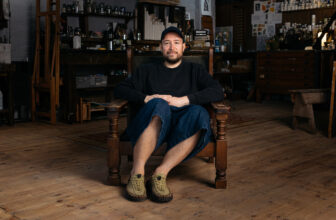
Lukas Gschwandtner, who has received training in traditional leather craftsmanship, and studied spatial design, is an artist living and working in Vienna—but one could also call him a choreographer, a set designer, a historian of textiles and a historian of reclining figures.
The material expression of his distinct ideological formation—rooted perhaps in living in a city steeped in art and design history—is embodied in canvas, leather, metal, but also historical textiles, fragments of 18th-century tapestries, decaying fringes, and horsehair. In his visual grammar, canvas—folded, pressed, cut, laid on the floor—is a vehicle for aesthetic innovation, historical discourse, and storytelling.
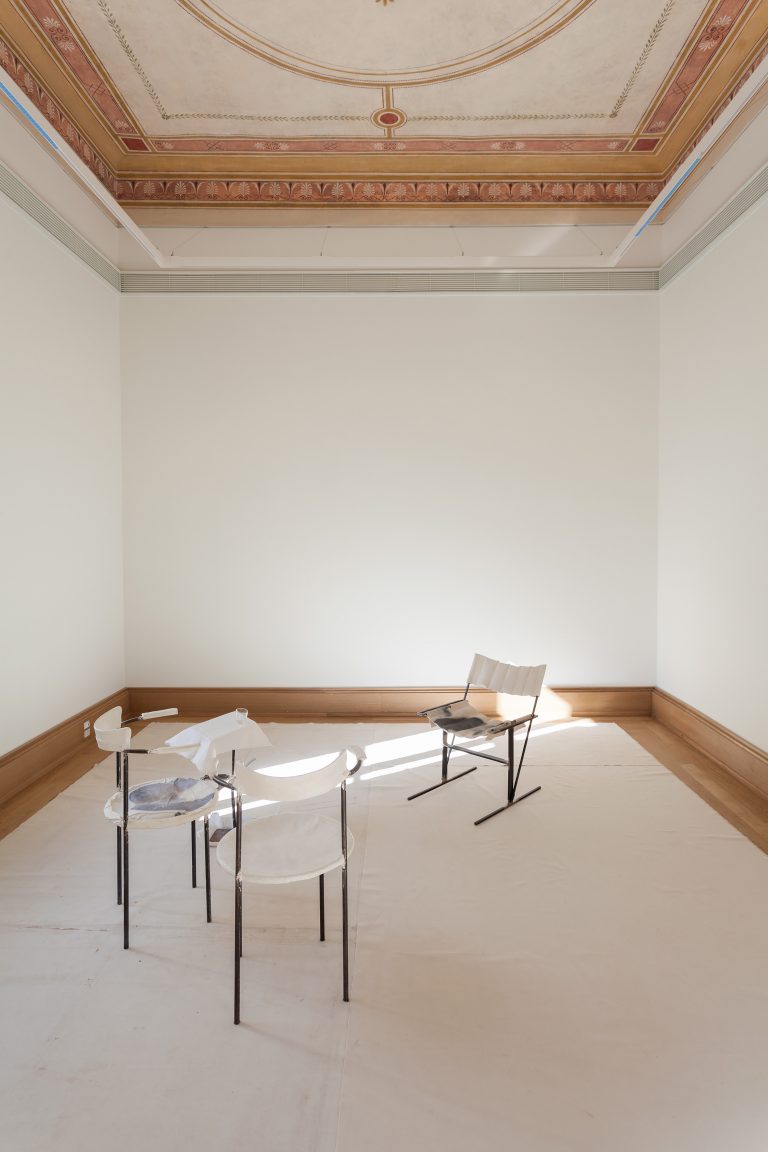
For his first exhibition at Radio Athènes, inspired by Aristophanes’ speech in Plato’s Symposium—a discourse on Eros set in an Athenian house during a banquet—Lukas presents new works: museum benches, lamps, vitrines, pillow chairs, and textile works, alongside their prototypes.
He explains here how speed dating (according to Aristophanes) came about:
Aristophanes’ idea of the “spherical people,” who, after being cut apart by Zeus, spend their lives searching for their other half—has followed me for a while. Somehow, it felt natural to apply this theory to many situations; there always seem to be two sides, two components, in my work: sometimes a historical one, sometimes a bodiless observation—and especially between the first attempt at a piece and its final version.
So I began thinking about giving my pieces the chance to find their other half, in Athens. Living in Vienna with the first iterations of each work helped me understand their domestic relevance more. After the final versions had been shown outside my personal space, the originals started to form an emotional dialogue with me, almost a kind of companionship. They became new protagonists in my life and my rooms.
One chair, for example, became my nightstand out of necessity. It held my water glass and books and, most importantly, greeted me every morning.
One light was never meant to be shown elsewhere; I made it for my partner’s birthday. Strangely, various versions of it found their way into exhibitions and collectors’ homes.
The gathered pieces will occupy a Greek apartment; each room will host a couple, two reunited halves—almost as if I were giving them privacy in each room to discuss their time apart. Their own symposium, or even speed dating: I let them converse with their opposite to see if it’s a match. Otherwise, we rotate.
Strange to think that I would be Zeus in this scenario. And what would my Mount Olympus be? Austrian hills? My apartment on the fourth floor? And at the opening I turn into a speed dating moderator?
Returning to Aristophanes and his companions discussing Eros and love, it’s interesting to consider the actual social and domestic setting of the Symposium. While each guest presents their thesis on love, they are also sharing a space—drinking, eating, listening to one another.
This brings me to imagine Phaedrus, Pausanias, Eryximachus, Aristophanes, Agathon, Socrates, and Alcibiades inhabiting the apartment—the exhibition space—and leaving behind glasses, fragments, and traces of an evening of conversation.
Laid on the floor of Radio Athènes at Tositsa: canvases, originally from my 30th birthday party in my Vienna atelier—my own kind of symposium.
—Lukas Gschwandtner, Vienna, November 2025
at Radio Athènes
until December 20, 2025