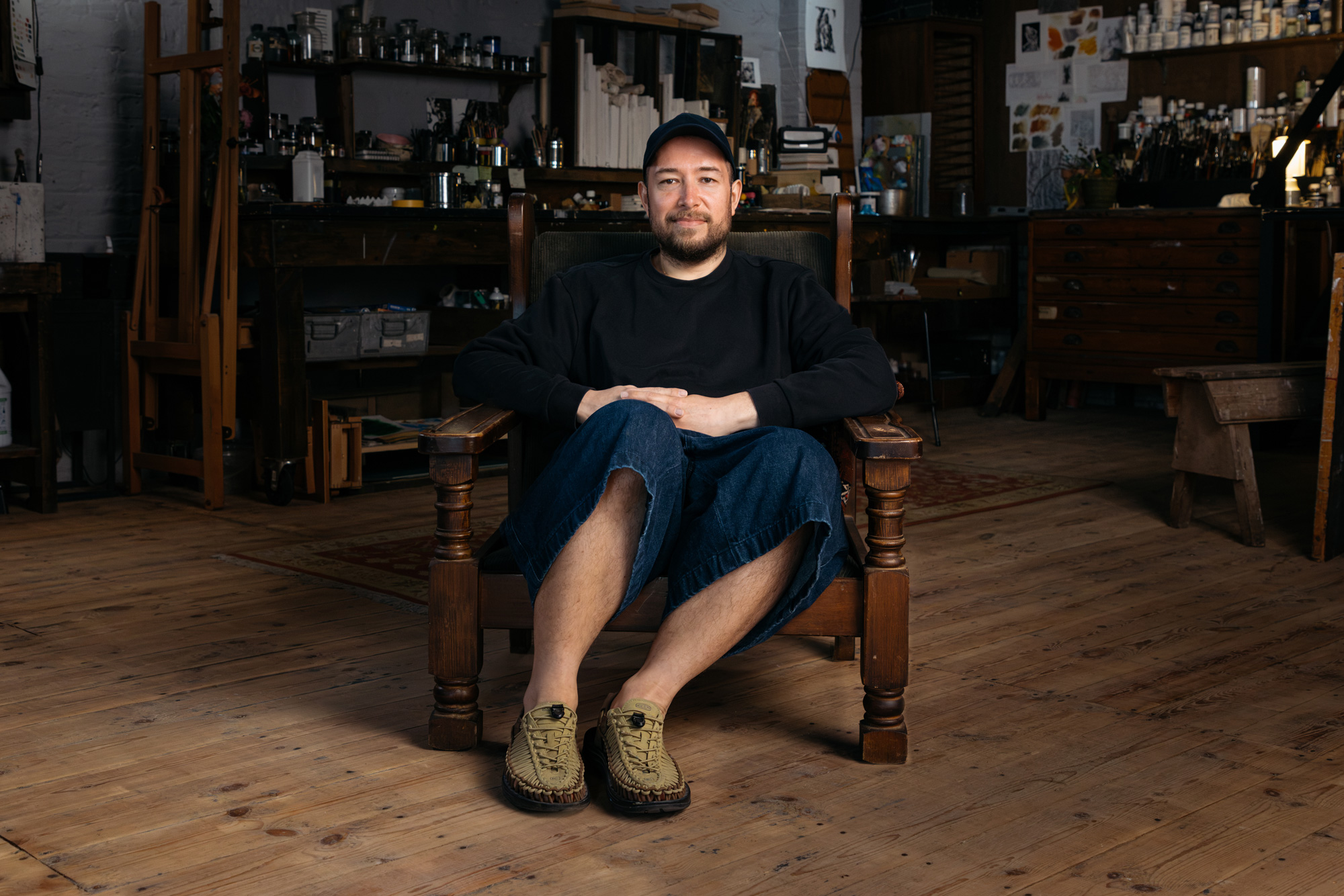
Multidisciplinary artist Jose Campos, who works under the name Studio Lenca, was born in El Salvador. As a child, he fled the country’s brutal civil war with his family, eventually settling in the United States. His brightly coloured paintings explore themes of migration and identity, combining Indigenous folk motifs with symbolically powerful found objects. His practice spans painting, sculpture, dance, and education. He joins us at the Jackson’s Studio to discuss his Margate-based practice, the materials he loves most, and his philosophy of experimentation.

Contents
0:00 “It can be my story, or it can be the story of many people”
0:21 Introduction
0:42 “Like many families, we had to leave because of the violence”
1:11 “It was like being in two worlds at once – I think art, at that moment in my life, was a kind of disruption”
2:02 “With my paintings, I try to create a world that feels like El Salvador, so I choose bright colours. Those kinds of colours really jolt me back to where I’m from.”
2:56 “The painting becomes about the marks that are very controlled, so they really kind of pop.”
4:02 “My favourite colour, a colour that I can’t not use, is Light Magenta by Golden.”
4:26 “That kind of changed my whole life; I was undocumented in the US, I had just fled a civil war, and dance was a sort of space where I could be myself fully.”
6:06 “I have always really liked the idea of a studio as a space for experimenting, so that’s why I use ‘Studio Lenca.’”
6:49 “My practice is very multidisciplinary, but I see it as an umbrella. I feel very fluid when I am making work, and I am driven by ideas rather than thinking ‘I have to stick to this process.’”
7:17 “I am challenging what a painting can be.”
9:16 “I’m untrained; paintings come from my imagination.”
9:37 “When I see a dance that is authentic, and a dance that really moves me, it’s because that dancer or performer is being so present.”
10:06 “Sometimes the figures look like they are moving, dancing, but also fleeing; it can read as both.”
11:20 “I love Pina Bausch – when I first saw her work, it redefined what I thought dance could be.”
13:25 “It feels so wrong to use oil on an acrylic, fuzzy blanket.”
14:02 “For larger areas in the paintings, I use acrylic; I just love how quickly it dries.”
14:47 “I love how immediate and sharp the colour is, and the texture it leaves behind.”
15:12 “I taught for almost 10 years … I had never really been in an art studio, and then all of a sudden I was in charge.”
16:34 “I actually became obsessed with these dancers from El Salvador called ‘Historiantes.’”
17:19 “When I think of my grandfather in El Salvador, I can’t remember him without wearing this big sombrero.”
17:42 “I think of birds as community, how nature doesn’t care about political borders.”
18:18 “I still have the table that I had when I first started making work.”
19:59 “I think about power, and the history of gold in Europe and Central America – so I use frames in my work to talk about what’s left out of those spaces.”
21:24 “I’m interested in this idea of rupture and repair, what is monumentalised and what isn’t.”
21:56 “I almost need to be bored – to be creative.”
22:53 “I don’t know the rules, so I am able to just say, ‘I am going to make a painting’.”
23:22 “Once I add really bold marks, those bold marks become the focus of the painting.”
24:02 “I’m not that interested in revising and kind of reforming things; I’m very immediate, and some might say impatient.”
24:54 “For oil, I use the hog hair brushes, and when I’m painting with acrylic, I tend to use synthetic brushes.”
25:53 “I’ll feel like I’m too exhausted to really see the painting.”
27:12 “I paint to K-Pop.”
27:52 “I really love to work with natural light, and I love working early in the morning.”
28:35 “A lot of discourse around displaced people usually doesn’t come from displaced people.”
29:15 “Even though I was from there, I was still not from there. I have to say it was difficult.”
32:04 “I love the work of Howard Hodgkin. I’m obsessed with his use of colour.”
32:55 “Just be it, just embody it, don’t be afraid to try new things.”
33:56 Credits

Film Extract
It’s about taking the power back. It’s about claiming this back for yourself. I went back to Mexico City. That was a place where my mother and I were stranded with no money before crossing the US border. I’ve changed that narrative. I’ve resolved that for myself. When I was young, I was making artworks with my mother at the kitchen table, and that, in a way, was a studio for me.

I started studying dance. I was in a ballet studio, and then I became a teacher. And I saw my classroom as a studio space, so I’ve always really liked the idea of a studio as a space for experimenting. So I think that’s why I use Studio Lenca, and it can be my story, or it can be the story of many people; Lenca or some of the indigenous people of eastern El Salvador and Honduras.
Hi, my name is Jose Campo, and I’m here at the Jackson’s Studio. I work as Studio Lenca, and I’m going to be talking about my artistic practice.

I was born in El Salvador during the Salvadoran Civil War, and like many families, we had to leave because of the violence. We travelled overland through Guatemala, Mexico, and eventually crossed the US border into California. I was so young that I can’t really remember all of the details, and I think that my practice now is a kind of response to that moment in my life.

It’s kind of a heavy start for a young person. When I arrived in San Francisco, we found a very Latin neighbourhood called La Misión. It was like being in two worlds at once. I think that’s why I loved going into those shops with my mother to buy ribbons and ceramic figures, because it reminded us of home.
We would just kind of construct these party favours, and I think of them as sculptures. I was also helping my mom clean houses. They would have really beautiful coffee table books with contemporary art in them. I think art at that moment in my life was a kind of disruption. It kind of allowed me to think – to realise there’s this other world that you’re not a part of yet. So I became really curious.

Studio Lenca
Oil and acrylic with antique frame on acrylic blanket, 14 x 14 x 26 cm | 5.5 x 5.5 x 10.25 in
Returning Home
I have a work called Border Vessel, where I went to the US border and dug the clay from the Rio Grande, which separates Mexico and the US, and we made gallons of water out of this clay. And then I took the gallons of water to El Salvador, and we made lids out of jade, which is a very important Mesoamerican material.

Studio Lenca
Clay sourced from the US-Mexican border and jade from El Salvador, 14 x 14 x 26 cm | 5.5 x 5.5 x 10.25 in
Border Vessel was really about returning home. I physically had to go back to a place that was so charged for me. And then taking the object that I made there back to El Salvador, I often think about the journeys that migrants make up north for a better life. In this work, I kind of did a reverse journey, so I went back with this object. The clay is a very charged material because a lot of people lose their lives in that river.
But the work is really about the labour that it takes, almost like a respect. When I returned Border Vessel to El Salvador, we actually held a ceremony at an archaeological site for the object. And part of that ceremony was to collect different materials like candles, cacao, cigars – kind of offerings to our ancestors. The ceremony was about creating a portal to create closure for the lives lost at the US border.

Studio Lenca
195 x 225 cm | 77 x 89 in
Collecting Materials
When I travel, I love to collect different materials. It’s really to think about what materials are left out and what materials are included. What I choose to present and what I choose, you know, to include in terms of narrative. That’s framing a history of practice.

Studio Lenca
Kitchen mantel scrubbed with cleaning chemicals, 176 x 140 cm | 69.3 x 55.1 in
I love these acrylic blankets from Mexico, which are normally very colourful. They have all these beautiful illustrations on them, and they’re almost like paintings in themselves. I grew up with these blankets, and I’ve also seen them here in the UK. So it’s kind of a material that’s following me around. And I’ve had people from different countries come in. They go, oh, my grandmother had that blanket. I have a work called Cobija, which means blanket. I guess I’m challenging what a painting can be, not working directly onto canvas. It’s actually supported on these two banana boxes.

All of these materials are links to narratives. They’re links to conversations and memories; the material in that way acts as a bridge. When I go to El Salvador, I might bring the wrapper from a toy, a bag that someone carries, you know, rice in it, or a toy horse, for example. So it’s about including different narratives, and it’s a kind of, if you know, you know. They’re almost like triggers to transport you to a different place.

Dance
I went to the Ruth Asawa School of the Arts in San Francisco. It was a free high school where you audition to get in. I came across dance because there was a local dance school, and I literally asked them if I could have a free space. My family couldn’t afford to put me into ballet lessons, but they said yes because I was the only boy in the school, which kind of changed my whole life.

I was undocumented in the US. I had just fled a civil war, and dance was a sort of space where I could be myself fully. And that’s how I eventually went to the Ruth Asawa School of the Arts. It was the first time I was surrounded by other kids like me, so that was really special. I was in the dance department, and we had access to world-class choreographers. So I was taking math in the morning, and then in the afternoon I was dancing ballet. There was this choreographer called Alonzo King, who founded the LINES Ballet company. He was very radical. You know, we were teenagers working with him, and he was hiring really tall dancers and artists of colour.
At that time, that was really kind of breaking the rules and the conventions around what ballet was. So to me, there was kind of this political charge in the work that he was doing. It really challenged me. I was seeing companies from New York, and my world was kind of shaken.

I’m untrained. Paintings come from my imagination. I literally started painting in my living room at a table and would just kind of feel it out – I think that comes from the dancer in me. I was just kind of improvising, being in the moment. It’s because the dancer performer is so present that you can’t help but be present with them. And that’s kind of what I hold on to when I’m painting.

I came to the UK to perform at the Edinburgh Fringe Festival as a dancer. I met my partner, and a year later we decided to move to London. Eventually, I decided to study at the London Contemporary Dance School. For me, contemporary dance is dance that talks about contemporary life in any way, from a very embodied perspective. I wasn’t necessarily interested in showing work in a theatre with people sitting down. I was interested in having movement in galleries; I became interested in how dance could exist in different spaces.

I really love artists like Pina Bausch. When I first saw her work, it redefined what I thought dance could be. She includes things from everyday life. The dancers are working in heels and in ball gowns, rain falling from the ceiling. Her work is about everyday things like how a woman combs her hair. When I was at London Contemporary Dance School, I was looking at John Cage and Merce Cunningham and their use of score. So I started to create works that had a lot of rules to see how performers would navigate them.
Creating a World in Painting
With my paintings, I try to create a world that feels like El Salvador, so I choose bright colours. I remember this gallerist reaching out to me and saying, I’d really like to work with you, but I think you need some colour theory lessons. Now, I want to keep that curiosity – that not knowing. If I put down a colour like red, I respond to it in the moment, here in my studio on a grey day in Margate. Those kind of colours really jolt me back to where I’m from and a different kind of sensibility. It’s a very kind of embodied relationship.

When I first start thinking about a collection of paintings, I start with like a colour range or a colour palette. I’ll go to the shop and buy a new collection of colours that I want to work with. Sometimes I go to an art shop if I feel stuck and buy a new colour. So it’s a really powerful stimulus for me.
My favourite colour is Light Magenta by Golden. It almost serves as a neutral in combination with so many other bright colours. It almost calms down when I put it against, like, an electric blue. I find that it’s the perfect shade of pink.

Teaching
When I applied to Goldsmiths, I didn’t think I was going to get in because the MA was really about art and education. There was a really radical teacher there at the time called John Johnston. And he saw that my dance practice could be valuable in a secondary school art classroom in art education as a tool for critical thinking.
If I could offer that in the classroom for a young person like it was offered to me as a young person, then, you know, that could be really powerful. I became a qualified secondary school art and design teacher, and I went to teach in Peckham. I taught for almost ten years. I’m laughing because I’m thinking about the moment of walking into a classroom.

I’d never really been in an art studio, and all of a sudden I was in charge of an art studio! And I had never used those materials. So there were a lot of tutorials going on before a lesson and things like that. And I was fortunate to be in a department that really understood my practice as valuable. And we started to include performance art in a secondary school art classroom. And what was amazing was that young people thrived. They could make performance art and make it about their identities. That was really amazing to watch.
Eventually I thought, well, if I’m asking these young people to try out these new materials, maybe I should try them out myself. And I started painting.

Motifs
I actually became obsessed with these dancers from El Salvador called The Historiantes. They were dancers in my village, and they wear costumes that are handmade with found materials. And they tell the story of colonisation. There are references to Mesoamerica, to agriculture, and to the Spanish that came over. I see them as almost like an embodied archive.

Studio Lenca
Oil and acrylic on canvas, 120 x 150 cm | 47.25 x 59
I use the hat quite a lot. I first saw it with The Historiantes – these big, beautiful, bold hats. But also, when I think of my grandfather in El Salvador, I can’t remember him without wearing this big sombrero. But now it’s more an object that looks at protection or exposure. I also think if you’re wearing a big, bright hat, that’s kind of an assertion of power, in a way.

Studio Lenca
Oil and acrylic on canvas, 150 x 120cm | 59 x 47.25 in
I often use birds in my work. They’re important because I think of birds migrating together. I think of birds as community. I think of birds as nature and how nature doesn’t care about political borders. It just kind of moves and flows. In dance, we have an exercise called flocking, which is about moving collectively together as a group without talking. So you’re kind of talking through your body sometimes. I also use flowers and things that remind me of home. So I’m always kind of referring to the memories of El Salvador in my paintings.

Studio Lenca
Oil and acrylic on canvas, 160 x 190 cm | 63 x 74.8 in
Materials
When I first started using oil paint, it was because I had never done it before and I was really curious about how it worked. During the pandemic, I bought myself a set of Winsor & Newton oil colours. I also like the texture that oil has when it dries. But I just love how quickly acrylic dries and how I’m able to layer the colours. That’s really important to me, that sense of speed or that immediacy. I tend to use Golden Acrylic Paint. I recently went into Jackson’s and the person that helped me in there actually recommended Golden Acrylic Medium. It just makes the paint flow better and a little bit glossy as well.

I love using Sennelier Oil Sticks – I love the colours that they offer and the textures that are left on the canvas. I love how immediate and sharp the colour is and the texture that it leaves behind. It really adds like an accent of colour.

When I first came to the UK, I started going to all the museums. I remember these big chunky frames – they were almost sculptural. So I use similar frames in my work to talk about what’s left out of those spaces. My figures kind of bleed over these European frames. It’s kind of a metaphor for history being a bit messier than we’re being presented. I also like the materiality of painting over a frame. It’s very kind of textural.


I’ve also created a series of works that are called Monuments; they’re large vases made out of papier maché and paper, and they’re usually displayed on kind of improvised, scaffolded plinths. With those works, I’m interested in this idea of rupture and repair. What is monumental and what isn’t, what’s left out and what’s included.

Studio Lenca
Paper, blankets and found materials, 102 x 6 x 58 cm | 40.2 x 2.5 x 22.8 in
Margate
As a school teacher, I couldn’t really afford to live near the school I taught in. So we moved to Margate. The sense of space, nature. It allowed me to think about my ideas clearly. It allowed me to be calm. I realised that I need a calm environment. I almost need to be bored to be creative. And I think that my drive as an artist comes from observing young people try new things, and I think that’s something that’s really kept me going, this curiosity; I don’t know the rules.

In Margate, I was able to have a flat and get a studio space. I actually started with a table in a shared space, and after teaching a full day, I would go to my studio space and make work. I had to do something creative for myself. And then I started showing the things that I was making in the studio, and one thing led to another. And then my studio became a little bit bigger and then a little bit bigger, and the work started becoming bigger and bigger as well.

Connecting with People
A lot of the discourse around displaced people usually doesn’t come from displaced people. Although I’m not in a traditional classroom, I’m still working with people at the US border. Or, if I get asked to do a show, then I ask the education department, how can I engage the local community who might not usually come into the space? So just using my practice as a form of including people.
I was invited to do a residency in Mexico City. And there I spent time painting, but I also was able to connect with a local organisation that looked after people travelling to the US by land, and I held workshops. I invited some people into my studio in Mexico City, and together, you know, what was really important is that we built a relationship; they understood that I had been on this journey and that it was a safe space for them to share their stories.

The first time I went back to El Salvador was when I was a teenager, and it was a huge culture shock. All I knew about El Salvador was like calling home to relatives and hearing their voices, and for the first time, I could actually see them. And when I finally got to meet them, it was like meeting all these mythical characters that I knew, from afar.

Even though I was from there, I was still not from there. And that was, I have to say, difficult. I also went right after the country had an earthquake, so a lot of the buildings had been knocked down. And it was like a totally different world.

I recently did a project at the Carl Freedman Gallery called Dreamland. It included three sculptures of volcanoes, and they were co-created with the Kent Refugee Action Network. I worked with unaccompanied asylum-seeking children. I think what was important in that work was that when you looked at the sculptures, you could feel their bodies, you could sense them in the space. We actually drew all over the call Freedman Gallery walls, and you could see their drawings in their writing and in their own languages. It was about creating a bridge between people that are unseen and their stories untold from their own perspective. And in a way, trying to challenge the narratives around the experience that they had just had.

The Painting Process
My practice is multidisciplinary, but I see it as an umbrella. I feel very fluid when I’m making work, and I’m driven by ideas rather than sticking to a process or material. It’s about keeping myself curious and leading with stories. What I’m trying to do is, like, question: why do we paint on this canvas? Like the painting that’s here at Jackson’s art studio includes a bag that’s a rice sack.

Once I run out of those materials, I have to work in a completely new way. So that piece is what it is. I like how it feels kind of quick and improvised, but I also really love thick cotton. I love working on a primed canvas. It gives you a fresh surface to work on. So I will often coat the whole canvas to get rid of the white and start with a beautiful colour – sometimes I’ll work with very watered-down acrylic to give it like a slight tint. Once I’ve added really bold marks, those bold marks become the focus of the painting.

I really like to work directly onto whatever I’m doing, but sometimes I’ll do a light sketch to work out a composition. So I do have sketchbooks, and I love using really large A3-size pages. And I love just using a very basic ballpoint pen. There’s something about that crisp line and the immediacy.

Sometimes I like to work on the floor – I might start with a primed canvas and just add pools of paint onto the surface. I really love using big brushes from the hardware shop. They’re the most kind of simple, basic brushes. For me, that’s about not being precious with the tools that I’m working with. For oil, I use hog hair brushes. And when I’m painting with acrylic, I tend to use synthetic brushes.

I really love working with sponges to cover large areas – I love how you can drench the sponge with colour. And then if you press hard on the surface of the canvas, you can allow that colour to bleed or not. Sometimes, I like to create stencils with textiles that I’ve found. So I might get a lace tablecloth, and then cover the canvas and use spray paint to create a copy of that lace.

In The Studio
Sometimes I think it’s weird that I even have a studio space, because I love going to a place and responding to it. So I’m kind of out and about a lot of the time and, you know, thinking about Studio Lenca, that can be anywhere. But my physical studio is in Margate, and it’s a beautiful space. It’s at the Tracey Emin Foundation.
Margate can be grey, so going in there, it really uplifts me. It’s a very light, beautiful space with high vaulted ceilings and lots of natural light. It feels like I’m in a cloud. I have these collected objects, textiles, and materials from wherever I’ve been. I have this blue Virgin Mary, and when I’m making a painting, you know, I might put the Virgin Mary next to it. And I think, do these things sit in the same world?

And I’m surrounded by other artists. I think just having that proximity to them, you know, you might kind of see someone’s work in the corridor, or someone might be rehearsing in the studio next to you. That all feeds into what you’re doing. It makes it part of a, like, an ecosystem.
In the studio, I have paintings that I’m working on on the walls, and I like to work on a large scale, so about 195 cm by 225 cm. And I still have the table that I started on when I first started making work in my studio. It’s this small school table, and I keep it there as a way of remembering all the work that I’ve done to get to this place.


I paint to K-pop. There’s something about K-pop that just lifts my mood. It just takes you out of where you are. If you’re sad about a painting or you’re unmotivated, it just pushes you into a different direction. I also love Selena Quintanilla-Pérez, who was a Mexican-American singer.
So I will get up and go for a walk with my dog, and then walk over to the studio. It’s about a ten-minute walk through the park. I’ll get in, and then after I’ve had breakfast, I will start my day. First, I’ll do the thing where I just kind of sit with the painting and allow it to come to me. I was thinking that I really love to work with natural light, and I love working early in the morning.

Inspiration
I love the work of Howard Hodgkin. I am obsessed with his use of colour. For me, he really takes in an experience, and then he kind of brings it out through his mark-making. Just the gestures in his paintings, the scale of things, the playfulness of going over the frames as well.

Studio Lenca
Oil and acrylic on canvas, 100 x 100 cm | 38.4 x 39.4 in
And I love the work of Jose Cabezas because he’s a photographer from El Salvador, and I have his book of historians. It’s called History Dancers, and I look at the photographs for details. It’s almost like a reference or a research tool. He’s done an incredible job of archiving these dancers who tend to not be very well documented.

Studio Lenca
Oil and acrylic on canvas, 195 x 225 cm | 76.8 x 88.6 in
Advice To My Younger Self
I guess I would say to a younger me is don’t be afraid to try new things. Don’t wait to experiment and explore. Just do it now. Something that I would hear Alonzo King say in the studio a lot was, do not dance. Even though we were dancing in the studio. And I think what I picked up from that was, don’t do the steps, you know, don’t do the working out. Just be it. Just embody it. So when I’m doing things, whatever it is, whether I’m teaching a lesson or I’m painting in my studio, I hold on to that philosophy of just being it, just doing it, and just kind of being as real as possible with it.

Further Reading
The Story of Golden Heavy Body Acrylic Paint
Creating Textural Effects with Acrylic Mediums
Artist Insights: Eilen Itzel Mena
Artist Insights: Billy Bagilhole
Shop Art Materials on jacksonsart.com