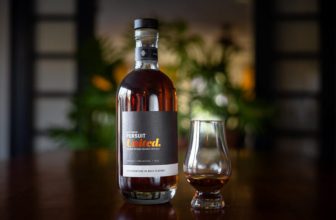
Auchentoshan, founded in 1823, is situated on the outskirts of Glasgow. Pronounced “ock-un-tosh-un” (helpfully spelled out for everyone on both the packaging and the website!), the name means “corner of the field”. The distillery proudly embraces its name with the playful declaration that it’s “challenging to say, easy to drink”.
Interestingly, whisky production at Auchentoshan was halted during World War II due to air raids which targeted the River Clyde and Glasgow shipyards. An air raid at the time actually resulted in some damage to the distillery, destroying one of its warehouses. Distilling recommenced around 1948, after the war ended and the distillery had recovered.
It used to be the case that when I went looking for a whisky from the Lowlands of Scotland, something from Auchentoshan was all I could reliably find. That’s now changing a little. This is possibly because there are more distilleries opening (or reopening), or perhaps it’s because a greater global demand for whisky in general has resulted in a wider variety of whisky making its way around the world.
At one time I was specifically seeking out different whiskies from each of Scotland’s whisky-producing regions, as I’d heard that each region has its own distinctive style or flavour profile. I was intrigued by this, and wanted to taste an example (or three) from each.
Technically, Scotland has five officially recognised whisky regions: the Highlands, Speyside, the Lowlands, Campbeltown, and Islay. However, you’ll often hear people refer to a sixth region, the Islands. This is not yet an officially recognised region, and at present is actually part of the Highlands. But there are calls for the Islands to be recognised as a distinct whisky-making region in its own right as it’s been argued that there are enough notable differences in flavour profile when it comes to Island whiskies. Whether or not this is true is genuinely an interesting question.
To some extent, knowing the region in Scotland that a whisky comes from can provide some idea of what that whisky may taste like. For example, Islay whiskies are typically peaty and smoky, while Speyside malts tend to be fruity and sweet. However, it’s increasingly the case that one can be less and less confident about making judgements on what a whisky will taste like based on knowledge about the region it hails from.
With the growing demand for whisky, many distilleries are experimenting in all sorts of ways. As a result, there are always exceptions to what is regarded as typical or characteristic of any given region. With that in mind, anything you know about the whisky-making regions of Scotland should only be regarded as a rough guide on what you might expect from a whisky, rather than any kind of guarantee.
It seems possible that there may well be so many distilleries producing a range of ‘exceptions’ in the future that any talk of whisky regions will be rendered obsolete. But, for now at least, knowing something about each region can still be somewhat useful when you’re deciding what whisky you might like to try next.
For what it’s worth, Lowland whiskies are typically said to be fairly light and gentle, and usually unpeated. Given this, they’re often seen as a great place to start for those who are new to Scotch (although exceptions like the heavily peated single malt from Ailsa Bay challenge this generalisation).
While most Scotch is double-distilled, Auchentoshan triple-distils all its whisky. This extra distillation results in a lighter, cleaner spirit which is often compared to Irish whiskey (as Irish whiskey is famously associated with triple-distillation). Whether or not this counts as a plus will come down to personal preference. Apparently, triple-distillation was historically the norm for Lowland whiskies, but it seems as though only Auchentoshan is keeping up this tradition across its range. I’ve even heard Auchentoshan jokingly referred to as a “breakfast whisky” because of how smooth and easy-drinking it is.
Auchentoshan American Oak is a no-age-statement (NAS) single malt that’s been aged exclusively in a combination of first and second-fill ex-bourbon barrels. It’s officially bottled at 40% ABV, which adds to the pre-existing reputation for approachability.
Available for around $30 (similar to the price of a bottle of Tamnavulin Sherry Cask), it’s also very affordable. Even though I am now more readily able to find some other Lowland whiskies, Auchentoshan American Oak remains the most budget-friendly option I’ve come across. That said, their 12-year-old expression is only slightly more expensive (usually available for around $35, which is roughly the same price as a bottle of Glen Grant 10), and offers a different flavour profile thanks to its combination of ex-bourbon and ex-sherry cask maturation. For just a fraction more, it might just be the better buy.
Auchentoshan American Oak – Review
Colour: Deep gold.
On the nose: Notes of vanilla and soft toffees emerge first. There’s a grassy note, something like hay. A faint tropical edge appears in the form of coconut, followed by citrus – perhaps grapefruit, orange zest, or some candied orange peel. There’s a floral sweetness that brings to mind rose-flavoured Turkish delight, and a touch of macadamia nut nougat. In the background, I detect a slightly herbal and medicinal note – subtle, but reminiscent of cough syrup.
In the mouth: Soft and fairly light in texture. There’s an immediate sweetness of vanilla, caramel, and some soft oak spice. However, it’s less sweet than the nose led me to expect. A slightly bitter edge comes through, balanced by a delicate herbal, liquorice note. The texture remains light, with a faintly drying, tannic quality toward the finish.
Conclusion:
Auchentoshan American Oak is enjoyable enough and an easy-drinking whisky. I haven’t tried it with breakfast (yet), but it certainly works well as an after-dinner dram or dessert whisky.
It’s not the most complex whisky I’ve tasted. I enjoyed the variety of aromas on the nose, but the palate seemed to me to have a little less to offer. It would not be my first pick if I was in the mood for real depth or nuance. Still, I think this would be a good introduction for those new to whisky – especially considering the price. It might also appeal to those who enjoy Irish whiskey, and could even convert someone who is a stalwart fan of Irish whiskey to Scotch.