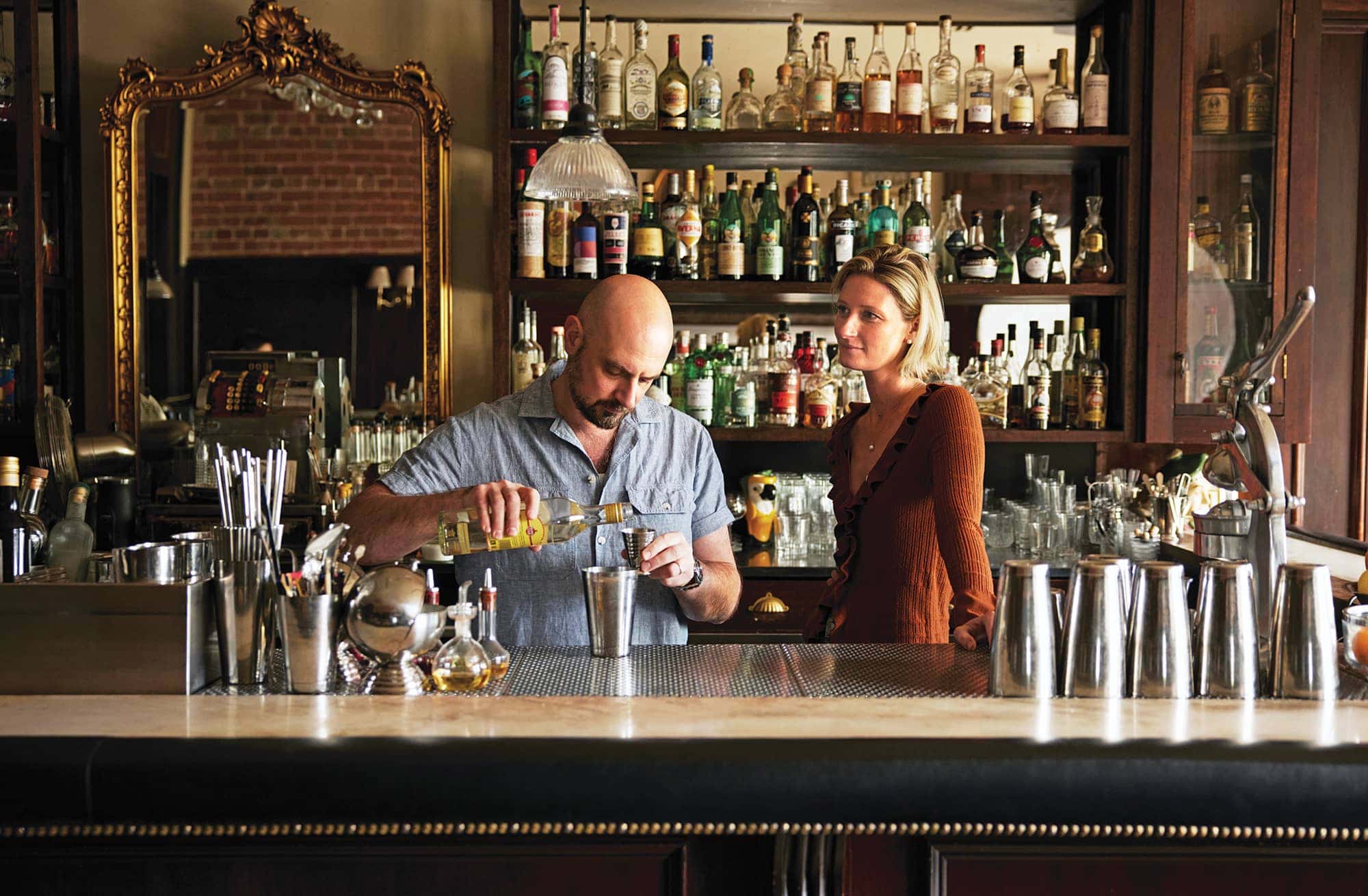
No one can memorize thousands of recipes or synthesize centuries of cocktail history overnight. That’s why Michael and Zara Madrusan culled more than 25 years of experience at some of the world’s most esteemed bars to create The Madrusan Cocktail Companion. Their ambitious and comprehensive book features more than 2,800 drinks, and makes sense of that bounty thanks to a system of cocktail “branches” that Michael began while working at the legendary New York City cocktail institution Milk & Honey. With insights and recipes from industry luminaries like Alex Day of Death & Co, Speed Rack creator Lynnette Marrero, and more, the book serves as a roadmap to the origins and evolution of modern cocktail culture. We caught up with the Madrusans to discuss how those heady years at the dawn of the 21st century shaped the drinks landscape for decades to come.
Imbibe: There are thousands of cocktail recipes divided into branches in this book. How does the system work?
Zara: It’s similar to the idea of a mother cocktail: the simplest formulation of a well-known drink that a number of other drinks are based on. It’s a step-by-step understanding of how cocktails fit together. When bartenders see how many drinks are riffing off of other drinks—these are five riffs on a Manhattan, or these are five Collins variations—it blows their minds. It’s incredible in terms of training and understanding drinks from a technical perspective, but it’s also very useful as a consumer or bargoer. If you know that you love a Whiskey Sour, when you navigate through the branches, you learn a clear explanation of what that drink is and the different drinks and styles of drinks that are related to it. And then you can start hopping into other branches and draw ties between, say, your Whiskey Sour and all sorts of Fizzes. Education is a massive pillar for us. Whether you’re an enthusiast or a professional, being able to draw those ties gives you a bit more understanding about what it is you’re enjoying or connecting with. I think it just lights a little fire in you to learn more.
How do you approach cocktails that might cross several branches or don’t fit neatly into one category?
Zara: That’s why the ‘By Popular Demand’ section of the book was really important to us. Sometimes, people are just looking for a drink with coffee. Or they want a tropical-style drink. If that’s how you’re going to navigate the book, we want you to be able to find what you’re looking for really easily. We don’t want to hide it in some obscure style or a branch of cocktails you’ve never heard of.
Defining the branches is an ongoing process, too. New drink styles are evolving all the time. I hope we get to do a second edition [of the book] one day. I would imagine the branches may even look a little bit different then.
Do you think industry professionals and home bartenders will use The Madrusan Cocktail Companion differently?
Zara: It’s pretty universal. In one way, it’s speaking to the industry because it’s along the lines of the same thing we would use in a bar. But it’s also geared toward enthusiasts, to anyone who is curious about drinks, because the language and the format are very approachable. I love the idea that people can use this book with some kind of interest in what they already drink, but then they’re also able to use it to get deeper into drinks and discover things that they’ve never tried before.
Michael, you worked at Milk & Honey right as the craft cocktail movement was getting started, in early 21st-century New York City. Can you describe what that time period was like?
Michael: It was such an exciting time. There was so much exploration. When I joined Milk & Honey, there was only a small group of bars—in New York or anywhere—that cared deeply about quality ingredients and classic cocktails. The internet wasn’t what it is today. The access to all the recipes and the information wasn’t anywhere near what it is today. When you’d find something, you’d tell everyone about it—like, ‘Oh my god, I don’t believe it, I just got a soft copy edition of Embury!’ You can find that everywhere now, but at the time, you’d bring it to that person’s bar, and it was almost like they’d put white gloves on to touch it. The excitement around classic cocktails and exploring these books was all really romantic. I’m so happy to have been a part of that.
How did that shape the service at craft cocktail bars?
Michael: When I think about the service model at Milk & Honey, and then at The Everleigh, especially with something like Bartender’s Choice [where guests provide their preferred spirits or flavors and let the bartender create their drink], it’s not about showing somebody how much you know. It’s about showing somebody how much you care. That’s a really big takeaway from the book, too. We have a whole section on how to be a bartender and what hospitality really looks like.
Drinks that we now consider modern classics, like the Paper Plane or Naked & Famous, came out of that time period. What was that process like?
Michael: At that time, especially in New York, there was a lot of room for experimentation. Places like Death & Co and PDT really took it to the next level. They took the classics and ran with them. It’s through the understanding of those classic drinks that you get to tweak them. When you do it in a clever way, and the timing is right, and flavors are of interest to the consumer, that’s when those things tend to really fly. It’s amazing how they capture a moment in time. When the right drink comes along, and it seizes the moment and the exact spec comes together, it’s like you’re lighting a fire.
What are some of the other ways those early days in New York City shaped our modern, global cocktail culture?
Michael: You look around today and you can go to a pub down the road and get a great cocktail. Back then, it was just a small group of people who wanted to do great things with drinks. We were really excited about telling everyone. The network of people in cocktails was a lot smaller, everybody communicated a lot less, and there was so much support for one another. You were excited to be lifting up your peers, not chopping anyone down.
And that small network really branched out. Enzo [Errico] went to do his own thing in Ischia, off the coast of Naples. Chad [Solomon] and Christy Pope went down to Texas to do Midnight Rambler, and they were really instrumental in the low-and-slow movement and creating Cooper Spirits as well. You have Sam Ross, who is probably the most prolific of all of us. Alex Day was working with us for a bit, but he couldn’t get enough shifts, and that’s why he ended up going to Death & Co. Richard Boccato and I started about the same time, and then he went up to do Dutch Kills [in Queens] and Hundredweight Ice. Eric Alperin went to Little Branch and then he did The Varnish in Los Angeles. There are so many names and so many great venues that came out of that time period in New York. When we opened The Everleigh [in 2011], Sasha [Petraske] was pretty excited. We were all spreading our wings as a family … and the tree just keeps on growing, which is really cool.