If you’ve ever encountered pesky carpenter ants, you might be wondering, “Do carpenter ants bite?” This question often arises when people experience an ant infestation or have had a close encounter with these insects. While many ant species can pose risks to humans, carpenter ants are generally not considered dangerous. They do not sting and are not known for aggressive behavior.
Carpenter ants are more likely to pose a threat to your property than your body and can even inflict massive structural damage onto your home over time. Even though carpenter ants can technically bite, these instances are really rare. Usually carpenter ants only bite when they believe their is a threat to their nest, purely in self defense. Their biting is a reaction to danger more than a true act of aggression.
How aggressive are carpenter ants?
Because carpenter ants are not particularly aggressive and usually bite only in self-defense or when their nest is disturbed, they prefer to avoid confrontation and will only attack if they feel threatened. While their bites can be painful due to their strong mandibles, carpenter ants do not have venom like many other insects and and prefer to avoid interactions with humans unless provoked.
What do carpenter ants look like?
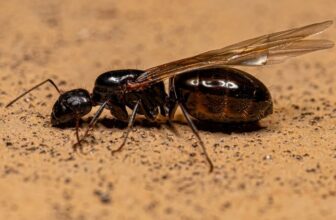
Carpenter ants are large, typically black or dark-colored ants that get their name from their habit of excavating wood to build their nests. These ants don’t eat wood like termites do; instead, they create smooth tunnels and galleries within wooden structures. These ants are very common and are the largest ant species in North America, with workers ranging from 6 to 12 mm in length.
Here are some specific characteristics of carpenter ants:
- They have one node (petiole) and a thorax (area behind the head) that is evenly rounded when viewed from the side.
- Carpenter ant workers are black or red and black
- Some carpenter ants have wings, but not all. Queens and reproductive males have wings, but workers do not

What does a carpenter ant bite look like on a human?
Although uncommon, when a carpenter ant does bite, it typically leaves a small, red mark on the skin. The bite may appear as a small puncture wound or a slightly raised bump. In most cases, the bite site is similar to that of other common ant species. However, carpenter ant bites are relatively rare compared to bites from other ants. Fire ants, for instance, can bite and sting humans and result in much more severe symptoms.
Do carpenter ant bites hurt?
Carpenter ant bites can cause a brief, sharp pain at the moment of the bite, but this pain is usually mild and short-lived. Instead of injecting venom, carpenter ants may spray formic acid into the bite, which can cause a burning sensation. For most people, the discomfort from a carpenter ant bite goes away quickly and doesn’t leave any lasting effects. If you have any additional questions or concerns about ant bites, be sure to contact poison control.
What other types of damage do carpenter ants inflict?
Do carpenter ants bite? Yes, but while carpenter ants may not pose a significant threat to humans with their bites, they can cause serious damage to wooden structures in and around your home. Carpenter ant damage can be extensive and there are clear signs to watch out for:
-
Hollow Spaces Within Wooden Structures
- If you knock on wood with a hammer or screwdriver and it sounds hollow, this could indicate that carpenter ants have hollowed out the interior to create their nests. These ants prefer moist or decaying wood and will excavate it to form smooth galleries, leaving the outer surface intact while compromising the wood’s structural integrity.
-
Visible Sawdust-Like Material (Frass) Near Wooden Areas
- Carpenter ants expel sawdust-like material, known as frass, from the wood they have hollowed out to keep their galleries clean. If you notice unexpected piles of sawdust around your home, it could be a sign that carpenter ants are nesting nearby and actively excavating wood to expand their colonies.
-
Smooth Tunnels and Galleries Within Wooden Structures
- If you can physically see smooth tunnels within wooden structures, this is a telltale sign of carpenter ant activity. Unlike termites, which create rough, mud-lined tunnels, carpenter ants produce clean, sandpaper-like galleries that follow the wood grain, indicating their presence and nesting habits.
-
Warped or Sagging Floors from Carpenter Ant Damage
- Over time, carpenter ants can cause significant structural damage to your home. Warped or sagging floors can be an indicator of severe infestation, as the ants weaken the wood by creating extensive networks of tunnels, compromising the overall stability and safety of the affected area. If you observe these signs, it’s crucial to address the issue promptly to prevent further damage.
How do you get rid of carpenter ants?
There are many preventative measures to help keep carpenter ants at bay including addressing moisture issues quickly, sealing entry points, and remove decaying wood from around your home.
There are also some DIY remedies but over-the-counter carpenter ant sprays can actually make the problem worse and are not effective for removing carpenter ants. Over the counter sprays often end up alerting ants to move to different areas of the homes, creating satellite colonies.
The best way to handle carpenter ants is to contact pest control professionals.
Speak to the carpenter ant experts in Upstate New York and Vermont
So, do carpenter ants bite? Yes, but their bites are uncommon much less severe than that of other ant species. The biggest threat of a carpenter ant infestation is their potential for structural damage. Contact the pros today for carpenter and detection and extermination in order to prevent damage and ensure the safety of your living space.
For additional guidance on how to prevent carpenter ant damage, contact Nature’s Way Pest Control and get a free inspection by a professional exterminator. Please call 518-745-5958 for services in Albany, Glens Falls, Saratoga, or as far north as Plattsburgh, NY. For experts in Rutland, Burlington, and western Vermont, call 802-855-2978.