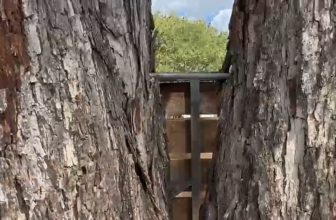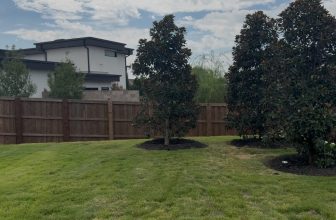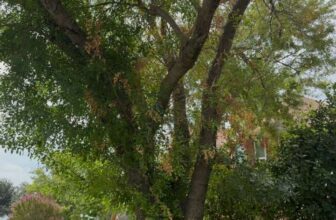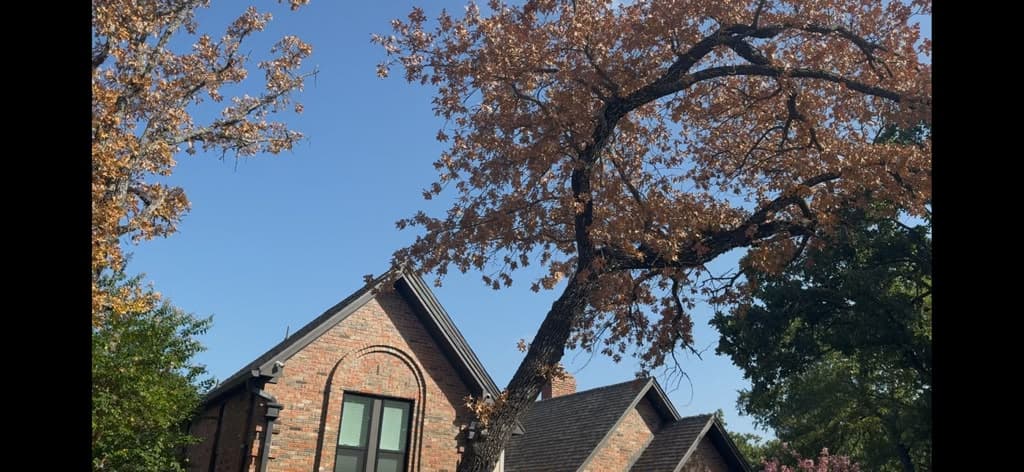
Today we’re here in Southlake, Texas, inspecting several mature Savannah Post Oaks (Quercus stellata) that are showing significant signs of environmental stress. These trees are experiencing premature foliage loss, thinning canopies, necrotic tissue, and reduced vigor during one of the most demanding periods of the North Texas growing season.
As I evaluated the property, the primary concern became clear: these trees are receiving more moisture than their root systems can safely tolerate.
Savannah Post Oaks naturally perform best in relatively dry, well-drained upland soils. They are remarkably resilient when their native growing conditions remain stable, but they do not adapt well to chronic irrigation, standing water, buried root flares, or turfgrass growing directly against the trunk. Post Oaks are commonly associated with dry upland habitats and coarse-textured soils rather than continuously saturated landscapes.
One of the biggest misconceptions homeowners have is believing that more water automatically means healthier trees.
That is not true.
A mature tree requires the correct balance of water and oxygen. When the soil remains saturated for too long, water occupies the pore spaces that should contain air. Oxygen movement into the soil declines, root respiration slows, and the absorbing roots begin losing their ability to function.
This condition is called root-zone hypoxia.
For a Savannah Post Oak, prolonged hypoxia can begin a cascading decline that eventually leads to root mortality, premature leaf cast, canopy thinning, vascular dysfunction, and complete tree loss.
Why Oversaturation Is Dangerous for Savannah Post Oaks
Savannah Post Oaks are adapted to sites where excess moisture can drain away from the root system. They may tolerate occasional heavy rainfall, but they are not designed to remain in waterlogged soil for prolonged periods.
The roots of every living tree perform cellular respiration continuously. During respiration, roots use oxygen to convert stored carbohydrates into usable energy.
That energy powers:
- Water absorption
- Nutrient uptake
- Root elongation
- Cell division
- Defense responses
- New foliage production
When irrigation repeatedly saturates the soil, oxygen diffusion slows dramatically.
The roots may be surrounded by water, yet they become physiologically unable to use that water efficiently. The tree begins experiencing a condition that looks similar to drought stress above ground, even though the soil may be wet below ground.
That is why overwatered trees can exhibit:
- Wilting foliage
- Yellowing leaves
- Premature leaf drop
- Necrotic leaf margins
- Sparse canopy development
- Branch dieback
- Reduced terminal growth
The problem is not always a lack of water.
Sometimes the problem is that the roots are suffocating.
What Root-Zone Hypoxia Does Inside the Tree
The vascular system of a Savannah Post Oak depends upon healthy roots.
The xylem transports water and dissolved minerals upward into the canopy. The phloem transports carbohydrates produced by the foliage to the trunk, branches, and roots.
When oxygen-deprived roots begin declining, water absorption becomes less efficient. The canopy continues losing moisture through transpiration, especially during temperatures above 100°F, but the root system can no longer replace that moisture fast enough.
This creates a hydraulic imbalance.
The Tree Begins Reducing Its Canopy
One of the tree’s first survival responses is premature leaf cast.
Every leaf requires water and vascular support. When the tree cannot support the full canopy, it may begin sacrificing foliage to reduce transpiration demand.
Dropping leaves can temporarily help the tree conserve water, but it creates another major problem.
Leaves manufacture carbohydrates through photosynthesis.
When foliage is lost:
-Photosynthesis declines
Why Mulch Is Better Than Grass Around a Post Oak
One of the simplest improvements homeowners can make is replacing turfgrass with a properly mulched root zone.
I typically recommend applying approximately 3 inches of long-fiber hardwood mulch around the tree while keeping the mulch pulled several inches away from the trunk itself.
Mulch provides several important benefits.
It helps:
- Moderate soil temperatures
- Reduce evaporation
- Improve soil biology
- Increase organic matter
- Improve oxygen movement into the upper soil profile
- Reduce competition from turfgrass
As mulch slowly decomposes, it also contributes organic carbon to the soil, supporting beneficial microorganisms that improve nutrient cycling and root health.
Unlike decorative rock, mulch insulates the soil rather than storing excessive heat.
That difference becomes extremely important during North Texas summers.
⸻
Why Decorative Rock Can Increase Heat Stress
During many of my inspections throughout Southlake and the Dallas–Fort Worth Metroplex, I frequently find mature Post Oaks surrounded by decorative stone.
Although attractive from a landscaping standpoint, decorative rock creates an entirely different soil environment than natural woodland conditions.
Stone absorbs solar radiation throughout the day.
As air temperatures climb above 100°F, the rock itself often becomes considerably hotter.
That stored heat is then radiated downward into the root zone and upward around the lower canopy.
The result is additional thermal stress placed on already stressed roots.
When excessive heat combines with saturated soil, the tree faces two physiological challenges simultaneously.
The roots are struggling to obtain oxygen.
The canopy is demanding more water because of the heat.
This imbalance often accelerates decline.
⸻
Point Irrigation Toward the Soil — Not the Trunk
Another issue I commonly observe is irrigation systems spraying directly against the trunk and root flare.
Tree bark is designed to protect the vascular tissues beneath it.
It is not designed to remain wet day after day.
Constant irrigation against the trunk creates unnecessary moisture around the root collar while increasing conditions favorable for fungal organisms and bark deterioration.
The irrigation heads should always be adjusted so water is directed toward the surrounding root zone rather than directly onto the trunk.
The objective is watering the soil—not the bark.
Simple irrigation adjustments often eliminate one of the major stress factors affecting mature Post Oaks.
⸻
Savannah Post Oaks Prefer Slightly Acidic Soil
Another important characteristic of Savannah Post Oaks is their preference for slightly acidic soils.
When soil pH gradually becomes more alkaline, several micronutrients become less available to the tree.
Even when nutrients are present in the soil, elevated pH can reduce the tree’s ability to absorb:
Reduced nutrient availability weakens chlorophyll production, slows photosynthesis, and gradually reduces carbohydrate production.
Healthy soil chemistry is just as important as proper irrigation.
The objective is maintaining an environment where both roots and beneficial soil microorganisms can function efficiently.
⸻
Our Plant Healthcare Program
Following my inspection, I recommended a comprehensive Plant Healthcare Program focused on reducing environmental stress rather than simply treating symptoms.
The treatment program includes:
- Seaweed kelp applications
- Humic acid soil conditioning
- Carbohydrate supplementation
- Micronutrient applications
- Proper irrigation management
- Root-zone monitoring
- Turf removal around the root flare
- Hardwood mulch installation
Each component addresses a different aspect of tree physiology.
Together they improve root function, support photosynthesis, rebuild carbohydrate reserves, and reduce long-term stress.
Our objective is restoring the environment before permanent decline occurs.
⸻
Hypoxylon Canker — The Final Stage of Decline
One of the diseases homeowners frequently notice on declining Post Oaks is Hypoxylon canker, primarily associated with Biscogniauxia atropunctata.
Many people assume the fungus killed the tree.
Most of the time, that is not the case.
Hypoxylon is generally an opportunistic fungus.
It attacks trees that have already become severely weakened.
The sequence usually looks like this:
- Chronic oversaturation
- Root-zone hypoxia
- Reduced root function
- Carbohydrate depletion
- Canopy thinning
- Progressive decline
- Tree mortality
- Hypoxylon colonization
By the time gray or black fungal mats appear beneath sloughing bark, the tree has often already experienced catastrophic internal decline.
The fungus is usually the final chapter—not the first.
That is why correcting environmental stress early is one of the most effective ways to reduce the likelihood of Hypoxylon becoming established.
⸻
Final Thoughts
The Savannah Post Oaks we inspected in Southlake are reminding us that healthy trees depend on balance.
Too much water can be just as damaging as too little.
Roots require oxygen just as much as they require moisture.
Allowing turfgrass to grow directly against the root flare, covering the landscape with decorative rock, directing irrigation toward the trunk, and maintaining chronically saturated soil all contribute to unnecessary physiological stress.
When that stress continues long enough, the vascular system begins shutting down.
Leaves are shed prematurely.
Carbohydrate reserves become depleted.
Eventually the tree reaches a point where recovery becomes extremely difficult, and opportunistic diseases such as Hypoxylon canker begin appearing.
At Arborist USA, our focus is identifying these environmental problems before they become irreversible.
By improving root-zone conditions, correcting irrigation practices, restoring proper soil biology, and implementing a science-based Plant Healthcare Program, many mature Savannah Post Oaks can continue providing shade and beauty for decades to come.
For general tree-care best practices, homeowners can also reference guidance from the Texas A&M Forest Service, https://tfsweb.tamu.edu/trees/, a trusted authority on Texas tree health.
Schedule a professional inspection. Early detection and scientific intervention are the difference between preservation and loss. If you’d like to speak to an arborist, please call us at 817-880-6130 or visit https://www.arboristusa.com/
Today we’re in Southlake, Texas inspecting several mature Savannah Post Oaks (Quercus stellata) that are exhibiting significant environmental stress caused by oversaturated soils, excessive summer heat, and poor landscape practices.
During our inspection, we found premature leaf drop, necrotic foliage, canopy thinning, and signs of vascular decline. While many homeowners immediately assume these trees are suffering from disease, the real problem often begins much deeper—in the root system.
One of the biggest contributors to decline is root-zone hypoxia.
Healthy tree roots require both water and oxygen. When soils remain saturated for extended periods, water fills the air spaces within the soil profile, reducing oxygen availability and slowing root respiration. Without oxygen, roots cannot efficiently absorb water or nutrients, even though moisture may be abundant.
This creates a dangerous physiological imbalance.