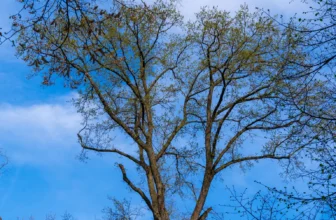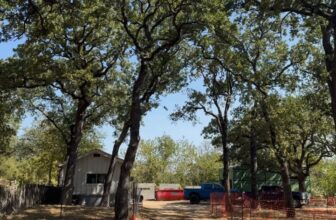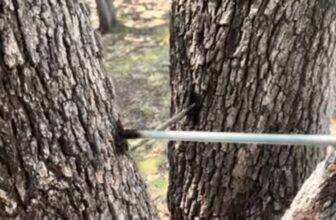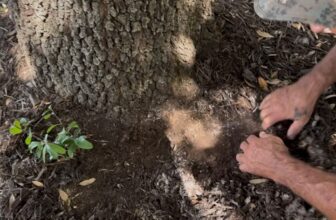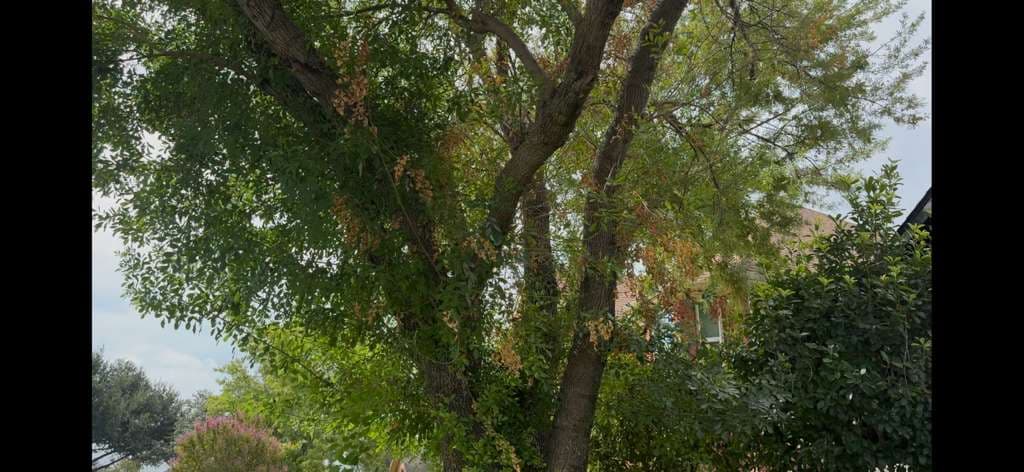
Today we’re here in Keller, Texas, inspecting a mature Ash tree that is showing significant signs of environmental stress during an extremely difficult North Texas summer.
We’ve been experiencing prolonged temperatures ranging from approximately 105°F to 110°F, combined with drought conditions and extremely high atmospheric demand for moisture. Under these conditions, trees can lose tremendous amounts of water through transpiration while the soil becomes progressively drier.
During my inspection, I observed several concerns.
There is significant dead tissue developing along two major stems. The canopy is losing foliage, soil compaction is present around the root system, turfgrass has been allowed to grow directly against the root flare, and I observed a small fungal conk near the root zone on the south side of the tree.
Another important observation is the enormous amount of reproductive growth occurring throughout the canopy.
This Ash is covered with samaras—the characteristic single-winged fruit produced by Ash trees.
Producing this reproductive crop requires resources. At the same time, drought stress and premature foliage loss are reducing the tree’s ability to manufacture carbohydrates through photosynthesis.
We’re essentially watching a tree attempting to support reproduction, maintain its root system, defend itself, and survive extreme heat while its photosynthetic capacity is being reduced.
This is exactly when environmental stress can begin developing into progressive canopy decline.
What Happens to a Tree During Extreme Drought?
Trees operate through a continuous relationship between the soil, roots, vascular system, leaves, and atmosphere.
Water enters the absorbing root system and moves into the xylem, where it is transported upward through the tree.
Once that water reaches the foliage, a portion eventually exits through microscopic openings called stomata during transpiration.
Under moderate conditions, the root system can generally replace much of the water being lost from the canopy.
But when temperatures reach 105°F to 110°F, the atmospheric demand for moisture can become tremendous.
The tree begins losing water faster.
Meanwhile, drought reduces the amount of available soil moisture.
The tree becomes caught between two extremes:
Increasing atmospheric demand above ground and decreasing water availability below ground.
Understanding Permanent Wilting Point
As soil dries, water becomes increasingly difficult for roots to extract.
Not all water present in soil is actually available to the tree.
As moisture levels continue declining, the remaining water becomes held increasingly tightly to soil particles.
Eventually the tree can approach what soil scientists call the permanent wilting point.
At this stage, the soil-water potential becomes so low that the plant can no longer extract sufficient water to maintain normal physiological function.
The tree begins wilting.
Stomata close.
Photosynthesis decreases.
Growth slows.
Leaves may scorch or become necrotic.
Premature leaf drop can begin.
If drought continues long enough, portions of the canopy can die.
Why Closing the Stomata Creates Another Problem
Closing stomata is one of the tree’s most important drought-defense mechanisms.
It reduces water loss.
But there is a tradeoff.
Stomata are also the openings through which carbon dioxide enters the leaf.
Carbon dioxide is necessary for photosynthesis.
When stomata remain closed for prolonged periods, carbon assimilation declines.
That means carbohydrate production also decreases.
The tree saves water, but it simultaneously reduces its ability to manufacture food.
This is one of the fundamental physiological conflicts trees experience during severe drought.
Carbohydrates Are the Tree’s Energy Reserve
Carbohydrates produced through photosynthesis support virtually every living part of the tree.
They are needed for:
- Root respiration
- New root development
- Defense responses
- New foliage
- Wound compartmentalization
- Vascular maintenance
- Reproductive growth
- Future bud development
When drought reduces photosynthesis, the tree increasingly relies on previously stored carbohydrate reserves.
Those reserves are finite.
If environmental stress continues long enough, the tree can eventually consume energy faster than the remaining foliage can replace it.
Heavy Samara Production Adds Another Demand
One of the most interesting observations on this Keller Ash is the tremendous quantity of samaras throughout the canopy.
Samaras are the winged fruits containing the seeds of Ash trees.
Fruit and seed production require carbon, mineral nutrients, water, and metabolic energy.
Under normal circumstances, reproduction is simply part of the tree’s biological cycle.
The concern here is the timing.
This tree is simultaneously dealing with:
- Extreme heat
- Drought
- Canopy loss
- Dead tissue
- Soil compaction
- Turf competition
- Reduced photosynthesis
At the same time, it has allocated resources toward a substantial reproductive crop.
I would not say the samaras themselves are causing the decline. Instead, they represent another carbon and resource demand occurring while the tree is already operating under a significant environmental deficit.
Premature Leaf Loss Reduces the Tree’s Food-Producing Capacity
The foliage is the tree’s solar-powered carbohydrate factory.
When drought causes premature leaf loss, the tree loses part of that factory.
Less foliage means:
Less photosynthesis.
Less photosynthesis means:
Less carbohydrate production.
And reduced carbohydrate production means fewer resources available for roots, defense, recovery, and future canopy development.
This can create a feedback loop.
Drought damages roots and foliage.
Photosynthesis declines.
Carbohydrates decline.
Root growth decreases.
The weakened root system becomes even less capable of supporting the canopy.
The environmental stress begins compounding.
Soil Compaction Makes Drought Stress Worse
During my inspection, soil compaction was another obvious concern.
Compacted soil contains reduced macropore space.
Those larger pores are important for:
- Oxygen diffusion
- Water infiltration
- Drainage
- Root elongation
- Biological activity
A drought-stressed tree needs an efficient root system.
Compacted soil makes that job more difficult.
Rainfall or irrigation may run across the surface instead of infiltrating effectively.
Roots encounter greater physical resistance.
Gas exchange becomes less efficient.
This means the tree can experience significant drought stress even when homeowners believe they are providing adequate irrigation.
The problem isn’t always how much water is applied.
Sometimes the problem is whether the soil can accept that water and whether healthy roots exist where that water is being delivered.
Turfgrass Should Not Be Growing Against the Root Flare
Another cultural condition we need to correct is turfgrass growing directly against the root flare.
Grass and trees compete for the same basic resources.
Water.
Nutrients.
Oxygen.
Rooting space.
During a severe drought, that competition becomes even more important.
My recommendation is to remove the turfgrass from around the root flare and establish a broad organic mulch zone.
The mulch should extend outward rather than being piled upward against the trunk.
Approximately 2 to 4 inches of coarse organic mulch can help moderate soil temperatures, reduce evaporation, protect soil structure, and eliminate direct turf competition.
The natural root flare should remain visible.
The Small Conk Requires Continued Investigation
Another finding that deserves attention is the small fungal conk located near the south-side root system.
A conk is the fruiting structure of a fungus.
Its presence tells us fungal activity is occurring, but the conk alone does not tell us how much structural wood has been affected or whether the fungus is responsible for the overall canopy decline.
That distinction is extremely important.
The fruiting body should be identified and the surrounding root flare and structural roots evaluated before making conclusions about decay or structural stability.
Because this tree already has significant environmental stress and dead tissue, I would document the conk and continue monitoring the area carefully.
If additional fungal fruiting structures develop, basal decay becomes apparent, or changes occur around the root plate, further investigation may be warranted.
Why We Shouldn’t Automatically Reach for High Nitrogen
A common reaction to a thinning canopy is:
“Let’s fertilize the tree.”
But forcing rapid shoot growth during extreme drought can be counterproductive.
The tree is already struggling to supply water to its existing canopy.
Aggressively stimulating additional shoot growth can increase demand on a compromised root system.
Our objective is not forcing the tree to grow faster.
Our objective is helping the tree stabilize.
This is why the treatment program should focus first on the soil environment, moisture management, root health, and cultural conditions.
Our Treatment Plan Begins With Soil Cultures and Soil Biology
Our Plant Healthcare strategy for this Ash begins underground.
We’re focusing on soil cultures and biological soil support designed to improve the environment surrounding the remaining functional root system.
The objective is supporting:
- Soil biological activity
- Organic matter cycling
- Root-zone conditions
- Moisture management
- Nutrient availability
- Long-term root recovery
This is not about forcing an immediate flush of artificial growth.
We’re trying to create an environment where the tree can gradually restore physiological balance.
Healthy soil supports healthy roots.
Healthy roots support healthy foliage.
Healthy foliage rebuilds carbohydrates.
Irrigation During Extreme Heat Must Be Managed Carefully
During temperatures approaching 110°F, irrigation becomes extremely important.
But irrigation needs to be based on soil moisture, not simply the calendar.
The goal is deep, effective moisture throughout the active root zone without creating chronic saturation.
Slow irrigation allows water to infiltrate rather than running across compacted soil.
The root zone should then be allowed to maintain appropriate oxygen conditions rather than remaining continuously waterlogged.
Trees need both:
Water and oxygen.
Too little water produces drought stress.
Too much water for too long can create root-zone hypoxia.
Successful Plant Healthcare requires finding the balance.
Why Dead Tissue Should Be Removed During Cooler Weather
This tree has significant dead tissue associated with two major stems.
My recommendation is to perform structural pruning during the cooler season, targeting November, when environmental conditions are substantially less stressful than the current 105°F to 110°F summer temperatures.
The objective will be removing confirmed deadwood and structurally compromised tissue while preserving as much healthy living canopy as reasonably possible.
We do not want to aggressively thin a drought-stressed tree.
Every healthy leaf remaining on this Ash is valuable.
Those leaves are producing the carbohydrates the tree needs for recovery.
Structural Pruning Should Have a Defined Objective
When pruning this Ash, our objective isn’t simply making the canopy look cleaner.
We’re trying to:
- Remove confirmed dead tissue
- Reduce unnecessary structural risk
- Preserve healthy foliage
- Maintain natural architecture
- Avoid excessive canopy loss
The tree has already experienced enough environmental stress.
Pruning should reduce problems—not create another one.
Large amounts of healthy foliage should not be removed simply because the tree is being serviced.
Recovery Will Take More Than One Season
One of the most important expectations with drought-stressed mature trees is understanding the timeline.
We aren’t going to reverse months of extreme environmental stress overnight.
The tree needs time to:
- Stabilize its root system
- Maintain remaining foliage
- Rebuild carbohydrate reserves
- Produce new absorbing roots
- Develop next season’s buds
- Replace portions of lost canopy
That process may require multiple growing seasons.
The question is whether the tree begins moving toward recovery once the environmental stresses are reduced.
Annual Monitoring Will Be Important
This Ash should continue to be monitored.
We’ll be watching:
- Canopy density
- New shoot elongation
- Additional deadwood
- Premature leaf loss
- Root flare condition
- Soil moisture
- Soil compaction
- Fungal activity around the root system
- Changes associated with the existing conk
Trees tell us a story over time.
One inspection gives us a snapshot.
Repeated inspections show us the direction the tree is moving.
Final Thoughts
This Ash tree in Keller, Texas demonstrates how severe summer drought can create a cascade of physiological stress.
Temperatures have been reaching approximately 105°F to 110°F.
Soil moisture has declined.
The tree is approaching serious water stress.
Foliage is being lost.
Photosynthesis is declining.
Carbohydrate production is being reduced.
At the same time, the tree has invested substantial resources into producing a heavy crop of samaras.
Soil compaction and turfgrass competition are making the root environment even more challenging.
And the presence of a small fungal conk near the root system gives us another condition that deserves continued investigation.
Our response should not be to force the tree into rapid growth.
Our response should be to reduce stress.
Improve the soil.
Manage water.
Remove turf competition.
Protect the root flare.
Support soil biology.
Preserve healthy foliage.
And perform necessary structural pruning during cooler weather.
At Arborist USA, we don’t simply look at the brown leaves.
We look at the entire biological system.
Because when a tree begins declining during a Texas drought, what you’re seeing in the canopy may only be the final expression of what’s already happening underground.
For general tree-care best practices, homeowners can also reference guidance from the Texas A&M Forest Service, https://tfsweb.tamu.edu/trees/, a trusted authority on Texas tree health.
Schedule a professional inspection. Early detection and scientific intervention are the difference between preservation and loss. If you’d like to speak to an arborist, please call us at 817-880-6130 or visit https://www.arboristusa.com
Today we’re in Keller, Texas, inspecting a mature Ash tree (Fraxinus spp.) experiencing significant drought and heat stress during one of the most demanding periods of the North Texas summer.
We’ve been experiencing temperatures ranging from approximately 105°F to 110°F, combined with drought conditions that are placing tremendous demand on mature trees.
During this inspection, we’re seeing several important symptoms:
- Significant dead tissue on two major stems
- Premature foliage loss
- Reduced canopy density
- Severe environmental heat stress
- Compacted soil around the root system
- Turfgrass growing directly against the root flare
- A small fungal conk near the south-side root system
- Heavy production of single-winged fruits known as samaras
This tree is approaching a critical level of water stress.