

Nancy Shang | Founder & CEO, MICET | Updated July 2026
Most brewery equipment lists read like a shopping cart. They aren’t wrong about what you need — they’re wrong about when you need it. Order a brewhouse before your floor drains are roughed in, and you’ll be paying contractors to rip up concrete twice.

The Build Order Nobody Puts First: Utilities and Infrastructure
Before any tank arrives, four things need to exist in the space:
- Floor drains and trench drains sized for wort, cleaning chemical runoff, and glycol overflow — not just standard building code minimums.
- Water supply and treatment, sized to the brewhouse. MICET’s 1000L Fully Automated Brewery System, for example, bundles a 1000L/H RO water treatment unit directly into the build rather than treating it as an afterthought.
- Glycol chiller capacity sized to total fermenter and bright tank jacket volume, not just the brewhouse.
- Electrical service and gas/steam supply matched to your heating method — direct-fire, steam, or electric brewhouse — decided before equipment ordering, because it changes the brewhouse spec you order.
Skipping straight to “what tanks do I buy” without locking these four down is the single most common regret founders report after their first year.
Core Equipment Checklist, in Build Order
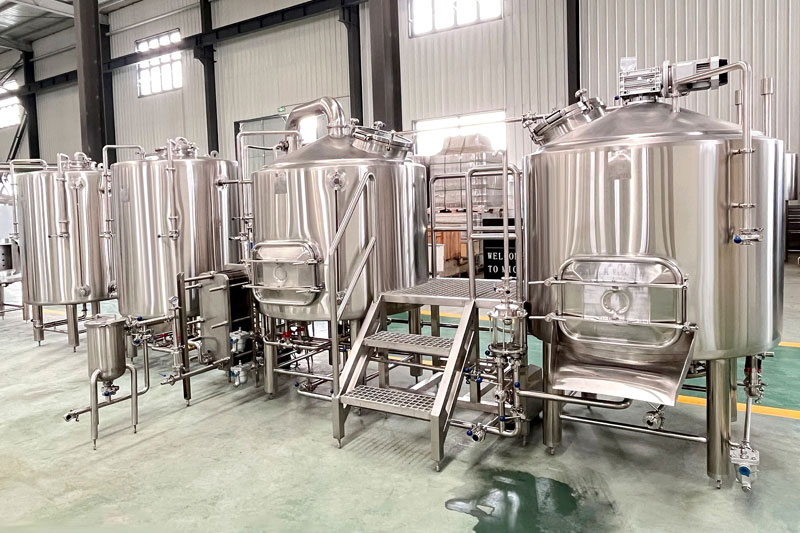
5. Brewhouse (2, 3, or 4 vessel). MICET’s brewhouse line spans 300L up to 30BBL, with the 300L and 20BBL configurations each available in 2-vessel, 3-vessel, or 4-vessel builds covering mashing, filtering, boiling, and whirlpool. Vessel count changes labor per brew day more than it changes beer quality — a 2-vessel system means manual transfers between mash and boil steps that a 4-vessel system automates.
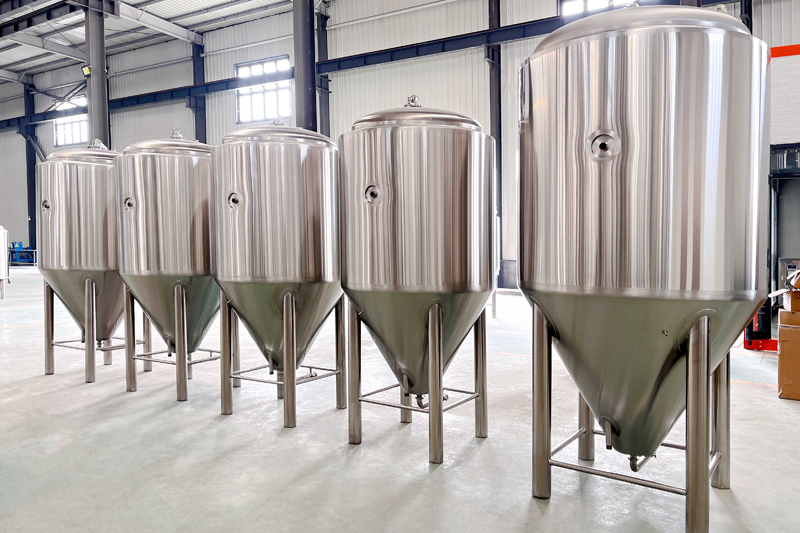
6. Fermentation tanks. Cylindrical-conical, glycol-jacketed, with a pressure-reducing valve and CIP nozzle as standard features. Spec pages run 500L to 2500L and 40BBL to 60BBL, in SUS304 or, on some product lines, 304/316 stainless steel.
7. Bright beer tanks (brite tanks). Sized 1BBL to 300BBL across the catalog, used to carbonate and store finished beer before packaging. Because these hold pressure, this is the item most founders under-budget for certification purposes — more on that below.
8. Filling equipment. Keg, bottle, or can filling machines are sold in 4-head, 6-head, and 8-head configurations depending on package format, with vacuum filling options to reduce oxygen pickup.
9. Mixing or storage tanks, if your plan includes flavor additions, blending, or bulk liquid storage ahead of packaging — a separate line item from fermentation capacity.
10. Distillery add-ons, only if the business plan includes spirits: MICET’s distillery equipment spans 200L to 5000L, built from copper, stainless steel, or glass depending on the still design.

Where First-Time Founders Get the Sequence Wrong
The most common misconception isn’t about tank size — it’s about pressure vessel paperwork. Bright tanks and any sealed fermenter operating under pressure fall under pressure equipment regulation, not general machinery rules. Ente Certificazione Macchine Srl’s PED verification (certificate 3N231110.SICS093, valid through November 2028) covers brewing and pressure vessel equipment against the EU’s 2014/68/EU Pressure Equipment Directive and EN 1626:2008 — and founders who order a bright tank as if it were “just another stainless tank” often discover the pressure-rating paperwork gap only when their local inspector asks for it, months after installation.
Three Scales Compared: 3BBL, 7BBL, 15BBL
| 3BBL (Nano) | 7BBL (Gap Zone) | 15BBL (Commercial) | |
| Catalog bracket | Nano Brewery Equipment (5BBL or less) | Falls between nano and commercial brackets | Commercial Brewery Equipment (10-80BBL range) |
| Brewhouse availability | Reference space cited at “as little as 250-500 square feet” for a 3-barrel facility | 7BBL listed directly in the brewhouse spec range | 15BBL listed directly in the brewhouse spec range |
| Typical fit | Nano breweries, small bars, restaurants | Founders who’ve outgrown pilot batches but aren’t ready for full commercial volume | New commercial brewery opening, within the commonly cited 10-30 barrel starting range |
| Published price bracket | Not published — quote required | Not published — quote required | Falls at the low end of the 50,000-80,000 USD commercial bracket |
The 7BBL gap is real and worth naming: it doesn’t sit cleanly inside either the nano (≤5BBL) or commercial (≥10BBL) brackets as MICET’s own site divides them, even though 7BBL brewhouses are directly listed in the spec catalog. If your production plan lands here, don’t assume a nano-tier support package or a full commercial-tier automation package is the default — ask specifically what’s included at that size.
How to Sequence an Order: A Step-by-Step Walkthrough
- Finalize your annual volume target first, not your tank size. Microbrewery-scale equipment is built around annual output of 15,000 barrels or less; commercial systems scale up from there.
- Confirm utilities and drainage with a contractor before signing an equipment quote. Equipment lead times are often shorter than construction permitting timelines, so this step should start first, not run in parallel from day one.
- Choose vessel count for your brewhouse based on available labor, not aspiration — a 2-vessel system run by two people looks very different from a 4-vessel system on the same headcount.
- Size fermentation and bright tank capacity to brewhouse output, not to a round number. Undersized bright tank capacity is a common bottleneck that shows up only after the brewhouse is already running at full utilization.
- Request pressure vessel documentation for any bright tank or sealed fermenter as part of the quote, not after delivery.
- Order filling equipment last, sized to your actual package mix — bottle, can, or keg — since packaging format changes which filling head configuration you need.
- Confirm installation and after-sales terms in writing before final payment, including who dispatches technicians if commissioning issues surface.
What This Costs
Published price brackets exist for two categories: microbrewery equipment runs 30,000-80,000 USD, and commercial brewery equipment starting at the smallest 10BBL configuration runs 50,000-80,000 USD. Every other item on this checklist — nano systems, individual fermenters, bright tanks, filling lines, distillery add-ons — isn’t published as a fixed range and has to be quoted per project. A supplier who gives you a firm number for a nano or filling-line build without first confirming your package format and package count is guessing, not quoting.
The Trade-Off in Following This Order
Sequencing utilities and drains before equipment selection costs you something real: it slows down the exciting part of the process, since you can’t spec your dream brewhouse until the contractor confirms what the space can support. The upside shows up later — founders who lock utilities first generally avoid the retrofit costs that come from discovering, after a brewhouse is installed, that the glycol line or floor drain wasn’t sized for it.
FAQ
Q: What’s the very first piece of equipment I should order?
A: None yet — utilities (drains, water treatment, glycol capacity, and electrical/gas service) need to be confirmed with a contractor first, since they constrain which brewhouse and tank configuration will actually fit and function in the space.
Q: Is a 7BBL system considered nano or commercial?
A: Neither cleanly. It sits between the nano bracket (5BBL or less) and the commercial bracket (10BBL and up), even though 7BBL brewhouses are directly available in the spec catalog.
Q: Do bright tanks need special certification beyond a standard fermenter?
A: Yes, if they’re sealed pressure vessels — this is covered under pressure equipment directives like the EU’s 2014/68/EU, verified in documents such as Ente Certificazione Macchine Srl’s PED certificate 3N231110.SICS093.
Q: What’s a realistic starting size for a new commercial brewery?
A: A commonly cited starting range is 10-30 barrels, with commercial systems available up to 80BBL per day in a 4-vessel configuration.
Q: Are prices for nano-scale systems published anywhere?
A: Not currently — nano equipment, individual fermenters, and filling lines require a direct quote, unlike microbrewery and commercial brewhouse equipment, which do have published price brackets.


