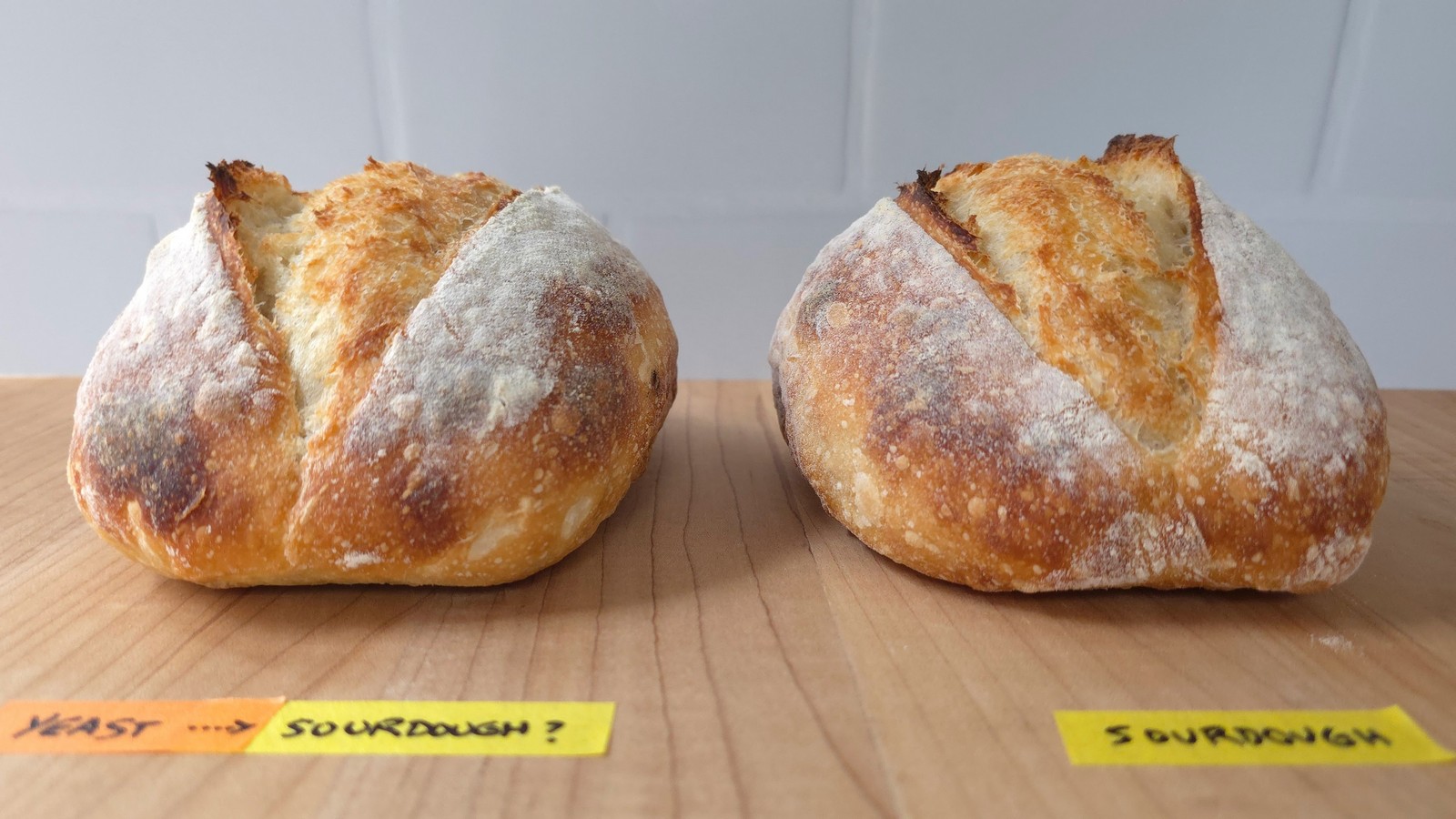
Almost six weeks ago I began an experiment to find out if I could make sourdough starter from instant yeast. Specifically, would a pinch of instant yeast in some flour and water, treated like sourdough starter for several weeks, develop a population of lactobacillus (sourdough bacteria) amid the saccharomyces cerevisiae (yeast)? Would it smell sour and make bread that tastes sour? I called this creation that I seeded with instant yeast my yeast frankenstarter (just “yeast” on the sticker). I alternated between discarding/feeding at peak and refrigerating it for six weeks and never added more instant yeast.
-

- A few grains of yeast

-

- Day 2 (multiple feeds for the yeast)

I also began a new sourdough starter from scratch at the same time because I wanted to compare two new leavens, especially from the standpoint of flavor and pH, rather than compare the yeast frankenstarter with my long established sourdough starter. Without a microbiology lab to identify lactobacillus, my criteria for the yeast mixture becoming sourdough starter were:
• Taking longer to peak and with less volume. For the first few days, the yeast mixture would quadruple within a few hours after a 1:1:1 feeding. Feeding ratio explanation here.
• Smelling sour as opposed to strongly of yeast
• Leavening bread that has a sour tang, and tastes and smells good
• Having a low pH (fortunately, I have access to a pH meter)
I baked bread with the two starters on days 8, 22, and 36. On day 22 I also made an instant yeast bread to help compare flavor and speed of molding.
Sourdough Starter Creation
-

- Day 2-3 false rise on the sourdough (bad smell)

-

- Day 4: yeast in the refrigerator; sourdough with lemon juice

-

- Day 5: yeast still fast to rise after refrigeration but smelling more sour; Sourdough still dormant as pH lowers

-

- Sourdough: small feeds days 5-6. Day 7 rising and smelling good 1:1:1 feeds

The new sourdough starter followed a fairly typical hot-kitchen trajectory and was ready to use on day 8. It had a little rise day 2 that got bigger and yucky smelling by day 3. I added a tsp of lemon juice to lower the pH and did small ratio feeds days 5 and 6. The aroma improved and it smelled good smell and was tripling by day 7. I refrigerated it after a second round of feeding and rising on day 7.
The yeast frankenstarter was super-active off the bat, of course, quadrupling and requiring many low ratio feeds when at room temperature. I refrigerated it on days 3, 6, and 7 to slow it down. It began to smell less yeasty and slightly sour around day 3-4.
On day 8, I fed both starters and made bread with them.
Day 8 Bake #1
Tap on the photos to enlarge. The red tape on the dough bowls indicates original and doubled dough levels.
The yeast frankenstarter dough rose a bit faster than the sourdough starter dough. The bread it produced tasted neutral, neither sour nor strongly of yeast. About three days after sitting on a cutting board under a bowl in my hot kitchen, the yeast frankenstarter bread developed what I initially thought was a type of bacteria growth called rope spoilage because it was thready looking, but there was no dampness nor melon smell to the threads so I later determined it was simply Rhizopus stolonifer aka standard bread mold. This seemed to indicate that the yeast frankenstarter bread had a higher pH than the sourdough bread i.e. less protection from mold.
Days 8-22 Refrigeration and Bake #2
I left both starters in the refrigerator for the next 12 days, pulling them out for a 1:1:1 feeding on Day 21. The yeast frankenstarter and sourdough starter took 3 and 5 hours to double, respectively. I refrigerated them and used them in doughs the next day. I fed, let them expand, and refrigerated them after mixing the doughs. I also made an instant yeast control bread to help assess the mold situation. The yeast frankenstarter dough and sourdough starter dough rose but were both somewhat slack, likely very acidic. I ended their bulk fermentation at only 75% expansion in 3 and 4 hours, respectively. I probably should have refreshed the starters more before baking given their newness.
The sourdough starter and yeast frankenstarter breads were similarly sour and underfermented in flavor. I bagged all of the breads after day one to see which would mold first—my prediction was that it would be the high pH instant yeast bread. Surprisingly, the instant yeast bread and sourdough starter bread molded first, confounding the theory that a higher pH bread molds faster.
-

- Ready to mix three doughs

-

- Underdeveloped starters in middle and right loaves

-

- Significant mold after 4 days on all but yeast frankenstarter

After mixing the three doughs on Day 22, I fed both starters, let them double, and refrigerated them again. The yeast frankenstarter was still doubling a bit faster at this point but smelling as sour as the sourdough starter.
Day 22-35 Refrigeration, pH Testing, More Refrigeration
On Day 27, after 6 days in the refrigerator, I briefly pulled the starters out of the refrigerator to test their pH. The yeast frankenstarter had a pH of 3.77 and the sourdough starter had a pH of 3.59. These pH levels matched the fact that both starters smelled sour and were showing signs of hunger, looking deflated and creamy in texture as opposed to stretchy.
For reference, mature sourdough starter has a pH of 3.7 – 3.9 and a young starter (not yet at peak) has a pH of 4.0 – 4.2 (On pH and Sourdough Breads) or 4.1 – 4.3 (forum post by @leonardo). In contrast a yeast sponge or preferment has a pH of 4.7 – 5.3 (The Role of pH in Bread Baking).
-

- Yeast frankenstarter

-

- Sourdough starter

Day 35-36 Feeding and Bake #3
On day 35, almost two weeks after the last feeding, I pulled the starters out of the refrigerator, gave them 1:1:1 feeds, let them double, and refrigerated them again. The yeast frankenstarter doubled a bit faster and perhaps of equal significance, deflated less during its time in the refrigerator.
The next day, day 36, I fed them again 1:1:1 and when they doubled (not at the same time), I made doughs with them. (As always after mixing dough, I fed each starter again, let them double and refrigerated them.)
Despite different starter ripening time, the doughs had similar length bulk fermentations: 5 hours for the yeast frankenstarter and 5.5 hours for the sourdough starter. Likewise with the final proof; the sourdough starter was a bit faster but the kitchen was running hot by then.
As for flavor, the two breads tasted the same. In a blind taste test, my family could not tell that the slices came from different breads.
Days 37-40 Refrigeration, Feeding, pH Testing
On day 40 of this experiment, I pulled the starters out of the refrigerator, along with my decade-old “established” starter, fed them 1:1:1, and pH tested them when they were a bit more than double in size. The yeast frankenstarter hit this level of expansion first and had a pH of 4.01, followed by my long-established starter fifteen minutes later with a pH of 3.97, and the new sourdough starter after another forty-five minutes with a pH of 3.91.

-

- Yeast frankenstarter 4.01 pH

-

- Established sourdough starter 3.97 pH

-

- Six week old sourdough starter 3.91 pH

Conclusions, Limitations, and Further Study
Based on the fermentation timing and bread flavors of the third bake, as well as the pH levels of the starters, it seem like the yeast frankenstarter contains lactobacillus, though probably not at the same ratio to saccharomyces cerevisiae as the sourdough starter I created at the same time. Without lab testing, I can’t be sure of the species of microbes in the starter. Nonetheless I think it is interesting that in this test case, the mixture did seem to evolve into sourdough starter.
It did feel “easier” to make the starter from instant yeast, though it was not as short of a process as making sourdough starter from scratch. (After many years of making new sourdough starters for experiments, I have a lot of experience in this.) Repeatability is a key question for further study, especially because my feeding and refrigerating strategy of the yeast starter was perhaps “advanced” i.e. informed by my experience with sourdough starter. I paid attention to the jar, not the clock, and used the cold in hopes of preventing starvation and contamination with undesired microbes. These are the same tools you use for an established sourdough starter. (For sourdough starter in the early days, the tools against the wrong microbes taking hold are adding an acid like lemon juice or starting with pineapple juice, and extra time between small feeds to encourage the pH to drop.)
Having only done this once, I can’t say this outcome is what will always happen when you inoculate some flour and water with a bit of instant yeast and treat it like sourdough starter. Another issue to consider for repeatability is how this experiment took place in my sourdough-saturated kitchen. Even though I used different utensils for the feedings, my kitchen likely has dry airborne sourdough from proofing baskets, pastry brushes, tea towels etc. Of course this is somewhat balanced by the idea that all a person has to do for sauerkraut is put cabbage and salt in water and lactobacillus flourishes. Having someone try this process in a kitchen with hands that have no sourdough contact would be key to further testing.
Before beginning this project, I scoured the internet for information on this subject and found only the speculation that a sourdough starter made this way might lack a diverse array of yeast—that the commercial saccharomyces cerevisiae strain might crowd out other sub species from the flour and environment. This seems possible but also I suspect if I began feeding the yeast frankenstarter with fresh milled whole grain flour, other wild yeasts would quickly come into the picture.

I plan to keep the test starters for a while to see how they continue to evolve. After each pH test on Day 40, I immediately fed the starter in question (yeast frankenstarter first, established sourdough 15 minutes later, sourdough starter 45 minutes after that) and mixed up a “kitchen sink” dough using the last of three bags of flour and the ripe discard from all three starters. In the photo above, the established sourdough starter is expanding the fastest.