Overview: Is CBD Legal In 2025?
- Federal Status: Hemp-derived CBD with less than 0.3% THC is federally legal in the U.S. under the 2018 Farm Bill, but FDA regulations restrict its use in food and supplements.
- State Variations: Most U.S. states allow hemp-derived CBD, but some, like Idaho, may require zero THC, and marijuana-derived CBD is often restricted to medical use.
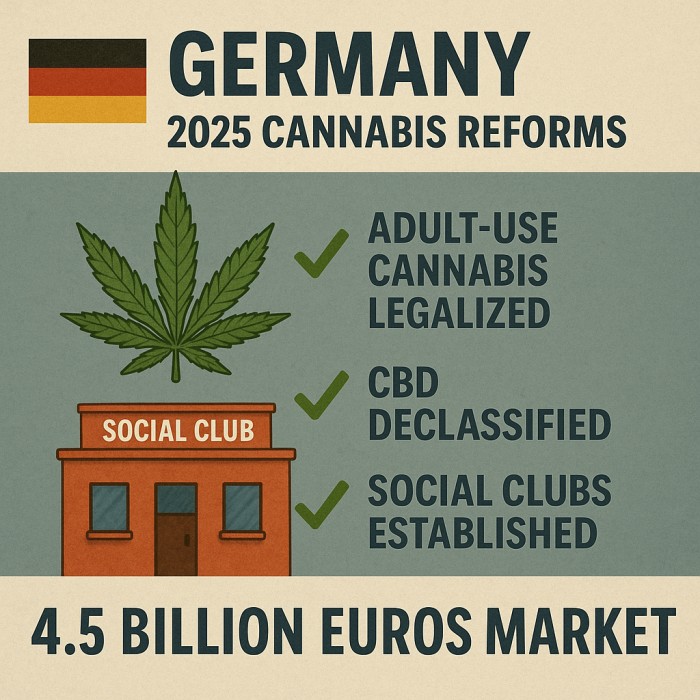
- International Differences: CBD laws vary globally; it’s legal in countries like Canada and Germany but banned in places like Russia. Germany’s 2025 cannabis reforms legalized recreational cannabis, declassified CBD as a controlled substance, and introduced social cannabis clubs.
- Controversy: Unclear regulations and mislabeled products create confusion, and enforcement varies, so checking local laws is essential.
- Uncertainty: Laws evolve rapidly, and 2025-specific data is limited, so always verify current regulations.
Federal CBD Laws in the U.S.
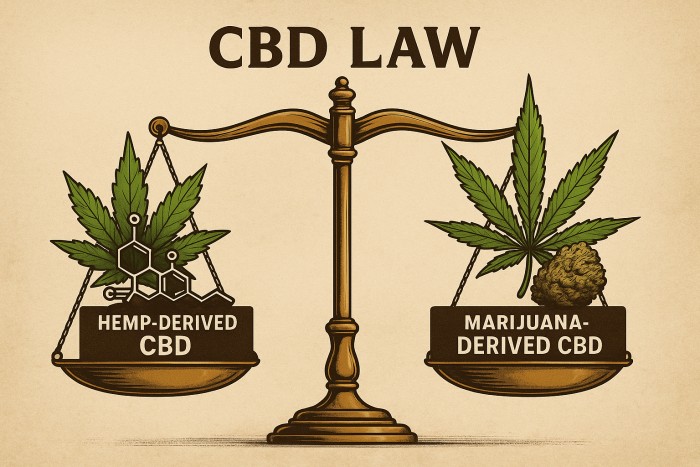
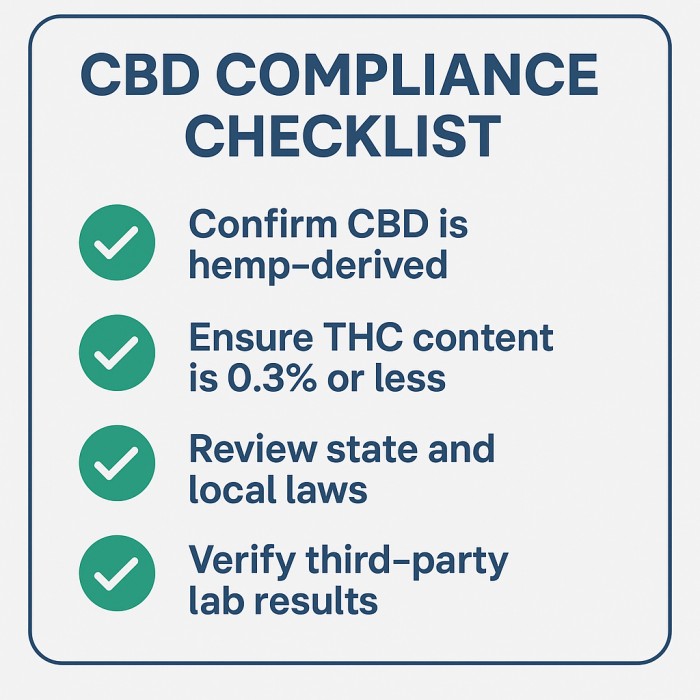
In the U.S., hemp-derived CBD containing less than 0.3% THC is generally considered legal at the federal level due to the 2018 Farm Bill.
However, the FDA regulates CBD products and prohibits their use in food or as dietary supplements, except for the approved drug Epidiolex.
Marijuana-derived CBD remains illegal federally due to its classification as a Schedule I substance.
State CBD Laws in the U.S.
Most U.S. states permit hemp-derived CBD, but regulations differ.
Some states allow it without restrictions, while others impose age limits or require zero THC.
Marijuana-derived CBD is typically legal only for medical use in states with medical cannabis programs.
States like Idaho and Nebraska have stricter rules, complicating compliance.
International CBD Laws
Globally, CBD’s legality ranges from fully legal to completely banned.
Countries like Canada and Mexico allow CBD with low THC levels, while Germany’s 2025 reforms have legalized recreational cannabis and eased CBD restrictions.
In contrast, nations like Singapore and Russia prohibit CBD entirely.
Travelers and businesses must research local laws to avoid legal issues.

Why the Confusion?
The patchwork of laws, combined with inconsistent enforcement and product mislabeling, creates uncertainty.
For example, some CBD products may contain higher THC levels than advertised, risking legal consequences.
Always consult local regulations and choose third-party tested products to ensure compliance.
Introduction
Cannabidiol (CBD), a non-psychoactive compound derived from the cannabis plant, has gained widespread popularity for its potential therapeutic benefits, including pain relief and anxiety reduction.
However, its legal status remains complex and dynamic, varying across federal, state, and international jurisdictions.
This comprehensive guide examines CBD laws as of 2025, covering U.S. federal regulations, state-specific laws, and international perspectives, supported by authoritative sources such as the FDA and FindLaw.
CBD & Federal Law: What You Need To Know
The legal framework for CBD in the U.S. is governed by the Controlled Substances Act (CSA), the Agriculture Improvement Act of 2018 (2018 Farm Bill), and the Federal Food, Drug, and Cosmetic Act (FD&C Act).
Key Federal Regulations
- Hemp-Derived CBD: The 2018 Farm Bill legalized hemp and hemp-derived products, including CBD, provided they contain less than 0.3% THC by dry weight. This legislation removed hemp from the CSA’s definition of marijuana, making hemp-derived CBD legal at the federal level.
- Marijuana-Derived CBD: Marijuana, which contains higher THC levels, remains a Schedule I controlled substance under the CSA, rendering marijuana-derived CBD illegal federally.
- FDA Oversight: The FDA regulates CBD products under the FD&C Act. As of 2025, only Epidiolex, a CBD-based drug, is FDA-approved for treating specific seizure disorders. Non-approved CBD products cannot be marketed as dietary supplements or added to food, including animal feed, due to the drug exclusion rule following Epidiolex’s approval. The FDA issues warning letters to companies for illegal CBD sales and monitors the market for violations.
- Import/Export: Importing CBD products must comply with U.S. Customs and FDA regulations. The DEA is generally involved only if the CBD product exceeds the legal THC limit.
Challenges and Enforcement
The FDA’s limited resources result in enforcement primarily through warning letters, with approximately 100 issued over the past five years.
This allows many non-compliant CBD products to remain available, contributing to consumer confusion.
Additionally, while hemp-derived CBD research faces fewer restrictions since 2018, marijuana-derived CBD research remains limited due to its Schedule I status (FindLaw).
State Laws in the United States
While federal law provides a baseline, state laws create a diverse regulatory landscape, with most states permitting hemp-derived CBD but imposing varied restrictions.
State laws can change rapidly.
The following table provides a general guide, but always verify the latest local regulations.
| State | Hemp-Derived CBD Legal Status | Marijuana-Derived CBD Legal Status |
|---|---|---|
| Alabama | Legal (age 18 and older) | Legal for registered medical marijuana patients |
| Alaska | Legal (age 21 and older) | Legal for registered medical marijuana patients |
| Arizona | Legal (no age limit) | Legal (age 21 and older) |
| Arkansas | Legal (no age limit) | Legal for registered medical marijuana patients |
| California | Legal (age 21 and older) | Legal (age 18 and older) |
| Colorado | Legal (no age limit) | Legal (age 21 and older) |
| Connecticut | Legal (age 18 and older) | Legal for registered medical marijuana patients |
| Delaware | Legal (no age limit) | Legal (age 21 and older) |
| Florida | Legal (age 21 and older) | Legal for registered medical marijuana patients |
| Georgia | Legal (age 21 and older) | Legal for registered medical marijuana patients |
| Hawaii | Legal (age 18 and older) | Legal for registered medical marijuana patients |
| Idaho | Legal only if it contains 0% THC | Illegal |
| Illinois | Legal (no age limit) | Legal (age 21 and over) |
| Indiana | Legal (no age limit) | Legal for registered medical marijuana patients |
| Iowa | Legal (no age limit) | Legal for registered medical marijuana patients |
| Kansas | Legal only if it contains 0% THC (no age limit) | Legal for registered medical marijuana patients |
| Kentucky | Legal (no age limit) | Legal for registered medical marijuana patients |
| Louisiana | Legal (age 21 and older) | Legal for registered medical marijuana patients |
| Maine | Legal (age 21 and older) | Legal (age 21 and older) |
| Maryland | Legal (no age limit) | Legal (age 21 and older) |
| Massachusetts | Legal (age 18 and older) | Legal (age 21 and older) |
| Michigan | Legal (age 21 and older) | Legal (age 21 and older) |
| Minnesota | Legal (age 21 and older) | Legal (age 21 and older) |
| Mississippi | Legal (age 18 and older) | Legal for registered medical marijuana patients |
| Missouri | Legal (no age limit) | Legal (age 21 and older) |
| Montana | Legal (no age limit) | Legal (age 21 and older) |
| Nebraska | Legal (no age limit) | Illegal |
| Nevada | Legal (age 18 and older) | Legal (age 21 and older) |
| New Hampshire | Legal (age 18 and older) | Legal for registered medical marijuana patients |
| New Jersey | Legal (no age limit) | Legal (age 21 and older) |
| New Mexico | Legal (age 18 and older) | Legal (age 21 and older) |
| New York | Legal (age 18 and older) | Legal (age 21 and older) |
| North Carolina | Legal (age 18 and older) | Legal for registered medical marijuana patients |
| North Dakota | Legal (age 18 and older) | Legal for registered medical marijuana patients |
| Ohio | Legal (no age limit) | Legal (age 21 and older) |
| Oklahoma | Legal (age 18 and older) | Legal for registered medical marijuana patients |
| Oregon | Legal (no age limit) | Legal (age 21 and older) |
| Pennsylvania | Legal (age 18 and older) | Legal for registered medical marijuana patients |
| Rhode Island | Legal (age 21 and older) | Legal for registered medical marijuana patients |
| South Carolina | Legal (age 21 and older) | Illegal |
| South Dakota | Legal (age 18 and older) | Illegal |
| Tennessee | Legal (age 21 and older) | Legal for registered medical marijuana patients |
| Texas | Legal (no age limit) | Legal for registered medical marijuana patients |
| Utah | Legal (no age limit) | Legal for registered medical marijuana patients |
| Vermont | Legal (no age limit) | Legal (age 21 and older) |
| Virginia | Legal (no age limit) | Legal (age 21 and older) |
| Washington | Legal (no age limit) | Legal (age 21 and older) |
| West Virginia | Legal (no age limit) | Legal for registered medical marijuana patients |
| Wisconsin | Legal (no age limit) | Legal for registered medical marijuana patients |
| Wyoming | Legal (age 21 and older) | Illegal |
Key Observations
- Hemp-Derived CBD: Most states allow hemp-derived CBD with less than 0.3% THC, but Idaho and Kansas require zero THC, posing compliance challenges.
- Marijuana-Derived CBD: Legal in states with medical or recreational cannabis programs, often requiring a medical cannabis license.
- Age Restrictions: Vary from no age limit to 21, with states like California and Florida setting higher age thresholds.
- Evolving Laws: States like Kentucky have introduced medical marijuana programs effective in 2025, expanding access to marijuana-derived CBD (Spruce).
International CBD Laws
Globally, CBD’s legal status varies widely, from fully legal to completely prohibited, with differences in THC limits and usage restrictions.
Below is an overview based on data up to 2023, with a specific update for Germany in 2025.
Select Countries
| Country | Legal Status/Details | THC Limit | Additional Notes |
|---|---|---|---|
| Canada | Legal, regulated under Cannabis Act, treated like prescription drug | 0.3% | Hemp must be industrial grade |
| Mexico | Legal for sale and consumption | 1% | – |
| Brazil | Legal for medical purposes since 2015 | – | – |
| Chile | Legal, allows cultivation for personal use including CBD extraction | – | – |
| Peru | Legal, less than 1% THC without prescription | 1% | – |
| South Africa | Legal, classified as Schedule 4 substance | – | Max daily dose 20mg CBD with explicit health claim |
| Thailand | Legal, removed low-THC cannabis and hemp extracts from controlled substances in 2020 | – | – |
| Australia | Legal, requires prescription, low-dose CBD over counter by pharmacists | – | – |
| Germany (2025) | Legal, recreational cannabis legalized, CBD declassified as controlled substance | 0.3% | Social cannabis clubs introduced, market estimated at 4.5 billion euros |
| Albania | Illegal, all cannabis derivatives including CBD banned | – | – |
| Serbia | Illegal, all cannabis derivatives including CBD banned | – | – |
| Singapore | Illegal, strict drug laws with severe penalties | – | – |
| Russia | Illegal, classified as narcotic substance | – | – |
| Belize | Legal but importation prohibited | – | Ambiguous legal status, creates uncertainty |
Germany’s 2025 Reforms
In 2025, Germany implemented significant changes to its CBD and cannabis laws:
- THC Limit: Increased from 0.2% to 0.3%, aligning with European regulations.
- CBD Status: Declassified as a controlled substance, easing sale and production.
- Recreational Cannabis: Legalized for adult consumption.
- Social Cannabis Clubs: Introduced, allowing registered members to cultivate and consume cannabis in regulated settings, with over 500 clubs planned in cities like Berlin and Munich.
- Economic Impact: The recreational cannabis market is estimated at 4.5 billion euros, with a 35% increase in legal consumers and 2 billion euros in foreign investments.
These reforms position Germany as a leader in European cannabis policy, potentially influencing neighboring countries like France and Italy (Lord of CBD).
Citation: Countries Where CBD is Legal
Challenges and Considerations
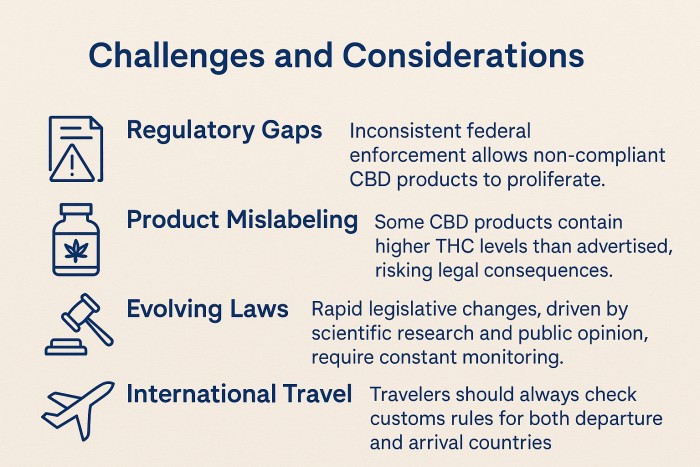
The complexity of CBD laws arises from several factors:
- Regulatory Gaps: Inconsistent federal enforcement (primarily through warning letters rather than product seizures) allows non-compliant CBD products to proliferate.
- Product Mislabeling: Some CBD products contain higher THC levels than advertised, risking legal consequences.
- Evolving Laws: Rapid legislative changes, driven by scientific research and public opinion, require constant monitoring.
- International Travel: Travelers should always check customs rules for both departure and arrival countries, as possession of CBD can result in severe penalties even if it was purchased legally. As CBD is legal in one country may be prohibited in another.
Consumers and businesses should:
- Ensure CBD is hemp-derived with less than 0.3% THC.
- Verify third-party lab testing through a Certificate of Analysis.
- Consult local laws and legal professionals to ensure compliance.
Conclusion
As of 2025, CBD’s legal status remains a complex landscape of federal, state, and international regulations.
In the U.S., hemp-derived CBD is federally legal, but state-specific restrictions and FDA oversight create variability.
Internationally, countries like Canada and Germany embrace CBD, while others, such as Russia, prohibit it entirely.
Germany’s 2025 reforms exemplify the global trend toward liberalizing cannabis and CBD laws, but the overall regulatory environment remains highly fragmented.
Consumers and businesses must stay informed, verify product compliance, and seek legal guidance to navigate this evolving legal terrain successfully.
Key Citations
Related
About The Author
Joseph Powers is the founder of Legal CBD Idaho and a trusted voice in Idaho’s hemp and CBD space. With over a decade of experience in cannabis compliance and education, Joseph is committed to helping Idahoans confidently understand what’s legal, what works, and where to buy safe, effective CBD products in the state.
A Twin Falls local, Joseph brings a consumer-first approach to navigating Idaho’s strict laws around hemp-derived CBD. He personally reviews legal updates, verifies product claims, and explains everything in plain English—so you can make informed, stress-free decisions about your wellness.
Joseph is not affiliated with any CBD brand, ensuring every review and guide on this site is unbiased and rooted in facts, not hype. Whether you’re just curious or looking for trusted products that meet Idaho’s 0.0% THC requirement, his goal is simple: to give you honest answers backed by research, not rumors.
Got a question about CBD in Idaho? Email Joseph directly at [email protected].