Key Points
- The 1st Cavalry Division’s 1st Squadron, 7th Cavalry Regiment tested new drones, vehicles, and navigation systems at Fort Hood, Texas, in April 2026.
- The squadron’s multifunctional strike troop, stood up in January 2026, integrates cavalry scouts trained in the new 15X drone operator role.
Two cavalry scouts sat inside a brand-new armored vehicle atop a hill at Fort Hood, Texas, watching a sky full of drones do reconnaissance work that used to take an hour and now takes minutes, according to a report by Gina Cavallaro, Senior Staff Writer for the Association of the U.S. Army, published July 31, 2026, based on an April exercise with the 1st Cavalry Division.
The exercise offered a glimpse into transforming in contact, an Army modernization initiative launched in 2024 that puts new technology directly into soldiers’ hands for field experimentation rather than waiting years for equipment to complete traditional testing before reaching units. The 1st Cavalry Division, one of the Army’s largest armored formations with a force approaching 24,000 soldiers, became the first armored division to undertake the initiative, branding its version of the effort Pegasus Charge, a program The Defence Blog has previously reported includes trials of next-generation platforms like the XM30 infantry combat vehicle and the M1E3 Abrams tank.
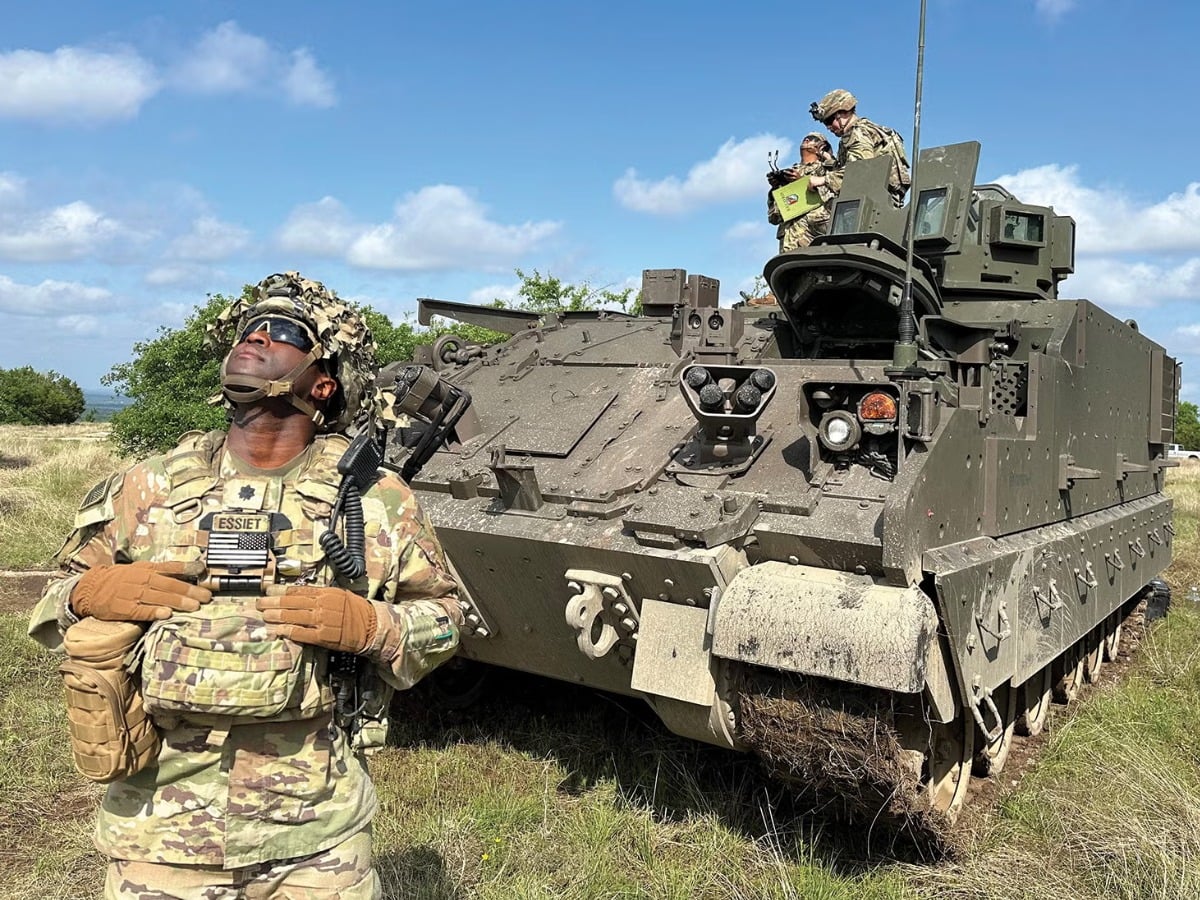
Lt. Col. Brandon Essiet, commander of 1st Squadron, 7th Cavalry Regiment in the division’s 1st Armored Brigade Combat Team, described the learning curve that comes with fielding so much unfamiliar equipment at once.
– ADVERTISEMENT – CONTINUE READING BELOW –
“It’s frustrating because it’s a new system and you have to commit yourself to learning it and see how far you can push it,” Essiet said.
Essiet pointed to the dramatic speed difference between the Army’s older Raven reconnaissance drones, which could take up to an hour to launch while a unit waited for approval from higher headquarters, and the newer systems now filling that same role.
“But here, we’ll be able to get this down to within five to 15 minutes for the different [drone] platforms so we’re able to make an immediate effect on the battle,” Essiet said.
Capt. Max Laguna, who commands the squadron’s newly formed multifunctional strike troop, a reconnaissance unit with deep strike capability, led the hilltop drone mission and reflected on how different his job would have looked with this technology just two years earlier, when he commanded a tank company without any dedicated aerial reconnaissance support at his level.
“So, I got to be the ground force, moving along, wishing I had a drone in front of me feeding me information,” Laguna said. “The closest thing you had to that would be an [unmanned aerial systems] platoon flying [drones] for the brigade. There was a big gap between the large-scale drones flying for the brigades and divisions and the ability to have small-scale drones that could actually provide information to companies. That shows how emerging this is.”
Maj. Gen. Tom Feltey, the division commander who was slated to relinquish command in July, said the transformation effort draws directly from lessons observed in the Russo-Ukrainian war, where static, trench-style fighting has dominated much of the conflict.
“That static, positional, attrition-based warfare is a result of not having the ability to generate offensive maneuver,” Feltey said. “When you lose the ability to conduct maneuver, when you lose tempo, when you lose your offensive capability, you are forced to fight in that static positional warfare. That’s what we want to avoid.”
Feltey compared the significance of an armored brigade combat team to a Navy carrier strike group, noting the active-duty Army fields 11 of each formation.
“An armored brigade combat team is akin to a [U.S. Navy] carrier strike group,” Feltey said. “When we show up on the battlefield, everyone notices, and that’s why it’s important that we adapt to the modern battlefield.”
As part of Pegasus Charge, the division stood up Laguna’s multifunctional strike troop in January, a new unit type distinct from the multifunctional reconnaissance companies infantry brigades created when their cavalry troops deactivated. That structural shift reflects a broader integration effort The Defence Blog previously reported on, including a related exercise where the division’s 1st Battalion, 12th Cavalry Regiment wove drone reconnaissance and counter-drone jamming directly into simulated combat sequences during training in Latvia, rather than treating those capabilities as separate demonstrations.
Pfc. Angel Adolfo, trained as a 19D cavalry scout, is also training in a newer military job called 15X, tactical unmanned aircraft system specialist, created specifically to add drone skills to the traditional scout role.
“With all the conflicts going on around the world, the Army is starting to use more drones,” Adolfo said. “I feel like I’m part of history.”
Maj. Sean Martin, the squadron’s operations officer, described how artificial intelligence-assisted reconnaissance has compressed a task that used to require a human watching every inch of terrain into something dramatically faster.
“Having it speed up from the computers, and then deconflicting the airspace, that is a game changer that’s going to take what would have taken maybe a six-hour block to do an aerial reconnaissance to be done now in maybe a half-hour,” Martin said.
The squadron has also fielded 40 new Armored Multi-Purpose Vehicles, built on a Bradley Fighting Vehicle chassis but without turrets, replacing legacy M113 personnel carriers and freeing up interior space for workstations when the vehicle serves as a tactical command post. Martin noted that command posts face growing danger from the same battlefield saturation of sensors driving the rest of the exercise, meaning those posts must reposition constantly to avoid detection and attack, a capability the new vehicles are actively testing during the training. That vulnerability tracks with a separate BAE Systems prototype The Defence Blog reported the division tested in April 2026, the company-funded AMPV-30, which pairs a 30mm cannon with radar specifically built to detect and destroy small drones, though the Army has confirmed it has not yet procured that specific system.
Capt. Amy Amparan, who commands the squadron’s Forward Support Troop, has been testing a jam-resistant navigation system developed by Tern AI that displays route information on a tablet roughly the size of a paperback, using artificial intelligence and a vehicle’s own motion sensors instead of satellite positioning.
“So, it’s not jammable, and you can drop pins,” Amparan said.
First Lt. Patrick McCampbell, a scout platoon leader in the squadron’s A Company, summed up the uncertainty running through the entire effort, acknowledging that neither he nor his soldiers fully know what equipment or tactics will ultimately prove effective.
“We don’t really know what’s going to be next, but we can figure out what works and what doesn’t. It’s the edge of change, and change is tough,” McCampbell said. “None of these [soldiers] have degrees in this stuff, but they’re starting to ask the right questions, and I’m telling them that it’s OK if stuff breaks.”
The squadron has three feedback touchpoints scheduled through April, August and October before the brigade rotates through the National Training Center at Fort Irwin, California, in March 2027, giving soldiers like Adolfo and officers like Essiet and Laguna a defined runway to sort out what survives the transition from experimental gear to standard equipment.