
By David Sher
I’m currently watching The Pitt, the hit Max series that follows life and death, hour by hour, in a crazy-busy emergency room in a large fictional Pittsburgh hospital.
This show will scare the living daylights out of you—but at least you know it’s a TV series, not an accurate depiction of how a real emergency department operates.
It might not be a perfect depiction, however in some ways it’s closer to reality than you’d think. Unfortunately, this past year I’ve had a good deal of personal experience in metro Birmingham emergency rooms with family members.
Stacked Up in the Hallway
We see throughout the series that the Pittsburgh hospital often does not have rooms available for ER patients who need to be admitted, so they keep stacking up in the hallways.
That’s not just dramatic license. It’s what’s happening, in some form, in Birmingham right now.
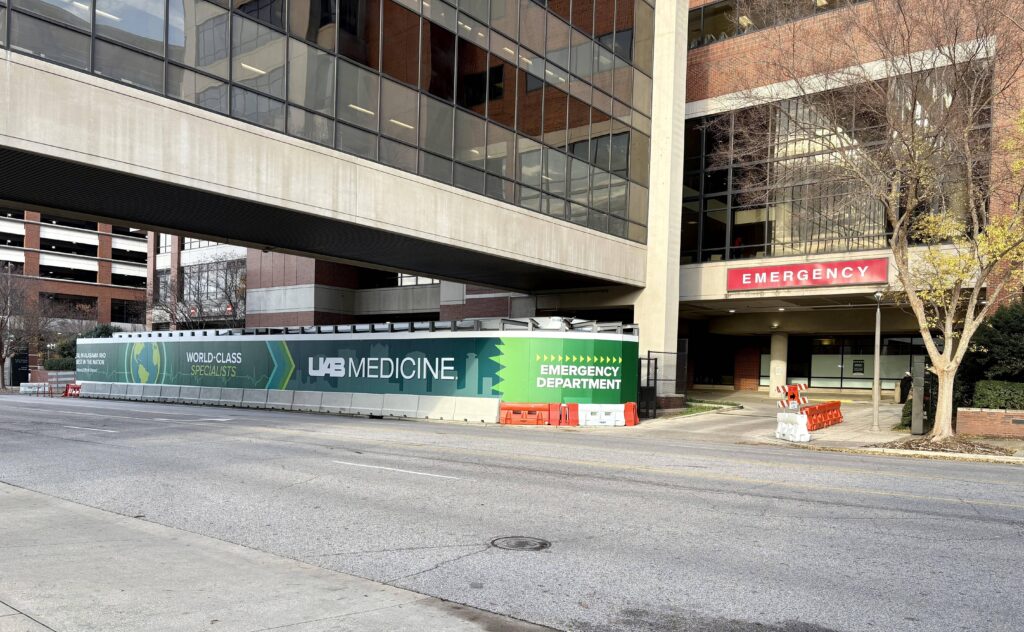
UAB has tried to ease the crunch by adding two modular emergency department units outside its main building—essentially trailers bolted onto the hospital to handle overflow. They expanded UAB’s ED capacity by 50%. That’s how serious the demand has become. But spending your worst day or days in a trailer in the parking lot isn’t ideal, even if it beats a hallway.
Where Are All These Patients Coming From?
A lot of them are coming from rural Alabama, where hospitals keep closing or cutting services.
Alabama has lost at least seven rural hospitals since 2010. Right now, the Alabama Hospital Association says 27 more rural hospitals are in danger of closing, with 19 of those at immediate risk. Eighty-three percent of Alabama’s rural hospitals are operating in the red. Only 15 hospitals in the entire state still have full 24/7 labor and delivery units—meaning women in much of rural Alabama now drive an hour or more just to give birth.
When a rural hospital closes or cuts its ER, the patients don’t disappear. They drive to the nearest place that’s still open—often Birmingham. Danne Howard, who runs the Alabama Hospital Association, put it plainly: “The rural issue is not just about rural Alabama, it’s about all of us. If the rural hospitals are not there stable enough, urban hospitals cannot absorb the volume.”
That’s the crushing burden landing on Birmingham.
“Not My Problem”—Except It Is
Plenty of well-off Birmingham-area folks figure Medicaid isn’t their problem. They have good insurance. They’re not the ones who’d qualify.
But sick people have to go somewhere. When rural Alabama runs out of places to send them, a lot of them show up here—in our ERs, our hallways, our trailers. Every insured and uninsured patient who can’t get care closer to home and ends up at UAB or Brookwood or St. Vincent’s adds to the wait you’ll face next time you or someone you love needs emergency care.
Uncompensated care costs get baked into everyone’s bills and insurance premiums, whether you ever set foot in a Medicaid office or not.
Alabama Is One of Only 10
Forty states plus Washington, D.C. have expanded Medicaid. Alabama is one of just ten holdouts left—along with Florida, Georgia, Kansas, Mississippi, South Carolina, Tennessee, Texas, Wisconsin, and Wyoming.
Alabama has turned down billions in federal funding that would cover 90% of the cost of expansion, year after year, while our rural hospitals collapse and our urban ERs absorb the fallout.
A 2022 economic analysis by the Public Affairs Research Council of Alabama (PARCA) found that expansion would cost the state an average of $225 million a year—but generate average savings of nearly $400 million a year through reduced state spending elsewhere and a stronger economy, for a net gain of over $170 million annually.
This isn’t charity. It’s math. And it’s costing all of us—in dollars, in wait times, and in the kind of care we get when we’re the ones lying in that hallway.
Maybe it’s time Alabama stopped being one of the ten.
David Sher is the founder and publisher of ComebackTown. He’s past Chairman of the Birmingham Regional Chamber of Commerce (BBA), Operation New Birmingham (REV Birmingham), and the City Action Partnership (CAP).
Care about Birmingham, sign up for ComebackTown newsletter
Invite David to speak for free to your group about how we can have a more prosperous metro Birmingham. [email protected]
(Visited 590 times, 13 visits today)