New York City Should Become the Site of a National Museum of Mental Health

New York City prides itself on being a center of cultural institutions, boasting proudly on its tourism website that “there’s an institution for every interest in the City.” The city is the site of roughly 170 museums! Yet, inexplicably, there is currently no museum focused on improving public understanding of mental health and illness in New York.

This is surprising given that mental health conditions are both highly prevalent (experienced by roughly 50% of people during their lifetimes, with serious mental health conditions occurring among 5–7% of the population) and greatly misunderstood. Members of the general population (not to mention many elected officials) still endorse stigma, associating mental illness with negative stereotypes of dangerousness, incompetence, and inability to recover. In 2025, New York State recognizes the need for mental health education among young people, and the New York State Board of Regents recently mandated “school mental health education” to “help young people and their families and communities feel more comfortable seeking help”; yet, teachers have no clear guide or resources for providing this education. A museum would provide a clear path for providing mental health education and make sure it doesn’t feel like school.
New York City also has a long history related to mental health treatment that deserves public documentation. The Bloomingdale Asylum, which was located where Columbia University now sits, opened in 1821 and was one of the first asylums in the US, while the public “New York City Asylum for the Insane” was opened on Blackwell’s (now Roosevelt) Island in 1839. An extension housing men was opened on Ward’s Island in 1871, where a state psychiatric hospital still stands. Thousands of New Yorkers (including greats such as Scott Joplin) lived and died there.
New York City proudly hosted a tuberculosis exhibition in the early 1900s that drew 750,000 visitors — who waited in lines to enter — during its 7-week run. The city took advantage of the educational, inspirational, and experiential magic of a museum to change the trajectory of tuberculosis. The same impacts can happen with mental health.
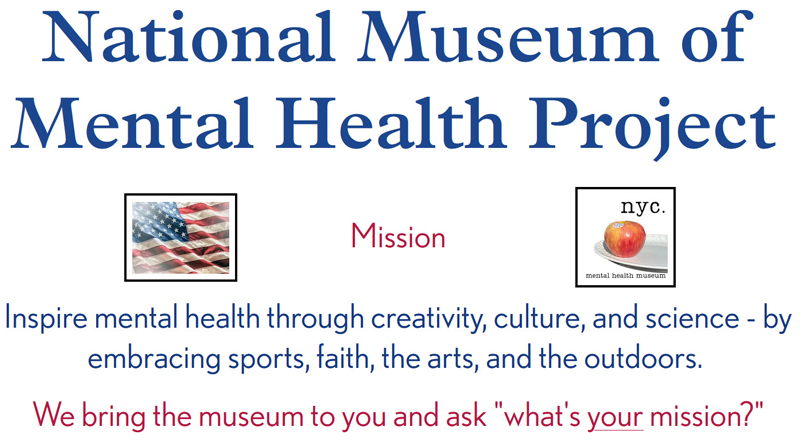
We believe that it is high time for New York City to become the site of a National Museum of Mental Health. Following best practices for mental health exhibits, it could include experiential, historic, and cultural aspects. Experiential exhibits could demystify and destigmatize mental health conditions; historical exhibits could provide information on the New York City Asylum for the Insane, the Bloomingdale Asylum, and related institutions; cultural exhibits could display artistic works (including painting and multimedia art) that demonstrate the positive benefits creativity can have on mental health. We also propose that the museum follow a “distributed” model, which could serve as a visitable museum where exhibition designers might talk with visitors to get advice that can be brought outside the museum. Like a restaurant with eat-in and delivery services, distributed museums harness the educational, inspirational, and creative know-how of museums and “deliver” the museum’s products to the community in the form of: pop-up exhibitions at schools, senior centers, and libraries; signage in public parks; flyers in coffee shops; graffiti; and relationships with other museums and cultural-making places. Distributed museums have two chances to succeed — as a destination, and as a neighborhood delivery service.
Where would such a museum be located? In the recently published Exiles in New York City, one of us proposed that it should be sited on Ward’s Island, which has served as a location of psychiatric treatment settings since the 1870’s (Robert Moses in fact once proposed that a “health” museum be located there). This location would honor the thousands of New Yorkers who have lived there and whose stories are at risk of being forgotten. Places within cities that allow one to “get away from the city” are coveted for the mental refreshment and change in perspectives they offer. The serene park on Ward’s Island, with its New York skyline backdrop, is such a place of such beauty. If citizens, politicians, and advocates should visit Ward’s Island parks, they will undoubtedly take up the cause of bringing a National Museum of Mental Health to New York City!
Phillip T. Yanos, PhD, is a professor at John Jay College (CUNY) and is the author of Exiles in New York City: Warehousing the Marginalized on Ward’s Island. Paul Piwko is co-developer of National Museum of Mental Health Project, Inc. and teaches business at Boston University. For more information, visit www.nmmhproject.org.