
Understanding “Hub-and-Spoke” Conspiracies and Why They Matter Under MCOCA


Why Should a Judge Care About a Wheel?
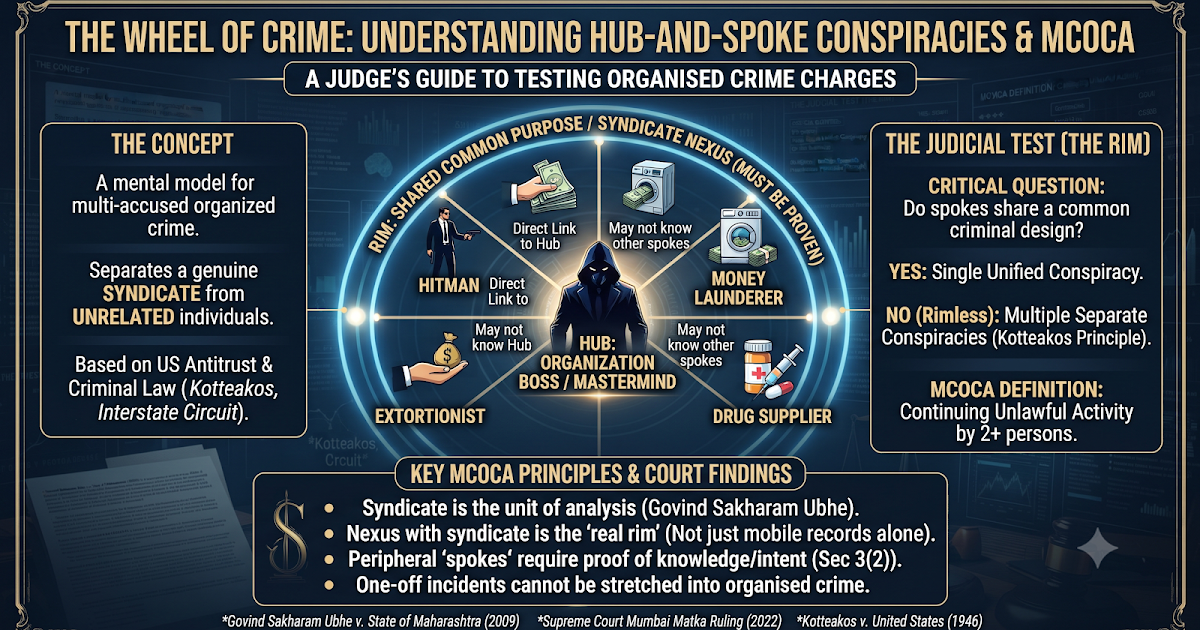
Picture a bicycle wheel. In the centre sits a hub. Radiating outward are the spokes. Holding it all together at the edge is the rim. Now replace that wheel with a criminal enterprise — and you have one of the most useful mental models available to any judge trying to make sense of a sprawling, multi-accused organised crime prosecution: the hub-and-spoke conspiracy.
This is not just an academic curiosity from American law. It is a structural lens that helps separate a genuine organised crime syndicate from a loose collection of unrelated individuals who happen to share a common contact. For judges dealing with MCOCA (Maharashtra Control of Organised Crime Act, 1999) cases — where chargesheets often name a dozen or more accused with wildly varying degrees of connection to each other — this distinction can decide whether a prosecution stands or collapses.
The Concept, Simply Explained
The hub-and-spoke doctrine originated in American antitrust and criminal law, most famously in Interstate Circuit, Inc. v. United States (1939) and Kotteakos v. United States (1946). It describes a conspiracy with three components:
– The Hub — the central figure or mastermind who deals with everyone else. In a criminal gang, this is typically the boss or don.
– The Spokes — the individual operatives, each of whom deals separately with the hub. They may never meet or even know of each other’s existence. One spoke might be a hitman, another an extortion collector, another a money launderer.
– The Rim — the invisible thread of a shared common purpose that connects all the spokes to one single, unified enterprise, even without direct contact between them.
The critical legal question is always this: do the spokes merely share a common hub, or do they also share the rim — a common criminal design? If the rim is missing, what looks like one giant conspiracy is really several separate, smaller conspiracies, each linked only to the hub and not to each other.
This is precisely what went wrong for prosecutors in “Kotteakos”. Several independent borrowers had each separately conspired with one loan broker to defraud a housing authority. The borrowers had no dealings with, or knowledge of, one another. The U.S. Supreme Court held this was not a single conspiracy but multiple independent ones — and lumping them together into one prosecution unfairly let evidence from unrelated schemes contaminate each individual’s trial. This came to be known as a “rimless wheel” — a hub with spokes, but no connecting rim, and therefore no single conspiracy.
Notably, courts have relaxed this standard somewhat for street-level criminal conspiracies (as opposed to antitrust cartels). In narcotics and organised crime settings, a spoke need not know the specific identity of the other spokes — general awareness that one is cooperating with the hub as part of a larger unlawful scheme is often enough to establish the rim.
| Element | What It Represents | What Must Be Proven |
| Hub | The central organiser or boss | Directs or coordinates dealings with each spoke |
| Spokes | Individual members/operatives | A separate link to the hub; need not know each other |
| Rim | The shared common design | A unifying criminal purpose connecting the spokes — this is the make-or-break element |
Where This Fits Into MCOCA
MCOCA defines an “organised crime syndicate” as a group of two or more persons who, singly or collectively, indulge in “organised crime” — meaning a “continuing unlawful activity” carried out through violence, intimidation, coercion or other unlawful means for pecuniary or other advantage [Sections 2(1)(e) and 2(1)(f)]. The syndicate structure described in the Act maps almost perfectly onto the hub-and-spoke model: a gang leader (hub) directing a network of extortionists, shooters, and financiers (spokes) who may never cross paths with one another but who all serve the syndicate’s common objective (the rim).
Points Settled by Indian Courts That Track the Hub-and-Spoke Logic
1. The syndicate, not the individual, is the unit of analysis.
In Govind Sakharam Ubhe v. State of Maharashtra (2009 SCC OnLine Bom 770), the Bombay High Court held that the requirement of more than one chargesheet in ten years attaches to the organised crime syndicate as a whole, not to each individual accused. Even if a particular “spoke” appears in only one case, they can still be prosecuted under MCOCA so long as their crime is part of the syndicate’s continuing unlawful activity. This is the same insight as the hub-and-spoke model: what matters is whether the enterprise is unified, not whether every individual spoke has an independent track record.
2. The Supreme Court confirmed this in the “Mumbai Matka” appeals (2022).
The Court held that chargesheets need only be filed in respect of the syndicate, not against every accused person individually, recognising that “an organised crime syndicate may consist of scores of people involved in unlawful activities in different capacities.” This is a direct judicial endorsement of the wheel metaphor — many spokes, one hub-driven enterprise.
3. The “link” or “nexus” with the syndicate is the real rim.
Courts have consistently held that what makes a person liable under MCOCA is their nexus with the organised crime syndicate — and this nexus can be established through circumstantial evidence: association with known members, participation in syndicate activities, or receipt of benefits from the syndicate. If this link is absent, the person cannot be roped in, however connected they might appear to the “hub” figure. This is the Indian judiciary’s own version of the “rim requirement” — mere contact with a central figure is not enough; a shared criminal design must be shown.
4. Section 3(2) of MCOCA casts the net wide — but the rim still needs proof.
Section 3(2) of MCOCA separately punishes conspiring, attempting, advocating, abetting, or knowingly facilitating an organised crime. This allows peripheral “spokes” to be prosecuted even without direct dealings with other spokes, provided actual knowledge or reason to believe that they are assisting the syndicate is established.
5. Weak links are not enough.
Courts have cautioned that flimsy circumstantial evidence — such as mere mobile call records — cannot, by itself, establish that an accused is part of the syndicate’s rim. As one Delhi court observed, mobile connectivity is at best corroborative and cannot substitute for substantive evidence connecting an accused to the syndicate’s common design.
A Practical Checklist for the Bench
When an MCOCA chargesheet names multiple accused, a hub-and-spoke analysis suggests the following questions before framing charges or deciding bail:
– Is there a genuine central “hub” — an identifiable individual or leadership structure directing the alleged syndicate?
– For each accused (“spoke”), is there specific evidence connecting them to the hub’s unlawful design — not merely incidental or circumstantial contact?
– Is there evidence of a shared common purpose (the “rim”) among the accused collectively, or does the prosecution’s theory only show parallel, unconnected dealings with a common figure?
– Does the “continuing unlawful activity” attach meaningfully to the syndicate as an entity, consistent with Govind Sakharam Ubhe and the Supreme Court’s 2022 ruling — or is the prosecution stretching a one-off incident into an organised crime label?
– Is the evidence linking a peripheral accused (a distant “spoke”) strong enough to show actual knowledge of, or reason to believe in, their assistance to the syndicate, or is it built on weak inferences like call records alone?
Closing Thought
The hub-and-spoke model does not appear anywhere in the text of MCOCA, but it captures exactly the analytical discipline the statute — and its judicial interpretation — demands. It reminds the bench that an organised crime syndicate is not simply “several people connected to one dangerous man.” It is several people bound by a common criminal design radiating from that man. Distinguishing a true wheel of crime from a mere hub with disconnected, rimless spokes is precisely the safeguard that prevents MCOCA’s stringent provisions — extended custody, reversed bail presumptions, admissibility of intercepted communications — from being misapplied to individuals who share nothing more than an unfortunate common acquaintance.


