


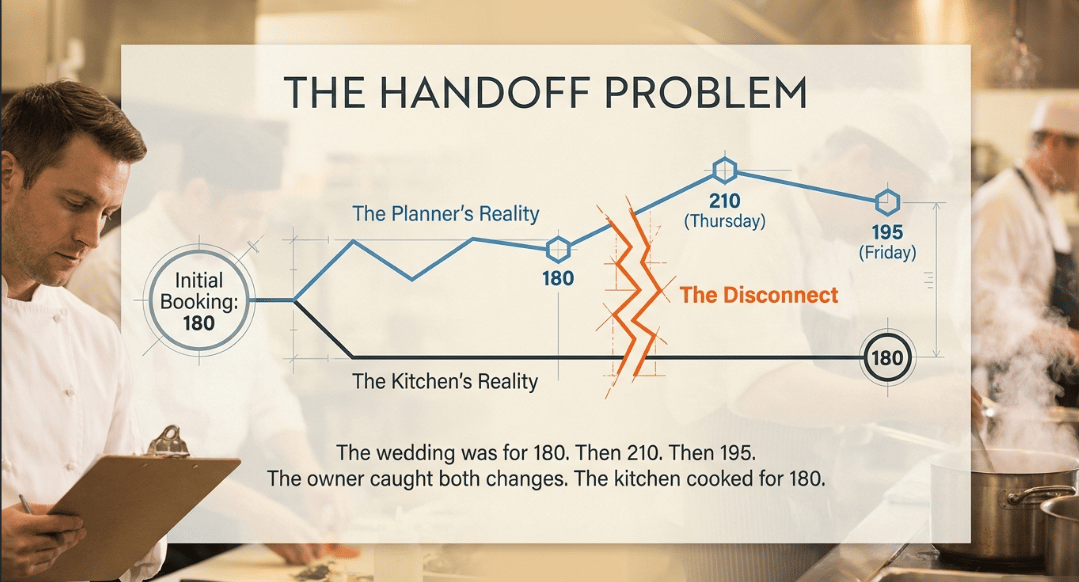
The wedding was for 180. By the Thursday before, it was for 210, then back to 195 by Friday afternoon, because the bride’s side had a falling-out with a block of cousins that I will not pretend to understand. None of that was the problem. Headcounts move; every caterer alive has built a plan around a number that changed twice before load-in.
The problem was that the kitchen prepped for 180.
Not because anyone was careless. The owner had caught both changes. She’d updated the count in the email thread with the planner, made a note on the printed BEO taped to her office wall, and mentioned it to her lead in passing on Thursday afternoon. Three places. All correct. And on Saturday morning, her chef walked in, pulled the production sheet that had been printed Wednesday night, and started cooking from the only number he could see, the wrong one.
Join us August 10-11 during Art of Catering Food, which brings fresh ideas, expert techniques, and real-world strategies to help chefs and caterers create unforgettable dining experiences. Learn More
She told me about this months later, and what stuck with me wasn’t the scramble at the event. They covered it; good teams always do. What stuck with me was the look on her face when she said the part that actually stung: “I didn’t miss it. I knew the right number the whole time. It just never made it to the one person who needed it at the one moment it mattered.”
That sentence is the whole subject of this article. Most catering mistakes are not cooking mistakes, nor are they knowledge mistakes. The food is good. Somebody usually knew the right answer. What breaks is the handoff, the pass from one person, one stage, one version of the truth to the next, and the handoff breaks quietly, in the gap where nobody is looking.
Stop picturing an event as one effort. Picture a relay.
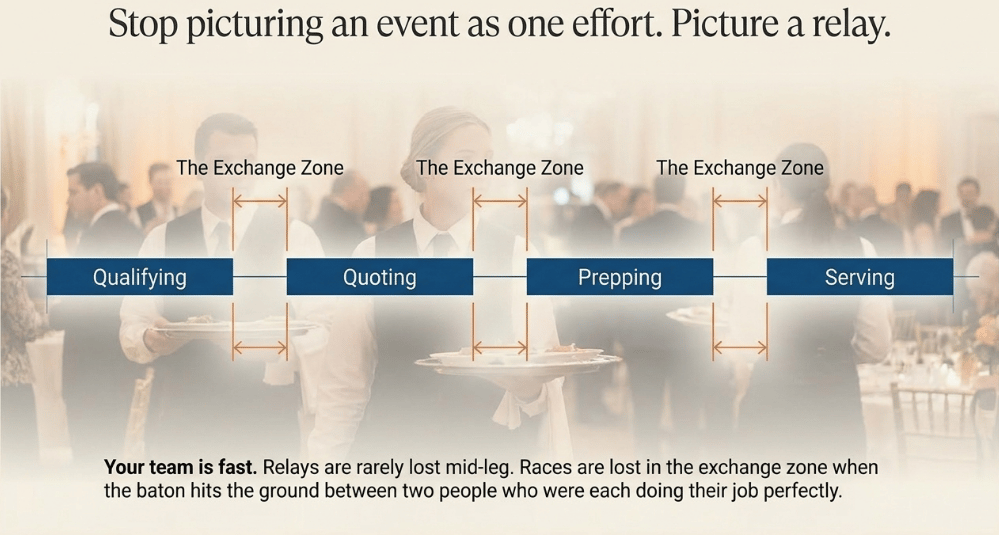
It helps to stop seeing an event as a single continuous push and start seeing it as a relay race. An inquiry comes in. Someone qualifies it. Someone quotes it. The client confirms. The details get locked. The kitchen preps. Staff gets assigned. The event runs. Someone follows up. Each of those is a leg, and between every leg is a baton pass, a moment where information has to travel cleanly from one hand to the next.
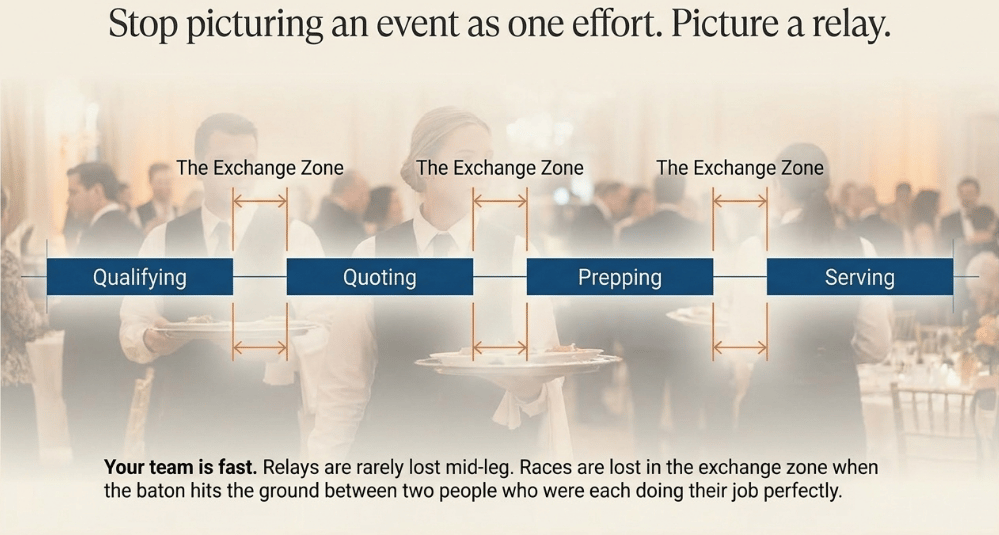
Relays are rarely lost mid-leg. The runners are fast. Races are lost in the exchange zone when the baton hits the ground between two people who were each doing their job perfectly. Catering is the same. Your team is good at the legs. The risk lies in the passes, and the passes are exactly where most operations have built the least structure, because the legs are visible and the passes are not.
Nobody dropped the ball during the race. The baton hit the ground in the exchange zone, between two people who were each running their leg perfectly.
Here is the useful part: once you see your operation as a sequence of handoffs, you can actually inspect it. For every pass you can ask four plain questions. Who is handing off? Who is receiving? What information has to travel? And how do we know it arrived? Most teams have never written that down. They run the passes on memory and habit, which works beautifully right up until Thursday, when a cousin gets disinvited.
The four handoffs worth inspecting first
You don’t need to map all of them at once. Four exchange zones cause most of the pain, and they’re the place to start.
The intake handoff: from inquiry to your pipeline.
Inquiries arrive everywhere: via email, a website form, voicemail, text, a social message, or a referral from a venue. The question isn’t whether you can answer them. It’s whether every one of them lands in a single place where it physically cannot be forgotten. If inquiries live in five inboxes, the dropped lead isn’t a risk; it’s a matter of time. Honest test: if you named every channel an inquiry can arrive through, could you prove each one was checked yesterday?
The booking handoff: from sales to the kitchen.
A confirmed event has to become a real thing that the people cooking and staffing can see, without anyone retyping it. This is the classic break, and it’s exactly what happened to the caterer above: the person who books and the person who cooks were reading from different copies. Honest test: when an event is confirmed or changed, can the kitchen see the current version without a human remembering to carry it over? Any pass that depends on someone remembering to make it, under pressure, is a pass you will eventually drop.
The change handoff: from “what we agreed” to “what’s current.”
Headcounts move, menus shift, start times slide. The danger was never the change. It’s having more than one “current” version alive at the same time: 180 on the production sheet, 210 in the email, 195 in someone’s head. The fix isn’t more communication about the change. It’s a single source of truth: one place everyone agrees is the real number, so updating it once updates it for everyone.
The closeout handoff: from event to relationship.
The event ends, and the baton just drops. No follow-up, no notes captured, no record of what the client loved or what you’d do differently. Next time that client calls, you start from zero, and so does the impression you make. Honest test: when a repeat client gets in touch, does your team instantly know their history, or does it live in one person’s memory and one buried email?
A 15-minute exercise for your next team meeting
Here’s something you can run this week with a whiteboard and no budget. Draw the journey of one real event as a horizontal line, from first inquiry to final follow-up, and mark every handoff along it. At each pass, ask three questions:
-
What information has to travel here, exactly?
-
How do we confirm it arrived, instead of assuming it did?
-
What happens when the person who normally makes this pass is out sick?
That last one is the question that exposes the fragile parts. Any handoff that only works because one specific person remembers to make it is a handoff that is one bad week away from failing. The goal isn’t to remove the people; catering is a human craft and always will be. The goal is to let the routine information move on its own, so your team’s attention is spent where it actually belongs: on the menu, the room, the client, the food. The judgment work. Not the retyping.
There’s a point where careful stops aren’t enough
Here’s the uncomfortable thing the wedding story points at. The owner didn’t fail because she was disorganized. She failed because she was running a coordination system made of her own attention, email threads, a taped-up BEO, a word to the lead in passing, and that system has a ceiling. It works at five events a month. It strains at 20. Somewhere past that, the number of passes in a week simply exceeds what one person’s memory can guarantee, no matter how good that memory is.
This is worth naming plainly, because most operators hit the ceiling without recognizing it for what it is. They assume the misses mean someone needs to try harder, be more careful, and check the thread one more time. But you can’t out-discipline a structural problem. When the volume of handoffs outgrows the capacity of human memory to track them, “try harder” is no longer an available answer. The work stops being about effort and starts being about whether the information can move without anyone having to remember to move it.
You can’t out-discipline a structural problem. Past a certain volume, the question isn’t whether your team is careful enough; it’s whether the information can travel without a person carrying it.
That doesn’t mean the answer is automatically a particular tool, or that more software solves anything on its own, plenty of operations own five systems and still drop the count, because the systems don’t talk and each one is its own new handoff. The point is more basic, and it comes before any tool decision: at scale, the routine information has to live somewhere durable and shared, not in one person’s head and one person’s inbox. How you get there is a separate conversation. Recognizing that you’ve hit the ceiling, that the misses are structural, not personal, is the part that changes what you do next.
Coordination is the part of the craft clients actually feel
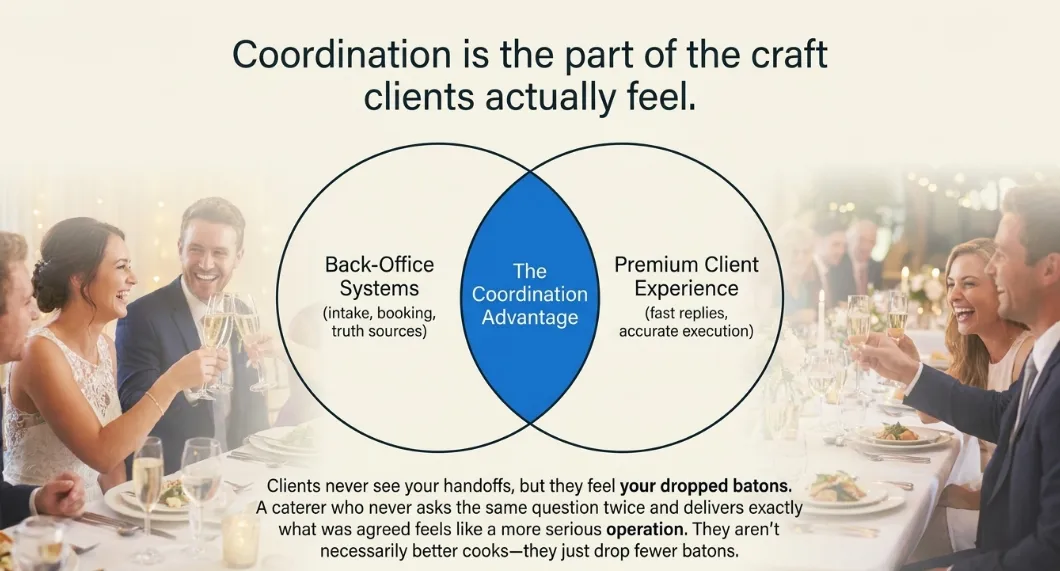
It’s tempting to file all of this under back-office housekeeping, less interesting than the menu, less visible than the plating. But clients experience your coordination directly, even though they never see it happen. The caterer who replies fast, never asks the same question twice, remembers last year’s order, and delivers exactly what was agreed feels, from the outside, like a more serious operation. Often, they aren’t a better cook than the shop across town. They just drop fewer batons.
You can’t control how many inquiries arrive, or how often a client changes their mind the Thursday before. You can control whether your operation is built to absorb that reality without losing things in the gaps. So, map your handoffs. Find your weakest exchange zone; you already suspect which one it is, and shore up that single pass this month. Then do the next one.
The caterer with the wedding fixed hers, by the way. Not with anything dramatic. She just decided there would be one place the count lived, and that the kitchen would pull from that place and nowhere else. The next time a number changed twice in a week, and of course it did, the chef cooked for the right one without anyone having to remember to tell him.
When I asked her what changed, she didn’t say she’d gotten more careful. She’d been plenty careful the first time. She said, “I stopped relying on myself to carry it. I built something that carried it for me.”
That’s the job. Not running the legs faster, you’re already fast. Practicing the passes, so the baton stays in the air all the way around the track.


