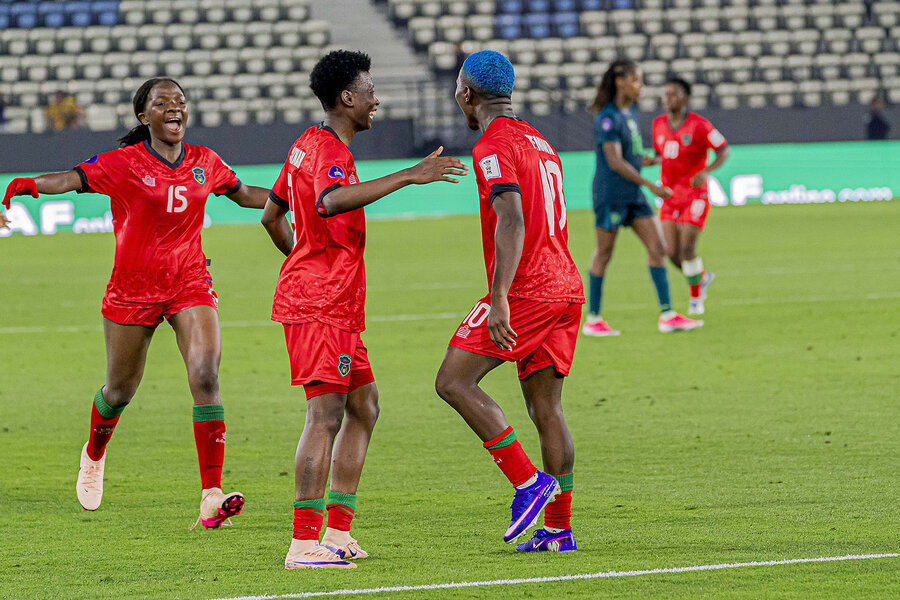
Imagine the Faroe Islands beating Germany in men’s soccer. Picture Tajikistan besting Argentina. Those were the kind of odds Malawi’s women’s national team, the Scorchers, faced when they stepped onto the pitch on July 28 in Rabat, Morocco.
The team’s first match in the continental championship was against Nigeria, the defending champion. The Super Falcons towered a full 117 places above Malawi in the FIFA rankings. As if that weren’t bad enough, Nigeria has won 10 of the 13 Women’s Africa Cup of Nations (WAFCON) tournaments ever played. This was the first time the Scorchers had even qualified.
“I told the players, forget about all that,” says coach Lovemore Fazili. “In football anything can happen.”
Why We Wrote This
Despite being 153rd in FIFA rankings, the Malawi women’s soccer team is now within grasping distance of the World Cup. Its staggering ascent in the Africa Cup of Nations is upsetting not just soccer stats, but ideas about who can be a soccer star.
Indeed, when the final whistle blew two hours later, Malawi had rewritten soccer history. A forward with electric blue hair named Temwa Chawinga twice broke through Nigeria’s defensive line, and her sister Tabitha socked away a goal of her own to give the Scorchers a 3-2 victory.

ESPN dubbed it “the biggest upset in WAFCON history.” And a week later, Malawi are on their way to the quarterfinals – putting the world’s 153rd-ranked team one game away from qualifying for the 2027 World Cup. But their shock victory means more than that.
The win was a kind of announcement of the meteoric rise of women’s soccer in Africa. No longer is world class play confined to the continent’s top teams, says professional player and commentator Hannah Baptiste. Even the scrappiest underdogs have “unreal talent.”
In many ways, that should come as little surprise. The informal pitches scratched out on the continent’s street corners and open lots have long produced some of world soccer’s best male players.
Now, Africa’s women are claiming their place too.
Scrappy beginnings
Take the Chawinga sisters. For American fans, Temwa needs no introduction. A striker for the National Women’s Soccer League’s Kansas City Current, she has been the league’s MVP and highest goal scorer for the last two years running. Tabitha, meanwhile, is a star player for Lyon, in the French Premier League.
Growing up in rural Malawi, the Chawingas played with the boys in village pick up matches, using balls improvised from wadded up paper and plastic. If the girls’ mother caught them, they got a beating.
But the sisters kept going, eventually finding their way to a third division team in Sweden.
“I was so young. I knew nobody there, no parents, no friends,” Tabitha recalled in a 2023 interview. “But … I am from a poor background full of strong young women, so I saw it was my opportunity.”
Seeing players like the Chawingas can be transformative for young girls coming up behind them, says Ms. Baptiste, who also plays internationally for Guyana. Growing up in the UK, she rarely saw players who looked like her.
“But the few I did see made me believe there was a place for me in the game,” she says.
At this year’s WAFCON, however, surprisingly few eyes are on the Chawingas – or any other players for that matter.
Barriers for viewers
The continent’s most important tournament, where berths for the 2027 World Cup are decided, was originally scheduled for March. But just 12 days before kickoff, the Confederation of African Football abruptly called it off without explanation. Tickets for the rescheduled WAFCON went on sale just five days before the first match in July.
So when the Scorchers David-and-Goliathed their way to a historic victory against Nigeria, the stands in Al Madina Stadium in Rabat were nearly empty. The same vacant seats greeted other star performances, like Zambian superstar Barbra Banda’s four goal blitz against Egypt. International TV coverage has also been spotty and disorganized.
The consequences are bigger than entertainment, Ms. Baptiste says. “Girls lose role models and players lose sponsorships because people assume there’s no audience, when in reality people simply haven’t got access to it.”
But on the field, Malawi continued to play like the whole world was watching. In the 35th minute of their second match, against Egypt, Temwa plucked a high ball out of the air, spun around a defender, and found the feet of fellow phenom Rose Kadzere. (When she was just 18, Ms. Kadzere became the first Malawian player of any gender to go directly from Malawi to one of Europe’s top leagues.) Her goal opened a scoresheet that ended with a 3-1 victory for the Scorchers.
Even after losing 2-1 to Zambia in their third match on Wednesday, the Malawians still topped their group. A win in Sunday’s quarterfinal will earn the team a bid to the World Cup in Brazil next year.
Forward Vanessa Mbinho Chikupila remembers a time when she couldn’t imagine being within grasping distance of the World Cup.
Growing up, “I didn’t know there was even women’s football in Malawi,” Ms. Chikupila says.
After the last two weeks, she knows it’s unlikely a young player will ever say that again.