
Don’t miss an episode of our podcast, Personal Finance for Long-Term Investors. Available on all podcast players.
Here’s the latest episode:
I was chatting with friend-of-the-blog Geff this past week. He’s a true Boglehead, a long-time investor in broad US-based index funds. Geff asked me whether / why international stocks are needed in portfolio construction.
It’s a fair question. There are two main reasons why some people lean all-US:
- US stocks have historically outperformed international stocks. Why invest in underperformers?
- Many modern US companies are multinational. You get pseudo-international exposure by owning them. Coca-Cola, for example, gets ~60% of its revenue outside of the US. But it’s part of US stock indices.
Despite these two true facts, I still think international exposure is important in portfolio construction.
The Performance Track Record
Since 1970 (when most data sets begin listing international indices), the US vs. international returns look like this:
- USA – 11.1% per year
- International – 9.3% per year
Though “only” a 1.8% difference between 11.1% and 9.3%, that’s a huge difference when compounded over the 55-year period.
The US market would have turned $1 in 1970 into $357 today.
The same dollar in an international index would have only grown to $147. Big difference!
But It’s Cyclical…
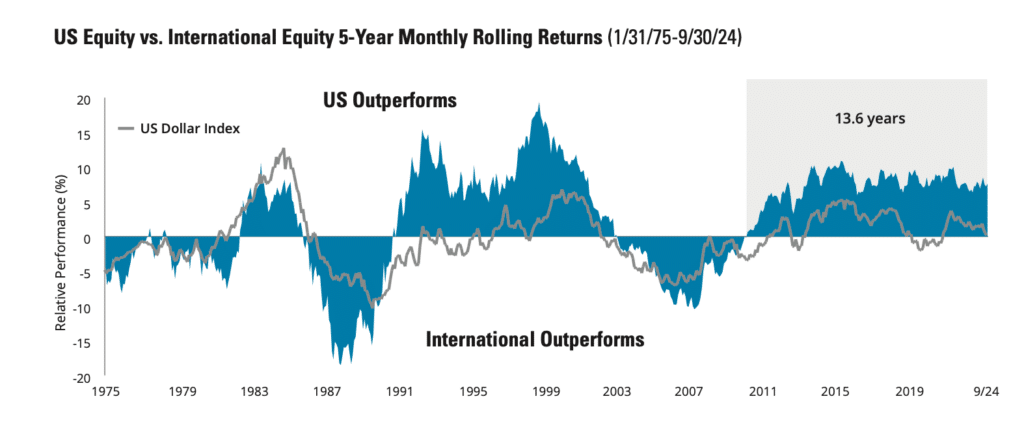
The chart below shows a bit of the “cyclicality” of US outperformance vs international outperformance. If we believe in John Bogle’s “iron rule of investing” – reversion to the mean! – then we might believe that someday, not sure when, international markets will outperform the US for a period of time. On and on, back and forth.
I don’t want to be a cherry-picker, but I think a worthwhile question to ask is:
Given the proposed cyclicality of USA vs. international performance, what if we go back to ~2010, when this current period of US outperformance started?
In other words – let’s measure from 1970 to 2010. In that 40-year period, the returns are:
- USA – 10.0% per year
- International – 10.1% per year
Interesting! Very similar performance over that 40-year period.
And since 2010 through the end of 2025?
- USA – 14.1% per year
- International – 7.2% per year
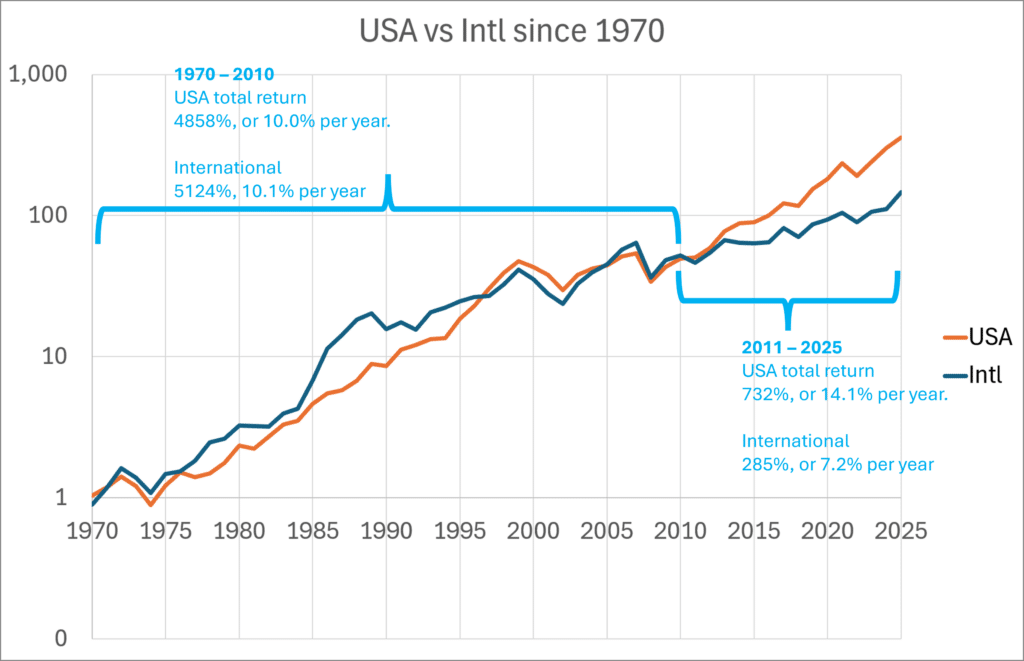
40 years of “even” performance, and then a most-recent 15-year period of clear US outperformance.
Will that US outperformance continue in perpetuity? A good question to ponder.
Are You Betting Your Portfolio On It?
Are you willing to bet your portfolio on future US outperformance? I see both sides of the argument.
The strongest argument toward “100% US stocks” is that a US-based investor with USD liabilities has a legitimate currency-matching reason to overweight US assets. They aren’t making an active investment bet, but instead matching their future USD liabilities to assets (stocks) denominated in USD.

But I much prefer the “global diversification” arguments.
- If markets are informationally efficient, then prices reflect all available information, and the risk-adjusted expected return of any segment (US, ex-US) is not knowably superior to any other.
- The global market-cap-weighted portfolio is the aggregate revealed judgment of every investor on the planet about how capital should be allocated across risk.
- Deviating from the global weighting is an active bet that the US will outperform ex-US on a risk-adjusted basis. This is the “shades of gray” of passive investing.
- Do you (or your advisor) have skill at making macroeconomic bets? If not, then home-country bias is an unrewarded active risk.
- Equity risk (ownership of a growing stream of corporate profits) is fungible across borders. A dollar of expected risk premium from Japanese or German equity is the same “type” of thing as a dollar of expected risk premium from a US equity.
That’s why I diversify internationally.
Thank you for reading! Here are three quick notes for you:
First – If you enjoyed this article, join 1000’s of subscribers who read Jesse’s free weekly email, where he send you links to the smartest financial content I find online every week. 100% free, unsubscribe anytime.
Second – Jesse’s podcast “Personal Finance for Long-Term Investors” has grown ~10x over the past couple years, now helping ~10,000 people per month. Tune in and check it out.
Last – Jesse works full-time for a fiduciary wealth management firm in Upstate NY. Jesse and his colleagues help families solve the expensive problems he writes and podcasts about. Schedule a free call with Jesse to see if you’re a good fit for his practice.
We’ll talk to you soon!
Thank you for reading! Here are three quick notes for you:
First – If you enjoyed this article, join 1000’s of subscribers who read Jesse’s free weekly email, where he send you links to the smartest financial content I find online every week. 100% free, unsubscribe anytime.
Second – Jesse’s podcast “Personal Finance for Long-Term Investors” has grown ~10x over the past couple years, now helping ~10,000 people per month. Tune in and check it out.
Last – Jesse works full-time for a fiduciary wealth management firm in Upstate NY. Jesse and his colleagues help families solve the expensive problems he writes and podcasts about. Schedule a free call with Jesse to see if you’re a good fit for his practice.
We’ll talk to you soon!