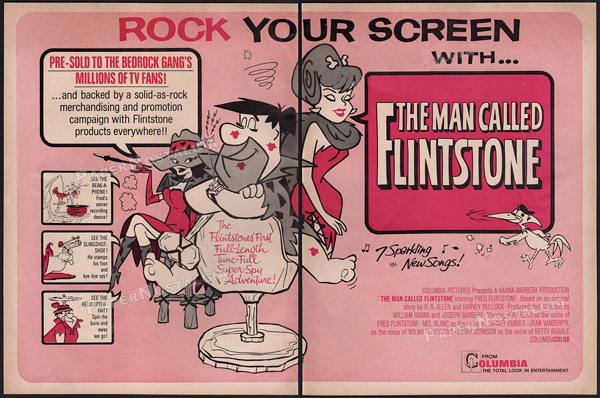

Rolling like a boulder into the “spy craze” of the 1960s came The Man Called Flintstone. The full-length, musical, animated feature starring the popular citizens of Bedrock, who had made their debut in 1960, in Hanna-Barbera’s landmark animated series.
 The film, which celebrates its 60th anniversary this summer, was produced just as The Flintstones series completed its run in April of 1966, at a time when Sean Connery had just starred in four James Bond hits, starting with Dr. No in 1962, and NBC’s The Man from U.N.C.L.E. became a TV phenomenon, along with British TV import Secret Agent with Patrick McGoohan. In early 1966, James Coburn played Our Man Flint on the big screen, and Diana Rigg and Patrick Macnee created a sensation with ABC-TV’s The Avengers.
Hanna-Barbera took full advantage of the spy-fiction popularity as a backdrop for The Flintstones full-length feature. The title was a twist on Our Man Flint, with Fred in a Coburn-like pose on the original poster.
Directed by William Hanna and Joseph Barbera, and written by TV sitcom veterans Harvey Bullock and R.S. Allen, The Man Called Flintstone takes Fred, Wilma, Barney, Betty, Pebbles, and Bamm-Bamm from the “the Town of Bedrock” for a globe-trotting adventure to Paris and Rome, rendered beautifully in the Hanna-Barbera/Flintstone style (Dino and Hoppy are boarded at the vet’s.).
Noah Bell, writer, animation historian, and creator of the Hanna-Barbera blog, The Exposure Sheet, said, “It’s easy to forget how big of an undertaking the film was for the crew at Hanna-Barbera. The movie was in production for eighteen months, over twice the time needed for an episode of the series. Three thousand drawings were made for the film. And though the story may not seem like much these days, the spy and vacation aspect made it far different than anything seen in the series, even if it still relied on the ‘Fred is mistaken for somebody else’ plotline the show loved to use.”
 “The ongoing process of bringing a TV series to a theatrical film goes back to radio,” said our fellow Cartoon Research writer, Greg Ehrbar. “The Great Gildersleeve starred in several films and other radio stars made special appearances, like Edgar Bergen and Charlie McCarthy in Walt Disney’s Fun and Fancy Free. On the other hand, The Adventures of Ozzie and Harriet premiered as a feature film called Here Come the Nelsons, to assert the appeal for the long-running series. Either way, the TV adaptations often took the characters out of their typical settings to open up their environment for the movie screen.”
In The Man Called Flintstone, Rock Slag, the world’s most famous spy, looks like Fred, and when Slag is injured, it’s discovered that Fred bears a striking resemblance to Slag, and Fred is recruited to take Rock’s place on assignment to stop the villainous Green Goose and devious plans involving a missile.
Fred keeps his mission a secret, and his family and friends think that trip is a vacation. However, the Green Goose’s second in command, Tanya, tricks Fred and Barney and leads them to Green Goose’s headquarters, where Rock Slag eventually arrives, and the Green Goose’s scheme is foiled.
 “By design Hanna-Barbera added a bit more dimension to Fred for The Man Called Flintstone, as they did particularly with Yogi in his 1964 feature, Hey There It’s Yogi Bear,” added Greg, who with Jacqueline Stewart, hosted the Turner Classic Movies premieres of both films last December. “Yogi was the rascal we knew and loved but was also capable of more compassion and heroics. In addition, Fred has his regular concerns about job, money, family, and friendship, but in the film he literally has the weight of the whole world on his shoulders, and not in a satiric ‘Madame Yes’ way.”
The Man Called Flintstone boasts a greater percentage of fuller animation and more lush, detailed backgrounds than those usually seen in the weekly TV show. After the main title song, which parodies the typical Shirely Bassey-type spy movie tune, the opening moments include dramatic prehistoric backdrops and a well-choreographed car chase between Slag and the film’s villains.
There are also creative animation montages in the film’s musical numbers, including the psychedelic “Spy Type Guy” and the Pebbles and Bamm-Bamm song, “(Someday) When I’m a Grown-Up,” which utilizes images with childlike drawings.
The songs in The Man Called Flintstone, from songwriters John McCarthy and Doug Goodwin, add to the adventurous plot and give the film a grander scale, making it feel much different than an episode of the show.
 “John McCarthy impressed Hanna-Barbera with his two songs for the ‘Christmas Flintstone’ episode,” Greg added. “Doug Goodwin was recommended by Friz Freleng when he worked at Hanna-Barbera briefly as a consultant. Goodwin was the primary house composer for DePatie-Freleng.”
A year before he would voice King Louie in Disney’s The Jungle Book, singer Louis Prima performs Goodwin’s “Pensate Amore (Think Love)” over the film’s soundtrack, accompanying a Shakespearian Fred’s attempts to romance Wilma, a gag sequence reminiscent of Hanna and Barbera’s MGM days.
The regular Flintstones cast returned for the film: Alan Reed as Fred, Mel Blanc as Barney, Jean Vander Pyl as Wilma, and Gerry Johnson as Betty, who had taken over for Bea Benadaret, in the fifth season of the series.
Henry Corden would provide the singing voice for Fred in The Man Called Flintstone, as he did in H-B’s Alice in Wonderland the same year. Corden would go on to take over the role of Fred after Alan Reed died in 1977.
Additionally, Harvey Korman (who would voice The Great Gazoo in the series and become a regular on The Carol Burnett Show) was the voice of the Chief, and Paul Frees, a ubiquitous voice actor at the time, provided several voices, including Rock Slag and the villain, Green Goose. June Foray, who, like Frees, would become a voice acting legend, portrays the femme fatale Tanya (a performance reminiscent of her work as Natasha on Rocky & Bullwinkle).
 Released by Columbia Pictures to theaters on August 3, 1966, The Man Called Flintstone brought plenty of the hallmarks of the show to the big screen, particularly the series’ “prehistoric technology” – a dinosaur is creatively used to operate an elevator, and spy gadgets have to be filtered through The Flintstones’ “world.”
Sixty years later, the film is still seen as a milestone for the “Modern Stone-Age Family.”
“The greatest impact The Man Called Flintstone left was on The Flintstones going forward,” said Noah. “No longer did Flintstones movies and shows have to be Fred and the gang living ordinary lives in Bedrock. If they could go on spy adventures, practically anything was on the table. The next twenty years of Flintstones spin-offs saw the characters reimagined as police officers, kids, and everything else in between. They met the Thing, the Shmoo, and the Frankenstones. Love or hate these later projects, it’s safe to say the Flintstones’ later years would’ve looked a lot different had it not been for The Man Called Flintstone, and the show’s final seasons for that matter, stretching the possibilities. At the very least, it’s an impressive legacy for such an oft-forgotten moment in the Flintstones history.”
“Hanna-Barbera did not have the luxury of lingering time and expansive budgets to make theatrical features like this,” said Greg. “Yes, Columbia gave them the means for songs, an original score, and more elaborate art, but the fact that they were carrying an increasing workload and still created a enduring, entertaining feature like this, is a remarkable and significant accomplishment. All I know is that I never missed it when it showed at matinees, and it continues to impress and endure.”