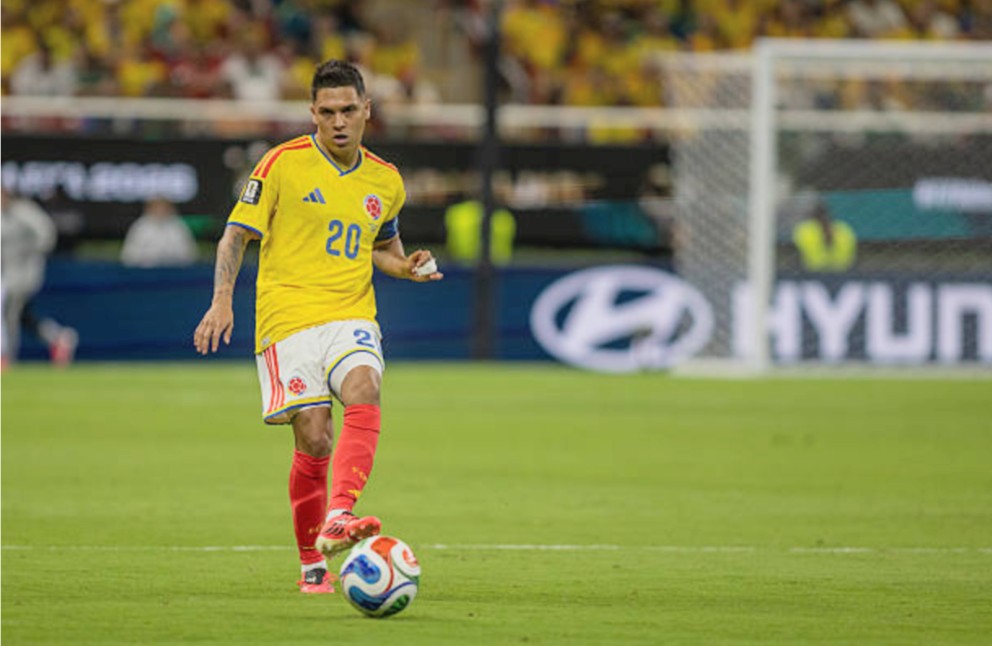
June 24th 2018, Colombia beat Poland 0-3 in a World Cup group stage tie, where Juan Quintero was excellent, playing disguised passes, combining with James Rodriguez. Eight years later to the day, Quintero impressed against DR Congo, once again showing off his creativity.
For many years, Quintero has been the understudy to James in Colombia’s outfit, but has offered a like for like replacement that can keep attacks alive in the latter stages of a match. A 58th minute substitute against DR Congo, Quintero supplied a range of defence splitting passes, one of which set up what ultimately proved the winning goal.
Colombia’s nominal 4-3-3 shape has been flexible in their opening two group games, with James, and then Quintero, nominally on the right flank, but with licence to drift inside into the centre, and even across to the other side of the pitch to keep attacks moving. This has seen midfielder Gustavo Puerta push ahead, with right-back Daniel Munoz breaking into the penalty-area, whilst left-back Johan Mojica overlaps Luis Diaz as he drifts inside having started out wide.


And Quintero was clever in the positions he took up to receive the ball, in both build-up, and closer to goal, from which he could play passes to set up teammates.
For example, Quintero moved into the channels, where he could play the ball out to in, or to Munoz on the outside. In one scenario soon after being introduced, Colombia worked the ball from right to left, and back again, with the ball finally back at Quintero’s feet. Colombia aimed to pack numbers in and around the box, with Quintero’s pass through a gap between four DR Congo players, finding centre-forward Jhon Cordoba.

With his back to goal, Cordoba passed to Arias, who returned the ball to Quintero. But Quintero’s attempt to find Munoz went out of play.
Quintero at times stationed himself out wide, where he could send passes over the top of the DR Congo defence. This was perfect for finding deep runs from Puerta, or Cordoba if he was making a run on the shoulder of a defender.
Below, after the ball was worked from left to right as Colombia built up patiently, Munoz passed to Quintero. Both Puerta, and Cordoba made runs. Quintero’s pass not only sped up the tempo of play, but was played into Cordoba after Puerta’s run occupied one defender, dragging them out of position. Cordoba was unlucky to see his first touch bring the ball out of play.

Similar outcomes occurred when Quintero held a deeper position, where he could take hold of possession unmarked. Puerta again had room to roam ahead of Quintero. Luis Diaz, meanwhile, dropped off the nearest marker to offer a short option as Colombia still looked to attack in narrow spaces, often overloading one side of the pitch. But Diaz’s movement also created further room for attackers closer to goal, Quintero picked another ball over the top of the DR Congo defence, this time finding Puerta down the right flank. The attack came to no avail, but it was clear Quintero was key to getting beyond the opposition’s back line.

The playmaker could also switch the play over to the spare man on the left hand side. Quintero at times followed the direction of play, moving across the pitch to offer the return option, by extension keeping the attack moving. A one-two with Mojica set the full-back free down the flank, before playing a cross into the box.
Eventually, following the second-half hydration break, Quintero provided the assist for Munoz’s goal. The goal showed everything about both players tendencies with Colombia’s system, but also the core strengths of their games.
Short combination play in the centre is disrupted, before ball is flicked to Quintero. In the process, Quintero had dropped a few yards into vacant space.


Quintero’s first touch not only brought the ball under control, but sets Quintero up to play a pass.

Quintero took a brief pause before playing the pass. The most delicate of through balls from a standing position to meet the run from Munoz, who was unmarked on the right wing. The move, and the overall set up platforms the players to do what they do best.

As the ball was played, Cordoba held off the defender so the ball could run on to Munoz…

who shot first time, with his effort deflected into the bottom left corner.

Quintero’s introduction to the match offered that extra creative presence needed to break down DR Congo. Quintero played 9 passes into the final third, 2 chances created, and completed 7 of 10 long balls.
Munoz’s run ignited another goal for himself, meaning he has 2 goals in as many matches, and has taken more shots than he has chances created. Munoz is a valuable cog in this Colombia set up, much like at Crystal Palace.
Colombia’s narrow attack, with the full-backs providing the width, is not too dissimilar to how other South American sides, including Brazil, and Argentina, are attacking; in close combinations, including in a 4-D-2. Nigeria also played this way during the most recent AFCON.
Quintero fits in with this, and is a lovely footballer, who follows a long standing tradition of languid no 10s in South America. Though not as prevalent in the modern game, they still pop about here and there. He is one of them, and will continue to offer a solution off the bench, or perhaps even start games later on in the competition.