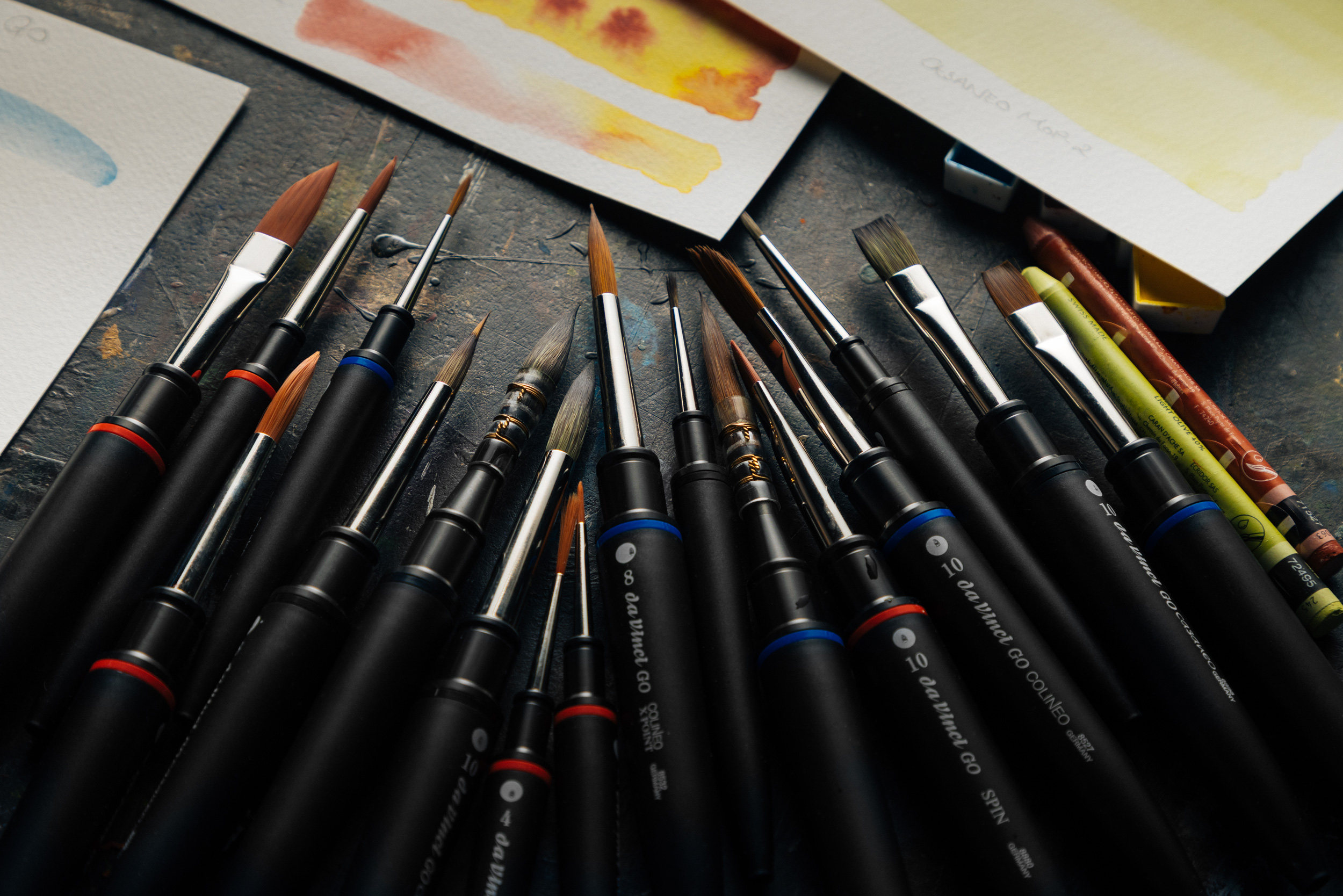
Da Vinci has a great track record with travel brushes, so I was interested in trying their new Da Vinci Go range. Available in several fibre types, with a variety of shapes and sizes, the Go range offers a comprehensive selection for artists on the move.
Da Vinci was founded in Nuremberg in 1950, building on the family’s brushmaking expertise dating back to the late 19th century. The aim was to make the best brushes in the world and, like their Renaissance namesake, the company has embraced innovation. Da Vinci was an early adopter of synthetic fibres, even developing their own equipment as the technology advanced.
Synthetic brushes were once considered inferior to natural hair brushes, but have come a long way. Their spring and low porosity offer distinct advantages. Furthermore, decades of development have led to increasingly convincing imitations of natural hair. I tested the three vegan Da Vinci Go ranges: Casaneo, Colineo, and Spin. I used Jackson’s Artist Watercolour half pans on a 300gsm, cold pressed Jackson’s Watercolour Block. I also tested Caran d’Ache Neocolor II Artists’ Watercolour Crayons, and Faber-Castell Graphite Aquarelle pencils. Using a range of watercolour techniques, I assessed their properties with travelling and plein air artists in mind.

First Impressions of the Da Vinci Go Brushes
A major consideration for good travel brushes is keeping the bristles safe, commonly achieved with retractable, fold-away, and screw-fitting designs. Da Vinci Go brushes have a hollow plastic handle into which the brush inserts, clicking securely closed. The rounded end makes the brush easy to remove from the handle, yet the fit feels strong; I’m not concerned about one coming loose in my bag. Although the brush head can rotate in the handle, it never did so unintentionally during use.

The handle has a maximum diameter of 12 mm, and is 97 mm long. Open brush lengths range from 141 mm to 190 mm. They are slightly larger than many travel brushes but feel lightweight and balanced in the hand. The spacious hollow handle allows room to insert the brush without trapping hairs or damaging the tip. Each range has a different coloured band, helping identification in a mixed collection.
Each collection features round brushes ranging from size 1 to 10, and a flat size 10. Additionally, the ranges each have two specialist brushes suited to their bristle characteristics, maximising mark-making potential across the Go selection.

The Da Vinci Go Colineo Range
Colineo brushes are made with a mixture of straight and wavy synthetic fibres, designed to resemble Kolinsky red sable hair. Sable has long been held in high regard by watercolourists due to its ability to hold plenty of water while retaining its shape, offering a balanced option for both loose marks and controlled detail.
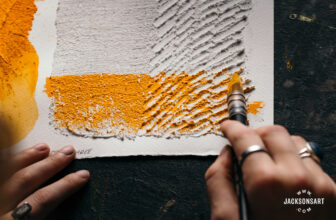
Using Cerulean Blue, a granulating colour, I created three washes: one on damp paper, one on dry paper, and a third with higher pigment load. The Colineo lays down colour well, but the bristles are strong enough to disturb wet paint when passing over, so there was a little streaking. The wash on damp paper was the most even. Diluted paint marks made on top of these washes did not appear to disturb the layer once dry.

Lifting from wet paint was quickest, though lifting from a dilute and a more pigmented layer of dry paint produced marks with more clarity.
I made brushmarks on damp paper, dry paper, and also similar marks with a more concentrated pigment load. The brushes felt comfortable throughout, suiting loose, expressive marks and controlled detail alike. The round brushes in this range are extra long, emphasising their precise tip. This added flexibility allows for curves and some fine details, even with a No. 8 round, one of the larger brushes, with a 5.3 mm diameter.
The Colineo performs well across a wide range of applications, making it a great all-rounder for a minimal travel kit.
The Da Vinci Go Casaneo Range
Casaneo brushes are made with soft, wavy synthetic fibres that replicate natural squirrel hair, which is renowned for its exceptional water-holding capacity. This quality makes them well-suited to washes and loose mark-making.
I repeated the three wash types with Olive Green. A single brush-load held enough paint for both dilute washes, which laid down evenly. The concentrated wash dried flat, though pigment accumulated at the edges; masking the area would reduce this. Fresh paint applied with soft Casaneo round, mop, and flat brushes, layered cleanly over the dry washes; even watery paint did not disturb the underlying wash. With the flat brush, I was able to build up considerable colour density; by the fifth layer, the wet brush began to disturb the paint below.

These absorbent brushes lifted wet paint effectively, although the surrounding colour spread, forming irregular edges. Lifting dry paint required several passes, and a firmer brush would be better for details. The soft fibres do not spring back into shape but regain their point when dipped in water. Using No. 2 and No. 10 round brushes, I mixed Olive Green and Alizarin Crimson wet-in-wet. Flooding the colours together, first on dry, then damp paper, created interesting effects and unpredictable colour mixing. In a glaze, a very wet application of green caused the red underneath to bleed slightly.
Though achievable with a steady hand, detail is not the strongest area for this range. However, with Neocolour II in Light Olive and English Red, and an 8B Graphite Aquarelle from Faber-Castell, the delicacy of Casaneo was great for leaving hints of the drawn line.

These travel brushes are flexible, full-bodied, and have a good point when wet. They are best suited to building base layers, big skies, and distant foliage.
The Da Vinci Go Spin Range
This is probably the fibre type that most people picture when thinking of synthetic brushes. The Da Vinci Spin brushes embrace the very characteristics that were once seen as a disadvantage compared to their natural hair counterparts. Although soft, the brushes hold and ‘snap’ back to their original shape, and the straight, smooth fibres carry less water.
These brushes readily load with colour and can paint dense marks with a high paint-to-water ratio. Colour applies steadily to the paper from a brush with the right balance of water to paint; a drier brush soon skims the surface, creating broken brush marks. Washier marks are possible but without the high surface coverage of the water-retaining synthetic naturals. A dilute paint load travelled around eight inches before the brush began to run dry. Another option is to draw paint out from an area of dense colour, reloading the brush with water as needed.

With a high colour load, wet-in-wet marks can be unpredictable; I overloaded my brush and flooded my area with Yellow Light. A drier brush yielded a much more controlled result, as did glazing over dry paint.
The resilient Spin brushes consistently supported controlled mark-making, from the largest to the smallest brush in the range, retaining their shape throughout use. These are the brushes I’d reach for to achieve intense colour and crisp details.
Comparing the Brush Shapes Between The Three Ranges
Many artists would likely select brushes across all three ranges, depending on subject and style. I set out to do side-by-side comparisons of the specialist brushes available.
The Colineo and Casaneo mop brushes produced similar results in graduated washes, but handled differently; the Casaneo releases colour more steadily for controlled application.

This same difference was evident when feeding Alizarin Crimson into wet Yellow Light – Casaneo retains more fluid while the Colineo releases paint more readily, particularly into wet colour.
Colineo and Spin feature slant-edge brushes. Painting solid marks with Cerulean Blue, the Colineo was more flexible, while the Spin responded to controlled pressure. Loading the brush bellies with dilute Olive Green, then the tips with concentrated colour, produced graduated marks. I repeated this with dilute Yellow Light and concentrated Alizarin Crimson. The gradient and the two-tone Spin marks are defined, though prone to puddling with an overloaded brush, while the Colineo marks are more blended and the fibres provide steadier colour flow.

Casaneo features a liner brush with a Casaneo ‘belly’ and a longer, fine point centre of Colineo fibres. The Casaneo reservoir feeds water to the Colineo tip, which has the strength to hold its point and manoeuvre across the page. Drawing a continuous line across, I ran out of stamina before the brush quite ran out of paint!
The Spin rigger has nothing like that range; however, directional changes are a little easier, and the brush can be reloaded for shorter lengths of more intense colour.

Rather than duplicating each other, these specialist brushes highlight the distinct qualities of each range.
The Da Vinci Go brushes don’t feel like a compromise. These are high quality brushes that feel just as capable as their studio counterparts, but designed with features to keep them safe when on the move. Together, the Colineo, Casaneo, and Spin travel brushes cover such a wide range of techniques that most watercolourists could assemble a well-tailored kit for travelling light or painting en plein air.

Further Reading
How Da Vinci Watercolour Brushes are Made
The Development of Synthetic Brushes
Review of Da Vinci’s New Synthetic Paddle Brushes
Shop Art Materials at jacksonsart.com