Building sculptural form and texture in watercolour paintings might sound like an outlandish idea to many, but a range of mediums make it possible. They can be applied under, over, or mixed into watercolours, to expand the material possibilities of the medium. In this article, I describe and demonstrate techniques for using each medium, with suggestions for their application. Articles in the Techniques Series define the meaning and context of art making processes and give practical tutorials on how to work with them.

Definition: Watercolour texture mediums are specialist liquids, gels, or pastes, that are applied beneath watercolours, mixed into them, or applied on top of them, to create textural effects. They make impasto possible for watercolour painters, and create visual textures that would be challenging to replicate by hand.
What is the Effect of Using Watercolour Texture Mediums?
Creating visual and physical texture with watercolours increases their versatility and allows for a range of surprising effects. Impasto is not a technique you would usually associate with watercolour, but impasto mediums make it possible. They allow watercolourists to emulate the characteristics of other types of paint without losing the core qualities of watercolour. These traditional and experimental effects can be combined within the same painting or practice using just one additional product.

By building texture or form on a watercolour surface before painting, the artist introduces new planes across which colour can disperse. Fluid watercolour washes will run and concentrate in the depths of the three dimensional forms, leaving the higher peaks exposed. Whereas dry brushing or scumbling over the peaks accentuates them. Even without adding extreme texture, using watercolour texture mediums to create an irregular surface breaks watercolour from the uniformity of paper. Some modelling grounds also allow watercolourists to prepare and paint on unconventional surfaces, like wood and metal.

The impact of watercolour texture mediums lies in their element of surprise. Sculptural form and physical texture are not what most people expect when they envision watercolour painting. Compared to acrylic texture mediums, they are still used relatively rarely by artists, making them an excellent way to experiment and surprise your viewers.
How Long Should You Leave Watercolour Mediums to Dry?
The drying time of watercolour mediums varies widely depending on the thickness of application, the nature of the product itself, and the climate you’re working in. Since they’re all water-based, they rely on evaporation to cure. Some mediums may feel touch dry on the surface before they’ve fully cured inside. It’s best practice to give watercolour mediums that add physical volume to your paint at least 48 hours to dry. For spray-on texturising mediums, like granulation or effect spray, the drying time is much shorter – sometimes only within a matter of minutes. For absolute certainty, give these mediums at least an hour to dry down.

What Surfaces Can you Apply Watercolour Texture Mediums to?
Heavy watercolour papers and watercolour panels are the best surfaces for applying watercolour texture mediums to, since they are better equipped to resist any warping caused by the weight of the products. Stretching the watercolour paper is also a good idea, which will help minimise the paper distorting. Dimensional grounds also allow watercolourists to paint on unconventional materials like wood, metal, or canvas.

How do you Wash up Watercolour Texture Mediums?
Since watercolour texture mediums are watersoluble, they can be washed with soap and water, just as you would wash your palette and brushes normally. Tools which have been used with mediums that aren’t re-wettable should be washed up straight after use.
Impasto Medium
Watercolour impasto mediums are transparent gels used to thicken watercolour paint. By increasing the viscosity of the paint, they allow watercolourists to mix paint that holds peaks and builds form, but still disperses easily with water.
For my technique example sheet, I used Schmincke Aqua Watercolour Pasto Medium. This product is dark yellow in the jar with a consistency like thick vaseline, which dries with a light yellow hue. As well as increasing the body of paint, it increases the gloss, and makes undiluted paint slick and malleable to handle. This impasto medium is also rewettable with water once dry, allowing you to loosen and edit your impasto watercolour painting with freedom. This is a slow drying medium, so giving it at least 24 hours to cure is best practice.

To begin, I applied some of the Schmincke impasto medium directly to the page to show its true colour, before mixing it with Phthalo Blue Lake with a palette knife, and dispersed it below. As you can see, the medium retained the grooves and lines from the swipes of the palette knife, and diluted easily with water.

On the right, I made an example painting combining conventional watercolour painting with areas of impasto. I painted a cloudy landscape with washes of watercolour, before pasting on a gnarled tree with the impasto medium mixed with black paint on top in the foreground. I drew sgraffito lines through the medium, to exaggerate the texture of the tree, which dried crisp. The contrast between the flat, matt paint of the background, and the sheen of the impasto tree creates depth and impact.

Modelling Paste
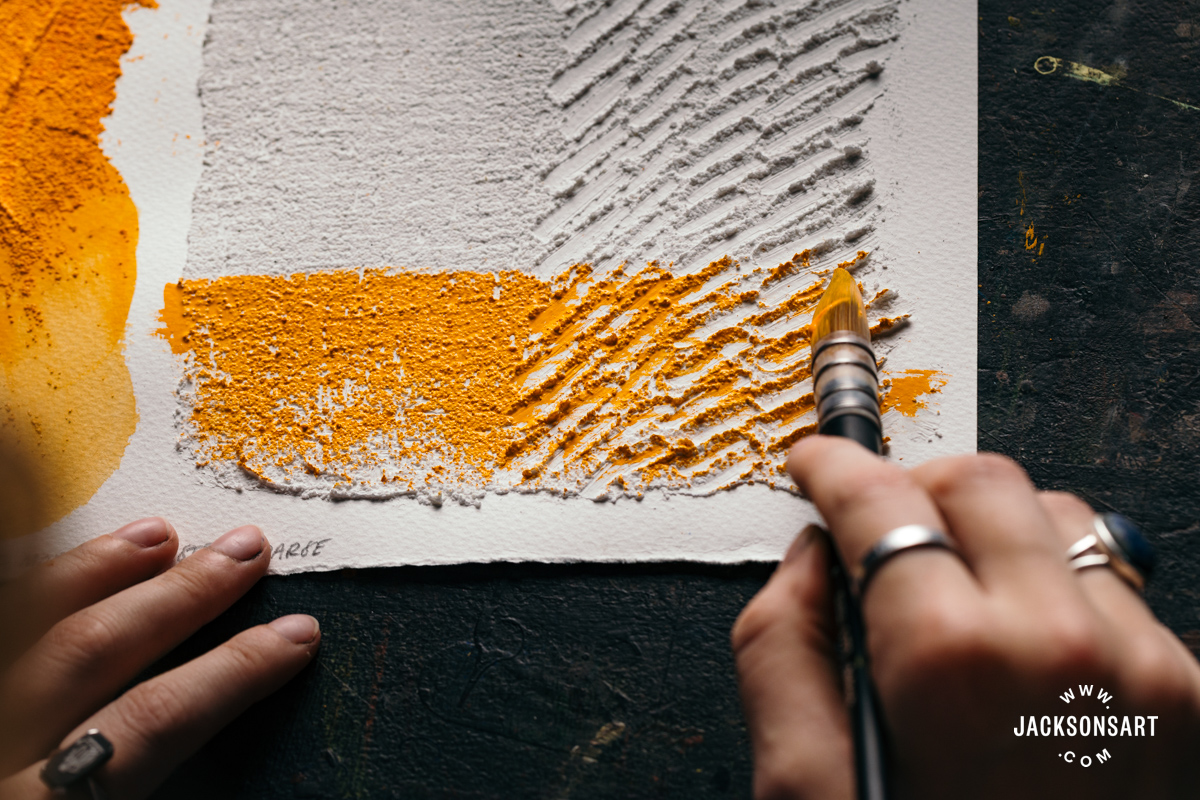
Modelling pastes appear opaque white straight from the jar, and are used to build texture on watercolour surfaces, or mix with watercolours to create thick paint. They may vary in consistency, from fine to coarse, depending on the texturising agents added to the paste. They allow painters to build impasto paintings, and create custom patterned, mottled or irregular surfaces to paint on top of. Modelling pastes can also be scraped through rigid stencils to create uniform patterns on painting surfaces. Modelling pastes are designed to be absorbent and dry matt – so they accept watercolours easily without beading.

For my technique example sheet, I used Schmincke Aqua Watercolour Modelling Paste in Coarse. To begin my sheet, I mixed the paste with a palette knife with Cadmium Yellow Deep. It didn’t require much paint to give the paste a strong colour, so tinting from the white of the paste isn’t a concern. The watercolour combined with coarse modelling paste had a thick icing-like consistency, with a slightly gritty texture, making it appear like coloured plaster. It held the structures from dragging my palette knife through the medium very well, and still diluted smoothly with water.

I tested spreading the modelling paste out as smooth as I could, to see how it would behave as a flat watercolour ground. It took some refining to flatten out the paste with my palette knife, but the resulting texture was like a heavy cold pressed watercolour paper. Next to this, I applied another layer of the paste, that I scored a diagonal repetitive texture into with the end of my palette knife, to test creating a custom surface for painting. After allowing the paste to dry, I painted over both of them with solid colour and a light hand to show the difference in finish.

Dimensional Ground
Dimensional ground is designed to be applied onto a surface before painting. It allows artists to apply watercolours to unconventional surfaces, like wood or metal, by creating a paintable layer without the need for paper. It builds texture and form very well, and can also be smoothed out. Unlike modelling paste, dimensional ground is designed solely for applying as a ground, and not to mix directly with watercolours.

For my technique example, I used Golden Qor Light Dimensional Ground. This product’s consistency is like thick foam and isn’t self-levelling, allowing you to smooth the surface out, or use it to create ridges, peaks, and patterns. Since this paste is very buildable, it can be applied in thick layers, which should be given several days to cure.

On my sheet I applied it flat with a palette knife and a brush, and then irregularly with a palette knife. It’s harder to apply the paste in a thick layer with a brush, so this is the thinnest swatch. It retained the texture of the brush hairs, making it resemble a gesso ground for oil painting, which could be an interesting finish to deliberately emulate. The irregularity of the palette knife surface resembles tree bark, or a craggy rockface, making this technique useful for emulating natural textures.

I painted over each of the grounds with Cobalt Blue, in a stroke with strong colour, and one that was more diluted. The paint emphasised the texture of each section as it settled into the crevices of the ground. It was very dry and absorbent to paint over, so it created some resistance on the brush as I worked over it and the water quickly sunk in. If you enjoy working with very fluid paint be prepared to mix a large pool to wash over this ground. By lightly wetting this dried ground, you could achieve wet-on-wet watercolour techniques like blooming and bleeding.

Effect or Granulation Spray
Effect, or granulation sprays, are applied to wet watercolour paint to exaggerate or emulate the effect of granulation, by forcing the wet pigment to separate, leaving bare patches on the paper. Some pigments granulate naturally since they’re physically heavier, and granulation can be exaggerated by using textured watercolour papers where the pigments settle irregularly to create an uneven paint layer. These same factors are true for using granulation spray – the most noticeable effect will be achieved on rougher paper, with naturally granulating pigments.

For my technique example sheet, I used Schmincke Granulation Spray. This granulation spray is in an atomiser, which should be shaken well before use. In general, granulation in watercolours is most noticeable when more water is present, and the same is true when using granulation spray, since the pigment is able to move more. To demonstrate this I applied my watercolours wet-on-dry and wet-on-wet next to each other, before spraying them. As you can see the wet-on-wet side produced better granulation in both colours.

As a general rule, it’s best to apply granulation spray about 30 cm away from the page, so that the spray scatters evenly, and you don’t unintentionally create a concentrated spot in the middle. The texture of granulation spray is perfect for breaking up the monotony of flat colour, by introducing spontaneous and organic shapes and flecks.
Further Reading
Salt Texture Techniques for Watercolour Painting
Your Comprehensive Guide to Watercolour Mediums
Painting with Watercolour on Canvas: Choosing the Best Watercolour Ground
Creating Textural Effects with Acrylic Mediums
Shop Art Materials on jacksonsart.com