What to do, what to skip, where to eat, where to stay, and the practical, on-the-ground details, this Mumbai itinerary covers everything you need to know to plan 1 to 4 days in India’s most exciting city.
I’d been to Mumbai twice before I actually saw it.
The first time, I had just graduated from college. I was there for a month-long training program in a new city, surrounded by new people who became friends. Everything felt exciting. We did go out and explore a bit, but if I’m being honest, it was more about us than Mumbai. The city stayed in the background while we chased late nights, laughter, and moments that felt big at the time. The photos from that trip still exist somewhere, and let’s just say… they’re not making it to the blog.
The second time was a short family trip: guided tours, group photos, rushed schedules, the usual. I saw the Gateway of India the way everyone sees it. I came back with nothing useful, photographically or otherwise.
Mumbai existed in my memory as that city I’d technically visited but never really met.
This time felt completely different.
I came back with a travel writer’s lens. I walked more, slowed down, invested time, and paid attention. And somewhere along the way, Mumbai started to make sense.
Patient, restless, overwhelming, and strangely comforting all at once, this time, I didn’t just visit Mumbai. I finally saw it.
Here’s what I found: this city is extraordinary and exhausting in equal measure. The architecture alone in South Bombay is worth a transatlantic flight. A concentration of Victorian Gothic grandeur sitting alongside Indo-Saracenic masterpieces will genuinely stop you in your tracks. The sea is everywhere, shaping the city’s geography and its soul in ways that surprised me, even as someone who grew up in India. The food, when you find the right places, is wonderful. And the energy, that famous, relentless Mumbai energy, is completely real.
I should say here that Mumbai is also, in places, loud, dirty, and overwhelming. If you’re arriving from a Western city expecting the sanitized version of India you may have seen in travel photography, some of what you encounter will be jarring. Hey, India is not doing anything wrong. After all, this is a country of 1.4 billion people navigating rapid, complex change. But the gap between expectations and reality can be wide if no one prepares you for it. The best thing you can bring to Mumbai, more than any app or guidebook, is genuine curiosity and a willingness to be surprised rather than startled.
Now, about this itinerary. Mumbai’s travel reputation has calcified around a set of places and experiences that bloggers and guidebooks have been recommending on autopilot for years. Some of them hold up. Some of them really don’t. I’ll tell you which is which, because I went and looked with fresh eyes rather than borrowed opinions. This is the honest version: what I’d actually send a friend to, what I’d skip, and why.
One last thing: I’m about to move to Mumbai. So this is really the beginning of my relationship with the city, not the end. This post will grow as I do.
Heads up: some links here are affiliate links. That means if you click and buy something, I may earn a teeny-weeny commission (think chai money, not a private jet) at no extra cost to you. It’s a small way to keep this blog running, the words flowing, and the pages free for you to enjoy. I only recommend things I truly love, use, or secretly wish I invented, because trust matters, and so do good recs. Thanks for supporting the little cozy corner of the internet I call my virtual home.
First, Get Your Bearings: How Mumbai Is Laid Out

Before you start, it helps to know how this city is organized. Mumbai is enormous, and the word “Mumbai” can mean very different places depending on who’s saying it.
At the heart of it all is South Mumbai, also called the Island City or just SoBo. This is original Bombay, the seven islands that were reclaimed and stitched together over centuries. It holds the city’s oldest landmarks (Gateway of India, CST, Marine Drive), its business districts (Nariman Point, Fort, BKC), upscale dining, and some of the most expensive real estate on earth, including Antilia, the Ambani residence on Altamount Road. Most of Day 1 of this itinerary happens here.
The Suburbs connect to South Mumbai via bridges and long, traffic-choked roads, and are split into two. The Western Suburbs run from Bandra to Dahisar and include the trendy, Bollywood-famous stretches of Bandra, Juhu, Versova, and Andheri. Day 2 of this itinerary happens here. The Eastern Suburbs, from Kurla to Mulund, are a mix of residential and industrial neighborhoods, as well as the growing tech hub of Powai. Tourists rarely spend time here unless they’re visiting someone.
Central Mumbai, encompassing areas such as Dadar, Parel, and Worli, serves as a bridge between the old city and the suburbs. This is where the old textile mills stood, now converted into restaurants, offices, and malls. Siddhivinayak Temple is here. Day 3 of this itinerary happens here.
North Mumbai, covering Andheri, Borivali, and Malad, is rapidly developing and largely residential. It holds one genuine surprise: Sanjay Gandhi National Park, 100+ square kilometers of forest within city limits, complete with leopards. Not on this itinerary, but worth knowing about.
Finally, Mumbai Harbor on the eastern coast connects to Navi Mumbai across the water. It is also a launch point for the Elephanta Caves.
Everything in the next four days is in South Mumbai, the Western Suburbs, or Central Mumbai. If something sounds unfamiliar, you can come back to this map in your head.
How to Spend 1 to 4 Days in Mumbai: Detailed Itinerary

Arriving in Mumbai

Most international flights to Mumbai land late at night or early morning at Chhatrapati Shivaji Maharaj International Airport (CSMIA). Domestic arrivals are spread throughout the day. Either way, your first few hours in the city are about getting in and getting settled.
The airport is in Andheri East. Figure 45 minutes to 2 hours to SoBo (₹700–1,200) and 20–45 minutes to Bandra (₹400–700) by prepaid taxi or Uber/Ola.
If you’re arriving after midnight, expect smoother traffic but tired drivers. Always confirm your hotel’s full address. Mumbai has many hotels with similar names; see the Where to Stay section below for honest specifics.
If you land in the morning, you can dive into Day 1 of the itinerary after a shower and breakfast.
If you arrive late afternoon or evening, check in, freshen up, and eat at your hotel. Don’t underestimate jet lag. A shower, a meal, and an early night will set you up for a strong Day 1.
If you have a few hours and the energy, a short walk around your hotel’s neighborhood is enough.
If you’re arriving late at night, just sleep.
Day 1: South Bombay (SoHo)
Start early. I cannot stress this enough. Mumbai’s heat and humidity are not to be taken lightly. I was out by six. Those first two hours before the city fully woke up were some of the best I spent in Mumbai.
6:00 AM: Ballard Estate

If you’re staying in South Bombay, and I’d recommend you do, step out before breakfast and just walk around Ballard Estate. This planned Edwardian precinct is one of Mumbai’s best-kept secrets. All symmetrical facades and peaceful tree-lined streets that feel nothing like the Mumbai you imagined.
This area has the densest concentration of Edwardian Baroque buildings in Mumbai. Because they were all built to the same strict guidelines, the streetscape has a rare coherence, almost like a film set, except entirely real. Look out for the Mackinnon Mackenzie building, the domed Marshall & Sons, and the Mumbai Port Trust headquarters with two boats carved right into its basalt facade.
If you spot what looks like a very well-preserved old petrol pump standing among all these grand buildings, that’s Karfule. Built in 1938, it’s one of the last surviving Art Deco petrol stations in Mumbai, still run by the same family, still with its original terrazzo flooring inside. I love that it just exists here, stubbornly, between all these important buildings, as nobody got around to replacing it, and now it’s irreplaceable.
Early morning, with barely anyone around (though you’ll find professional photographers, models, and the occasional film crew already at work) and the light coming in low, it’s photogenic in a way that caught me completely off guard. I got some of my best shots of the entire trip here, before 7 AM, in what is essentially just a business district that hasn’t woken up yet.
Britannia & Co., the much-talked-about Irani café, is also right here in Ballard Estate and has been since 1923. You’ll find it in every Mumbai list ever written, and if it’s on your radar, now you know where it is. It opens at 11:30 AM and is lunch-only, so factor that into your planning. I’ll be honest: I walked past it on my morning stroll and decided to spend my appetite elsewhere. Some institutions coast a little on their legend, and I’d rather point you toward places that are earning it fresh every day.
7:00 AM: Sassoon Dock and Afghan Church
I’m a pure vegetarian, and the fish market wasn’t somewhere I could comfortably go. But Sassoon Dock is worth knowing about even if, like me, you see it only from the outside. The dock comes alive before dawn with the night’s catch arriving, all color and chaos, and the scene that makes for extraordinary photographs if you have the stomach for it.
What I genuinely wanted to see and what you should look for is the Sassoon Dock Art Project, a collection of murals painted onto the dock’s walls by Indian and international artists as part of a public art initiative, a street art intervention that changes how you see a working space entirely. Whether you can access the art from outside the port area or need to enter is worth checking before you go; I’d have gone just for that if I could have.
A two-minute walk from the dock is the Afghan Church, officially the Church of St John the Evangelist, built in 1858 to commemorate British soldiers who died in the First Anglo-Afghan War. It’s one of Mumbai’s most underappreciated beautiful buildings, a Gothic Revival structure with soaring stained-glass windows and a stillness inside that feels completely removed from the city outside.
8:00 AM: Breakfast


I walked back to my hotel after Ballard Estate. I was staying at the Grand Hotel, a heritage property right in the area, and breakfast there set me up well for the day. If your hotel offers a complimentary breakfast, take it. You’ll need the energy.
If not, or if you want to start the day with some history alongside your coffee, both Leopold Cafe and Mondegar are on Colaba Causeway and open early. Leopold from around 7:30 AM, Mondegar from 8. Most people associate both with their famous draught beer, which they only start serving after 1 PM, but they’re worth visiting in the morning for a completely different reason.
Leopold is one of Mumbai’s oldest cafes, dating back to the 1870s, and gained worldwide fame after Gregory David Roberts featured it in his novel Shantaram. It earned a darker kind of fame on the night of 26th November 2008, the worst terrorist attack Mumbai has seen. Ten people were killed here, many more injured, in what became one of the most harrowing evenings in the city’s recent memory.
The owners deliberately chose not to repair the damage. The bullet marks are still on the walls. The cracked windows remain. A security check at the entrance is now just part of the process of walking in. It’s a lot to sit with over a morning coffee, but there’s something honest about a place that chose memory over renovation. The ambiance and energy are still very much alive; it’s bustling and characterful, though I’ll be honest, the cleanliness in the non-AC ground floor section left something to be desired.
Mondegar next door is where I’d send you if you want the lighter version of the same experience. The Mario Miranda wall murals are wonderful; irreverent, witty, very Goan, and the jukebox gives the whole place a personality that’s entirely its own. Both cafes manage something impressive: they’re perpetually full, the space is small, and somehow neither keeps you waiting long. They’ve figured out the Mumbai art of moving people through without making anyone feel rushed.
9:00 AM: Gateway of India and Taj Mahal Palace

Yes, it’s the most photographed spot in Mumbai. Go anyway, and go early; by mid-morning, this area is packed. The Gateway itself is grander in person than in photographs, a 1924 basalt arch built to welcome King George V and that became the spot from which the last British troops left India in 1948. That detail alone changes how you look at it.
During my visit, the lower section was wrapped in black cloth for renovation work, and the immediate surroundings were a little rough: some dirt, some smell that comes with any heavily crowded waterfront area under construction. It didn’t take away from the monument itself, but worth knowing so it doesn’t catch you off guard.
Turn around and look at the Taj Mahal Palace Hotel instead. That terracotta dome, the Florentine Gothic façade, the sheer audacity of the building, it opened in 1903, and still holds the room. Built by Jamsetji Tata after he was reportedly turned away from a European-only hotel, it became India’s first hotel with electricity, a licensed bar, and a discotheque, and it has hosted everyone from freedom fighters to film stars to royalty in the century since.
You don’t need to go in to appreciate it; if budget allows, the Sea Lounge on the first floor is worth an experience in itself. A Mumbai institution, it sits in Art Deco surrounds with live piano music and views of the Arabian Sea. It serves breakfast from 7:00 AM, lunch from 11:45 AM, and afternoon tea in two sittings: 2:00 to 4:00 PM and 4:30 to 6:30 PM, both by prior reservation only. The spread mixes English classics with Indian street food, which somehow feels exactly right in a building this old and this grand.
There’s a lovely bit of Mumbai folklore attached to the lounge too. For generations, it’s been the spot where Mumbai’s high society has arranged introductions between prospective couples, and regulars will tell you about a “lucky loveseat” said to bring good fortune to those who sit there. Ask the head waiter when you arrive. Dress semi-formal if you’re going in.
If you’re staying at the Taj as a guest, sign up for their Heritage Walk, an in-house tour led by the hotel’s Palace Historians through the Taj’s history, art, and architecture. There are multiple slots throughout the day, first at 8 AM.
But before you walk away, pause for a moment with what this building has lived through. On the night of 26th November 2008, the Taj was one of several targets (along with Leopold Cafe and CST) in the worst terrorist attack Mumbai has ever seen. For nearly 68 hours, armed terrorists held the hotel under siege. Thirty-one people were killed here. What followed was one of the most extraordinary acts of collective courage anyone had witnessed. The hotel’s staff, with no training for what they faced, stayed behind to shield guests, guide them to safety, and, in some cases, give their own lives. Not a single employee ran. The Harvard Business Review later wrote about it. The world took note. The Taj reopened within a month, its message clear: we will not be broken.
The Taj has chosen to remember rather than rebuild over it. A small memorial corner pays tribute to the staff and guests who died: names engraved on a wall, candles lit each evening, even a mention of Lucy, a hotel dog who died protecting guests. A surviving tree from the attack stands nearby, now called the Tree of Life. The hotel just stands there, as it always has, looking out over the same harbor. That, somehow, says everything.
10 AM: Colaba Causeway and Regal Circle

Colaba Causeway is worth a slow walk even if you’re not a big shopper, but if you are, you’ll want to budget extra time here. The street vendors set up from around 10 AM, selling everything from junk jewelry and boho earrings to bags, scarves, Kolhapuri chappals, handicrafts, brass items, and sundry Mumbai souvenirs. The quality is what it is; these are street finds, not heirlooms, but the designs are often genuinely on-trend, and the prices are so easy on the wallet that you don’t really need them to last forever. Bargaining is non-negotiable here; start at roughly half the asking price and work from there.
It’s a particularly good spot if you’re shopping for a teenager or picking up gifts: fun, inexpensive, and you can spend an hour and come away with a little bag full of things that made you happy. I went looking for jewelry for my daughter at nearly 10 PM on my last evening here, and the causeway was fully alive: vendors still out, Leopold and Mondegar buzzing, people everywhere. Mumbai doesn’t really wind down in Colaba, which is part of what makes it so likable.
A few things to know: mornings are calmer, and vendors are often more willing to deal. Evenings are more electric but more crowded. Keep your bag close; any busy market in any big city warrants that. Also, wear comfortable shoes because the pavement is uneven and you will walk more than you planned.

At Regal Circle, stop by the Regal Cinema, Mumbai’s first Art Deco cinema, opened in 1933 and designed by Charles Stevens, notable for being India’s first air-conditioned theatre. It’s still very much running. When I was there, it was screening Dhurandhar, one of Bollywood’s biggest recent hits, and there’s something genuinely lovely about watching a blockbuster in a single-screen Art Deco theatre in the age of multiplexes. The interiors, the wide screen, the whole unhurried atmosphere, it feels like cinema used to feel. And the tickets and snacks are wonderfully easy on the pocket compared to what multiplexes charge these days. If a film you like is showing, seriously consider going. Just nearby is the INS Vikrant Memorial, commemorating India’s first aircraft carrier. Worth a quick stop, especially if you’re interested in naval or modern Indian history.
11:00 AM: The UNESCO Walk (Kala Ghoda to CST)

This is the heart of Day 1 and the reason South Bombay deserves its own full day. The entire stretch is walkable, and every hundred meters brings something worth stopping for. Don’t rush it.
Walk north from Regal Circle up Mahatma Gandhi Road (MG Road) and the city starts revealing itself properly.
First stop is Kala Ghoda, the art district named for the black horse statue of King Edward VII. The original was removed after independence; a replica now stands in its place, which is a very Mumbai kind of compromise.
The museums and galleries are all clustered here. The Chhatrapati Shivaji Maharaj Vastu Sangrahalaya, formerly the Prince of Wales Museum, sits in a magnificent domed Indo-Saracenic building that is itself worth the visit before you’ve even walked in. The National Gallery of Modern Art showcases contemporary Indian art in a sequestered, more contemplative space. The Jehangir Art Gallery has free entry and rotating shows, more casual, equally worthwhile. Pick one based on your mood and give it time. I spent close to 90 minutes at each museum I visited, and I didn’t feel it was enough. And practically speaking, stepping inside is also the smartest thing you can do as the heat climbs: cool, beautiful, cultural, and you come out feeling like you’ve actually earned the rest of the day.
While you’re in the precinct, look for the David Sassoon Library, built in 1870 by the Baghdadi Jewish Sassoon family, which has a garden where people still sit and read, one of those small, real Mumbai pleasures. Elphinstone College across the road is Victorian Gothic Revival at its most confident. The Charging Bull sculpture near the precinct makes for a good photo stop.
The Keneseth Eliyahoo Synagogue, painted blue since 1884, is tucked into this stretch and is one of the most beautiful and least-visited buildings in all of South Bombay. It’s a reminder that this city was assembled by communities from everywhere, and their layers are all still here.
Book lovers will find Fort a quiet kind of paradise. The most iconic of all is Kitab Khana, tucked into the 150-year-old Somaiya Bhavan near Flora Fountain. High ceilings, Corinthian columns, two floors of carefully curated fiction and regional Indian literature, and an in-house café called Food for Thought. The Financial Times once listed it among the most brilliant bookshops in the world, and that isn’t an overstatement. Nearby, Oxford Bookstore at Apollo Bunder is another longstanding favorite, well-loved for its curated picks and frequent author events.
A small, slightly mournful aside for the bibliophiles: Strand Book Stall, the legendary 70-year-old institution that ran from a building on Sir P.M. Road in Fort and was a rite of passage for generations of Mumbai readers, closed its doors in February 2018. Locals still talk about it. If you ask older Bombay regulars about their favorite bookshop, you’ll often hear Strand’s name first, then a sigh.
When you’re done, Kala Ghoda Café and Malido are both right here, and this is exactly the right moment for both. Kala Ghoda Café earns its reputation honestly: good coffee and a lovely, characterful space. Malido nearby, not as famous as KGC, but worth trying for a snack or something light. Bake House Café is also a beautiful alternative. Rest your feet, have something cold, and then continue north toward Flora Fountain.


Officially, Hutatma Chowk, Flora Fountain is a 1864 Portland stone fountain at the junction of five roads. Mumbai’s Piccadilly Circus. The Hutatma sculpture alongside honors those who died in the Samyukta Maharashtra movement. Two statues, two eras, one square.

From Flora Fountain, head east toward Horniman Circle. The circular garden here, recently restored in 2024, is ringed by magnificent colonial commercial architecture from 1858 to 1878. At the northern end stands the Town Hall, home to the Asiatic Society Library, founded in 1804 and one of India’s oldest. The sweeping stone staircase is iconic. Step inside if it’s open; the reading room is extraordinary.
The Reserve Bank of India building nearby is another landmark worth a glance: a solid, imposing 1930s structure that anchors this stretch as the financial nerve center it has always been. The New India Assurance Building is another architectural stunner in the same vicinity.

Now head to CST: stand across the street and just look at it. This 1888 Victorian Gothic railway station by Frederick William Stevens is one of the most extraordinary buildings in Asia, and it’s a fully functioning station that handles millions of commuters every day. That combination of grandeur and ordinary life is pure Mumbai. Directly across from it, the BMC Building is CST’s Gothic counterpart and receives a fraction of the attention it deserves. Look at both together.
3:30 PM: Marine Drive

From CST, walk west toward Churchgate. As you do, the Bombay High Court comes up on your right, same architect as CST, Early English Gothic, with a blind Justice and blind Mercy carved into its facade. Next to it, the University of Mumbai campus, and rising above it, the Rajabai Clock Tower, 85 meters of Venetian-Gothic ambition that looks like it was relocated from Florence. You can’t go inside, but you don’t need to.
Then Oval Maidan opens up, a long colonial-era cricket ground with all that Victorian Gothic stone on the eastern side and a row of Art Deco residential buildings on the western side facing it across the green. That contrast in one glance is one of those only-in-Mumbai moments.
As you continue toward Marine Drive, you’ll pass Mantralaya, the Maharashtra State Parliament building, the seat of the state government, an imposing presence on this stretch that most tourists walk past without realizing what it is. Worth knowing.

From here, it’s a short walk to Marine Drive. The Art Deco apartment buildings here, Soona Mahal, Keval Mahal, and others along this stretch, form one of the largest surviving collections of Art Deco architecture in the world. Most visitors, including many Indians, don’t know this. Some were under renovation when I visited, which is actually a good sign.
Walk the entire promenade north toward Chowpatty. The sea on one side, those curved facades on the other, the city turning golden as afternoon softens into evening. All 3.6 kilometers of it. Worth every step.
Sunset and Blue Hour: Girgaon Chowpatty Viewing Deck

End the walk at Chowpatty Beach and go up to the viewing deck. The sunset from here, looking back down the full curve of Marine Drive as the lights come on one by one, the Queen’s Necklace earning its name in real time, is one of Mumbai’s genuinely unmissable sights. I stood here well into blue hour and still didn’t feel done. Bring your camera and give yourself more time than you think you need.
The beach itself is lively and worth the atmosphere. I’d be cautious about the food stalls on hygiene grounds, but the scene: families, children, couples, the evening chaos of a city unwinding, is worth taking in.

Dinner at Soam
End Day 1 at Soam, near Babulnath, which does Gujarati and Rajasthani vegetarian food with real care and in a clean, calm setting. Dining here is beautifully casual, unhurried, nourishing, and genuinely good.
A note on pacing: I walked about 25,000 steps on this day, and I’m a seasoned traveler who was deliberately trying to cover ground. You don’t have to do all of this in one go. If you have two or more days in Mumbai, consider splitting the museum visit and the Marine Drive walk.
If you have just one day or you’re on a layover and want to make the most of limited time without the stress of navigating it yourself, a guided tour is the smarter call. This private Mumbai sightseeing tour is a Traveler’s Choice Award winner with over 1,600 reviews, a private English-speaking guide, air-conditioned car, and a flexible itinerary, starting from around $27 per person. The highlights of the Mumbai sightseeing tour are a good alternative. Both will get you to the highlights without the guesswork.
One more idea: start Day one with a guided Bombay by Dawn tour. A handful of Mumbai operators run an early-morning experience that begins around 4:30 to 5 AM and shows you the city before it officially wakes up, covering the wholesale flower market at Dadar, the Sassoon Dock fish market, dabbawalas in motion, mill workers heading home from night shifts, and the morning rituals of working-class Bombay. The tour runs 3 to 4 hours and usually ends with breakfast at an Irani café. No Footprints runs the most-loved version, costs around ₹8,000 per person, and requires booking a day ahead. A wonderful alternative if you’d rather have a local guide you through Mumbai’s most peaceful and beautiful hour, rather than figuring it out on your own.
Day 2: Bandra, The Queen of Suburbs
Bandra is one of those places that takes a full day to feel. This day starts at the sea and drifts north through old lanes and new cafés, ending where Mumbai’s most famous bridge begins.
5:45 AM: Cab from South Bombay via Sea Link

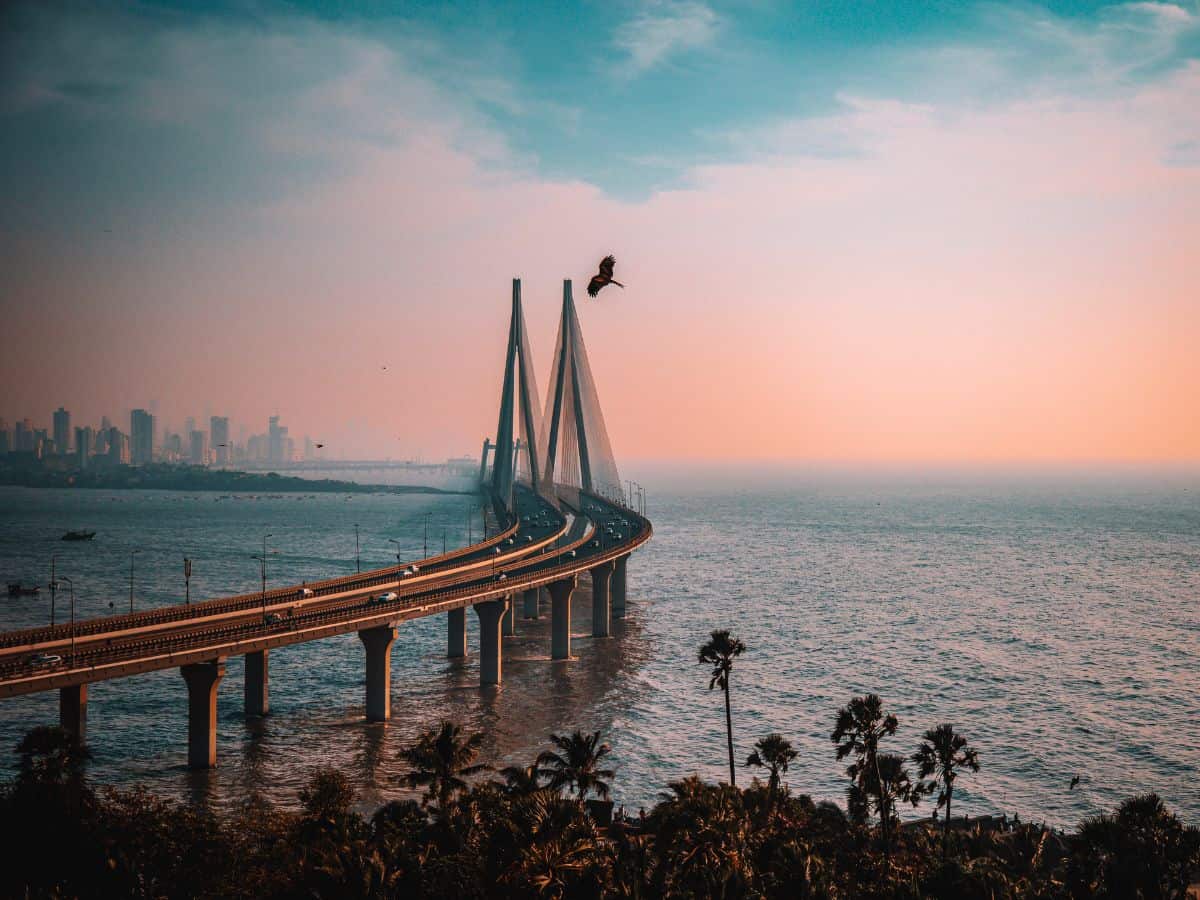
Start the day in a cab, preferably Uber. If you’re staying in South Bombay, the drive to Bandra via the Bandra-Worli Sea Link is an experience in itself: early morning, barely any traffic, the bridge lit up, the city on both sides of the sea.
On your right as you cross, you’ll spot Antilia, Mukesh Ambani’s 27-story private residence, one of the world’s most expensive homes, and genuinely impossible to miss.
On your left, Haji Ali Dargah sits on its little island, connected to the mainland by a narrow causeway. A quick note on Haji Ali: it’s one of Mumbai’s most photographed landmarks and deeply significant as a Muslim shrine, but I’ll be honest about my own experience: the approach is crowded, pushy vendors line the causeway, and the upkeep of the surroundings left me disappointed. Worth seeing from a distance for the view, the white dargah floating on the sea is genuinely beautiful, but whether you go in is your call.
The drive takes about 20-25 minutes from South Bombay and drops you right at Bandra Fort, where Day 2 begins.
6:00 AM: Bandra Fort at Sunrise
Bandra Fort, officially Fort Castella de Aguada, is a 17th-century Portuguese sea fort built to defend the bay at Land’s End, Bandra’s southernmost tip. It’s small and somewhat ruined, but the views from here at sunrise are extraordinary, the sea stretching out in front of you, the Sea Link curving out on one side, the city waking up on the other.
7:00 AM: Mount Mary Church
A five-minute walk uphill from Bandra Fort brings you to the Basilica of Our Lady of the Mount, built on a hillock 80 meters above the sea. Open from 6 AM, open to all faiths, and early morning, it’s peaceful and cool, with a stillness inside. The current semi-Gothic structure is over a hundred years old, but its history dates back to the 16th-century Portuguese Jesuits, who first built a chapel here.
The story is worth knowing. Arab pirates once raided it, looking for treasure, found none, cut off the hand of the Virgin Mary statue in frustration, and were then chased out by a swarm of bees. The broken statue is still worshipped here today. Some stories write themselves.
7:45 AM: Brooke Bond Taj Mahal Tea House
From Mount Mary Church, walk two minutes to St John Baptist Road, and the Taj Mahal Tea House is right there, tucked into an old Parsi bungalow in a quiet Bandra lane. It opens at 7:30 AM, which is the perfect time.
Over 40 varieties of tea, a breakfast and tea-pairing menu, interiors that feel like someone’s well-loved home, cups everywhere, vintage furniture, and Indian classical music drifting through the rooms. I first found it in South Bombay, but the Bandra version has more character.
Order the masala chai or a kahwa, get something from the breakfast menu, sit, relax, don’t rush. This is the best breakfast stop on this route.
Alternatively, you can head over to The Bandstand Pantry at the Bandstand Promenade. This cozy eatery is ideal for a relaxing break, serving tasty protein-rich snacks and drinks with a beautiful sea view, making your meal even more enjoyable.
9:00 AM: Bandstand Promenade

Walk back down the hill. The bandstand is at the bottom, a 5-minute walk away.
This is where Bollywood royalty lives, and Bandstand wears that fact proudly. The 1.2-km seafront promenade has a Walk of the Stars pathway studded with the handprints and signatures of Bollywood’s biggest names: Amitabh Bachchan, Shah Rukh Khan, Madhuri Dixit, Hrithik Roshan, and others.
There’s a small amphitheater sitting along the walk that occasionally hosts open-air performances, a graffiti wall that rotates art every few months, and viewpoints along the sea wall where you can just sit, watch the Arabian Sea, and catch one of the best sunset points in the city.
Then there are the celebrity homes. The Bandstand and nearby Carter Road stretch is where Bollywood’s biggest stars live. Within a short walk or cab ride, you can pass.

10:00 AM: Ranwar Village, Chapel Road, and Bollywood Art Project

Head inland from Bandstand into Ranwar Village and Chapel Road. I want to be honest with you about what to expect here, because every travel blog describes this as a must-do street art walk, and I went with those expectations and came back with different feelings.
The art is there. The Bollywood Art Project murals are large, vivid, cinematic, and genuinely worth seeing. But the lanes are narrow, full of moving and parked vehicles, and in Mumbai’s heat, this is not a comfortable walk. I kept looking for the photogenic, Instagram-worthy Bandra I’d been promised, and what I found was a real neighborhood, a bit chaotic, not particularly walkable.


What I actually loved was the Ranwar Village houses themselves, the old Portuguese-influenced bungalows with their sloping roofs, wooden balconies, and bougainvillea tumbling over compound walls. That old East Indian Catholic neighborhood energy that predates every Bollywood story, Bandra has collected. Chapel Road has that. You just have to find it rather than have it presented to you, which is fine once you adjust your expectations.
Go with curiosity, wander, photograph what catches your eye, don’t try to follow a map too rigidly. Be done by 11 AM before the heat becomes unpleasant.
11:00 AM: Mary Lodge by Subko
Right in the bylanes of Chapel Road, and if you’ve been wandering Ranwar, you’ll practically walk past it, is Mary Lodge by Subko, one of Mumbai’s best specialty coffee cafés. Third-generation coffee roasters, a converted old Bandra bungalow, exposed brick, rustic wood, multiple floors with different moods.
The coffee is exceptional, and the baked goods, the double-baked almond croissant especially, are worth the visit alone. It gets busy during weekend brunch hours, so a weekday mid-morning is ideal. This is also the perfect moment to escape the heat. Prices are on the higher side, but the quality is there.
Alternatively, Veronica’s on Waroda Road is another gem. Housed in the historic St. Jude’s Bakery with Portuguese design, it serves excellent breakfast and sandwiches.
12:30 PM: Hill Road
Walk north from Ranwar to Hill Road, Bandra’s main commercial street with shops, street stalls, and a mix of everything. More neighborhood-feeling than Linking Road and more affordable. A good time to browse and pick up anything that catches your eye.
If it’s lunch time, and it likely is by now, Hill Road has two very different options depending on your mood. Elco Market is the Bandra institution for chaat, pani puri, sev puri, and Gujarati street food, clean and safe, and served right. This is where locals actually come for their street food fix without worrying about hygiene.
2:00 PM: Carter Road Promenade
Continue north to Carter Road, a 1.25 km seafront walkway lined with palm trees, benches, and cafes and dining spots, with uninterrupted views of the Arabian Sea, the Sea Link, the skyline, and far less crowded than Marine Drive.
Boojees Cafe is right here, on Perry Cross Road, just off Carter Road, and opens at 8 AM. Clean, well-run, great coffee, good honest café food. Perfect for a late lunch or afternoon drink while the sea breeze does its work. This is also the answer to the afternoon heat. Order something cold, rest before the evening.
Carter Road SOCIAL is another of my favorites in the area: prettier, livelier, all-day kitchen, great for a long, lazy afternoon if you’re in that mood.
If you want to extend your café-hopping a bit further into Pali Hill, Kitchen Garden by Suzette does fresh salads, avocado toasts, and Mediterranean food in a pretty outdoor space. And for dessert, Magnolia Bakery nearby is the stop, the iconic American bakery, famous for its banana pudding and cupcakes that are genuinely worth the hype.
4:30 PM: Linking Road
From Carter Road, head east to Linking Road, Bandra’s serious shopping street. More upmarket than Colaba Causeway, a mix of street stalls and proper stores. Good for clothes, shoes, accessories, and everything in between. Bargaining on the stalls, fixed prices in the shops.
6:30 PM: Love Mumbai Sign, Bandra Reclamation
Walk or take a short auto south to the Bandra Reclamation Promenade. The Love Mumbai installation by the St+Art collective has a permanent home here, Mumbai’s version of the I Amsterdam sign, good for an evening photo with the Sea Link curving behind you in the golden light. The park entrance can be slightly tricky to find; check Google Maps carefully before you go.
This is the view of the Sea Link from the Bandra end, golden hour, the bridge sweeping south toward Worli, where tomorrow’s day begins.
8 PM: Dinner at Candies

End the day at Candies, two minutes from the Love Mumbai sign, right at Bandra Reclamation. One of Mumbai’s most beloved institutions, with a simple menu and good food, has been feeding Mumbaikars for decades without needing to reinvent itself.
One thing to know: Candies is closed on Mondays, and Google doesn’t always show this correctly, so check before you go. If it is a Monday, Pure Kitchen next door is a lovely alternative: smaller, calmer, a little pricey but clean and pleasant. 145 Bandra is another good bistro-style option for dinner if you want something slightly more polished.

After your meal, head back to your hotel via the Bandra-Worli Sea Link, and if you’ve got the energy, ask your driver to go along Worli Sea Face before getting on the bridge. The lights of the Sea Link from the Worli side at night are one of Mumbai’s wonders, and it’s the perfect full-circle ending to a day that began here, on the other side of the same bridge, at sunrise.
Day 3: Temples, Worli, and Lower Parel
Day 3 is about the iconic temples that anchor the city’s spiritual life, an open-air laundry that’s become a city icon, the fishing community that predates everything, and the old mill district, now a modern hub.
6:00 AM: Siddhivinayak or Mahalakshmi
Mumbai has two temples that matter most to its daily pulse, and both are worth the early morning pilgrimage. Pick one based on where you’re staying and what pulls you. Both are non-negotiable on one thing: go super early.
Option 1: Siddhivinayak Temple, Prabhadevi
One of India’s most celebrated and wealthiest Ganesh temples, Siddhivinayak is the spiritual heartbeat of Mumbai. Renowned for granting the wishes of its devotees, Bollywood stars, politicians, and ordinary Mumbaikars, everyone makes their way here at some point. The idol is carved from a single black stone, with the trunk turned to the right, a rare feature considered especially auspicious.
Go between 5:30 and 7:00 AM on any day except Tuesday. Tuesdays are the most sacred day for Lord Ganesha, and draw lakhs of devotees; queues can stretch for several hours. Weekdays and early mornings are your best bet for a peaceful darshan. The temple opens at 5:30, and the Kakad Aarti at this hour is genuinely moving.
Also worth knowing: the main shrine is closed to the public between 7:30 AM and 1:00 PM on certain days for the Maha Abhisheka ritual, so 6 AM is the sweet spot.
No phones, cameras, or bags inside. Lockers are available outside for ₹10. Entry is free. Dress conservatively.
Option 2: Mahalakshmi Temple, Breach Candy
For a shorter queue, a more peaceful experience, and one of Mumbai’s most dramatic temple settings, Mahalakshmi is the call.
Built in 1831 on a hillock overlooking the Arabian Sea, the temple houses three deities: Mahalakshmi, Mahasaraswati, and Mahakali, and has one of the most moving origin stories in the city. The idols were recovered from the sea during the construction of the Hornby Vellard, the causeway that eventually joined Mumbai’s seven islands into one. Without this temple, in a very real sense, there’s no modern Mumbai.
Go between 6:00 and 7:00 AM. The morning aarti at 7:00 AM is the right moment to be there. The temple closes for an afternoon break from 12:30 to 4:00 PM, so stick to the morning. Queues are usually 15–45 minutes on weekdays, but can stretch to 2–3 hours on weekends, during Navratri, or on Diwali.
Photography is not allowed inside the sanctum. Entry is free. Dress modestly.
Which one?
If you want the full, crowded, grand Mumbai-temple experience and you’re a Ganesh devotee, choose Siddhivinayak. If you’re a devotee of the Goddess or want something less crowded and deeply tied to Mumbai’s physical origin story, choose Mahalakshmi. Both are profound. Both are so Mumbai.
8:00 AM: Breakfast (Depending on Your Temple Choice)
Both temples sit in food-rich pockets, so you won’t struggle to find a good breakfast after your darshan.
If you chose Siddhivinayak (Prabhadevi)
You’re in proper Maharashtrian breakfast country here. A short walk or quick cab ride takes you to some of the most beloved spots in the area, and the best pick depends on how early you are and what day it is.
If you’ve just come out of the temple around 7:30–8:30 AM, start with Chai Pe Charcha in Prabhadevi. It’s about 700 meters from Siddhivinayak, located in Prabha Vinayak Building directly opposite the Prabhadevi Temple, yes, another temple, the 12th-century Prabhavati Devi Temple that actually gave this entire neighborhood its name. Chai Pe Charcha is a funky little café with auto-rickshaw tables, board games, and a wonderfully unpretentious Mumbai-chai menu: masala cutting chai, Irani chai with buttered toast, bun maska, onion parathas, kanda poha, firangi khakra, and sabudana khichdi. Opens at 8 AM, stays open till midnight. Perfect for a quick early bite or a longer sit-down over tea.
If you’re up for something more substantial and you’re not in a hurry, head into Dadar for one of these two old-school Maharashtrian institutions. Prakash Shakahari Upahar Kendra opens at 7:30 AM (closed Fridays), an old-school Maharashtrian favorite where piyush, sabudana vada, and piping-hot batata vada are the picks.
Aaswad Upahar and Mithai Kendra is the place most locals send first-timers: legendary for its misal pav, poha, sabudana khichdi, kothimbir vadi, batata vada, and thalipeeth. Simple, clean, vegetarian, almost always busy, and exactly what a Maharashtrian breakfast should taste like. But note: it opens at 9:30 AM and is closed on Mondays, so if you’re a very early riser, Prakash or Chai Pe Charcha is the better call while you wait, or time your temple visit so that Aaswad becomes a slightly later, slower breakfast around 9:45 AM.
If you want to taste Mumbai’s most legendary vada pav, walk 12 minutes from Siddhivinayak to Ashok Vada Pav next to Kirti College, a no-frills street stall named after Ashok Vaidya, the man credited with inventing the city’s defining snack and selling it from this corner since the 1960s. ₹25–30 a piece, hot, crisp, addictive. I’d been eating vada pav in Delhi for years from places like Haldiram’s, and the original Mumbai version, eaten at a street stall I’d usually walk past, is a different snack entirely.
For South Indian breakfast lovers, a 5-minute cab south of Dadar takes you into Matunga, Mumbai’s South Indian food capital. Cafe Madras has been serving pure-vegetarian South Indian food since 1940, best known for its strong filter coffee, ghee roast dosas, upma podi, and the city’s most argued-about uttapam. A Mumbai institution that has aged well. Closed Mondays.
If you chose Mahalakshmi (Breach Candy)
The breakfast scene right around Mahalakshmi itself is thin, so here’s the honest advice: keep it simple and don’t let food detours break the flow of your morning.
The easiest option is to walk or take a quick cab to Haji Ali Juice Center on Lala Lajpat Rai Road, right at Haji Ali Circle, barely five minutes from Mahalakshmi Temple and directly on your route toward Dhobi Ghat. It opens at 5 AM and is a Mumbai institution: fresh fruit juices (over 25 varieties, their strawberry and mango cream are legendary), sandwiches, sabudana vada, and simple South Indian breakfast plates. Started in the 1960s to feed pilgrims crossing over to the dargah, it’s clean, quick, and perfectly positioned for your morning.
If you’d rather just power through, do the temple, see Dhobi Ghat quickly, and save your appetite for a proper mid-morning meal once you reach Worli or Lower Parel. Worli Koliwada itself is a working fishing village and not set up for tourist breakfast, but you can easily grab a cutting chai and a vada pav from a local tapri once you’re there, which is its own kind of Mumbai moment. Lower Parel, fifteen minutes further, is where you’ll find proper cafés if you want a sit-down brunch later.
9:30 AM: Dhobi Ghat
A short ride south-east from Mahalakshmi or a slightly longer one from Siddhivinayak brings you to Dhobi Ghat, the open-air laundry district where Mumbai’s washermen have been doing the city’s laundry for over a century.
Head directly to the Dhobi Ghat Viewing Deck on Anandilal P Marg, right next to Mahalaxmi Railway Station. This is now the designated public vantage point (you’ll find it easily on Google Maps), and it’s the best spot to see the whole spread: hundreds of open concrete wash pens, flogging stones, sheets, and shirts drying everywhere you look, and the sheer scale of it is genuinely staggering.
Twenty minutes here is enough. You don’t need to go inside the ghat itself; the viewing deck is free, safe, and gives you everything you came for. Worth knowing: touts near the entrance may try to sell you a paid “inside tour”, politely decline, and head straight to the viewing deck. This is a working neighborhood, not a staged experience, so treat it with respect.
10:30 AM: Worli Koliwada
Head south to Worli. This is the hidden gem of Day 3 and arguably the most original stop in the entire itinerary.
Worli Koliwada is an 800-year-old Koli fishing village, the original inhabitants of Mumbai, still here, still fishing, still living the way they always have, despite the skyscrapers and the Sea Link curving around them. Narrow lanes, colorful houses, fishing boats at the pier, women sorting the morning catch, and the 17th-century Worli Fort (built by the British in 1675) offering extraordinary views of both the Sea Link on one side and the vintage village on the other.
The Golfa Devi Temple sits at the heart of the village; locals call her the talking goddess, and the folklore around her is one of the more fascinating layers of Koli culture. The temple is often the starting point of guided walks here.
You don’t technically need a guide, but one helps enormously for context. No Footprints and Mumbai Magic both run excellent walking tours here, worth the money if you want depth.

12:30 PM: Walk or Drive Along Worli Sea Face
Worli Sea Face is literally a five-minute walk north of the Koliwada. You exit the fishing village and step onto a 3.5 km seafront promenade lined with palm trees and benches. This is the stretch that gives you the best view of the Bandra-Worli Sea Link from the Worli end.
You saw the Sea Link from the Bandra side yesterday, and now you’re seeing it from Worli. Far less crowded than Marine Drive, equally beautiful. Walk the length at your own pace, stop at the Worli Sea Face Garden or Bhagwan Gautam Buddha Udyan for a proper sit-down break, and when you’re done, head inland east toward Lower Parel; it’s a short cab ride or a 15-minute walk.
2:00 PM: Lunch
A short cab ride south from Worli brings you to Lower Parel — Mumbai’s old mill district, now transformed into one of the city’s most interesting dining and cultural neighborhoods. The converted textile mills house restaurants, bars, art spaces, and retail in heritage industrial buildings that still wear their past on their sleeves. Phoenix Mills is the obvious anchor, but the smaller lanes and repurposed warehouse spaces are where it gets interesting.
This is where you settle in for the rest of the day: lunch, coffee, sundowner, and dinner all happen here.
For lunch, the one name that has stood the test of time and belongs on every Mumbai first-timer’s list is The Bombay Canteen at Kamala Mills, Process House. Housed in a recreated old Mumbai bungalow with marble mosaic tables and Art Deco flourishes, it reimagines regional Indian food with seasonal ingredients. Iconic dishes include Eggs Kejriwal, Chettinad Prawns Ali-Yolio, pork birria tacos with jowar bhakri, and the Coffee Rasgulla for dessert. If you want the full experience, order the Canteen Experience tasting menu (around ₹1,600–2,000 per person). Fantastic for vegetarians, a large part of the menu is veg-friendly and genuinely creative, reliably excellent since 2015, and not an afterthought. Book ahead.
For something simpler, cheaper, and more local, Mumbai Ladu Samrat at Lalbaug/Parel, a 5-minute cab from Worli on Dr Babasaheb Ambedkar Road, is perfect. Family-run since 1969, serving authentic Maharashtrian food: misal pav, vada pav, sabudana vada, batata vada, puran poli, piyush, upma, and pohe that locals come back for. It’s a foodie pilgrimage spot for travelers willing to skip ambiance for taste. They have a second outlet at Growel’s 101 Mall in Kandivali East if you’re in the suburbs, but the original Lalbaug is the one to go to.
For a more predictable alternative right inside High Street Phoenix / Palladium Mall, you’ll find reliable chains and fine-dining options that are far less likely to have closed: Smoke House Deli, Shizusan (Palladium), Soda Bottle Opener Wala, and food court options for a quick meal.
While you are at Phoenix Mall, visit Bombay Sweet Shop. It has reinvented the traditional Indian mithai counter, offering innovative sweets like gulab jamun cheesecake, modern packaging, and a lovely sit-down café for breakfast and snacks. Worth a stop if you have a sweet tooth and an interest in how India’s classics are being reimagined.
If you’re ready for a proper splurge night and willing to travel a few minutes south to Mahalaxmi, Masque is one of Mumbai’s most ambitious tasting-menu restaurants, featuring seasonal Indian ingredients, serious technique, and a consistent presence on Asia’s 50 Best Restaurants list. Reserve weeks ahead. Closed Mondays.
4:00 PM: Explore Lower Parel at Your Pace
Walk through Kamala Mills Compound or Todi Mill Compound to see how the old textile mills have been reimagined. Drop into galleries, boutiques, or specialty stores. If you’re into design, the mill compounds are Mumbai’s best neighborhood for it.
6:30 PM: Sundowner
End the day with a slow drink as the sun drops and the Sea Link lights come on in the distance. Lower Parel has some of Mumbai’s best rooftop bars in converted industrial spaces. Aer, Four Seasons Hotel, Worli (on the 34th floor, technically Worli but walking distance from Lower Parel) is the city’s most iconic sky bar, with panoramic views including the Sea Link itself. Asilo, the St. Regis rooftop on the 40th floor, is another premium option.
8:00 PM: Dinner in Lower Parel
For dinner, the safest and most consistently excellent option is The Sahib Room & Kipling Bar at The St. Regis Mumbai on the 9th floor. Refined North Indian and Mughlai cuisine in a beautifully designed space inspired by colonial-era Bombay. Classy, unhurried, and a place that has been polished and reliable for years. Book ahead and dress smart-casual.
If you’d rather have a second meal at The Bombay Canteen, which genuinely does do dinner as beautifully as lunch, that’s also an excellent choice. The menu changes enough that you won’t feel repetitive.
Please note that the mill compound restaurant scene changes fast. Places open, close, rebrand, and relocate at an unusual pace. So rather than sending you on a specific goose chase, my honest suggestion is to walk around Kamala Mills and Mathuradas Mills with a curious eye once you arrive. Whatever is new, buzzy, and packed with locals when you’re there is likely to be your best bet. Check Google Maps reviews from the last three months before committing. The three I’ve named above: The Bombay Canteen, The Sahib Room & Kipling Bar, Asilo, and Aer, are institutions that have earned their places and are very likely to still be there whenever you read this.
Day 4: Mumbadevi, Khotachiwadi, and Malabar Hill
Your last day in Mumbai is the one I’d call the most soulful: it’s about feeling the city’s layered history in quiescent places. You’ll start with the goddess the city is named after, wander through a 200-year-old Portuguese-Catholic village that still exists impossibly in the middle of South Bombay, climb up to Malabar Hill for some of the best views in the city, and end at a 12th-century water tank that somehow has an underground spring a few metres from the sea, wrapping the day with a farewell dinner in South Bombay.
6:30 AM: Mumbadevi Temple
You cannot leave Mumbai without visiting the temple that gave it its name.
Mumbadevi Temple is enfloded into the crowded lanes of Bhuleshwar, near Zaveri Bazaar, in the old heart of the city. The current structure is just over 350 years old, but the temple goes back further. The original was at the site where CST now stands, before it was moved here in 1737. The goddess, Mumba Aai, was the patron deity of the Kolis and Agris, the fisherfolk and salt collectors who were the original inhabitants of the seven islands. The city’s very name, Mumbai, comes from her.
The temple opens at 6 AM. Budget 30–45 minutes, including the walk through the surrounding bazaar lanes, which start coming alive around 7 AM.
8:30 AM: Khotachiwadi
A 15-minute cab ride north-west from Bhuleshwar brings you to one of the strangest, most wonderful places in South Mumbai.
I didn’t know Khotachiwadi existed until I caught a glimpse of it in the Hindi soap Itti Si Khushi. Intrigued, I looked it up and realized this was exactly the kind of cultural corner I love: a living, breathing pocket of history tucked inside the chaos of Mumbai. On my most recent trip, I made sure to visit. I did a self-guided walk, wandering slowly, stopping at every pretty facade, reading the small plaques, talking to the occasional resident, spending close to two hours here. Next time, I’m going with a proper guided walk; there’s so much more to know, and only a local historian can really open up the layers.
Khotachiwadi is a 200-year-old East Indian Catholic village in Girgaon or Girgaum: pastel-coloured Portuguese-style bungalows, narrow winding lanes, Burmese teak balconies, and Mangalore-tiled roofs. Settled in the late 18th century by an East Indian community on land sold by a Pathare Prabhu named Dadoba Waman Khot (hence the name, Khot’s Wadi), it once had 65 bungalows. Only about 24 remain now; the rest have been lost to Mumbai’s relentless redevelopment, including the Fernandez Bungalow in 2022, whose facade is all that’s left after residents lost their preservation battle. Walking through feels like stepping into a sleepy, gentler century, one that’s actively disappearing.
Look out for:
- Gallery 47-A: the ground floor of a mid-19th-century bungalow owned by the Crasto family since 1857, restored and opened as a contemporary art gallery in 2022. The iconic blue and yellow marker at the end of the lane.
- Bungalow 47-G (James Ferreira’s home): the celebrated fashion designer runs his 200-year-old bungalow as a heritage homestay. He’s also president of the Khotachiwadi Heritage Trust, actively fighting to save what’s left. You can’t walk in unannounced, but if you spot it, the exterior alone is worth a pause.
- Casa Baptista: the 130-year-old family bungalow of André Baptista, a history and archaeology professor, fourth-generation resident, and one of the wadi’s most vocal preservation advocates. It’s a private home, you’re passing by, not entering, but it’s one of the loveliest exteriors in the precinct.
- Wilfred Fernandez’s house: diagonally opposite Ferreira’s, known for the little menagerie in the yard: birds, cats, rabbits, and a fish pond built into an old sink. Mr. Fernandez himself is often out strumming his guitar.
- St. Francis Xavier’s Chapel: the tiny neighborhood chapel that anchors the wadi spiritually.
- The murals and graffiti: tucked away in unexpected places.
If you want to join a guided walk, 47-A Gallery regularly organizes heritage and architecture walks, a yearly Christmas market, and local cuisine events, and you can plan your visit to coincide with a detailed walk led by Dr. André Baptista himself, who sometimes includes a stop at his ancestral home. Khaki Tours’ Grisly Girgaon Ghost Walk is a cult favorite since 2017, a late-night 2-hour-15-minute walk starting at 10 PM that winds through Girgaon’s narrow lanes, old graveyards, cursed stones, and chawls before ending inside Khotachiwadi at midnight. Private guided tours by Viator and other local tour operators that include pickup from SoBo hotels often combine Khotachiwadi with Mani Bhavan and Malabar Hill in full-day packages.
How to get there: The nearest station is Charni Road. Tell your cab driver “Khotachiwadi, Girgaon” — most will know the name, but expect to walk the last bit because the lanes are too narrow for cars. From the main road, Jagannath Shankar Seth Marg, it’s near St. Teresa’s Church.
Best time: Early morning (before 10 AM) is when the light is soft, and the lanes are quiet. December, especially around Christmas, is magical; the whole wadi is lit up, and Marathi carols drift through the streets.
Give this 1 to 1.5 hours. It’s a place to wander slowly, not check off. Bring a camera, but be respectful; people live here.
11:30 AM: Brunch at Shree Thaker Bhojanalay (Kalbadevi)
This is the meal you plan your day around.
A 5-minute cab from Khotachiwadi, 7 minutes from Mumbadevi, Shree Thaker Bhojanalay has been serving Gujarati thalis from a tiny lane in Kalbadevi since 1945. The story is worth knowing: it was started by 16-year-old Maganbhai Purohit, a boy from Sindarli, Rajasthan, who arrived in Bombay in the late 1930s with a few rupees in his pocket. He worked odd jobs, breaking coal, washing dishes at dhabas, and saved up enough to open a small eatery in Zaveri Bazaar. When the building collapsed, he moved to Kalbadevi, and the Bhojanalay has stood here ever since. His son Gautam Purohit now runs the kitchen, personally cooking and tasting all 35 items that go into each thali, over 400 of which are served every single day.
The thali is unlimited. Waiters move between tables with four-bowl caddies of vegetable preparations, chutneys, pickles, farsan, rotis, rice, and refuse to stop refilling you. The menu changes daily. Weekends get sweet additions: shrikhand, gulab jamun, and fruit custard. The food is pure, traditional Gujarati with a touch of Rajasthan (reflecting the family’s roots), and the atmosphere is that particular kind of Bombay warmth where strangers become lunch companions by sheer proximity.
The celebrity wall tells its own story: Dhirubhai and Kokilaben Ambani have eaten here, as have Sachin Tendulkar, Vidya Balan, Saira Banu, Dia Mirza, Raj Thackeray, and Michelin-starred chefs Vineet Bhatia and Suvir Saran. But on a regular weekday, the crowd is mostly Marwari and Gujarati traders from the surrounding bazaars, grandparents feeding their grandchildren, and the occasional food-obsessed traveler who read about it somewhere and made the trek.
Timings: 11:30 AM to 3:30 PM for lunch, 7 PM to 10:15 PM for dinner. Closed Monday evenings. Arrive by 12 PM to avoid the worst of the queue. Seating is first-come, first-served, and it fills up fast.
1:00 PM: Cab to Malabar Hill

A 20-minute cab from Kalbadevi takes you up to Malabar Hill, the highest point in South Mumbai and easily its most exclusive neighborhood. This is where Mumbai’s political power and old money live: the Governor’s residence (Raj Bhavan), the Chief Minister’s bungalow, the Deputy Chief Minister’s home, and some of the priciest real estate in the world.
It’s worth a drive through just to see how the other half lives: wide tree-lined roads, colonial bungalows, and a calm that feels impossible in Mumbai.
I first came to Malabar Hill back in 2000, during my very first job training with Cipla, fresh out of college. We were staying at Sahil Hotel opposite the Cipla office, and Malabar Hill was one of the sightseeing spots we all headed to together on an evening off. It was my first solo trip away from home. I was young, scared, nervous, completely out of my depth. But I ended up making friends for life during that training: people from all over India, coming from entirely different cultures, speaking different languages, eating different food, and yet we became as close as family. One morning, we all went to Kamala Nehru Park and sat around the giant concrete boot, which was white back then and is blue now, and laughed until our stomachs hurt. Some of the best days of my life.
So when I went back to Malabar Hill on this latest trip, it was pure nostalgia. I’ll be honest: both parks are just neighborhood parks. Hanging Gardens and Kamala Nehru Park are nothing extraordinary on their own; you won’t miss much if you skip them. I went because I needed to sit near that shoe again and remember who I was at 21.
The other memory I’ll take back from this visit: I happened to be passing the CM’s residence just as some important event was on, and the road was briefly cordoned off. In that small window, I actually saw CM Devendra Fadnavis and Deputy CM Eknath Shinde up close. Malabar Hill does that; it’s a neighborhood where you might catch a glimpse of the people who run the state, just stepping into their cars.
If nostalgia isn’t pulling you here, skip the parks and just do a slow drive through Malabar Hill for the atmosphere, that’s really where the neighborhood’s charm lives.
Two quick stops, both five minutes apart on foot:
Hanging Gardens (Pherozeshah Mehta Garden), terraced gardens built in 1881 on top of a reservoir, with topiary animals and views of the Arabian Sea. Pretty, though honestly, the views from the edge are better than the gardens themselves. A heads-up: the park has some shade, but not much, so if you’re visiting in the hot afternoon, pace yourself and carry water.
Kamala Nehru Park, across the road from Hanging Gardens, is best known for the iconic “Old Woman’s Shoe” structure (a concrete boot you can climb into, though access is restricted to kids under 12 these days). The viewpoint here offers the classic Queen’s Necklace shot, with Marine Drive curving along the coast and Chowpatty at the bend. This park is the more comfortable of the two on a hot afternoon: it has canopied walkways, cane benches, an echo gazebos, and a rainbow amphitheater, so you can rest in proper shade even when the sun is brutal.
2:00 PM: Banganga Tank
Banganga Tank is a 12th-century sacred water tank set into the western slope of Malabar Hill, just below the Governor’s residence. It’s part of the Walkeshwar Temple complex, and it’s the oldest continuously inhabited spiritual site in Mumbai. The tank was built in 1127 AD by Lakshman Prabhu, a minister in the Silhara dynasty. The Portuguese destroyed it in the 16th century. It was rebuilt in 1715 with a donation from a Gaud Saraswat Brahmin merchant named Rama Kamath. The Gaud Saraswat Brahmin Temple Trust still runs the complex today, and many families from the community still live in the buildings around the tank.
Here’s the part that makes it magical: the tank is spring-fed, and its water is sweet, freshwater, despite being just a few hundred meters from the Arabian Sea. Locals call it a little Varanasi in Bombay. You walk down stone steps on all four sides, past small temples, oil lamps (diyas) on ancient pillars at the entrance, older priests, pigeons, laundry drying in the sun, and an unbroken calm. The skyline of Malabar Hill skyscrapers looks down on you from above, but inside the tank complex, time holds still.
The legend is pure Ramayana: when Lord Ram and Lakshman passed through here searching for Sita, Ram grew thirsty. Lakshman shot an arrow (baan) into the ground, and a tributary of the Ganga sprang up. Hence, Ban-Ganga, the Ganga created by an arrow.
Entry is free. Early morning and late afternoon/evening are the most atmospheric times. Light is soft, crowds are thin. There’s a small Hindu cremation ground (now a gas crematorium) in the same complex. If this makes you uncomfortable, you can stay on the tank side.
The neighborhood around the tank is worth a wander: narrow alleys, old Brahmin homes, tiny shrines tucked into walls. Photography is okay, but be respectful of worshippers.
Every February, MTDC hosts a two-day Banganga Music Festival here. Hindustani classical music is performed around the lit-up tank. If you’re in Mumbai, it’s extraordinary.
3:00 PM: Mani Bhavan (Gandhi Museum)
A 10-minute cab from Banganga brings you to Mani Bhavan, the unassuming two-story bungalow on Laburnum Road in Gamdevi that was Mahatma Gandhi’s Bombay residence from 1917 to 1934. This is where Gandhi launched the Non-Cooperation Movement in 1920, and where he began the Civil Disobedience Movement that eventually led to the Salt March. It was also here that he started spinning the charkha and using khadi as a political statement.
The house is now a museum, preserved almost as he left it. You can see the small room on the second floor where he lived and worked, his spinning wheel, his writing desk, his bed-roll, his books. The library holds over 50,000 books and a research collection on Gandhi, and the ground floor has a series of 28 dioramas depicting major events in his life. Letters he wrote to Tolstoy, Hitler, and Roosevelt are also on display.
It’s beautifully quiet, tiny, powerful, and blessedly cool in the thick of Mumbai’s afternoon. An hour is enough.
4:00 PM: Back to the Hotel, Freshen Up
You’ve been on your feet since 6:30 AM, and you skipped lunch because Shree Thaker kept you full. Head back to the hotel, shower, change, rest for an hour.
6:00 PM: Sunset

Your last Mumbai sunset is a pick-your-own.
Bandra Bandstand, if Day 2 at the Bandra Fort sunrise mesmerized you, come back at sunset to close the loop. The promenade along the Arabian Sea, the rock pools, and the Bandra-Worli Sea Link lighting up in the distance. Another full-circle moment: you saw Bandra at dawn, now watch it at dusk.
Marine Drive, Nariman Point end, if you’d rather stay in South Bombay. Walk the Nariman Point end of Marine Drive (you covered the Chowpatty end on Day 1). Sit on the tetrapods, watch the lights of the Queen’s Necklace come on one by one, and let Bombay hold you one last time.
If distance isn’t an issue and you want a sunset spot that’s entirely new, Mumbai’s coastline is generous. Versova Beach for a calmer, fisherfolk-village feel; Juhu Beach for that classic Mumbai energy of horse carts, chaat stalls, and crowds cheering the sun down; or Mahim Beach for a raw, less-polished view that most tourists skip. Same sun, same sea, but each corner of the city shows it a little differently.
Any of them ends the trip beautifully, sunsetty.
8:30 PM: Farewell Dinner
For your last meal, here are the hand-picked options, depending on mood and location:
Trishna (Fort, near Kala Ghoda), if you eat seafood, this is the institution to end on. Mangalorean-style coastal food, butter pepper garlic crab that the city has worshipped since 1965, simple wooden interiors, reliably excellent. Book well ahead.
Swati Snacks (Tardeo, a short cab from Malabar Hill), if Shree Thaker was too much food, Swati is a lighter, refined Gujarati-Maharashtrian vegetarian meal. Clean, bright, famous for panki, dahi batata puri, and sev khamani. A SoBo institution since 1963.
Sea Lounge at the Taj Mahal Palace Hotel, if you want to end the trip the way South Bombay likes to end an evening: looking at the Gateway of India from the same windows where Bombay’s elite have watched the harbor for a century. Dress smart, book ahead.
Ladoo Samrat in Lalbaug is a hole-in-the-wall serving puran poli, missal pav, sabudana vada, and traditional Maharashtrian breakfast since 1969. The local pilgrimage spot for serious food lovers willing to skip ambiance for taste.
If You Have More Time
Four days in Mumbai are enough to see the city’s soul, but it has layers that don’t quite fit into a tight itinerary. If you have an extra day, a half-day, a spare evening, or you want to swap a place recommended on this itinerary, here are two worthwhile add-ons.
Mumbai’s Bollywood Side
Mumbai is the epicenter of Hindi cinema, Bollywood, India’s biggest film industry, and one of the largest in the world by output. If you’re a fan or even just curious, a few ways to feel the industry up close:
The Bandra–Juhu Celebrity Circuit. This is the real heart of Bollywood, and it’s where most of your favorite stars live.
Bandra (Bandstand + Pali Hill) is where most of the younger stars and the Khans live. In Bandstand, I assume, you’ve already seen Mannat (Shah Rukh Khan) and Galaxy Apartments (Salman Khan) on Day 2, the two most-visited celebrity homes in India, each with a daily crowd of fans outside hoping for a wave. A short drive into Pali Hill, the neighbourhood just above Bandstand, opens up the rest of the circuit: Krishna Raj, the iconic Kapoor family bungalow (Rishi, Neetu, Ranbir Kapoor’s ancestral home); Vastu, the apartment building where Ranbir Kapoor and Alia Bhatt currently live; and the homes of Aamir Khan, Sanjay Dutt, Rani Mukerji and Aditya Chopra, and Kangana Ranaut. Pali Hill is leafier and quieter than Bandstand, and the homes are mostly tucked away behind gates, but a slow cab drive through its lanes is its own quiet pleasure.
Juhu is where the older guard of Bollywood lives: more bungalows, more space, more old-money-showbiz calm. The single most iconic stretch is the cluster of Bachchan family properties in the JVPD Scheme: Jalsa (Amitabh Bachchan’s current residence), Pratiksha (the original family home where Abhishek and Aishwarya Rai were married), Janak (the family office), Vatsa (leased to Citibank), and a newer bungalow behind Jalsa, all within a kilometer of each other. Every Sunday at 7 PM, Amitabh Bachchan steps out to the gates of Jalsa and waves to the fans gathered below, a ritual he’s maintained for decades. Juhu is also home to Akshay Kumar and Twinkle Khanna, Hrithik Roshan, Anil Kapoor, Ajay Devgn, Kajol, Rekha, and Dharmendra, among many others.
Film City (Dadasaheb Phalke Chitranagari), Goregaon East. Mumbai’s sprawling 520-acre studio complex, where hundreds of Bollywood and TV productions shoot every year. The only way in is through a pre-booked guided tour, the MTDC-approved one runs about 2 hours, costs roughly ₹600 per person, and takes you through outdoor sets, sound stages, and sometimes active shoots (luck of the draw). You’re unlikely to see an A-list star, but you will see how the machinery of Indian cinema actually works. Book at least a day in advance. Closed Sundays.
Watch a film at a grand old cinema. Mumbai still has a handful of single-screen heritage cinemas that are experiences in themselves. Regal Cinema in Colaba (Art Deco, 1933) and Liberty Cinema in Marine Lines (1949, also Art Deco, gorgeous interior) still screen films occasionally, check listings. For a modern but atmospheric option, catch a Bollywood release at PVR Icon at Phoenix Palladium or INOX Nariman Point. Watching a masala film in a packed Indian theatre, experiencing whistles, claps, and dialogues shouted back at the screen, is unlike any cinema experience in the West.
Private Bollywood-themed tours. If you’d rather have someone drive you through the whole circuit and explain who lives where, several Mumbai operators run dedicated Bollywood tours covering stars’ homes, Film City, studio visits, live shoots when possible, dance workshops, and voice-recording sessions. Mumbai Magic, Bollywood Tours, Young Tours & Travel, and Bollywood Entertainment Tours are among the better-reviewed operators. Prices range from ₹2,000 to ₹8,000 depending on what’s included. Worth it if you’re a genuine fan; skip if Bollywood is only a passing curiosity.
A Cultural Evening at NMACC
If you happen to be in Mumbai on a night when something is showing at the Nita Mukesh Ambani Cultural Center (NMACC), build your evening around it.
Opened in March 2023 inside the Jio World Center at BKC, NMACC is Mumbai’s most ambitious cultural venue, a multi-disciplinary arts space with a 2,000-seat Grand Theatre crowned by a Swarovski-crystal lotus chandelier, a 250-seat Studio Theatre, and a more intimate 125-seat space called The Cube.
Programming spans Indian classical music, contemporary theatre, international ballet, jazz, art exhibitions, and major touring productions. Even the building itself, with its sweeping marble interiors and the Art House gallery space, is worth visiting.
Check what’s on at nmacc.com before your trip and book ahead as popular shows sell out weeks in advance.
Elephanta Caves
An hour-long ferry ride from the Gateway of India takes you to Elephanta Island, home to a set of 6th- to 7th-century rock-cut cave temples carved into basalt cliffs, a UNESCO World Heritage Site since 1987. The caves are dedicated to Lord Shiva, and the showstopper is the Trimurti, a 20-foot triple-headed sculpture depicting Shiva as creator, preserver, and destroyer. It’s one of the finest pieces of ancient Indian sculpture, and standing in front of it in the dim cave light is genuinely humbling.
To get there, ferries leave from the Gateway of India every 30 minutes between 9 AM and 2 PM. The journey takes about an hour each way. Return ferries run until 5:30 PM, don’t miss the last one or you’re stuck on the island.
Once you land, a steep flight of stairs (or a ₹10 toy train) leads up to the cave complex. Wear good shoes. Watch out for the cheeky monkeys; they steal food, phones, and occasionally glasses.
Budget a full day. It’s a 5- to 6-hour round-trip from Gateway, including the ferry, a walk, and cave exploration, not to be squeezed into a packed day.
One honest caveat: Elephanta is genuinely beautiful, but it’s a full-day commitment. If you’re short on time or not particularly drawn to ancient Indian sculpture, skip it without guilt. If temples and rock-cut art stir something in you, it’s extraordinary.
What I’m Not Recommending And Why
Quite a few Mumbai itineraries out there will tell you to go to these places. I won’t, and I want to explain why, because skipping them intentionally is very different from not knowing about them.
Chor Bazaar. Once upon a time, Mumbai’s “Thieves’ Market” was a real thing, a sprawling maze of stalls in Bhendi Bazaar selling antiques, vintage Bollywood posters, old gramophones, brass, and genuine curiosities. Today, it’s a shadow of that: mostly cheap reproductions, repackaged junk, and aggressive sellers. Unless you’re a serious antique collector who knows exactly what you’re looking for and how to bargain hard, you’ll leave tired, dejected, overwhelmed, and underwhelmed. The Instagram version of Chor Bazaar doesn’t match the lived reality.

Crawford Market (Mahatma Jyotiba Phule Mandai). Architecturally, it’s stunning, a Gothic structure from 1869 with the Lockwood Kipling bas-reliefs on the facade (sculpted by Rudyard Kipling’s father, who was principal of the J.J. School of Art at the time). But inside, it’s now a wholesale fruit, vegetable, spice, and pet market that’s overwhelmingly crowded, hot, smelly, and honestly not pleasant for a casual visitor. The pet section, in particular, is distressing, with puppies and kittens in cages in poor conditions. If you want to see the building, drive past it on your way to Mumbadevi on Day 4, and admire it from the outside. That’s the best of it.
Lockwood Kipling Fountain (inside Crawford Market). This one I genuinely hate skipping because it’s beautiful, sculpted by John Lockwood Kipling, combining Victorian and Indian motifs and depicting Indian peasants, water-bearers, and working people. But it’s trapped inside Crawford Market, which, as above, isn’t worth the visit for most people. If you’re an architecture enthusiast, combine a brief stop at the Crawford Market exterior with a view of the Kipling fountain, then leave. Fifteen minutes, tops. Otherwise, skip it.
Dharavi. Asia’s largest slum, made famous by Slumdog Millionaire, is now the subject of Adani Group’s massive redevelopment project. I don’t recommend slum tours, full stop. They’re well-intentioned on paper, but in practice, they reduce people’s homes to a tourist spectacle, and the ethics of “poverty tourism” are deeply questionable. If you want to understand Mumbai’s economic layers, read Katherine Boo’s Behind the Beautiful Forevers on the flight home instead.
Fashion Street. The 150-stall open-air market on MG Road near Azad Maidan comes up in every Mumbai shopping guide as the budget-friendly go-to. It used to be, back in the ’80s and ’90s, that the nearby garment factories meant real export surpluses at throwaway prices. That pipeline has long dried up. My honest take, though: it’s overrated now. I walked through the entire stretch on this trip and didn’t buy a single thing. I walked the entire stretch on this trip and didn’t buy a single thing. The merchandise is mostly cheap mass-produced stuff now, poor fabrics, shoddy stitching, and the “export surplus” label is mostly a story. You’ll see Mumbai college students and tourists bargaining hard, but unless you have time to kill and patience to dig through a lot of junk for one or two decent finds, you’re better off going somewhere else.
Everything Else You Need to Know
When to Go
Mumbai doesn’t really do “seasons” the way North India does. It has a long, hot-and-sticky dry stretch, a dramatic monsoon, a short window of something like pleasant weather, and a slow slide back into heat. Here’s the breakdown.
November to February: The best time, undoubtedly. This is when Mumbai is at its most wearable. Temperatures sit between 17°C and 30°C, humidity drops, the skies are clear, and evenings on Marine Drive actually feel cool with a breeze off the sea. All of the city’s biggest cultural moments happen in this window: the Kala Ghoda Arts Festival in early February, the Banganga Music Festival in January or February, and the long, festive build-up from Diwali in October–November through Christmas and New Year’s Eve. This is also peak tourist season, so expect higher flight and hotel rates, booked-out hotels and restaurants, and longer queues at the famous attractions. Book ahead. Worth every rupee.
March to May: Hot, humid, and frankly not great. I’ve been to Mumbai in both spring and summer, and I’ll be straight with you: March feels manageable, April is sticky, and May is brutal. The coastal humidity means you’re damp from the moment you step outside. Daytime temperatures climb to 34–36°C, nights don’t cool down much, and walking outdoors for more than 20 minutes leaves you wrung out. The upside is that hotel prices drop noticeably, and you’ll get restaurant tables at places that are impossible to book in winter. If you’re on a budget and can plan your days around early mornings and air-conditioned afternoons, summer can work. If you want to enjoy the outdoors, skip it.
June to September: It’s the monsoon. Beautiful, and a little mad. Mumbai’s monsoon is legendary, and every local will tell you it’s the city’s soul. July is the wettest month; the 26 July 2005 record of 944 mm of rain in a single day is part of Mumbai folklore. When the rains are gentle, the city feels romantic; Marine Drive with crashing waves, cutting chai and pakoras at corner tea stalls, everything green and washed clean. When the rains are heavy, streets flood, local trains stop running, and the city grinds to a halt for hours. I haven’t been in Mumbai through a full monsoon, but every friend who has tells me the same thing: travel plans will be disrupted, and you need to be okay with that. Come in June or September if you want to taste the monsoon without the worst of it. Avoid July.
October: It’s a beautiful, underrated sliver. The rains retreat, the city dries out, and for a few weeks before the winter crowds arrive, Mumbai feels fresh and unhurried. Humidity is still high, but the worst of the heat is behind you. This is one of the best months to visit if you want good weather without the December-January prices. A quick note on festivals, if you’re planning around them:
- Ganesh Chaturthi (August or September): the biggest festival of the year in Mumbai. The entire city lives and breathes it for 10 days. Stunning, but transport gets chaotic, especially on the final immersion day.
- Diwali (October or November): lights, fireworks, and the city at its most festive.
- Kala Ghoda Arts Festival (early February): a week of art, music, and theatre across SoBo. Highly recommended.
- Christmas in Khotachiwadi and Bandra (December): the East Indian Catholic neighborhoods are beautifully decorated; carols drift through the streets.
To sum up, November to February is the sweet spot. October is the smart alternative. Monsoon is for the adventurous. March to May is best avoided unless you’re on a budget.
Where to Stay

Mumbai is enormous, traffic is famously unforgiving, and the neighborhood you pick will shape the tone and flow of your trip. Here’s how I’d think about it.
If you ask me, I’d strongly recommend staying in South Mumbai. This is where most of your sightseeing happens (Days 1 and 4 are entirely SoBo; Day 3 is central Mumbai, which is well connected to SoBo; and Day 2 in Bandra is a cab ride away). It’s where the city’s history, culture, architecture, and atmosphere are most concentrated, and it’s also the most walkable part of Mumbai. If you’re splitting stays, 2 nights in SoBo and 2 in Bandra gives you both flavors, but for most travelers on a 4-day trip, a single base in SoBo is simpler and less time-consuming.
South Mumbai (Colaba, Fort, Ballard Estate, Marine Drive)
This is the historic heart of Bombay, Victorian and Art Deco architecture, the Gateway, Marine Drive, Kala Ghoda, and most of the restaurants you’ll actually want to eat at.
Premium or Luxury
The Taj Mahal Palace, Mumbai (Colaba). The iconic 1903 heritage hotel overlooking the Gateway of India. The Palace Wing is the original; the Tower Wing is newer. Even if you don’t stay here, have a drink or afternoon tea at the Sea Lounge to experience it. Expect ₹25,000+ per night.
The Oberoi, Mumbai (Nariman Point). Sleek, business-traveler polish with floor-to-ceiling windows and sweeping views of the Queen’s Necklace. Less history than the Taj, more modern comfort. ₹18,000+.
Trident Nariman Point. The Oberoi’s sister property next door, with the same views, slightly lower rates, and consistently excellent service. ₹15,000+.
Mid-Range
Grand Hotel, Ballard Estate. This is where I stayed on my most recent trip, and I’d recommend it, with a few honest caveats. It’s a heritage property from 1922, designed by George Wittet (the same architect who designed the Gateway of India), wrapped into the leafy, quiet, colonial-era Ballard Estate precinct, right between CST and the Fort district. You can walk to Kala Ghoda in 10 minutes and Colaba Causeway in 15. Staff are genuinely warm (ask for Shyam, the Resident Manager). The building is stunning. That said, it’s currently undergoing renovation; rooms are spacious but dated, mattresses could use replacing, and the upkeep hasn’t kept pace with the history. If you value character, location, and a proper Bombay heritage experience over sleek modernity, you’ll love it. If you want polish, look elsewhere. ₹6,000–8,000 per night.
Abode Bombay (Colaba). A boutique hotel on the first floor of Lansdowne House, a 1910 building right behind the Regal Cinema. 25 rooms, heritage design, strong reviews. About 100 meters from the Gateway. Breakfast is small but thoughtful. ₹7,000–12,000 per night.
Hotel Suba Palace (Colaba). A reliable, well-reviewed 3-star right next to the Gateway. Rooms are small but clean; location is as good as it gets. ₹4,000–6,000.
Budget
Hotel Godwin (Colaba Causeway). Rooftop restaurant with great views, walkable to everything. Rooms are basic but honest. ₹2,500–4,000.
YWCA International Guest House (Fort). A long-standing backpacker and solo-traveler favorite. Dependable, safe, simple, and in a great location between CST and Marine Drive. ₹2,000–3,500. Book well ahead; they fill up.
Bandra (Bandstand, Pali Hill, Khar)
Bandra makes sense if you’re splitting stays, visiting friends in the suburbs, prioritizing the Bollywood/celebrity circuit, or want a near-airport option to save the final-day commute.
Premium
Taj Lands End, Bandstand. The flagship Bandra property. A large five-star overlooking the Arabian Sea and the Bandra-Worli Sea Link. Views are spectacular (though some rooms currently face construction, ask specifically for a clear sea view). Excellent dining at Masala Bay and Ming Yang. ₹18,000+.
Sofitel Mumbai BKC. In the Bandra-Kurla Complex, not Bandra West, so it’s a business-hotel vibe rather than a seafront one. Polished, modern, close to the airport. Good for business travelers. ₹14,000+.
Trident Bandra Kurla. Another BKC option, consistently excellent reviews. Slightly calmer than Sofitel. ₹12,000+.
Mid-Range
Le Sutra (Khar). A quirky art hotel where every room is themed around Indian mythology. Small, character-led, a 2-minute walk from Carter Road. Good for creatives and couples who want something different. ₹7,000–10,000.
Budget
ITC Fortune Select Exotica (Khar). Reliable 4-star at lower rates than Taj Lands End, still well-located for Bandra sightseeing. ₹5,000–7,000.
One practical tip: Whatever you book, always confirm your check-in address and neighborhood with your cab driver when you land. Mumbai has dozens of hotels with similar names (Grand Hotel Ballard Estate is not Grand Hyatt Santacruz, Hotel Sea Palace in Colaba is not Sea Palace Hotel in Bandra, and so on). The trip from the airport is expensive; you don’t want to be rerouted.
How to Get Around Mumbai

Mumbai’s transport is genuinely intricate. The city runs on a combination of local trains, taxis, auto-rickshaws, metros, buses, and a lot of walking.
Uber and Ola are your easiest default. Both apps work well across the city, with prices reasonable (₹150–400 for most in-city rides). With real-time tracking, they are safe alternatives to local taxis for solo travelers and help avoid taxi scams. Ola is the local option; Uber works the same way it does anywhere else. Both let you pay by cash, card, or UPI. During peak hours (8–11 AM, 6–9 PM) and heavy monsoon rain, fares surge and wait times balloon. Plan accordingly.
The iconic black-and-yellow taxis (kaali-peelis). These still roam the streets of South Mumbai and are part of Bombay’s visual identity. They run on meters (no haggling required in most cases), and a short SoBo ride will cost you ₹100–200. If the driver refuses the meter or quotes a flat rate, just wave him on and catch the next one. These taxis aren’t allowed in the newer suburbs; they’re largely a South Mumbai thing now.
Auto-rickshaws are available only in the suburbs. The three-wheeled yellow autos are everywhere in Bandra, Juhu, Andheri, and the rest of the suburbs, but they’re not allowed to operate in South Mumbai. This catches many visitors off guard. If you’re in Colaba or Fort, don’t wait for an auto; take a taxi or an Uber. If you’re in Bandra or further north, autos are cheap and everywhere. Same rule: insist on the meter.
Mumbai Metro is increasingly useful. The network has expanded significantly in the last few years. The most useful line for tourists is the newly operational Line 3 (Aqua Line), which connects Colaba and BKC via Worli and Bandra. If you need to get from SoBo to Bandra during rush hour, the metro will beat any road option. Tokens are cheap (₹10–60 depending on distance), trains are air-conditioned, and the system is simple to use, which makes it worth considering even for short trips.
The local trains are Mumbai’s lifeline, but with caveats. The suburban rail network carries 7.5 million passengers a day and is genuinely the city’s circulatory system. While the trains can be wildly crowded and far from the most comfortable way to get around, riding a Mumbai Local is considered an indispensable experience for any first-time visitor. If you want to see the city the way locals do, take one ride.
While I retreat, traveling on a Mumbai Local is a quintessential experience, it’s important to take certain precautions to ensure a safe and comfortable journey.:
- There are three lines: Western (Churchgate to suburbs up to Dahisar), Central (CST to suburbs), and Harbor (CST to Navi Mumbai).
- Avoid rush hour (8–11 AM and 6–9 PM) entirely. The crowds are legendary and not in a good way.
- Women should use the ladies’ coaches. Every train has dedicated, much safer carriages marked for women only.
- Buy a ticket at the counter or via the UTS app. First-class coaches are ₹50–150, second-class are ₹10–30, and yes, the difference in comfort is real.
- Tourist tickets offer unlimited travel and are valid for 1, 3, or 5 days. You can buy them at any suburban station ticket counter, no advance booking needed. If you plan to take more than two or three local train rides, the tourist pass is the easiest way to skip ticket queues each time. Check current prices and class options on the Western Railway official page.
- A short, off-peak ride from Churchgate to Bandra or vice versa is a good, safe introduction.
BEST buses. The red city buses are cheap and cover the entire city, but for tourists navigating by phone, they’re rarely worth the effort unless you’re a seasoned public transport enthusiast. Skip them unless you have a specific reason.
Walking is the underrated Mumbai experience. South Mumbai is genuinely walkable. Day 1 of this itinerary (Gateway → Colaba → Kala Ghoda → CST → Marine Drive) can be done almost entirely on foot. Bandra’s Bandstand and Pali Hill are walkable too. The suburbs (Andheri, Juhu, Borivali) are not. Pavements are uneven, traffic is relentless, and in summer, the humidity will get you, but early mornings and evenings in SoBo are a joy to walk.
Airport transfers. The Chhatrapati Shivaji Maharaj International Airport (T2 for international, T1 for domestic) is in Andheri East, about 25–35 km from SoBo (45 minutes to 2 hours depending on traffic) and 8–12 km from Bandra (20–45 minutes). Options:
- Prepaid taxis at the airport counter (₹700–1,200 to SoBo, ₹400–700 to Bandra). Reliable, no haggling.
- Uber/Ola from the designated pickup zone. Usually cheaper, slightly more wait.
- Airport shuttles from many hotels are worth booking in advance if your hotel offers them.
- Metro Line 3 now connects the airport to BKC and will eventually reach SoBo; check the current status when you visit.
Also, note that Mumbai traffic is famously unforgiving. A journey that Google Maps says will take 40 minutes can easily take 90 during rush hour. Always leave a generous buffer, especially for flights and trains. If you’re heading to the airport, start at least 3 hours before an international flight and 2 hours before a domestic flight.
Mumbai Tips Nobody Tells You
Like every city, Mumbai has its quirks. Here are the lived-in tips that genuinely make a difference.
- Get an eSIM before you fly in. From cab bookings and payments to navigation, food deliveries, and restaurant menus, you need data all the time. International roaming is expensive, and getting a local SIM as a tourist is a paperwork-heavy process. I use and recommend Airalo eSIM, which activates as soon as you land.
- Calculate travel in hours, not kilometers. Mumbaikars don’t plan their day by distance; they plan it by time. A 12-km journey can take 30 minutes if traffic is light, or 90 minutes if it isn’t. Always think in hours, and try to do your within-city travel during off-peak hours when you can.
- Plan with the traffic, not against it. Here’s something most visitors don’t realize — Mumbai traffic moves in one direction at a time. In the morning, everyone’s heading into SoBo, BKC, and Lower Parel from the suburbs, so going that way is a nightmare. Going the other way? Almost empty. By evening, it flips, leaving SoBo or BKC for the suburbs is gridlocked, but heading in is fine. So plan your day in the same direction as the crowd is moving. For airport runs, leave 3 hours before international flights and 2 hours before domestic ones, no matter what Google Maps tells you.
- Mumbai starts the day late, and that’s a useful planning insight. Coming from Delhi, where everything kicks off by 8 AM, I was caught off guard by Mumbai’s slower morning tempo. The city comes to life around 10 AM. Offices, restaurants, malls, and most non-temple attractions don’t really get going until then. Use this to your advantage, start your day at 6 or 7 AM (sunrise spots, temples, early breakfast), and you’ll have iconic places almost to yourself. By the time the city wakes up, you’ve already seen the best of three or four sights.
- Be ready for the grime. I used to think Delhi NCR was a garbage dump until I came to Mumbai. The streets, the beaches, the back lanes, the markets — they can be properly filthy. My Mumbai friends call it a people problem, not a system problem. Too many people, too little space, and waste handling that hasn’t kept up. The BMC has its work cut out for it. I’m not saying this to put you off the city; just go in with eyes open. You’ll see beauty and grime in the same frame, sometimes within the same minute. Leave the white sneakers and open sandals at home. Wear closed shoes you don’t mind getting a little dirty.
- The smells are part of the city, and not all of them are pleasant. Mumbai is a coastal city, and you’ll smell it. The fish-and-sea air is part of the magic, but the same smell drifts unexpectedly into many posh areas of the city. Add to that the smell of meat from butcher shops, frying street food, and traffic exhaust, and you have an overwhelming sensory landscape. Carry tissues, a mask, or a small handkerchief if you are hyperosmic, like me.
- Always check the meter while hailing black-and-yellow taxis. They are supposed to run on meters; some drivers will try a flat rate when they spot a tourist. Just say “meter chalu karo” before you sit. If he refuses or quotes a high price, get out — another taxi will pull up in seconds. Better yet, where you can, just book an Uber or Ola. It’s safer, the route is tracked, and it skips the negotiation and the small scams that come with it.
- Auto-rickshaws don’t run in South Mumbai. They start from Mahim and head north. So if you’re in Colaba, Fort, or Marine Drive, don’t wait for one, take a kaali-peeli or an Uber.
- Foreign tourists can now use UPI, but they should still bring cash. There’s a prepaid wallet now: UPI One World. You can pick it up at the kiosk at Mumbai Airport (Delhi and Bangalore have it too). You’ll need your passport and visa for KYC. Once it’s complete, you can load it onto your Visa or Mastercard, then scan the QR codes like everyone else. Daily cap somewhere between ₹2,000 and ₹10,000, depending on the plan. Anything you don’t spend, you get back when you leave. Still carry cash in small denominations (like ₹10, ₹20, ₹50, ₹100) for autos, temple donations, tips, street stalls, and the moments when your phone signal drops. For ATMs, HDFC, ICICI, or SBI are the most reliable.
- Don’t drink tap water; only bottled or filtered. Also, check that the cap is sealed.
- Carry ORS, probiotic, and anti-nausea meds, and antibiotics. Even careful eaters occasionally get an upset stomach in India. It’s the change in water and bacteria, not necessarily food poisoning. Norflox-TZ (₹30 at any chemist) and ORS sachets (₹10) handle most situations.
- Mumbai is among India’s safer big cities, but use your judgment. Use the ladies’ coaches on local trains, especially after dark. Share your Uber trips through the app. Crowded areas are fine well into the evening. Avoid empty late-night stretches in unfamiliar neighborhoods. Keep your phone charged and save your hotel’s address offline. And save 103 — Mumbai’s Nirbhaya Squad helpline for women in distress.
- You don’t have to do everything to feel like you’ve “done” Mumbai. If a train looks too crowded, let it go. If the traffic and heat are getting to you, find an AC café or a mall, sit down, drink something cold, and reset. There’s no point in exhausting yourself trying to live like a local in three days. Some things here take years to get used to, and that’s perfectly okay.
- Download m-indicator if you’re using public transport. The app provides real-time train and metro timetables, maps, and platform information. Indispensable.
- Monsoon (June–September) needs serious gear. Waterproof shoes, a proper rain jacket (not just an umbrella), and a dry bag for your phone and wallet. Mumbai rain is not Delhi drizzle.
- The dabbawala system is real and worth understanding. Mumbai’s dabbawalas, about 5,000 men in white kurtas and Gandhi caps, pick up 200,000 home-cooked lunches every weekday morning from suburban homes and deliver them to office workers across the city by lunchtime, then return the empty tiffins by evening. Their error rate is famously around 1 in 6 million deliveries: they’re a Harvard Business School case study. You’re unlikely to interact with them as a tourist, but if you see a man balancing a long wooden crate of stacked metal tiffins on his head while running through a station, that’s a dabbawala. Best spotted around 10–11 AM CST at Churchgate and Andheri stations.
- Locals honk a lot. It’s how they navigate. Try not to let it stress you out.
- Don’t agonize over the “Bombay” vs “Mumbai” thing; both are fine, both are used. The city was officially renamed Mumbai in 1995, but most locals still casually say “Bombay”, especially older residents and South Mumbai families.
- If you have an extra day, leave the city. A day trip to one of Maharashtra’s hill forts (Lohagad, Rajmachi, Karnala) or to Alibaug for the beach is a refreshing contrast to the urban grind. Drivers can be hired for ₹3,500–5,000 for a day-trip return.
- Foodies, take a guided food tour. This is one of the best ways to eat in Mumbai without doing all the legwork yourself. Reality Tours & Travel, Mumbai Magic, No Footprints, and Khaki Tours run excellent walks through Bhendi Bazaar, Bohri Mohalla, Matunga, and Khotachiwadi. ₹1,500–₹3,500 per person, 3–4 hours, and worth it as much for the stories as the food.
Final Note
Mumbai is not an easy city. It’s loud, dirty, crowded, expensive, exhausting. But it is also, somehow, one of the most alive places on earth.
Four days isn’t enough for Mumbai. No amount of days is. You’ll leave with a list of places you didn’t get to, restaurants that closed the week before you arrived, neighborhoods you ran out of time for, sunsets you wish you’d stayed longer for, and the feeling that Mumbai has barely started to show itself to you.
Save this Itinerary for Mumbai to Pinterest