
Editors’ note:
“Amy Dickens,” the pseudonym used by the author of the following guest column, will be quickly recognized as such by anyone aware that British author Charles Dickens’ most memorable female character was arguably Amy Dorrit, heroine of his novel Little Dorrit, published serially in 1855-1857.
ANIMALS 24-7 does not know who “Amy Dickens” is.
We rarely post anything sent to us anonymously, nor do we often use anonymous information. If we must stand up for what we publish, we believe, our sources should too.
Beginning with an email we received on December 3, 2025, however, “Amy Dickens” has furnished an unusual wealth of documentation, including many side-by-side image comparisons, in support of her allegations about apparent falsification of predation scenes in nature videos.

See for yourself
Any reader may inspect this evidence, drawing whatever conclusions he or she may, at either https://medium.com/@thewildtruth2026/the-wild-truth-reports-on-evidence-of-animal-cruelty-in-natural-history-films-625193fe8892 or https://bit.ly/wildtruthreport.
ANIMALS 24-7 acknowledges that much of what appears in the “Amy Dickens” side-by-side images showing alleged staged predation and artificial set-ups represented as “nature” could have been done by someone highly skilled in either photographic manipulation or the use of artificial intelligence.
But these scenes have been sold by the producers as made from life, not even AI-enhanced.
And if the producers contend that “Amy Dickens” herself is the source of any fakery, why have none of them so far come right out and said so?

Inquiries going nowhere
ANIMALS 24-7, as described in previous reportage, has since first receipt of the “Amy Dickens” materials made extensive efforts to obtain meaningful responses to them from humane organizations in multiple nations who might be supposed to have some relevant jurisdiction and professional expertise.
See The Wild Truth about wildlife videos & lack of humane jurisdiction, posted on April 24, 2026, and When others looked away, ANIMALS 24-7 looked at the evidence, posted on April 26, 2026.
Our efforts have in nine months gone nowhere.
ANIMALS 24-7 must wonder if some of the apparent indifference of major national and international animal rights and welfare organizations reflects that the “Amy Dickens” allegations primarily involve relatively unpopular species––rodents and reptiles––rather than the warm, cute, and cuddly species typically used in fundraising appeals.
Meanwhile, as “Amy Dickens” recounts, the primary responses to her by the producers of the videos in question, at least in extensive correspondence shared with us, has been not to refute her allegations in any specific detail, for example with a statement from a videographer saying “I filmed this at such-and-such location on such-and-such date, and here are some out-takes proving it,” but rather to abuse and misuse the Digital Millennium Copyright Act to prevent “Dickens” from showing others why she believes what she does.

Such cases can be won––but not anonymously
Showing Animals Respect & Kindness [SHARK] encountered a parallel situation in December 2007 when the Professional Rodeo Cowboys Association repeatedly used Digital Millennium Copyright Act takedown notices to suppress SHARK distribution on YouTube of videos of animals suffering injury during copyrighted rodeo performances.
Eventually the Electronic Frontiers Foundation sued the Professional Rodeo Cowboys Association on behalf of Showing Animals Respect & Kindness.
On February 12, 2009 the Electronic Frontiers Foundation announced that the Professional Rodeo Cowboys Association had agreed to pay $25,000 and accept restraints on making claims of copyright violation against Showing Animals Respect & Kindness.

But South Africa is not the U.S.
But despite this and other clear precedents, “Amy Dickens” and The Wild Truth, the organization she represents, have so far enlisted no comparable legal clout, apparently to preserve what ANIMALS 24-7 believes is their misguided anonymity.
ANIMALS 24-7 acknowledges, however, that some of The Wild Truth sources appear to be in South Africa, a nation in which witnesses in court cases, some of them involving wildlife, have often been assassinated in recent years.
Thus there may be more cause for “Amy Dickens” anonymity than the mere trepidation over professional consequences than she admits to.
–––––––––––––––––––––––––––––––––––––––––––––––––––––––––––––

The Wild Truth about wildlife videos & our efforts to tell it
by Amy Dickens
The Wild Truth is a group of anonymous wildlife film-making professionals and industry insiders dedicated to investigating and documenting evidence of unethical practices and potential animal cruelty in wildlife documentary production.
Over the past several months, we have published a series of detailed reports examining evidence that predation scenes in some wildlife documentaries may have been staged using captive animals. Our investigations focus on productions involving Lion Mountain Media, Aquavision TV Productions, African Reptiles & Venom, and The Living Vivarium, with programs distributed by Bomanbridge Media and Earth Touch Media, broadcast by National Geographic.
The evidence presented in these investigations indicates that birds, rodents, snakes, and crocodiles were intentionally placed into staged predation scenes, resulting in their deaths.
Those sequences were subsequently broadcast to audiences as authentic depictions of wild animal behavior. These findings suggest not only a serious breach of documentary ethics, but also raise significant animal welfare concerns.
We have provided the organizations named in our investigations with the opportunity to review the evidence and respond to our conclusions. To date, none has produced evidence that directly addresses or contradicts the specific factual findings documented in our reports.

Lion Mountain Media
Lion Mountain Media has corresponded with us extensively, both directly and through its legal representatives. During that correspondence, the company informed us that it had engaged a private investigator in an attempt to identify us.
After initially declining to engage, Lion Mountain Media provided lengthy responses discussing general wildlife behavior, standard filming practices, company policies, and the scale of its archival footage. However, these responses did not directly address the specific evidence presented in our investigations.
Throughout our correspondence, we repeatedly asked two simple factual questions:
- Were any animals intentionally harmed or subjected to unnecessary suffering during production?
- Were all predation scenes with live prey filmed in the wild and not staged in captivity?
Despite multiple opportunities over the course of several emails, neither question was answered. After we presented further evidence, including behind-the-scenes photographs published by a pet shop located not far from Lion Mountain Media’s offices that appeared to match scenes broadcast in The Secret World of Snakes, correspondence was taken over entirely by the company’s legal representatives. They characterized our work as “false,” “defamatory,” and “unlawful”.
However, despite these serious allegations, neither Lion Mountain Media nor its lawyers identified a single statement in any of our reports that they asserted was factually incorrect, nor did they provide any evidence demonstrating that any of our findings were false.

Bomanbridge Media
As co-producer and distributor of The Secret World of Snakes, Bomanbridge Media was provided with the same evidence and a series of questions concerning animal welfare oversight, ethical standards, disclosure, and its knowledge of the production.
Rather than responding directly, all correspondence was handled through the company’s solicitor.
Bomanbridge Media stated that it was committed to high ethical and animal welfare standards, required production partners to comply with applicable legislation and recognized industry guidelines, and would take appropriate action if those standards were shown to have been breached.
However, it did not answer our specific questions concerning the production itself, nor did it directly address the evidence presented in our investigations.
After we supplied further evidence linking multiple predation scenes to behind-the-scenes photographs published by a Johannesburg pet shop credited at the end of the episode, Bomanbridge Media ceased responding altogether.

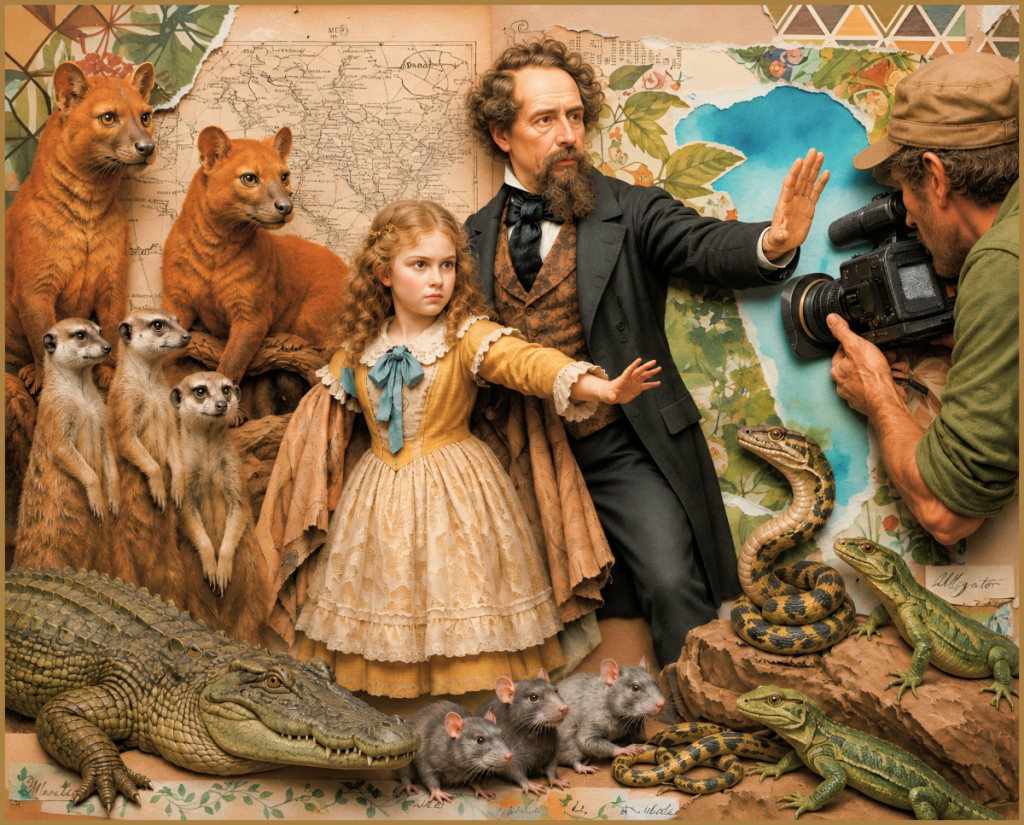
(Beth Clifton collage)
National Geographic
National Geographic is the broadcaster of most of the productions examined in this report and commissioned Africa’s Deadliest. We are aware that senior National Geographic personnel became aware of our allegations through correspondence from Lion Mountain Media.
In particular, Peter T. Lamberti, chief executive officer of Lion Mountain Media and Aquavision TV Productions, copied Janet Han Vissering, senior vice president of development and production for National Geographic Content, on correspondence relating to our investigations.
We also independently provided National Geographic with the evidence supporting our findings. Despite having multiple opportunities to review that evidence, National Geographic has not provided a response to our reports or answered our questions concerning the production or broadcast of the programs examined in our reports.

The National Geographic Society
We twice reported our findings to the National Geographic Society through its ethics reporting system, providing detailed reports, supporting evidence, and links to our video analyses. We explained that our objective was to prevent unnecessary harm to animals and asked the Society to review evidence suggesting that predation scenes broadcast under the National Geographic brand had been staged using captive animals.
In response, the Society stated that it does not produce or control National Geographic television programming, is a separate non-profit organization, is not affiliated with Lion Mountain Media, and that our concerns should instead be directed to The Walt Disney Company. The Society advised that it could not assist further and would not respond to any additional correspondence.

Digital Millennium Copyright Act Abuse
In addition to publishing written reports, we produced a series of videos presenting the evidence uncovered during our investigations. Following their publication, Lion Mountain Media submitted multiple Digital Millennium Copyright Act complaints against our content.
As a result, our videos were removed from multiple platforms, our social media accounts were suspended or disabled, and even some of our email accounts were blocked, significantly limiting our ability to communicate our findings.
We believe these copyright complaints are without merit. Our videos are transformative works created for the purposes of criticism, commentary, and public interest reporting. We believe they constitute fair use (or the equivalent fair dealing exceptions in applicable jurisdictions).
We believe that copyright law should not be used to suppress legitimate public scrutiny or prevent discussion of matters of public interest.

Sources
We have now put together the findings of our investigations into a single 61-page report, currently accessible at either https://medium.com/@thewildtruth2026/the-wild-truth-reports-on-evidence-of-animal-cruelty-in-natural-history-films-625193fe8892 or https://bit.ly/wildtruthreport.
The overwhelming majority of the evidence presented in this report is derived from publicly available sources, including television broadcasts, YouTube videos, Facebook posts, production company websites, and other publicly accessible material.
Wherever possible, we rely on primary source material and provide sufficient detail for readers to independently verify our findings.

Two confidential sources
In addition, we relied on two confidential sources.
First, we received a pre-release copy of The Secret World of Snakes, which was subsequently broadcast by National Geographic under the title The Hidden World of Snakes.
Aside from the title change, the broadcast version was otherwise identical to the version we received.
Second, an anonymous source provided us with Aquavision TV Productions screener videos showing predation sequences filmed under controlled conditions.
The authenticity of these screeners has since been independently corroborated by Lion Mountain Media’s DMCA copyright complaints, which identify the same material, as well as by the inclusion of matching footage in later broadcast productions.

Multiple productions, years, species, & sites
The investigations brought together in this report span multiple productions, years, species, and filming locations.
They examine programs produced for National Geographic and other broadcasters by Lion Mountain Media and associated companies, using a wide range of evidence, including broadcast footage, production screeners, publicly available social media posts, archived online videos, and frame-by-frame comparative analysis.
The same patterns emerge repeatedly. Across these investigations, we identified:
- Reuse of filming sets presented as different wild locations.
- Repeated use of prey animals displaying behavior inconsistent with wild animals.
- Filming techniques indicative of controlled setups.
- Direct links between broadcast footage and captive animals shown in behind-the-scenes material.
Considered individually, each finding raises legitimate questions. Considered collectively, they present a consistent body of evidence suggesting that these are not isolated anomalies but part of a broader pattern.

Evasive response
Equally concerning has been the response to these findings. We provided the organizations involved with opportunities to review the evidence and respond.
Rather than directly addressing the specific factual observations documented in our reports, the principal responses consisted of general statements about wildlife film-making practices, aggressive legal correspondence, or no substantive response at all.
None of the responses provided evidence capable of explaining or disproving the specific observations presented in this report. If these sequences were genuinely filmed as spontaneous wild encounters, it is reasonable to expect that production records—such as travel documentation, behind-the-scenes photographs, production logs, or unused footage—could assist in addressing the questions raised.
At the same time, r epeated copyright complaints were used to remove our videos, social media accounts, and other means of communicating our findings, significantly limiting public access to this evidence.

Not an argument against any use of captive animals
This report is not an argument against the use of captive animals in wildlife film-making.
Captive animals are frequently used for education, scientific illustration, and documentary production, and such practices can be entirely ethical when conducted responsibly and disclosed honestly to audiences.
Our concern is the apparent presentation of controlled predation involving live animals as spontaneous events occurring in the wild, without transparency and, where live prey is intentionally introduced, in circumstances that may raise serious animal welfare concerns.
The issues identified in these investigations extend beyond the productions examined here. Wildlife documentaries occupy a unique position of public trust. They are widely regarded as factual representations of the natural world and play an important role in conservation, education, and public understanding of wildlife. If audiences cannot rely on broadcasters and production companies to distinguish between genuine field observations and constructed scenes, confidence in the genre as a whole is undermined.

Call for independent investigation
For that reason, we believe these findings warrant independent investigation by broadcasters, distributors, regulators, industry bodies, and organizations responsible for overseeing animal welfare in film production. The evidence presented here should be assessed on its merits, and the questions it raises answered through transparency rather than suppression.
We recognize that extraordinary claims require strong evidence. That is why our report relies, wherever possible, on publicly verifiable material, allowing readers to examine the evidence and reach their own conclusions. We remain willing to correct any factual error if credible contrary evidence is produced, and we continue to invite those involved in these productions to provide explanations addressing the observations documented throughout this report.

“Not to assign guilt but to encourage accountability”
Ultimately, the purpose of this report is not to assign guilt but to encourage accountability. If wildlife film-making is to retain the confidence of audiences and continue serving conservation and education, it must be transparent about how its most dramatic sequences are obtained and ensure that the welfare of animals is never subordinated to entertainment.
Our goal is simply to see cruel and misleading filmmaking come to an end. We hope our work will encourage greater public awareness of how some wildlife footage is obtained, particularly where there is evidence that animal welfare may have been compromised for entertainment.
We also hope broadcasters and distributors will take their ethical responsibilities more seriously by conducting meaningful investigations when credible concerns are raised, rather than dismissing or ignoring them.

(Beth Clifton collage)
Note: If you have information that may assist our investigations, wish to discuss the evidence presented in this report, or would like to request supporting materials, please contact us at [email protected] or [email protected].
We are happy to provide full-resolution images, frame comparisons, source materials, and other supporting documentation to substantiate the findings presented in our report.
Please donate to help our work:
More related posts:
Discover more from Animals 24-7
Subscribe to get the latest posts sent to your email.