
“I’ve used push-ups to build strength fast multiple times in my life.
What fascinates me isn’t effort. It’s how often a smarter system beats brute force.”
— JD Meier
Push-ups are one of my favorite exercises (well… love–hate is probably more accurate).
That’s why I’m always curious when I come across a method that claims to make them easier, faster, and more sustainable.
Especially when it actually works.
Key Takeaways
-
Strength is largely a nervous system skill, not just muscle
-
Perfect reps while fresh build faster results than grinding to failure
-
High frequency + low fatigue beats high intensity
-
Stopping when form slips prevents injury and accelerates progress
-
Consistency compounds when the movement becomes automatic
Overview Summary
The Soviet push-up method isn’t about grinding harder.
It’s about training the nervous system, not just the muscles.
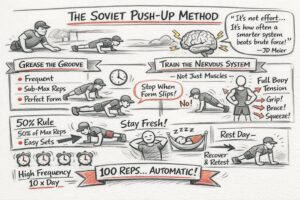
Instead of maxing out or chasing fatigue, the system uses Grease the Groove:
-
frequent
-
sub-maximal
-
perfect-form reps
-
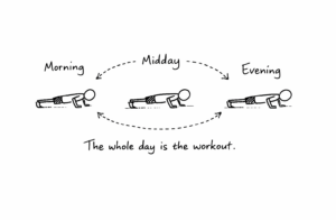
spread across the day
By staying fresh and stopping before form breaks, you hard-wire better movement patterns.
Over time, push-ups stop feeling “hard” and start feeling normal.
This is how 100 reps in one set becomes achievable instead of heroic — or painful.
Key Insights
1. Your nervous system is the real bottleneck
Strength isn’t just your muscle. It’s how efficiently your brain fires movement patterns.
Neurons that fire together, wire together.
Fatigued reps = sloppy wiring.
Fresh reps = clean highways.
2. Form > effort
The Soviets had a hard rule:
Stop the set the moment form degrades — not when it burns.
If you practice bad reps, you get good at hurting yourself.
3. High frequency beats high intensity
10 easy sets spread across the day:
-
no burn
-
no pump
-
no exhaustion
The movement starts to feel as “normal” as walking.
4. 50% rule prevents burnout
Working sets are always half your max, recalculated every 2 weeks.
This guarantees:
-
zero fatigue
-
perfect technique
-
fast progress
5. Full-body tension multiplies strength
Every rep uses:
-
grip tension
-
core bracing
-
glute squeeze
The body moves as one unit, not isolated parts — instantly boosting your control and power.
6. Recovery locks in gains
One full rest day per week allows neural patterns to consolidate.
Progress happens because of rest, not despite it.
Actions (Simple Protocol)
Step 1: Establish your baseline
Step 2: Set your working reps
Step 3: Grease the Groove
For 6 days:
Step 4: Rest + retest
Step 5: Add full-body tension to every rep
Before each rep:
-
Grip the floor (twist palms outward)
-
Brace your core (solid wall)
-
Squeeze glutes hard
Maintain all three the entire set.
Final Thoughts
This isn’t just a push-up method.
It’s a performance principle:
What you practice repeatedly — without fatigue — becomes automatic.
That applies to:
-
strength
-
skills
-
leadership behaviors
-
decision-making
-
habits
Train the pattern.
Protect the form.
Let consistency do the compounding.