
“I did push-ups and sit-ups every day. I never stopped.”
— Herschel Walker
Herschel Walker didn’t do thousands of push-ups by grinding through some brutal two-hour workout.
He did them the way water carves rock.
A little at a time, all day long, for decades.
That detail matters.
Because the method behind Walker’s legendary bodyweight volume is far simpler than most people expect.
And that simplicity is exactly why it worked.
Here’s how it actually played out.
Key Takeaways
-
Walker didn’t train in workouts — he trained all day.
He aimed for a daily total and spread small sets across his waking hours. -
Low fatigue made massive volume possible.
Most sets were far from failure, which let him repeat them again and again. -
Consistency mattered more than intensity.
No cycles. No breaks. Decades of showing up beat short bursts of motivation. -
Variation protected him from burnout.
He rotated push-up styles, tempo, and difficulty so no single movement shut him down. -
Distribution changes the stimulus.
1,500 push-ups spread over a day is fundamentally different from 1,500 in one session. -
The real secret was patience.
Thousands of reps weren’t forced — they were built gradually, over years.
Overview Summary
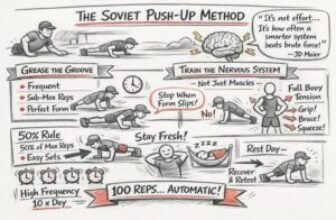
Herschel Walker’s thousands of daily push-ups weren’t the result of brutal workouts or superhuman grit.
They came from a deceptively simple system: a daily target, broken into small sets, spread across the entire day, and repeated consistently for decades.
Instead of training until exhaustion, Walker trained around fatigue — keeping each set easy enough to recover quickly, rotating variations to manage strain, and letting volume accumulate naturally over time.
This article breaks down the structure behind that system — how he distributed work, why low fatigue mattered more than intensity, and why consistency over years reshaped his body in ways short-term programs never could.
The lesson isn’t to copy his numbers.
It’s to understand the architecture that made them possible — and why simplicity, patience, and distribution quietly outperform grind.
A Daily Target — Not a Workout
Walker didn’t think in terms of workouts.
He thought in terms of a daily number.
Depending on the phase of his career, that target ranged from roughly 1,500 to 3,500 push-ups per day — lower during his MMA years, higher during periods of pure bodyweight training.
The key distinction:
He was never trying to finish them in one session.
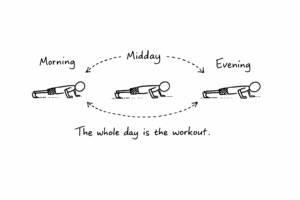
Instead, he spread the reps across his entire waking day in small, frequent sets — often just 10 to 20 reps at a time, with short rests.
Think less “workout.”
Think practice.
-
A block of sets in the morning
-
Another block around midday
-
Another in the evening
-
Plus scattered sets filling the gaps in between
The whole day was the training session.
Any single moment was easy.
The accumulated volume was enormous.
A rough illustration for a 1,500-rep day (not his exact numbers, but the same architecture):
That’s 900 reps.
A handful of extra sets throughout the day quietly brings the total home.
Inside the Push-Up Blocks: Rotation, Not Repetition
This wasn’t mindless repping.
Within those micro-sets, Walker rotated difficulty, tempo, and variation to manage fatigue and keep the stimulus fresh.
A typical push-up block reportedly looked something like this:
-
Partial-range push-ups (halfway down) for higher reps — accumulating volume without early burnout
-
Harder variations (one-arm, diamond, close-grip) for 10–20 reps
-
Slow-tempo standard push-ups to emphasize time under tension
-
Handstand push-ups, often in sets of about 10, with short rests
The pattern mattered:
Easier high-rep work → harder variation → easier again → slow reps → overhead pressing.
Then repeat.
No single variation accumulated enough fatigue to shut him down.
But the overall volume kept climbing.
The Full Daily Picture
Push-ups were just one pillar.
Walker built his entire training around extreme-volume calisthenics, every day, for decades — no traditional weights.
His daily structure also included:
-
Sit-ups: 2,000–3,000 per day, built gradually from sets of 10 using the same micro-set approach
-
Other bodyweight work: high-rep dips, squats, lunges, pull-ups, and jumping drills
-
Conditioning: sprints and rope work to maintain explosiveness
No barbells.
No machines.
No gym memberships.
Just his body, gravity, and an almost incomprehensible commitment to showing up daily.
Why It Works (and What Most People Miss)
It’s easy to look at those numbers and assume Walker was simply a genetic outlier — and his genetics certainly helped.
But the method explains far more than the raw totals.
He built volume over years, not weeks.
Walker has said he started as a kid who could barely do 10 push-ups and 10 sit-ups.
No program jumped from 50 to 2,000.
Just small, patient increases compounding over a very long time.
Low per-set fatigue was the engine.
Each set stayed well short of failure — 20 reps when he could do 80.
That meant he never created the kind of deep fatigue that demands long recovery.
Easy sets are repeatable all day.
This is the same principle later popularized as greasing the groove.
Consistency beat intensity.
Walker didn’t cycle on and off.
He didn’t peak or deload.
He simply never stopped.
Decades of daily volume built connective tissue, work capacity, and endurance layer by layer — adaptations no 12-week program can touch.
Distribution mattered as much as total volume.
1,500 push-ups spread across 16 waking hours is a completely different stimulus than 1,500 in 90 minutes.
Distributed effort keeps each bout moderate, allows real recovery, and lets the body absorb work that would be crushing if compressed.
The Takeaway
You don’t need to do 3,000 push-ups a day.
But the underlying architecture is available to anyone:
-
Daily targets instead of scheduled workouts
-
Small sets far from failure
-
Variation to manage fatigue
-
Relentless consistency measured in years
Walker’s real secret wasn’t superhuman willpower or freak genetics — though he had both.
It was a system so simple that the only hard part was never quitting.
And he never quit.
Get the Book

If you want this philosophy straight from the source, Herschel Walker’s Basic Training is where Herschel Walker lays it out in his own words.
The book isn’t a modern training program or a step-by-step workout plan.
It’s a window into the mindset and daily discipline behind his legendary bodyweight training.
Walker explains:
-
Why he trained every day, not in cycles
-
How small sets done consistently beat brutal workouts
-
How patience and accumulation shaped his strength over decades
If you’re curious how someone actually lived this approach — not just the push-ups, but the mentality behind them — the book fills in the gaps this article can only outline.
Get Herschel Walker’s Basic Training on Amazon
(Available in paperback and used editions)
You Might Also Like
25 Best Exercises to Master Calisthenics