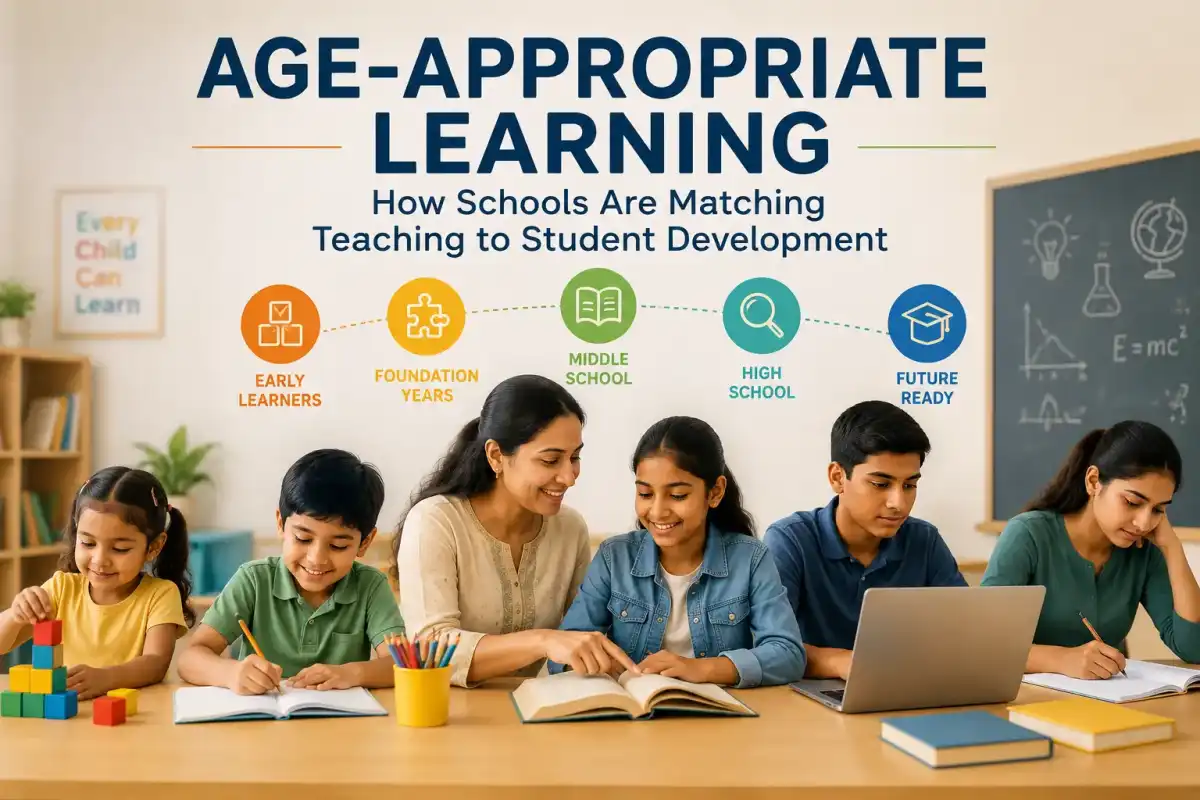
Across Indian classrooms, a quiet shift is underway. Schools are moving away from using the same teaching methods for all students, regardless of age. Instead, many are adopting curricula and pedagogical approaches that align with how children learn at different stages of development.
This shift reflects the recommendations of India’s National Education Policy (NEP) 2020, which advocates developmentally appropriate teaching methods across different stages of schooling. The policy recognises that early learners, primary school students, and secondary school students have distinct educational and developmental needs.
Research in child development indicates that children acquire cognitive, social, and motor skills differently as they grow. Early learners benefit from play-based and experiential environments, while older students require more structured instruction that supports analytical thinking and conceptual understanding.
Studies also indicate that approximately 90% of brain development occurs by the age of five. During early childhood, the brain forms more than one million new neural connections every second, highlighting the importance of providing rich learning experiences that support foundational development.
Multiple Schools Are Adopting Age-Appropriate Learning
Multiple schools across India have adopted age-appropriate teaching frameworks based on the principle that curriculum, pedagogy, assessments, and classroom activities should be aligned with children’s developmental readiness.
Among the schools adopting age-appropriate learning frameworks is Narayana Schools, also known as Narayana eTechno Schools, a network of private educational institutions operating across India. The institution has organised its educational framework into three stage-specific programmes: eKidz for pre-primary education, eChamps for primary education, and eTechno for middle and secondary education, with curriculum and pedagogy aligned to the developmental requirements of each stage of schooling.
Alignment with National Policy
The programmes are aligned with the National Curriculum Framework (NCF) 2023, which outlines the Panchpadi instructional model, a five-stage learning process comprising:
1. Introduction (connecting with prior knowledge)
2. Conceptual understanding (exploration and discovery)
3. Practice (reinforcement of learning)
4. Application (real-world application of concepts)
5. Expansion (reflection and peer learning)
The National Education Policy (NEP) 2020 emphasises that schools should reconsider not only what they teach but also how they teach.
Developmentally appropriate pedagogy is recognised as an important component of improving learning outcomes by aligning curriculum and classroom practices with the evolving needs of students.
The adoption of stage-specific learning frameworks reflects a broader shift in Indian school education towards developmentally aligned teaching practices. As schools increasingly tailor curriculum and pedagogy to different stages of learning, age-appropriate education is becoming an important feature of K–12 schooling in India.