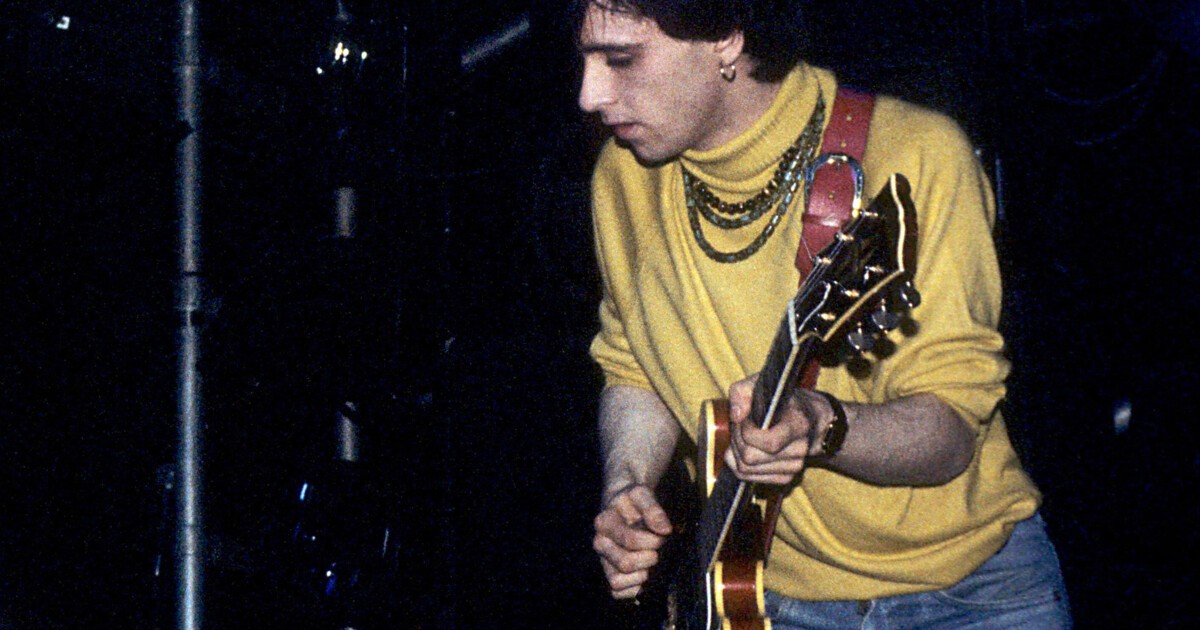
Johnny Marr with his Gibson ES-355 at Hammersmith Palais, London, 15 June 1984 (DPA)
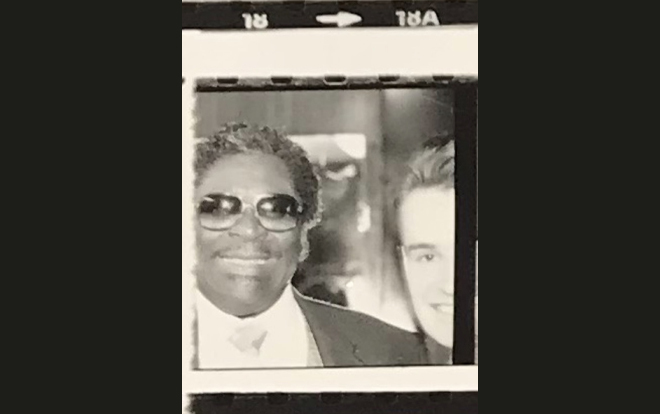
On a rainy night in October 1987 I went with a friend to see B.B. King at the Pavilion Theatre in Glasgow and after the show we went round to his dressing room. He seemed to like talking to young people – we were 19; he was 62 – and he made a great performance of pointing to his guitar, ‘Lucille’, an adapted black Gibson ES-355 with an ivory fretboard, which stood by itself in a shower stall. As King told us how he’d rescued one of its predecessors from a burning dancehall, my mind was drifting to another Gibson of the same model, a red one played by Johnny Marr of the Smiths, a band that had just broken up.
Marr’s guitar was made in Kalamazoo, Michigan, around 1960, and nobody knows who played it for the first 24 years of its life. It ended up in We Buy Guitars on West 48th Street in New York. Fred Smith, the bass player in Television, was a salesman there. The cherry-red Gibson could be viewed through the window. ‘It just glowed and spoke to me,’ Marr later said. ‘I fell in love with it.’
The Smiths were in New York to play their first American show, at Danceteria on New Year’s Eve 1983, as Marr recalls in his book Marr’s Guitars. Seymour Stein was keen to sign them for Sire Records and had told Marr that he’d once bought a guitar for Brian Jones. ‘A couple of days later, after going into Sire Records to sign the record contract, I marched Seymour through the snow’ to West 48th St. ‘I won’t lie,’ Marr later said of the red Gibson ES-355, ‘it looked like the most expensive one in the shop.’
The Smiths were staying at the Iroquois Hotel and Marr went immediately to his room, sat on the bed and picked out the opening chords of what would become ‘Heaven Knows I’m Miserable Now’. ‘The song just arrived under my fingers, complete,’ he said. He then proceeded to write the song that would become ‘Girl Afraid’, the B-side. ‘Some instruments come with songs in them, and this guitar came with quite a few.’
The Smiths kicked off the Scottish leg of their Meat is Murder tour at the Magnum Leisure Centre in Irvine New Town on 22 September 1985, and I was at that gig, watching from the middle of the crowd as all the tough boys from school tried to climb the stage. It was a signal moment. There on his own side was Johnny Marr. He had an amazing stance, folded around his fabulous guitar and swaying his head from side to side. The lighting was bad in the games hall where they played, but I remember him changing guitars during the set and picking up an emerald Telecaster, which brought an evergreen flavour to ‘Stretch Out and Wait’. Whichever guitar he held, Marr always seemed to own it, the song, the guitar, and the love flowing back from the fans, in our case teenagers from a small town that was referred to as an Unemployment Black Spot.
Marr appeared like the man with the blue guitar in Wallace Stevens’s poem, but a working-class guy from Manchester with a good haircut, ‘jangling the metal of the strings’ to bring ‘a tune beyond us as we are’. He loved the sound of Rory Gallagher, Bert Jansch (‘folky, and not too macho’) and James Honeyman-Scott of the Pretenders (‘I thought I could do that’) as well as James Williamson of the Stooges. He established his own sound in a beautiful miasma of theirs.
I’d seen the Gibson on TV in 1984, the night the Smiths appeared live on the Channel 4 rock show The Tube, when Marr had sliced the instrument right, left and centre while performing ‘Barbarism Begins at Home’. It’s funny to think about bands that no longer exist but whose existence once defined you. I suppose it’s embarrassing to talk about, like talking about your first attempts at sex, but it was the tone of Marr’s guitars that brought me to the Smiths.
In July 1986, I watched in glee as Marr took to the stage of the new G-Mex Centre in Manchester and blew all the other bands away. I later wrote about that concert in my novel Mayflies, the sense of appointment we had. ‘They say you know nothing at eighteen,’ my narrator offers, ‘but there are things you know at eighteen that you will never know again.’ The sound rolling from the stage felt like ours. Before the internet, before YouTube, the things that happened to us usually only happened once, and I remember standing shoulder to shoulder with my friends that night, some of them now dead, and we watched Marr hold one of his guitars aloft as he left the stage. ‘In memory,’ Tennessee Williams wrote, ‘everything seems to happen to music.’
Forty years on, 112 items from Johnny Marr’s collection, including most of his guitars, have been sold at Christie’s. At a pre-sale party at the auction house in King Street, Marr’s friends and family walked among the mounted guitars and the tattered amps and the gold discs as if they were at a wedding. There was nostalgia, of course. We are all apt at times to put a price on our fondness for those absent years, parcelled out in pop-cultural relics. People can buy them to feel closer to everything that mattered, and why not? At least a guitar is tactile and has songs associated with it, as well as history around it, and can still be played or admired by people with tunes of their own. ‘I can’t believe I’m standing next to a guitar you saw being played in 1984,’ my daughter said, as if 1984 were not only a ridiculous date, some weirdo’s idea of the dystopian future, but also a Certifiably Long Time Ago. She whipped out her phone and took more photographs in ten seconds than I have from my entire childhood. Maybe that’s why people like me dote on what remains.
‘I don’t really want to be a museum,’ Marr said to his interlocutor, Martin Kelly, at a discussion following the preview party at Christie’s. ‘I’m still a young man.’ The crowd laughed and he was handed another of his old guitars. After tonight, he wouldn’t play them again, and it seemed both a fond farewell and a bold renunciation. ‘You get to that stage in your career,’ he said, taking hold of a Rickenbacker 330 Jetglo (estimate: £60,000 to £80,000), ‘where you wear white gloves.’ He’d bought the guitar at A1 Repairs in Manchester in 1983 and as he picked out a few notes at Christie’s the room sighed. It was the real sound of ‘This Charming Man’, clear, melodic and jangling, and he told us he came up with the tune on this guitar in the time it took to rewind a tape.
He was then handed the cherry-red Gibson 355 (estimate: £100,000 to £150,000) and my mind fluttered with images. He played the beginning of ‘Heaven Knows I’m Miserable Now’. ‘The guitar made me do it,’ he said quietly. ‘I was always looking for the next song.’ I remembered a well-known photograph by Paul Slattery that I’d seen again in the catalogue, taken after a gig at the University of East Anglia on Valentine’s Day in 1984. A slim Marr, twenty years old and smoking a cig and rocking his latest mane, bends over his new Gibson 355, knowing nothing yet about what time does to people and their possessions.
One of the unsung things he has done over the years is to lend his guitars to other musicians – Oasis, Radiohead, Fontaines DC – as if wishing to lend their magic to something new. Before the end of the talk at Christie’s and the return of the drinks’ trays, he picked up his emerald Giffin Telecaster (estimate: £20,000 to £30,000), and, as he strummed out ‘The Headmaster Ritual’, I could see the instrument, green as we were, glinting all those years ago at the edge of the Magnum gymnasium.
At 2 p.m. on 17 September 2026, the main room was full and there was overspill gathered around the sides. At one point, the sound of ‘William, It Was Really Nothing’ was falling through the air. It all seemed a long way from the box bedrooms of Dublin, Dundee and Humberside. ‘We don’t have complete emotions about the present,’ Virginia Woolf once wrote in her diary, ‘only about the past.’ At Christie’s, sales people were poised at the telephone banks that fanned out from the auction block, and the auctioneer, Yü-Ge Wang, in an Issey Miyake-style pleated top, choreographed with her arms a sense of flow between the bidders.
She quickly sold the first famous guitar of the evening, the Rickenbacker 330 Jetglo. Marr wrote much of the Smiths’ first album on that guitar, and it can be seen lying behind Liam Gallagher on the cover of Oasis’s first single, ‘Supersonic’. Sitting in the room, a man in a white baseball cap was not to be beaten by bidders in Florida or the Far East. Keeping up a steady and cool-headed run of counterbids, he got the guitar for a hammer price of £280,000. This was £200,000 above the estimate and it set the tone for the auction. In the end, a combined figure not far off four million pounds was raised, a proportion of it going to charity. I watched as the green Telecaster and red 355 vanished into fandom. Goodbye, I said. And it seemed only fair after all the excitement that we still had the tunes.