Subscription Required
By Karl Sinclair
August 14, 2026, © Leeham News: On the surface, program accounting is a simple concept. Closer inspection reveals a far more complex and intertwined system.
Individual aircraft production costs are capitalized and accrued in inventory, to be expensed over time and averaged out–smoothing earnings over the life of an aircraft program.
Such an accounting strategy makes sense, as initially produced aircraft are more expensive to make than examples coming off factory lines later in a program cycle. The company relies heavily on the use of estimates to gauge how much it will earn on future models, balanced against what it will cost to produce them. Those projections are updated each reporting period.
Investors are therefore less likely to be frightened off by high initial costs and low margins, as an aircraft makes its way through the product life cycle.
Perils of Program Accounting
In this manner, Boeing uses program accounting to spread out production costs over the lifetime of an aircraft program. That, in of itself, is not a problem–so long as projections align with reality.
The pitfall is described in Boeing’s financial reports, wherein the company cautions: “We enter into firm fixed-price aircraft sales contracts with indexed price escalation clauses, which subjects us to losses if we have cost overruns or if increases in our costs exceed the applicable escalation rate.”
As previously reported by Leeham News and Analysis (LNA), Boeing has been beset by a litany of production and certification issues which are not covered by price escalation clauses with customers.

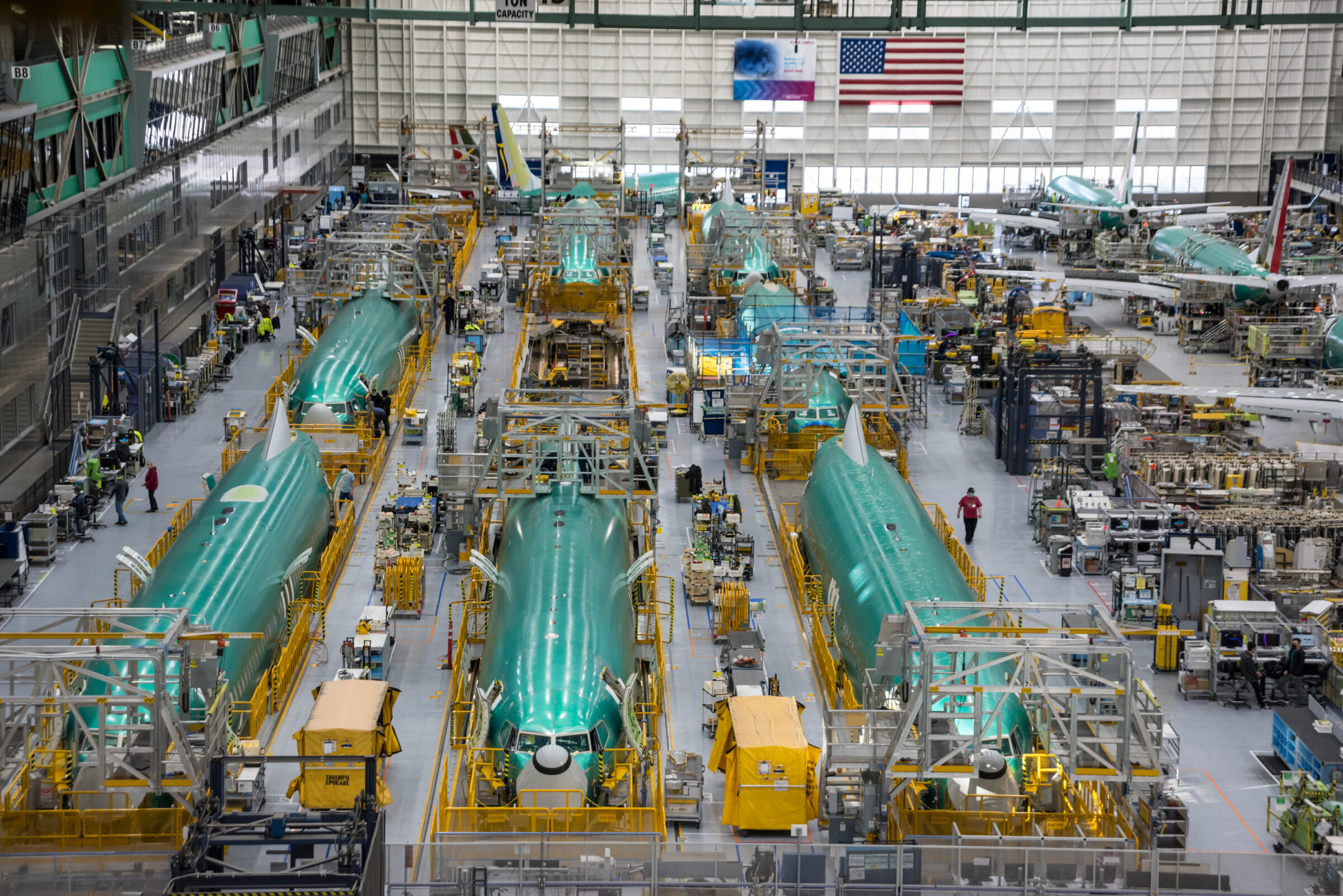
The second-ever 737 Max 10 to be loaded onto Boeing’s new North Line in Everett, Washington. Photo credit: Photo credit: Jennifer Buchanan/Seattle Times/Pool
If long-term revenue and expense assumptions are overly optimistic, the company can fall into a rinse-repeat cycle of building up capitalized costs in inventory, followed by a periodic write-off. Investors and analysts unaware of rising balances in the deferred production balances of the three commercial programs may be caught off-guard, when a reach-forward charge is announced.
A reach forward charge (or loss) is when the expected total costs to complete a contract exceed the expected total revenues. In Boeing’s case, it is when the costs for an entire program, exceed the estimated total revenues that the program will generate. It is then recorded as a reduction to deferred production costs, stored in inventory.