By Leeham News and Analysis Staff
October 16, 2026
When people hear about aircraft manufacturers struggling with supply chain disruptions—a shortage of a specific fastener, a late fuselage delivery, a supplier quality escape—it can be tempting to assume this is the same kind of problem every manufacturer deals with, just at a bigger scale. A car company deals with chip shortages, an appliance maker deals with steel price spikes, and an aircraft company deals with the same category of headache, just with more expensive parts. But that framing misses something important about why aircraft supply chains are structurally more fragile than the supply chains behind most everyday manufactured goods. It comes down to the difference between unit production and conventional assembly line production.
Understanding the unit production versus assembly-line distinction helps explain this fragility. It’s not that aircraft manufacturers are worse at supply chain management. It’s that the process has almost no slack built in for exactly the kind of disruption that a conventional inventory-building line is designed to mitigate against.

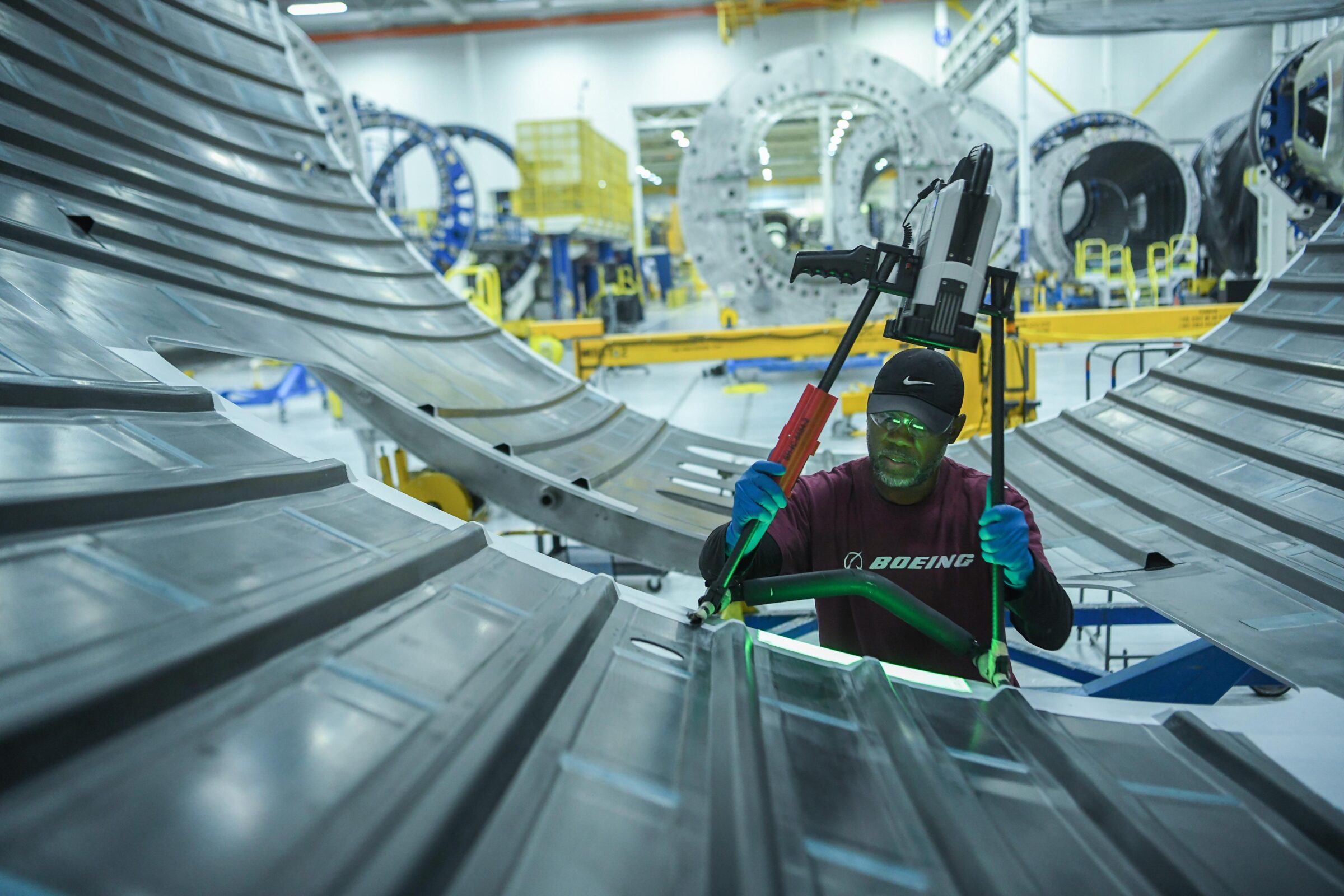
Boeing 787 production in North Charleston, South Carolina. Photo credit: Boeing
At first glance, a lot of factories look basically identical. You see a long line, products moving down it step by step, workers or robots doing their piece at each station, and everything moving at a steady, predictable pace. Whether that factory is building custom aircraft or building toasters, the scene on the floor is almost the same. But underneath that surface similarity, there are two very different ways of organizing production. The difference matters a lot for how a company operates, what risks it takes on, and how it manages its money. These two approaches are called unit production and assembly line (or repetitive) production.
What Unit Production Is
Unit production means building things one at a time, where each item is unique and made for a specific buyer or a specific purpose. The item is usually complex and expensive, and it’s typically built in fairly low volume—you’re not making thousands a day, you might be making a handful a month, or even just a few a year. Because each item is custom, the work involved changes almost every time. The workers building unit No. 1 might be doing something noticeably different from the workers building unit No. 2 because they aren’t the same product. They just belong to the same general category.
A good way to think about this is a commercial aircraft. When an airline orders an airplane, that airframe is configured around exactly what that airline wants: a specific engine type, a particular seating layout and cabin interior, specific avionics packages, and sometimes structural provisions unique to how that airline plans to use the aircraft (cargo capability, extended-range certification, and so on). The next aircraft built on that same line, right behind it, might be configured completely differently because it’s headed to a different airline with different requirements. Even though every unit shares the same basic airframe design, each individual plane is effectively a custom product—built to order, for a buyer who already exists, rather than built speculatively and then sold.
Assembly Line Production Explained
Assembly line production, sometimes called repetitive manufacturing, is the opposite idea. Instead of building one unique item at a time, you’re building many identical (or nearly identical) items over and over, one after another. The product moves through a series of fixed stations, and—this is the key part—each station does the exact same task on every single unit that passes through it. Station 1 does the same job on unit 47 that it did on unit 46 and will do on unit 48.
The goal of this kind of production isn’t to fulfill one specific order. It’s to build up a stockpile, or inventory, of finished goods that the company can then sell as customers come along and want to buy them. The company is essentially betting that people will want what they’re building, based on forecasts and past sales data, and they build ahead of actual demand so that product is ready and waiting when someone wants to buy it.
Cars (for the most part), appliances like refrigerators and washing machines, and consumer electronics like phones and laptops are the classic examples. A car company doesn’t wait for you to walk in and order a specific vehicle before they start building it (with some smaller exceptions). They build a large volume of cars to a standard set of trims and options based on what they expect to sell, ship them to dealerships, and then customers choose from what’s already been built or close to it.
What Looks the Same
Here’s where it gets interesting: from a distance, both of these processes can look nearly identical. Both typically involve a literal, physical assembly line—a product moving step by step through a sequence of workstations. Both use a steady, controlled pace to keep everything moving smoothly, often called a “takt time,” which is just the target amount of time allowed at each station before the product moves to the next one. And both create the visual impression of a continuous, organized, almost rhythmic flow of work from the start of the line to the end.
If you walked onto a factory floor and watched either process happening, you might not immediately be able to tell which one you were looking at. Workers moving in sync with the line, parts being installed at each station, finished units rolling off the end—the physical choreography can look remarkably alike whether the product is a custom airplane or a mass-produced car.
The Real Differences
The differences aren’t visual; they’re informational and economic. Here’s where the two systems really diverge.
In unit production, every item moving down the line is different from the one before it and the one after it. Different specifications, different customer, different final configuration. Even though the physical line and its stations are fixed, what each station actually has to do changes depending on which unit is currently in front of it. This requires an enormous amount of tracking and coordination, because workers need to know exactly what makes this particular aircraft different from a “standard” one.
In assembly line production, every item moving down the line is essentially the same. Same specifications, same configuration, built to one design that doesn’t change from unit to unit (aside from very minor, pre-planned variations like color options). This uniformity is what allows companies to automate heavily and build very efficiently, because a machine or a worker doing the exact same task over and over can get extremely fast and consistent at it.
There’s also a difference in purpose. Unit production builds toward a specific order that’s already been placed—the customer exists, the sale has essentially already happened, and the factory is just fulfilling it. Assembly line production builds toward forecasted demand—meaning the company is predicting that customers will want the product, but no specific sale has happened yet for any individual unit coming off the line.
That leads directly into the biggest practical difference: inventory. Unit production keeps very little finished-goods inventory sitting around, because every item is already spoken for by the time it’s built —an airline isn’t going to let an already-configured, already-sold aircraft sit unused. Assembly line production, by contrast, deliberately creates a stockpile of finished goods. That’s actually the whole point of the system: build ahead of demand so product is ready and waiting.
Why the Difference Matters
These two approaches create two very different kinds of risk, and understanding that risk is really the heart of why this distinction matters.
Unit production requires extremely careful tracking and coordination so that the right customization ends up on the right item. If a company loses track of which unique specifications belong to which aircraft, that’s a serious and often costly mistake—you can’t easily “fix” a custom-configured plane built to the wrong spec the way you might just pull a replacement off a shelf. The risk here is complexity: managing all those differences without errors.
Assembly line production requires accurate demand forecasting, because the company is committing resources to build products before anyone has agreed to buy them. If they build too much, they end up with excess inventory sitting in warehouses, tying up money and space, and possibly becoming outdated or unsellable. If they build too little, they miss out on sales because customers who wanted the product couldn’t get it in time. The risk here is a forecasting and inventory problem, not a customization problem.
So, while both systems might look like the same kind of factory floor to an observer, they’re actually solving two completely different business problems. Unit production accepts complexity and coordination challenges in exchange for never having to guess what will sell—the sale already happened. Assembly line production accepts the risk of guessing wrong about demand in exchange for the simplicity, speed, and efficiency that comes from building the exact same thing over and over. Neither approach is better in some absolute sense; they’re just suited to very different kinds of products. Recognizing which one you’re looking at requires understanding what’s happening beneath the surface of the line, not just what the line looks like from the outside.
Related