Comedian Compares Sound System Shutdown to Silencing Martin Luther King Jr.
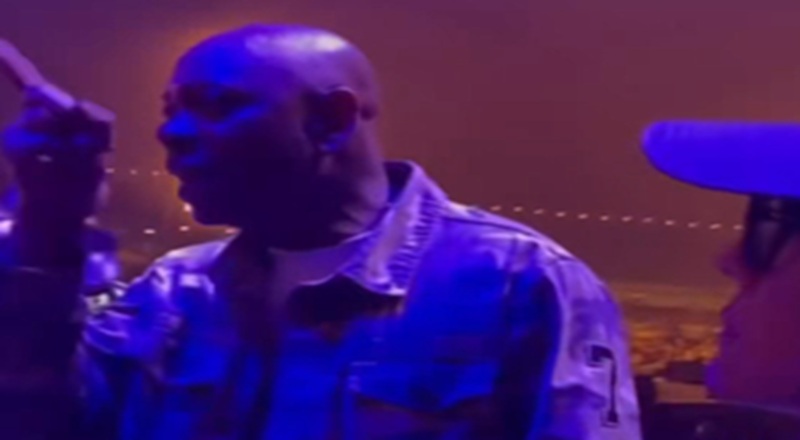
Dave Chappelle erupted after the Fugees’ performance at the Milton Keynes National Bowl was cut short by a strict 11 p.m. curfew, comparing the sound system shutdown to silencing Martin Luther King Jr. The 49-second clip, posted on X by @ArtOfDialogue_, has gained over 1 million views. In addition, it sparked debate about the comedian’s reaction.
The incident occurred during the inaugural UK edition of Diaspora Calling!, a festival curated by Lauryn Hill. Chappelle, who served as host, was seen confronting organizers near the stage after the microphones were disabled mid-performance. His remarks framed the interruption as a profound disruption of a meaningful cultural event.
35,000 Fans, One Hour, and a Hard Stop
The festival was designed as a celebration of African diaspora culture. As a result, it drew more than 35,000 attendees to the Milton Keynes National Bowl on August 7. The lineup included Erykah Badu, Giggs, Fireboy DML, and YG Marley, with the Fugees—Lauryn Hill and Wyclef Jean—as headliners. Pras Michel, the third original member, was absent due to a prison sentence.
The headlining set focused on marking the 30th anniversary of the Fugees’ 1996 album The Score. Hill and Jean took the stage around 10 p.m. BST. So, this left roughly one hour before the venue’s strict 11 p.m. curfew. The venue operates under a licensing restriction requiring amplified music to conclude by 11 p.m. This is a common noise ordinance for UK outdoor venues.
Midway through a performance of “Ready or Not,” the microphones were cut. Hill and Jean attempted to address the audience about the situation, but their mics were disabled. A message appeared on stage screens apologizing for the abrupt finish and citing the legal requirement to end the show at 11 p.m. The crowd responded with boos.
An MLK Comparison That Raised Eyebrows
Chappelle, appearing animated and direct while moving among people near the stage, delivered a series of pointed statements in a raised, emphatic tone. He repeatedly asserted that those responsible were “fucking up history.” He specifically claimed, “You turned off the mic on Martin Luther King, […].” Basically, Dave was framing the interruption as equivalent in gravity to silencing the civil rights leader.
He insisted, “Let us close the show,” and elaborated that “It’s a moment.” At this point, he was emphasizing the significance of allowing the artists to finish properly. He continued with “Man, y’all […] up,” followed by a declaration that he will “never forget this.” Chappelle then asked repeatedly for accountability. So, he began questioning: “Who can I talk to?”, “Tell ’em, whoever’s in charge,” “Let us close,” “Who’s in charge?”, and “Where are they?”
The rhetoric used strong profanity and a direct historical analogy to elevate the perceived cultural and historical weight of the interrupted set. His tone was one of indignation, urgency, and personal investment rather than measured discussion.
What the Artists Said After the Curfew Cut
Wyclef Jean later stated to The Sun that the artists were “really sad how it ended,” that they “were just getting started,” and that they hoped to continue the following year. He emphasized the energy of the crowd and the event’s theme of unity amid division.
Lauryn Hill posted on social media acknowledging surprise guests who were prepared to perform but could not due to the curfew. She framed the overall event positively as aligned with its original mission of reclaiming path and celebrating diaspora power, passion, and creativity, while noting lessons for future iterations.
Reports indicated the planned set had additional material and guests remaining. The late start by the headliners compressed the available window. This illustrates how scheduling variances can interact with fixed rules to produce abrupt endings.
Why UK Venues Shut Down at 11 PM
UK outdoor venues operate under strict licensing restrictions that require amplified music to conclude by 11 p.m. to limit noise disturbance to nearby areas. Violations can result in significant fines. The Milton Keynes National Bowl has hosted major outdoor events under similar curfew constraints.
The late start by the headliners—a common issue in Lauryn Hill’s touring history—left insufficient time for the full planned set. The curfew is a legal necessity rather than an arbitrary decision, enforced by local authorities to manage community impact.
Chappelle’s invocation of Martin Luther King Jr. positions the interruption of a rare Fugees reunion performance as a matter of cultural and historical gravity within the African diaspora narrative. This frames the technical cutoff not merely as operational inconvenience but as a silencing of a significant Black artistic moment.
Viewers on X Are Split on Chappelle’s Outburst
The @ArtOfDialogue_ post has over 1 million views, more than 8,000 likes, and hundreds of replies. Reactions were mixed and polarized.
One response stated “Sad how Chappelle has become so full of himself,” reflecting a critical view of his demeanor. Another clarified and defended the context: “It CLEARLY says ‘During The Fugees performance’… Not during Dave’s performance. He’s sticking up for The Fugees.” A further reply observed, “When dave speaks with conviction like this its lowkey paralyzing 😭😭 how do you respond to this […],” highlighting the rhetorical force of his delivery.
Additional comments referenced “CPT” (Colored People’s Time) in connection with the late start, argued that the curfew is a legal necessity rather than arbitrary, questioned the applicability of an American civil-rights analogy in an English venue context, or mocked the elevation of a music set to historical status on the level of Martin Luther King Jr. Some expressed simple frustration with curfews themselves, while others emphasized that organizers and artists should have anticipated the hard cutoff.
Final Thoughts
The clash between the festival’s cultural aspirations and the venue’s legal obligations has become a flashpoint for larger debates about how society values Black artistic expression. When a celebration of diaspora culture is silenced by a noise ordinance, the symbolism is hard to ignore, especially when a figure like Chappelle frames it in historical terms.
The late start by the headliners created a situation where the curfew became unavoidable. That scheduling decision, whether driven by artistic preference or logistical delays, ultimately meant the audience got less than what was promised. The venue enforced its rules. The artists and host reacted. The crowd left disappointed.
For future iterations of Diaspora Calling! and similar events, the lesson is clear: either start earlier or find venues with more flexible licensing. The cultural significance of the moment matters, but so does the clock. Both must be accounted for if these celebrations are to reach their full potential without being cut off mid-song.