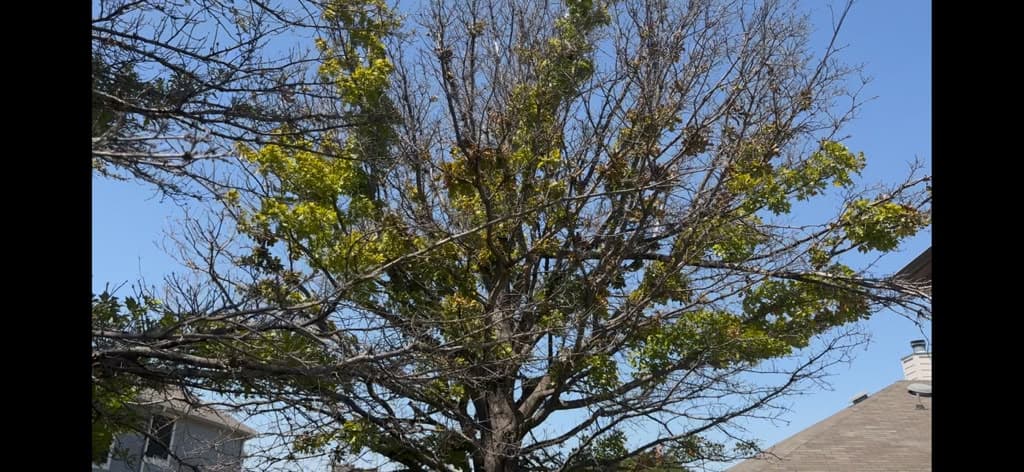
Today we’re here in Roanoke, Texas, inspecting several mature Shumard Red Oaks (Quercus shumardii) that are experiencing abnormal canopy development, poor bud break, progressive twig dieback, and the loss of portions of their scaffold structure.
One of the first things homeowners naturally want to know when a tree fails to leaf out normally is:
“What disease does my tree have?”
But not every declining tree is suffering from an infectious disease.
Sometimes the problem is environmental.
That is an important distinction in this particular case because these Shumard Red Oaks appear to have experienced a disruption in their normal dormancy and spring growth cycle following an unusually warm winter.
Deciduous trees operate according to a biological calendar influenced by temperature, day length, genetics, accumulated winter chilling, and spring heat.
When those environmental signals become abnormal, the tree’s normal developmental sequence can become disrupted.
That disruption can produce delayed or irregular bud break, uneven canopy development, weak shoot elongation, and—in more severely affected tissues—branch dieback.
For these Shumard Red Oaks in Roanoke, our concern is that environmental conditions have contributed to an abnormal dormancy-to-growth transition, leaving portions of the canopy unable to resume normal growth.
⸻
Understanding Dormancy in Shumard Red Oaks
A Shumard Red Oak does not simply lose its leaves in the fall and wait passively for spring.
Dormancy is a highly regulated physiological process.
As temperatures cool and days shorten, the tree begins preparing for winter.
Growth slows.
Leaves are eventually shed.
Carbohydrates produced during the growing season are redistributed and stored within living tissues throughout the trunk, branches, and root system.
The tree then enters a period of winter dormancy that protects vulnerable growing tissues from unfavorable conditions.
Inside each dormant bud is the biological potential for the following year’s growth.
When environmental conditions become favorable again, those buds must transition from dormancy into active growth.
That process is what eventually produces spring bud break.
⸻
Why Winter Chilling Matters
Many temperate deciduous trees require exposure to a sufficient period of cool temperatures before dormant buds can transition normally into spring growth.
This is commonly referred to as a chilling requirement.
The exact chilling response is influenced by species, genotype, tree condition, site conditions, and local climate.
Once adequate winter chilling has occurred, warmer spring temperatures begin accumulating the heat necessary to stimulate bud development and shoot elongation.
In simplified terms, the tree needs the proper sequence:
Fall acclimation → winter dormancy → adequate chilling → spring warming → bud break → shoot elongation.
When that sequence is disrupted, spring growth can become irregular.
⸻
The Warm Winter of 2025 and Dormancy Disruption
One of the environmental factors we’re considering on these Roanoke trees is the unusually warm winter preceding their abnormal spring development.
If a tree does not experience the winter temperature pattern its buds are physiologically adapted to, dormancy release may become inconsistent.
Some buds may open normally.
Others may open late.
Some may produce weak shoots.
Other portions of the canopy may fail to develop as expected.
The result can be a tree that looks extremely uneven during spring and summer.
One section may contain healthy foliage while another scaffold branch appears almost completely bare.
That pattern immediately raises concern because mature canopy structure depends upon successful bud break throughout the scaffold system.
⸻
Genotype Matters
Not every Shumard Red Oak will respond identically to the same winter.
Individual trees possess genetic differences that influence how they respond to temperature, moisture, soil conditions, and other environmental pressures.
That is why two trees growing relatively close together can experience the same weather yet respond differently.
One may develop a nearly complete canopy.
Another may experience delayed bud break.
A third may suffer significant twig or branch mortality.
The environmental exposure may be similar, but the physiological response of each tree can be different.
This is an important concept when diagnosing environmental tree decline.
We cannot assume that because one tree survived an unusual winter without visible symptoms, every neighboring tree should respond the same way.
⸻
Extreme Cold Can Also Disrupt the Canopy
We have seen the opposite environmental extreme in North Texas.
The historic winter storm of 2021 exposed trees throughout the Dallas-Fort Worth region to unusually severe freezing temperatures.
Extreme cold can physically injure living cells within buds, twigs, branches, and vascular tissues.
That creates a different mechanism of injury than insufficient winter chilling, but the visible result during spring may sometimes appear similar:
- Poor bud break
- Dead twigs
- Sparse canopy development
- Branch dieback
- Delayed foliage production
This is why diagnosing environmental damage requires understanding what happened during the months before symptoms became visible.
The canopy often tells us the end of the story.
The weather history helps us understand the beginning.
⸻
What Happens When Bud Break Fails?
When a dormant bud successfully breaks in spring, it produces new foliage and shoots.
Those leaves become the tree’s photosynthetic machinery.
Through photosynthesis, the canopy manufactures carbohydrates that provide energy for the rest of the tree.
If substantial portions of the canopy fail to produce foliage, carbohydrate production decreases.
Now the tree must rely more heavily on stored reserves.
Those reserves are needed for:
- Root respiration
- New root development
- Defense responses
- Wound compartmentalization
- Secondary shoot production
- Vascular maintenance
- Future bud development
The longer canopy production remains reduced, the more difficult recovery can become.
⸻
Twig Dieback Versus Scaffold Branch Loss
Not all canopy dieback carries the same significance.
Losing small peripheral twigs is very different from losing a major scaffold branch.
A mature tree may be capable of replacing smaller portions of canopy over time through secondary growth.
Major scaffold branches are different.
Scaffold limbs form the permanent structural architecture of the mature canopy.
Once a large scaffold branch dies, the original branch cannot simply be brought back to life with fertilizer, irrigation, fungicide, or another treatment.
Dead tissue is permanently dead.
The question then becomes whether the remaining living canopy can support a healthy, structurally acceptable tree.
⸻
How Much Living Canopy Remains?
This becomes one of the most important questions during our evaluation.
If a Shumard Red Oak loses a relatively small percentage of peripheral canopy but maintains healthy primary scaffold structure, preservation may still be realistic.
If multiple major scaffold limbs become permanently necrotic, the conversation changes.
We begin evaluating:
- Remaining live crown percentage
- Canopy balance
- Structural architecture
- Location of dead scaffold branches
- Ability to develop replacement foliage
- Root health
- Trunk condition
- Target occupancy beneath the tree
- Long-term aesthetic value
The decision to preserve a tree should never be based solely on whether a few leaves remain.
We have to evaluate what kind of tree will remain after the dead material is removed.
⸻
There Is No Treatment That Can Revive Dead Wood
This is where setting realistic expectations becomes extremely important.
There is no synthetic treatment capable of making a dead scaffold branch become alive again.
There is no fertilizer that reverses dead vascular tissue.
There is no micronutrient that restores a completely necrotic branch.
There is no cultural treatment that reconnects living vascular tissue after that tissue has permanently died.
Once dieback becomes established, our objective changes from reversing dead tissue to protecting and supporting the living portions of the tree.
That distinction matters tremendously.
Plant Healthcare can support recovery.
It cannot resurrect dead wood.
⸻
Why High Nitrogen Should Be Avoided
When homeowners see a sparse canopy, one of their first instincts is often to fertilize aggressively.
The thinking seems logical:
“My tree isn’t growing. Let’s give it more nitrogen.”
But that may be exactly the wrong approach.
High nitrogen can stimulate rapid, succulent vegetative growth at a time when the tree is already struggling to maintain physiological balance.
The objective with these stressed Shumard Red Oaks is not forcing rapid shoot production.
The objective is conserving resources, supporting root function, maintaining remaining foliage, and allowing the tree to stabilize.
A severely stressed tree does not necessarily need to grow faster.
It needs to function better.
⸻
Where Cambistat May Become Beneficial
In selected cases, Cambistat, a paclobutrazol-based tree growth regulator, may become part of the management strategy.
Cambistat works differently from traditional fertilizer.
Instead of attempting to force excessive shoot elongation, paclobutrazol suppresses gibberellin-driven shoot extension and can shift growth characteristics toward a more compact canopy and greater resource allocation below ground.
For a stressed tree, that can sometimes be advantageous.
Rather than spending tremendous energy producing long shoots, the objective is helping the tree operate more conservatively while supporting root development and stress tolerance.
However, growth regulators are not magic.
Cambistat cannot revive dead scaffold branches.
It cannot correct catastrophic vascular failure.
It cannot replace a canopy that has already been permanently lost.
It is a management tool that may be beneficial when enough viable tree structure remains to justify preservation.
⸻
Root Health Still Determines Long-Term Recovery
Whenever I evaluate canopy decline, I also look below the canopy.
The root system ultimately supports everything above ground.
A Shumard Red Oak attempting to recover from environmental stress needs adequate:
- Soil oxygen
- Moisture
- Drainage
- Rooting space
- Soil biology
- Nutrient availability
Oversaturation should be avoided.
Severe drought should also be avoided.
The objective is maintaining a stable root environment while the canopy attempts to rebuild its photosynthetic capacity.
Trees recover best when we eliminate additional stress rather than continuously introducing new variables.
⸻
Why We Monitor Before Making Major Decisions
One of the biggest mistakes in environmental tree decline is making permanent decisions too quickly.
A tree experiencing delayed bud break may require time before the full extent of living and dead tissue becomes obvious.
We want to identify which branches remain viable.
We want to evaluate whether secondary growth develops.
We want to determine whether the remaining canopy stabilizes.
And we want to watch how the tree responds through the next growth cycle.
Monitoring provides information.
That information allows us to make better decisions.
⸻
Proper Pruning After Environmental Dieback
Once dead branches have been clearly identified, pruning should focus on removing deadwood while preserving as much healthy foliage as reasonably possible.
This is not the time for aggressive thinning.
The tree has already lost photosynthetic capacity.
Removing unnecessary living foliage compounds that loss.
Proper pruning should concentrate on:
- Confirmed deadwood
- Broken branches
- Structurally compromised limbs
- Clearly necrotic scaffold material
- Maintaining viable interior foliage
Every healthy leaf remaining on the tree is producing carbohydrates.
Those leaves are part of the recovery system.
⸻
Recovery May Take Multiple Growing Seasons
Tree recovery should be measured in growing seasons—not weeks.
A mature Shumard Red Oak cannot rebuild substantial canopy architecture overnight.
The tree must first stabilize.
Then it must produce viable buds.
Those buds must develop foliage.
The foliage must produce carbohydrates.
Those carbohydrates must replenish depleted reserves.
Only then can the tree begin rebuilding meaningful canopy density.
That process can take years.
The key is determining whether the tree continues moving toward recovery or whether progressive scaffold mortality continues.
⸻
When Preservation May No Longer Make Sense
There is a point where canopy loss becomes so extensive that preserving the tree may no longer be reasonable.
That decision depends on more than a percentage.
We consider structural integrity, canopy distribution, remaining scaffold architecture, target occupancy, tree vigor, and the likelihood of meaningful recovery.
A tree that retains enough healthy structure may deserve time and supportive Plant Healthcare.
A tree that continues losing major scaffold limbs year after year may eventually become structurally compromised or biologically unsustainable.
The objective is not keeping a tree alive at any cost.
The objective is preserving a safe, functional, biologically viable tree.
⸻
Final Thoughts
These Shumard Red Oaks in Roanoke, Texas demonstrate how strongly trees are connected to their environment.
Sometimes decline begins with insects.
Sometimes it begins with disease.
And sometimes the weather itself disrupts the tree’s normal biological cycle.
The suspected dormancy disruption following an unusually warm winter may have contributed to irregular bud break and canopy development in these trees. Severe cold events can create a different type of injury, but both environmental extremes remind us that mature trees operate according to complex physiological signals.
Once scaffold branches become completely necrotic, those branches are permanently lost.
Our responsibility then becomes determining how much healthy tree remains and whether that living structure can be supported through future growing seasons.
That means avoiding aggressive high-nitrogen fertilization, protecting healthy foliage, maintaining proper soil moisture and oxygen, selectively using tools such as Cambistat when appropriate, and monitoring the tree’s response over time.
At Arborist USA, our goal is not to sell a treatment simply because a tree looks stressed.
Our goal is understanding why the tree is stressed, determining what biology can realistically recover, and giving homeowners a clear picture of what to expect.
Sometimes successful Plant Healthcare means treating.
Sometimes it means monitoring.
And sometimes it means recognizing that portions of a mature tree have been permanently lost and making the best decision for what remains.
For general tree-care best practices, homeowners can also reference guidance from the Texas A&M Forest Service, https://tfsweb.tamu.edu/trees/, a trusted authority on Texas tree health.
Schedule a professional inspection. Early detection and scientific intervention are the difference between preservation and loss. If you’d like to speak to an arborist, please call us at 817-880-6130 or visit https://www.arboristusa.com
Today we’re in Roanoke, Texas inspecting mature Shumard Red Oaks (Quercus shumardii) experiencing poor bud break, canopy thinning, twig dieback, and the loss of portions of their scaffold structure.
Not every declining Red Oak has an insect or disease problem.
Sometimes the environment itself becomes the primary stressor.
In this video, we’re discussing how abnormal winter temperatures can interfere with the natural dormancy cycle of deciduous trees. Shumard Red Oaks depend on seasonal temperature changes to move through winter dormancy and prepare their buds for normal spring development.