View of the 2026 exhibition “Brancusi” at the Neue Nationalgalerie in Berlin.
Photo David von Becker. ©Succession Brancusi/VG Bild-Kunst
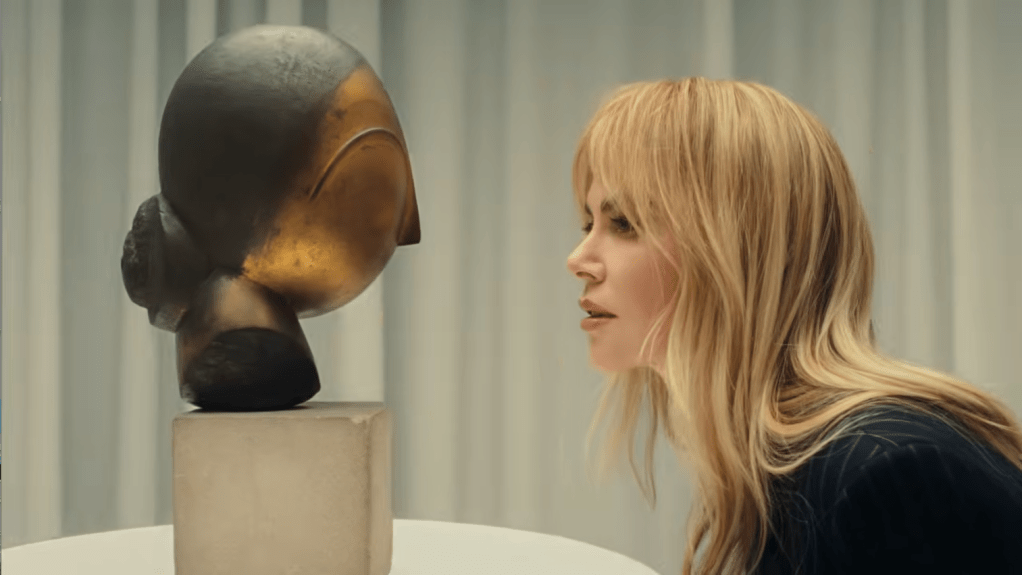
“The legendary actress visits Christie’s galleries at Rockefeller Center and finds herself captivated by the gilded sculpture.”
Thus trumpets the tagline for Nicole Kidman’s assignation with Constantin Brancusi’s bronze and gold leaf Danaïde (1913), circulated online this past spring in advance of the work’s auction. The “cinematic short film” produced by Christie’s indeed reveals the Hollywood star finding herself… duly captivated.
She rushes an unnamed caller off the phone to stalk the sculpture in her stilettos from behind a circular curtain. To the tune of David Bowie’s “Golden Years,” Kidman gazes fixedly into Danaïde’s burnished, nearly vacant visage. The camera cuts intermittently to a speculative montage of her inner experience.
Like some ancient oracle, the sculpture’s mere presence unleashes a series of visionary insights into its presumed (read: decidedly fantastical) origins: from all manner of Greek statuary to eastern Buddhas, from the latter-day pre-Raphaelite painting The Danaïdes (1904) by John William Waterhouse to (utterly anachronistically) Alberto Giacometti’s 1951 sculpture The Chariot (Does Christie’s not employ a single art historian among its marketing ranks?).
Stare into the abyss and the abyss stares back. Or so Kidman’s filmed epiphany would suggest. She ends up dancing around the sculpture with tousled hair like some latter-day, midtown Maenad, her face—and ostensibly her soul—convulsed by the sculpture’s extrasensory revelations.
Danaïde left the block for a record $107.6 million, breaking the record for the auctioned sale of a sculpture. Whether Kidman’s performance inched the price upward remains unclear. It nevertheless undeniably played into a moment of renewed attention to the artist.
View of the 2026 exhibition “Brancusi” at the Neue Nationalgalerie in Berlin.
Photo David von Becker. ©Succession Brancusi/VG Bild-Kunst
BEFORE HIS DEATH in Paris at the age of 81, the Romanian-born Brancusi (1876–1957) bequeathed his estate to the French government on one condition: that his 15th arrondissement studio be reconstructed and preserved in perpetuity. Ongoing renovations of the Centre Pompidou, which has long since hosted the “Atelier Brancusi” in its abutting plaza, have set the workspace and its wide-ranging contents on the road.
They landed this summer at Berlin’s Neue Nationalgalerie, the first major exhibition of Brancusi’s work in Germany for a half century. MoMA will mount its own version of the show in October. More than 150 sculptures—along with works on paper, photographs, and extensive archival material—provide the occasion for an expansive survey of one of the twentieth century’s most influential artists. The host institutions have been given free curatorial rein.

View of the 2026 exhibition “Brancusi” at the Neue Nationalgalerie in Berlin.
Photo David von Becker. ©Succession Brancusi/VG Bild-Kunst
Designed by Mies van der Rohe, Berlin’s Neue Nationalgalerie offers up the ideal venue for Brancusi’s crisp distillations of form, at least in theory. Interrupted by just four load-bearing columns in its main gallery space, the open plan practically begs for vertical interventions by Brancusi—one of the twentieth-century artists most in tune with van der Rohe’s consummately modernist, “Less is More” sobriety.
In practice, puzzling choices by curators Klaus Biesenbach and Maike Steinkamp rendered the experiment fraught in places. Conservation questions surely informed certain placements (glass vitrines, elevated platforms). Yet the setting of so many of the sculptures against the wall impeded the kind of looking the works demand. Bird in Space (1923) was made to look decidedly agoraphobic. One had to crane one’s neck (almost impossibly) to get a glimpse of the maquette which Brancusi made for the lintel of the Kiss gate (1935–37)—part of his war memorial in Târgu Jiu, Romania.

View of the 2026 exhibition “Brancusi” at the Neue Nationalgalerie in Berlin.
Photo David von Becker. ©Succession Brancusi/VG Bild-Kunst
The exhibition did lend welcome attention to the full gamut of Brancusi’s media and formats. Present in photographic form, his 1918 Endless Column (part of the same Târgu Jiu complex) forms just one of several arresting architectural designs. These also offer oblique insight into the relation of his sculptures to their carved bases, miniature structures in their own right, after all, which often rival their objects for attention.
Yet some of the show’s rather obtuse groupings (“Portraits,” “Animals,” “Bird in Space”) precluded more nuanced considerations, which might have included materials, questions of primitivism, gender, folk culture vs. high modernism, or any number of less literal taxonomies. One section bore the title “The Ambiguity of Form.” Perhaps no modernist artist proved less equivocal regarding form than Brancusi (save perhaps Mondrian). His sculptures evince a lapidary certainty even in their weird, seductive lyricisms.
The elemental spareness of eggs and bones forms the metaphorical (and literal) touchstones of Brancusi’s series of resting heads (Sleep, Head of a Sleeping Child, The Newborn, etc.) and stylized “portraits” (Nancy Cunard, Eileen Lane, Princess X). The phallic arc of the latter sculpture—which caused a rumpus upon its debut at the 1920 Salon des Indépendants—exemplifies Brancusi’s conciliation of incongruous elements: lithe female corporeality and swollen male member; the mythical Leda and the Zeus-cum-swan who ravishes her; a young bird and the egg which birthed it.

View of the 2026 exhibition “Brancusi” at the Neue Nationalgalerie in Berlin.
Photo David von Becker. ©Succession Brancusi/VG Bild-Kunst
CHRISTIE’S PR VIGNETTE is not the first rendezvous between Brancusi’s legacy and something of the beau monde, as it were. A short film shot by Man Ray around 1930 on view herereveals Lee Miller running her hand over the smooth neck of Princess X. Rather than Miller’s budding career as a photographer, it is her fame as a model which seems the point here. The rhyme between her graceful form and the sculpture’s anatomy underscores the clip’s unmistakably erotic frisson.
Brancusi’s body of work has likewise informed the design of Balenciaga dresses, Rick Owens boots, and jewelry by the Tokyo-based Ambush firm—or, at least, it has informed their respective publicity campaigns. Among the objects that the Bulgari designer Mary Katrantzou wishes she had made, the T Magazine reported recently, figures Brancusi’s Sleeping Muse (1910) for its managing to be “devoid of any intricacy.”
Intricacy need not present itself as such, of course. In that paradox lies the beguiling complexity of Brancusi’s work, which he often carved frommarble, wood, or limestone without recourse to the molding process (what sculptors call taille directe). Even his cast bronze sculptures quite literally reflect the obsessive acts of polishing or the application of patina to which he submitted them. The modest volumes of Sleeping Muse, or Danaïde, or Bird in Space belie an intricate and iterative labor, which in turn erased its own traces.
Attesting to his labor is an ovoid pavilion at the exhibition’s center recreating Brancusi’s studio, chock-a-block with his myriad tools and flanked by walls on both sides bearing letters, photographs, and archival items. From postcard exchanges with Fernand Léger and Blaise Cendrars to documents of his artistic formation in Romania, the material puts intellectual, professional, and personal flesh back on the bareboned laconicism of his sculptures.
The fundamentally subtractive ethos of Brancusi’s vision gave rise to a phenomenon that one journalist deemed—with a seemingly unironic oxymoron—a “minimalism glut” taking over contemporary American culture. Detailed by Kyle Chayka in his book The Longing for Less (2020), that sensibility informs everything from the penchant for sleek, streamlined appliances to “decluttered” lifestyle practices (at least, it must be said, among those with the means to dispense with luxury trappings or material excess to begin with).

View of the 2026 exhibition “Brancusi” at the Neue Nationalgalerie in Berlin.
Photo David von Becker. ©Succession Brancusi/VG Bild-Kunst
Brancusi’s sensibility echoes elsewhere than high-end design or social trends, to be sure. The German curator Nicolaus Schafhausen explored the “The Brancusi Effect” on the work of several artists and architects in 2014. His exhibition and book notably featured the German architect Jürgen Mayer H. and industrial designer Konstantin Grcic; the sculptor and video artist Shahrayr Nashat; and a global group of conceptual artists including Sofia Hultén, André Cadere, and Saâdane Afif. The range in itself attests to the varied ramifications of Brancusi’s corpus.
Though it now sits behind glass at the Philadelphia Museum of Art, it was Brancusi’s marble Sculpture for the Blind (c. 1920) that shifted sculpture’s invitation to the viewer from the rational, metaphysical plane of sight to the embodied experience of touch. While not as frenziedly as Naum Gabo’s Kinetic Construction (Standing Wave) (1919–20), the buffed Leda (1926) was once mounted atop a spinning metal disc—footage of which appears in Berlin, along with a new rotating display.
One wall text claims that Brancusi aimed to depict his animals in motion. Yet while Leda’s table may spin, her form remains singularly still. Seal reveals only the slightest of obliques, while the wooden Turtle (1940)—like The Cock (1924), Maiastra (1910), and other creatures—retain a hieraticism just shy of symmetry. The stateliness of Brancusi’s sculptures is never reducible to some platonic idea of nature, however. Even in the fixedness of their forms—their sententious certitude—a single work may conflate the erotic and the machinic, the vernacular and the archetypal, the abstract and the practical.
First shipped stateside in 1926 for a retrospective organized by the photographer Edward Steichen, Bird in Space was initially charged with an import tax upon “manufactured metal objects.” Only a subsequent court case and deposition by the artist famously restored the work’s aesthetic pedigree on US soil, undoing its putative tax status as a “tool.” From Steichen (a keen photographer of the sculptor’s work) to Duchamp (a close confidant) to the collector John Quinn, Brancusi’s American reception inflects his oeuvre with a particular set of cultural, professional, and interpretive contingencies. What MoMA will make of these a hundred years later remains to be seen.