Rosa Bonheur not only defied the conventions of 19th-century France by resisting the gendered expectations of her era to become a successful and prolific artist – she was equally determined to love on her own terms. She continues to be celebrated for her ability to capture the movement, musculature, and spirit of animals in paint, from lions to dogs. But beyond the international acclaim she earned through her immense talent, who were the people with whom she formed intimate personal relationships?
Connections between individual artists in art history remind us that at the core of art movements and the progress of visual culture were human individuals, with real personalities, fears, and dreams. Whilst we can never know their true feelings, documented relationships between artists – whether clashes or companionship – offer fascinating context to their lives. No artist truly creates in isolation, and competition and collaboration are as much facets of the art world as creation.
Introducing Rosa Bonheur

André Adolphe-Eugène Disdéri
Albumen silver print, 8.4 x 5.2 cm | 3.3 x 2 in
Getty Museum
Rosa Bonheur (1822-1899) is preceded by her image. She smoked, sported trousers, and cut her hair short during an era when these behaviours were considered unacceptable for women. And their place in society was strictly regulated. Yet despite her rebellious nature, or perhaps partly because of it, she rose to become one of the most famous artists of her era and continues to be upheld as one of the master animaliers of art history.
Rosa Bonheur was born in 1822 in Bordeaux, France, the first of four siblings. The family moved to Paris in 1829. Her father, Oscar-Raymond Bonheur, was a landscape and portrait painter. In 1832, he left his wife and children to become a follower of Saint-Simonianism, a political, social, and religious movement in 19th-century France that emerged in response to rapid industrialisation and is considered a precursor to modern socialism. Soon after, Rosa’s mother Sophie passed away from what was recorded as ‘exhaustion’ at the time, and Raymond became the carer of his children again. Rosa Bonheur was born Marie-Rosalie Bonheur, but after her mother’s death, she adopted the name Rosa in honour of her mother’s pet name for her.
Her father trained each of the Bonheur siblings to become artists, encouraged by the Saint-Simonian belief in the importance of artists in society. They all specialised in depicting animals and landscapes, although Rosa was undoubtedly the most adept and became the most famous. Her siblings include the artists Auguste Bonheur, Isidore Jules Bonheur, and Juliette Bonheur, photographed together here surrounding their powerfully posed sister.

André Adolphe-Eugène Disdéri
Albumen silver print, 8.4 x 5.2 cm | 3.3 x 2 in
Getty Museum
Rosa Bonheur is lauded for defying the conventions of her era by pursuing art despite the systemic barriers placed before her. Although she was unable to attend formal training at art institutions because of her gender, her father’s tutelage allowed her to become a professional artist regardless. Her sister Juliette also pushed against these social and professional restrictions and managed to regularly exhibit her work in the Paris Salon. And notably at the Palace of Fine Arts in Chicago in 1893. To put their achievements into context, the École des Beaux-Arts in Paris did not admit women as students until 1897.
From a young age, Bonheur made studies of live animals, both in the studio and in the countryside surrounding Paris. She later studied directly from masterpieces in the Louvre. At just 14, she was amongst the youngest people permitted to make copies there. She also studied animal anatomy in the abattoirs of Paris and through veterinary dissections. Her first submission to the Paris Salon, titled Two Rabbits, was accepted when she was 19 years old. The following painting, Two Horses, was completed when she was 20, and displays the early formalisation of her skill.
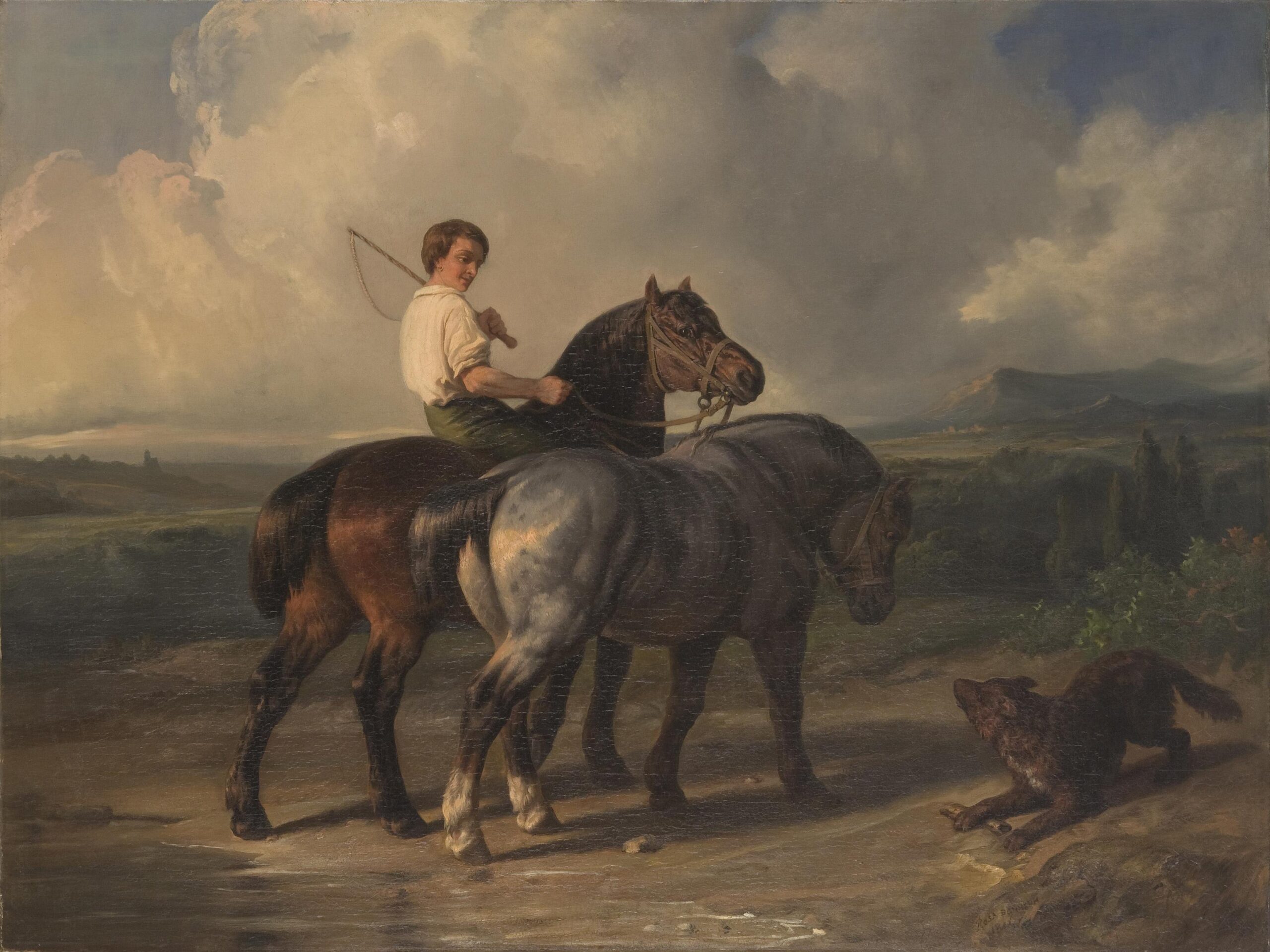
Rosa Bonheur
Oil on canvas, 97.8 x 130.2 cm | 38.5 x 51.3 in
Philadelphia Museum of Art
A decade later, the character of her horses developed into her masterpiece, The Horse Fair, completed in 1855 after four years of work. This monumental work displays a parade of horses churning around the Paris horse market and required extensive study from life to complete. Bonheur would dress herself as a man to avoid attention – visiting the horse fair twice a week for a whole year and a half to make preparatory studies. She even had to obtain legal permission from the police to wear trousers. The musculature, pose, movement, and personality of the horses are an incredible feat of observational art making.

Rosa Bonheur
Oil on canvas, 244.5 x 506.7 cm | 96.3 x 199.5 in
The Metropolitan Museum of Art
In the same year that she completed her masterpiece, Bonheur was invited to Britain by Ernest Gambart, the art dealer who had bought the painting. She had become a renowned painter in France, but was only just beginning to build her reputation in the UK. The British referred to her as the ‘French Landseer’, after the Victorian painter and sculptor Edwin Landseer who was famous for his depictions of animals. Upon her arrival, she attended a dinner where she met Landseer, whose work she admired for their shared love of painting animals. On meeting Bonheur, he was ‘full of impudence’ and playfully proposed marriage in front of the other guests, declaring that he would ‘be too happy to become Sir Edwin Bonheur’. His remark was intended to encourage the other men in attendance to pursue her.
During this trip, The Horse Fair was exhibited in London, where visitors paid an entrance fee of one shilling to view the painting, and the gallery was reportedly ‘crowded daily for months’. Later that year, the massive painting began a tour of Britain. The galleries that displayed the original also often sold prints of the work, copied from a smaller reproduction of the painting which is now housed in the National Gallery. The work toured from Glasgow to Liverpool, Manchester, Birmingham, Sheffield, London, and finally returned to Glasgow.

Rosa Bonheur
Black chalk, brush, and wash with white, 13.7 x 33.7cm | 5.4 x 13.3 in
The Metropolitan Museum of Art
Influenced by Landseer’s paintings of the animals and landscapes of the Scottish Highlands, her love of Sir Walter Scott’s writing, and the fact that her painting spent 6 of its 18-month tour in Scotland, Bonheur decided to travel to Scotland to paint. She captured the character of the Highlands and its fauna with enthusiasm, and returned to France with studies that she would continue to work from throughout her career.

Rosa Bonheur
Pastel on brown paper, 49 x 63.8 cm | 19.3 x 25.1 in
Art Institute of Chicago
By the 1860s, Bonheur’s international fame had risen to the degree that a doll was created and sold in her image. It wore trousers and had cropped hair, and was especially popular in America. In 1865, Bonheur became the first female artist to be awarded France’s Légion d’honneur, aged 43. When she was given the award by Empress Eugénie – who visited Bonheur’s studio and was amazed by her work – the Empress famously stated in reaction, ‘genius has no sex’.

Rosa Bonheur
Oil painted palette, 51.3 x 47.0 cm | 20.2 x 18.5 in
Minneapolis Institute of Art
After this brilliant success, Bonheur’s wealth increased, allowing her to purchase Château de By near Fontainebleau. This made Bonheur the first known woman in French history to buy a stately property with her own money. There, she kept a menagerie of animals to paint and sculpt from, including lions, horses, deer, monkeys, birds, boar, and dogs. One of these animals was her dog Barbaro, whom she captured looking forlorn and yearning for freedom, in Barbaro After the Hunt. Around 30 years after receiving the Légion d’honneur, Bonheur also became the first woman in history to become an Officer of the Order – France’s highest military and civil merit.

Rosa Bonheur
Oil on canvas, 96.5 x 130.2 cm | 38 x 51.3 in
Philadelphia Museum of Art
The Relationship Between Bonheur, Micas, and Klumpke
Despite Bonheur’s incredible oeuvre and renown, much of her private life remains somewhat obscure. Nathalie Micas was born in Paris in 1824, and is remembered as a French painter and inventor – and the great love of Rosa Bonheur’s life. Micas and Bonheur met for the first time as children, in 1836, when Bonheur’s father was commissioned to paint a portrait of Nathalie, then aged 12. Rosa was 14. They forged a bond immediately and would spend the rest of Micas’ life together.

Rosa Bonheur
Oil on canvas, 54.9 × 66.4 cm | 21.6 x 26.1 in
Art Institute of Chicago
Micas created her own paintings, working in Bonheur’s studio throughout her illustrious career, although they aren’t represented in museum collections. Her hand is also found in some of Bonheur’s works, including the smaller replica version of The Horse Fair housed in the National Gallery in London. Although Bonheur was cautious about describing the nature of her relationship with Micas, given the era’s attitudes towards same-sex relationships and unmarried women, it is clear that they acted as a married couple might. Bonheur even wrote:
‘Had I been a man I would have married her. . . . I would have had a family, with my children as heirs, and nobody would have had any right to complain.’
Although at other points, Bonheur avoided the question of her relationship status by proclaiming her greatest love of all was her work:
‘I wed art. It is my husband—my world—my life-dream—the air I breathe. I know nothing else—feel nothing else—think nothing else. My soul finds in it the most complete satisfaction.’
Perhaps most telling about her sexuality, she also famously stated:
‘As far as males go, I only like the bulls I paint.’

Rosa Bonheur
Oil on canvas, 65.1 x 81.3 cm | 25.6 x 32 in
The Metropolitan Museum of Art
As Bonheur’s star rose and the couple acquired larger property and more land, Micas looked after household affairs, allowing Bonheur to focus on her studio practice. Outside of art making, Micas invented a system for braking trains, which she tested using a railway track she built at their Château de By. This system was patented as the ‘Micas brake’ in 1862.
Sadly, Nathalie Micas passed away in 1889 at their Château. Bonheur was heartbroken, having spent 50 years with her partner, and now aged 67 herself. Micas had been Bonheur’s constant companion throughout all of her travels and successes, with their bond having endured since childhood. Without her, Bonheur suddenly found herself untethered.

Rosa Bonheur
Oil on canvas, 147.6 x 114.6 cm | 58.1 x 45.1 in
LACMA
A few months after Micas’ death, in a chance encounter, Bonheur met the woman who would become her next partner. Anna Klumpke visited her chateau as a translator for an American businessman who had brought Bonheur horses as a gift. Meeting Bonheur was a dream for Klumpke, who had owned a porcelain Rosa Bonheur doll and had painted a copy of Bonheur’s Plowing in the Nivernais, which kickstarted her own painting career when she sold it for 1000 francs as a student. She wrote in her memoir:
‘Was it not, indeed, in copying that picture that there came to me a revelation of my artistic vocation? That picture became to me a talisman.’
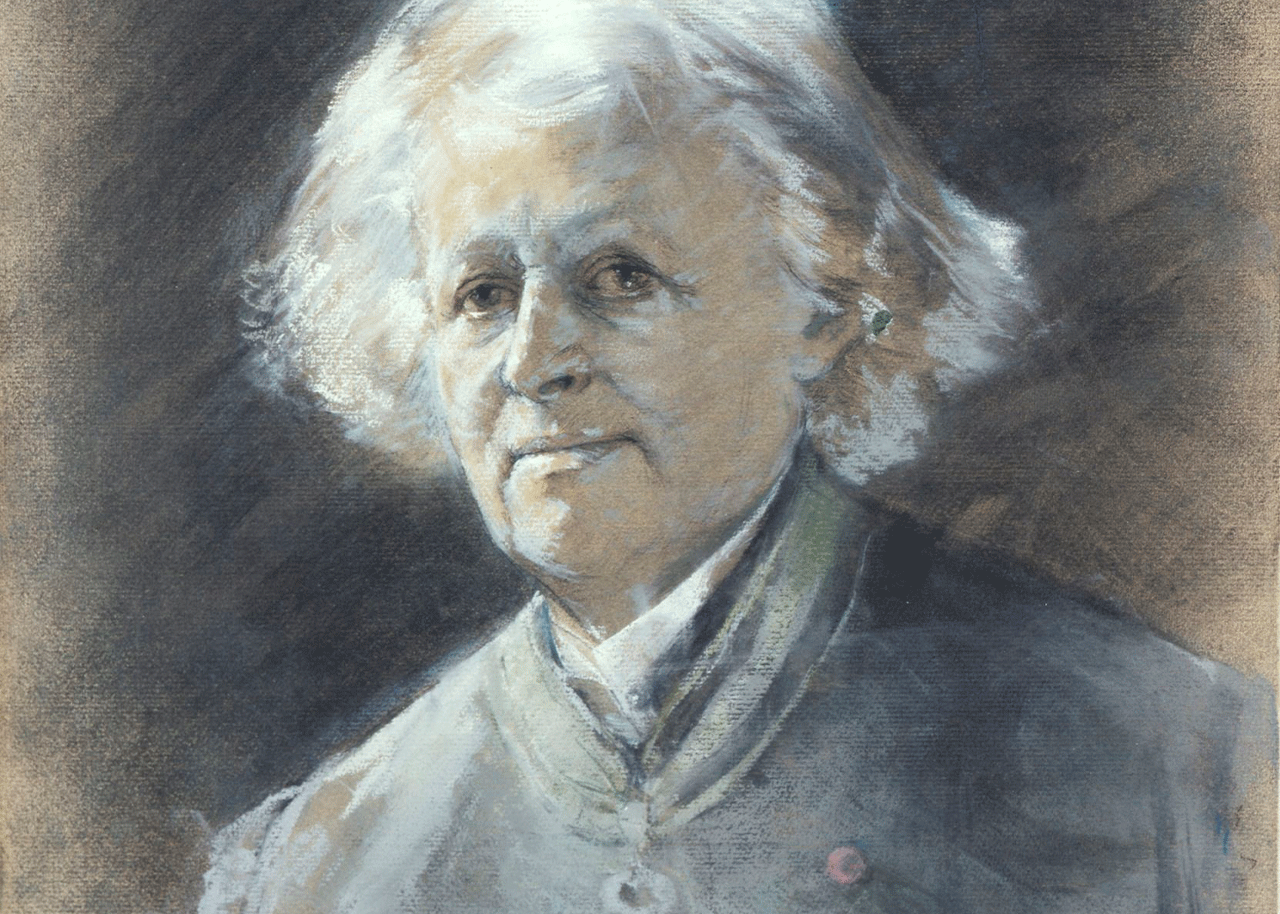
Bonheur and Klumpke remained in contact for a decade after communicating through letters. Klumpke had returned to Boston, where she exhibited, had a studio, and taught painting classes. In 1898, Klumpke asked if she could paint a portrait of Bonheur, which Bonheur immediately agreed to. When she arrived, Bonheur prolonged Klumpke’s visit as long as possible by withholding sittings. In her portrait of Rosa Bonheur, which was finally completed, we see Bonheur smiling back at us, her face haloed by the light catching her white hair.

Anna Klumpke
Pastel drawing on paper, 55.5 cm x 45.5 cm | 21.9 x 17.9 in
Bowdoin College Museum of Art
After Klumpke finished the work, she wrote about how Bonheur confessed her feelings for her. Stating in her memoir that they could have ‘a divine marriage of two souls,’ which made sense: ‘Since we’re both alone in life.’ At this stage, Bonheur was 76, and Anna Klumpke was 42, yet they stayed together. Like her relationship with Micas, none of the writing about their relationship outwardly states that they were in a romantic relationship, although in at least one surviving letter, Bonheur did refer to Klumpke as her ‘wife’. Quotes like the following make it impossible to deny that they had an intimate bond:
‘Friendship of the soul may become a divine affection; it is superior to family relations, and such friendship will last beyond our earthly existence.’
The two women agreed that Klumpke would have her own studio at Bonheur’s chateau, and that she would complete two more portraits of the artist, and write her biography. Sadly, their time together was cut short when, just a year after the painting was completed in 1899, Bonheur passed away from pneumonia in Klumpke’s arms.

Rosa Bonheur
Black crayon on paper with stumping, 63.8 x 49.2 cm | 25.1 x 19.4 in
Dallas Museum of Art
Beyond the Relationship
Klumpke spent the rest of her life – the next 43 years – promoting and protecting Bonheur’s legacy. In the same year, Klumpke opened the Rosa Bonheur Memorial Art School, which was open solely to women artists. She gifted 50 artworks by Bonheur to the French government, and 25 years after Bonheur’s death, she opened the Rosa Bonheur Museum. She believed in Bonheur’s convention-defying approach, and strove to give more women artists opportunities. She recorded in her memoir that Bonheur once said to her, ‘It belongs to us women to elevate the human race.’

Rosa Bonheur
Oil on canvas, 41.3 × 50.8 cm | 16.3 x 20 in
Dallas Museum of Art
Despite her efforts, Klumpke didn’t go without criticism. Bonheur left everything she had to Klumpke when she passed, including the Château and all its contents. Her family was outraged, and accusations were made that Klumpke had preyed on the elderly artist to snatch her fortune. To dismiss these rumours, Klumpke quickly organised a Paris auction that listed 4700 items from Bonheur’s estate for sale, and gave half of the proceeds to the Bonheur family. Over time, as Klumpke aged, the Château fell into disrepair and was then passed to her heirs, who only visited it occasionally.
When Anna Klumpke died, she was buried in the grave that already housed Rosa Bonheur and Nathalie Micas. Their shared headstone reads, ‘Friendship is divine affection.’
Further Reading
Rivalries and Friendships in Art History: Whistler vs. Ruskin
Friendships and Rivalries in Art History: Rodin and Claudel
Art Through Symbols: The Horse
Shop Art Materials on jacksonsart.com