
I have known about the city of Troy since I was a kid. Troy meant Achilles and Hector, Helen and Paris, Odysseus and the wooden horse. It meant one of the great stories of the ancient world, a story so enduring that even people who have never read Homer still know the outlines. Yet standing on the site itself, in northwestern Türkiye, I was reminded that Troy is not just a legend. It was a real city, occupied for thousands of years, destroyed and rebuilt over and over again, and important long before modern visitors began arriving with copies of the Iliad in their backpacks.
Table of contents: ()
Was Troy a Real City?
Yes. Troy was a real ancient city, although the Trojan War Homer describes mixes history, legend, and mythology. Archaeologists have uncovered multiple settlements built on the site over thousands of years. Whether Homer’s Achilles, Hector, Helen, and Trojan Horse reflect historical people or events remains unknown.
Where Is Troy?
The ancient city of Troy is in northwestern Turkey, near the village of Tevfikiye and about 30 kilometers south of Çanakkale. It is about a 5-hour drive from Istanbul. The archaeological site sits near the Dardanelles, the narrow waterway connecting the Aegean Sea with the Sea of Marmara and, ultimately, the Black Sea.
That position helps explain why this city mattered for so long. It was not simply the setting for a poetic war story. It stood near trade routes linking Europe and Asia, and it occupied a strategic location valuable in almost any period of ancient history.
Troy was not in Greece, although it is one of the most famous places in Greek mythology. The Greeks who fought at Troy came from cities and kingdoms across the Greek world, while Troy itself stood in ancient Anatolia, in what is now Turkey.

Troy’s Long History
Archaeological evidence suggests that settlement at Troy began around 3000 BCE, in the Early Bronze Age. Over the centuries, communities built, destroyed, rebuilt, expanded, and adapted the site. What survives today reflects nearly four thousand years of occupation. That long continuity is what makes Troy remarkable.
When I first learned that archaeologists divide the site into Troy I through Troy IX, I assumed that meant nine neat cities stacked one on top of another. The reality is much messier and more interesting. Different parts of the site were used in different ways across different periods. Some walls were reused. Some structures were built over. Some areas were dug deeper than others. Visiting Troy means seeing pieces of many different eras side by side.
That can make the site harder to understand at first glance. Cities are not tidy. People build on what came before them. They reuse stone, reshape streets, and adapt old spaces for new needs.

Getting to Troy
Most travelers visit Troy as a day trip from Çanakkale, the lively city on the Dardanelles that serves as a base for exploring the region, making it an easy excursion if you are spending the night in town. Many guided tours include Troy along with nearby WWI battlefields at Gallipoli or other ancient sites in the region, but you can also visit independently by taxi, rental car, or local transport, depending on the season and current schedules.
If you are planning your own visit, I would suggest staying in Çanakkale rather than rushing through from farther away. The city has a pleasant waterfront, plenty of hotels and restaurants, and enough energy to feel like a destination in its own right.
- Distance from Çanakkale: ~30 km
- Driving time: ~30–40 minutes
- Nearest major city/base: Çanakkale
- Site name to put into Google Maps: Archaeological Site of Troy / Troya Ören Yeri
- Museum: Troy Museum / Troya Müzesi

Schliemann’s trench
First Impressions of the Ruins
The first thing that struck me at Troy was that the ruins were larger than I had expected. I had heard the site described as small, and while it is not enormous like Ephesus or some of the great Roman cities, it has more breadth and complexity than I anticipated.
The second thing that struck me was how much interpretation matters here.
At many archaeological sites, you can walk down a former avenue, identify a theater, admire a temple, and immediately grasp the shape of the city. Troy does not reveal itself so easily. The site is a multilayered excavation, and some of the most important things you are seeing are differences in depth, construction style, and chronology. Without signs or a guide, it’s easy to miss the significance of what you are seeing.
One of the site’s most famous visual features is Schliemann’s trench, a dramatic cut through the mound created during Heinrich Schliemann’s excavations in the late 19th century. The trench slices through Troy’s archaeological layers and clearly shows how complicated the site is.
Heinrich Schliemann, and the Trouble with Famous Discoverers
Schliemann is one of those historical figures who makes simple judgments difficult. He was deeply inspired by Homer and determined to prove that Troy was real. In that sense, he helped change the conversation about myth and history. He also approached the site with the confidence of a man who thought he already knew the answer.
His excavation began in 1870, and it revealed that the mound at Hisarlık was not just one ancient city but many. That was a major discovery. At the same time, his crude methods destroyed parts of the very site he was trying to uncover. For example, his trench cut through many layers as he searched for the city of Homer. Who knows what was lost in the rush.
He also became famous for finding what he called “Priam’s Treasure,” a cache of gold and other objects that he linked to the legendary king of Troy. That connection remains doubtful. The treasure appears to predate the likely period associated with any historical kernel behind the Trojan War. Even more colorful is the story of how Schliemann smuggled the treasure out of the Ottoman Empire rather than sharing the finds as required under his agreement. His wife famously wore some of the jewelry in staged photographs, which says quite a lot about the man and his flair for drama.
Later archaeologists, including Wilhelm Dörpfeld and Carl Blegen, brought more systematic methods and a clearer understanding of the site’s chronology. In the 20th century, Manfred Korfmann and his team added modern technologies such as remote sensing and more sophisticated surveying, revealing a larger lower city and expanding our picture of Troy as a substantial urban center rather than a small hilltop stronghold.

Which Troy Was Homer’s Troy?
This is the question many visitors arrive with, and it is a fair one.
Was this the Troy of the Trojan War?
The careful answer is that Troy was certainly a real place, and there may well have been a conflict or series of conflicts here that contributed to later legend. The less satisfying but more honest answer is that the story told in Homer’s Iliad is not history in the modern sense.
Archaeologists have often focused on Troy VI and Troy VIIa as the most likely candidates for a historical Troy associated with a Late Bronze Age conflict. Troy VI was a wealthy city with impressive walls, and Troy VIIa shows evidence of destruction around the right broad timeframe, roughly 1200 BCE. Carl Blegen in particular argued for Troy VIIa as the more likely candidate. Other scholars have debated the issue for decades.
So no, I do not think we can say the Trojan War happened exactly as Homer described it, with divine interventions and larger-than-life heroes. But I also do not think that means the story is disconnected from reality. Troy was real. Its location mattered. Its destruction mattered. Its memory lasted.

Walking Through the Site
What makes Troy memorable as a visitor experience is not a single spectacular ruin. It is the cumulative experience of walking through a place where each stone may belong to a different chapter.
Some of the walls are massive and impressive, especially when you consider their age. Some foundations seem modest until you realize they belong to civilizations more than three thousand years old. Some sections require you to stop, read, and mentally reconstruct the city from a handful of clues. This is a site that rewards patience.

The Replica Trojan Horse and the Power of Story
Of course, no modern visit to Troy escapes the horse.
The wooden horse is not archaeological evidence. It is a symbol, a story, and a piece of cultural inheritance so strong that it has become inseparable from the place. Visitors photograph it, joke about it, and immediately connect it to the phrase “beware of Greeks bearing gifts.”
I could not resist the joke that perhaps the better lesson is “beware of gifts bearing Greeks.”
That sense of play is part of Troy’s appeal. This is a serious archaeological site, but it is also one of the few places in the world where myth is part of the visitor experience so openly. The horse may not tell us what actually happened in the Late Bronze Age, but it tells us how people have remembered Troy for centuries.

The Excellent Museum of Troy
After exploring the ruins, we visited the Museum of Troy, and I would strongly recommend pairing the two. In fact, I think the museum is essential if you want Troy to make sense.
The museum is modern, well-designed, and much better than many museums I have visited around the world. It does not simply display artifacts in cases and assume you already understand the context. Instead, it helps build the larger story of the site, from Bronze Age origins to later Greek and Roman interpretations of Troy.

Inside, the collection includes pottery, jewelry, weapons, architectural fragments, and objects that help show the long life of the settlement. Models and visual reconstructions help make sense of the site’s changing layers. Interactive exhibits add variety, and there is enough explanation to orient general visitors without overwhelming them.
There is also a bit of humor in the museum, which I enjoyed. Some of the displays and media installations have a playful side, reminding visitors that the story of Troy has lived many lives, from ancient poetry to modern pop culture. Near the café and gift shop, a couple of video displays leaned into that spirit in a way that made me smile, like one that mixed the Trojan Horse with stormtroopers.

Practical Tips for Visiting Troy
If you are planning a visit, here are a few things I think make the experience better.
- I highly recommend a guided tour so someone can help you make sense of the place.
- Allow time for both the ruins and the Troy Museum. I would budget at least an hour for the archaeological site, plus additional time for the museum.
- Give yourself time. Troy is not a site to rush through in twenty minutes. You need time to read, pause, and let the chronology sink in. An hour at the ruins plus additional time at the museum is a reasonable minimum. More is better if history is your thing.
- Go with realistic expectations. Troy is important for its history and meaning, not for offering the most visually dramatic ruins in the Mediterranean. If you arrive looking for monumental temples and soaring columns, you may be disappointed. If you arrive interested in archaeology, mythology, and the long memory of place, you will probably love it.
- Consider the season and time of day. Like many archaeological sites in Türkiye, Troy can be hot and bright in summer. Bring water, wear a hat, and use sun protection. Morning or later afternoon light is often more pleasant for walking and photography.
- Stay curious. Troy is one of those places where the guidebook matters, the signs matter, and the questions matter.

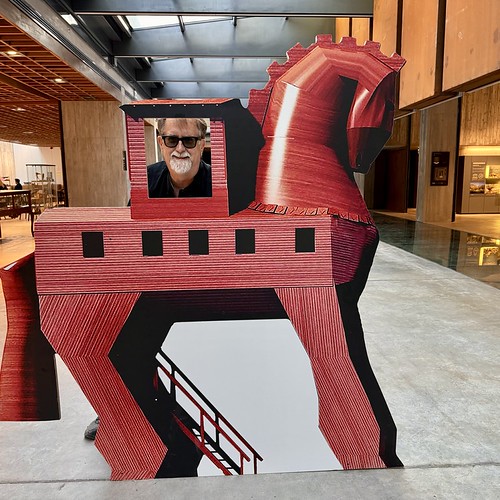
author at the Troy Museum
Why Troy Stayed with Me
Troy reminded me that travel is not always about seeing the most beautiful thing or the most intact thing. Sometimes it is about visiting a place that has occupied your imagination for years and discovering that the real version is more complicated, more human, and more interesting than the simple story you started with.
Was there really a Trojan War as Homer told it? Almost certainly not in that exact form.
Was there a city here whose importance, destruction, and memory echoed down through the centuries until it became epic? Very likely. And perhaps that is enough.
Troy is a UNESCO World Heritage Site, a challenge for archaeologists, a gift to storytellers, and a deeply rewarding stop for travelers willing to look beyond the legend.

Frequently Asked Questions About Troy
Where is Troy?
Troy is in northwestern Turkey near the village of Tevfikiye, about 30 kilometers south of Çanakkale and close to the Dardanelles.
Was Troy a real city?
Yes. Archaeological excavations have shown that Troy was a real city that was occupied and rebuilt many times over thousands of years.
Was Troy in Greece?
No. Troy was in ancient Anatolia, in what is now Turkey. It is strongly associated with Greece because the Trojan War is one of the foundational stories of ancient Greek literature.
Is the Trojan War real?
There may have been one or more conflicts at Troy during the Late Bronze Age, but historians cannot confirm that the Trojan War happened exactly as Homer described it in the Iliad.
Can you visit Troy today?
Yes. The Archaeological Site of Troy is open to visitors in northwestern Turkey, and the nearby Troy Museum helps explain the site’s history and archaeological layers.
How far is Troy from Çanakkale?
Troy is approximately 30 kilometers south of Çanakkale and is commonly visited as a day trip from the city.