Gougères Recipe | La Cuisine de Géraldine

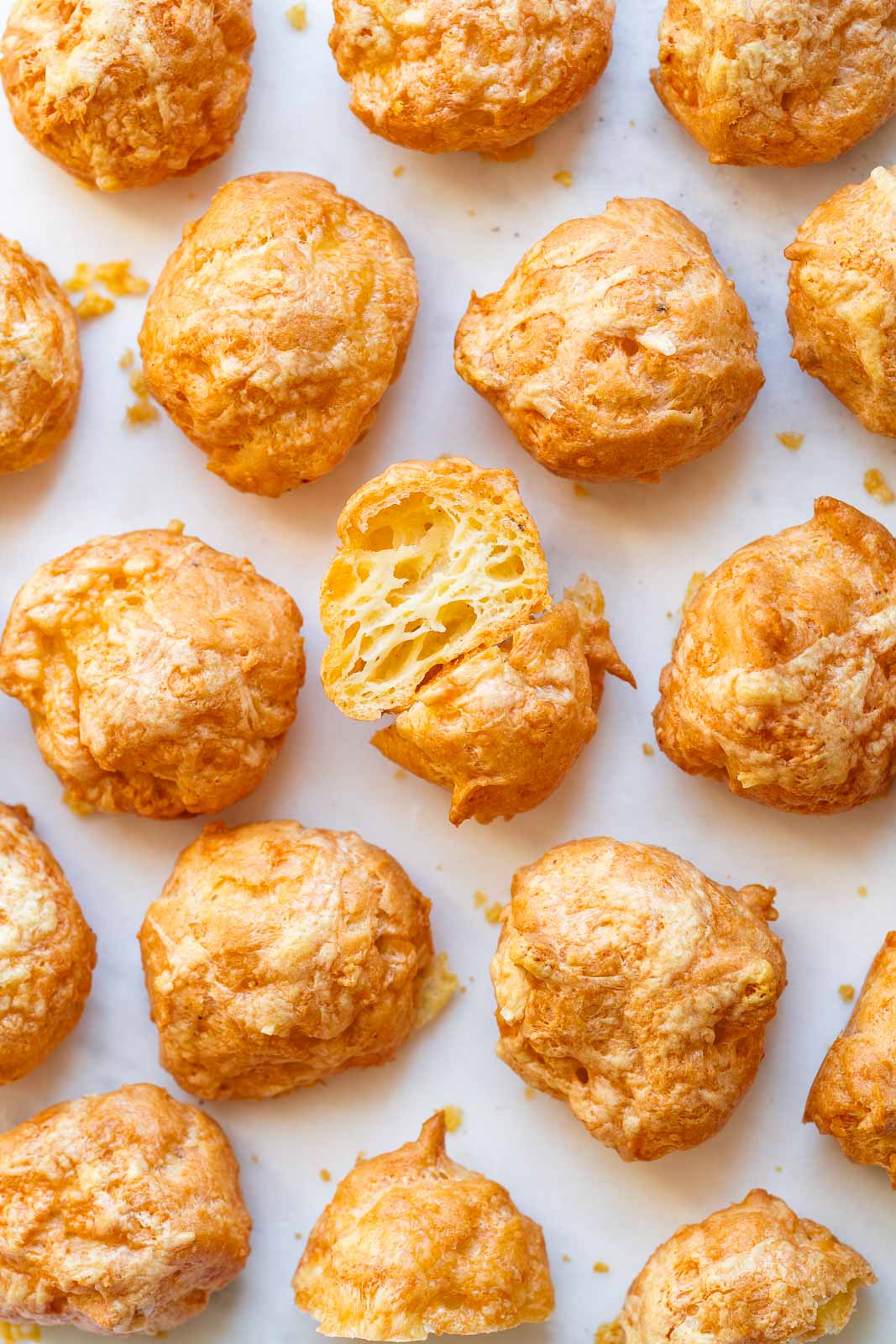
This recipe I have been making for years as an appetizer and my friends still ask me to make them every time: gougères. They’re simply little cheese puffs—light and airy—and they’re really easy to make.
Quicker than you think, you will have thirty little gougères ready which, I assure you, will disappear in no time as soon as you set them on the table. The fact that you can make them ahead of time and always keep some in the freezer makes them perfect for the holidays or spontaneous visits!

Recipe Card
Gougères Recipe
Click on the stars to rate!
Gougères have been one of my favorite appetizer for years, and honestly, everybody loves them! They’re these little cheese puffs from Burgundy, traditionally served with a glass of white wine. And the best part? One batch gives you about thirty of them.

-
Preheat the oven to 425°F/220°C (conventional) or 400°F/200°C (convection).
-
Bring the water, the butter (cut into pieces), and the salt to a boil.
-
Take the pot off the heat, dump in all the flour at once, and stir it with a spatula until it forms a smooth ball of dough that pulls away from the sides of the pot.
-
Put it back over low heat for 1 to 2 minutes, stirring, until a thin film forms on the bottom of the pot.
-
Let it cool for 5 minutes. Add the beaten eggs one at a time, mixing well after each addition. The dough will look like it’s breaking apart at first — that’s totally normal. Just keep going and it’ll come back together.
-
The choux dough is ready when it forms a ribbon that slowly droops off the spatula into a beak-like point.
-
Fold in the cheese (save a little for topping) and add pinch of nutmeg, salt and black pepper the pepper, and the nutmeg. Taste and adjust the seasoning as needed.
-
Spoon out walnut-sized mounds, spacing them well apart, and sprinkle with the remaining cheese.
-
Bake for 10 minutes at 425°F/220°C (conventional) or 400°F/200°C (convection), then lower the temperature to 375°F/190°C (conventional) or 350°F/170°C and bake for another 10 to 15 minutes to dry them out — don’t open the oven door during this time.
Storage: Baked gougères keep for 2 days at room temperature in an airtight container. Reheat them for 5 to 8 minutes in the oven or air fryer at 350°F (180°C) before serving so they’re crispy again.
Freezing: Gougères freeze great, either raw or baked (more on that in the article).
Calories: 65kcal | Carbohydrates: 4g | Protein: 2g | Fat: 4g | Saturated Fat: 2g | Polyunsaturated Fat: 0.3g | Monounsaturated Fat: 1g | Trans Fat: 0.1g | Cholesterol: 33mg | Sodium: 98mg | Potassium: 18mg | Fiber: 0.1g | Sugar: 0.1g | Vitamin A: 145IU | Calcium: 29mg | Iron: 0.4mg
Ingredients for your gougères
The great thing about gougères is that they look very elegant on the table, but they’re actually very inexpensive to make. You only need six ingredients:
- Flour: Choose all-purpose wheat flour. I sometimes like to replace one-third of it with cornstarch to make the gougères even lighter and fluffier.
- Butter: mild.
- Water: It’s the water in the dough that turns into steam and makes the choux puff up. You can replace half of it with milk to make softer gougères.
- Eggs: They’re what give the dish its final texture.
- Grated cheese: the star ingredient of this recipe! Add some to the dough and some on top.
- Salt, pepper, and nutmeg: Nutmeg is optional, but it adds a nice little flavor.
My tip: As is often the case in baking, you need to be precise. So it’s best to weigh your eggs rather than count them, because an egg can weigh anywhere from 45 to 70 g depending on its size, and that’s the number one reason why batter turns out too runny. For 250 ml of water, I aim for about 200 g of eggs, or four medium eggs.


How to Make Perfect Choux Pastry for Gougères (Step-by-Step)
The base for gougères is the same as for chouquettes: it’s a choux pastry with cheese added.
- To make the dough: Bring the water, butter (cut into pieces), and salt to a boil; remove from heat, then add the flour all at once. Mix immediately with a spatula or wooden spoon until you have a smooth ball of dough that pulls away from the sides of the pan.
- Dry out the batter: Return the saucepan to low heat for about a minute, stirring constantly, until a thin film forms on the bottom. This helps remove excess water so the eggs incorporate better later.
- Add the eggs: let the mixture cool for five minutes, then add the beaten eggs a little at a time, mixing well between each addition. The batter will break down at first, but keep mixing and it will eventually come together.
- Check the consistency: stop when the batter forms a ribbon that slowly drips off the spatula, forming a bird’s beak. If it runs on its own, you’ve added too many eggs, and if it sticks together in a clump, you need to add a little more.


What kind of cheese should you use for gougères?
Once you’ve made your choux pastry, all you have to do is add the cheese—along with a little nutmeg if you want to give them that authentic Burgundian flavor. The cheese is what will give your gougères the most flavor, so you might as well choose it carefully. Here are my favorite cheeses for my gougères:
- Comté—my favorite: I really like Comté that’s aged between twelve and eighteen months; it has plenty of character while still melting nicely when cooked.
- Gruyère: a classic, a little milder than Comté but just as delicious.
- Beaufort: fruitier.
- Emmental: It’s okay, but I think it’s a little too mild.
Above all, avoid cheeses like feta, mozzarella, or ricotta, which contain too much water and prevent the choux pastry from rising.
My tip: Grate your own cheese! Pre-grated cheese sold in stores often contains a little starch to keep it from sticking to the bag, and that starch tends to weigh down the dough and can prevent the gougères from rising properly.


Shaping the gougères
Here, you have two options: either, like the pros, use a piping bag; or, my favorite method—the one my grandmother taught me—form small mounds using two teaspoons. Just
Honestly, since gougères puff up while baking, it doesn’t matter if the mounds aren’t perfectly smooth. Besides, gougères traditionally have a slightly rustic shape. Just be sure to space them out well because they puff up quite a bit while baking.c
Finally: top your gougères with a little more grated cheese before putting them in the oven.


Baking Gougères (so they don’t collapse)
For a long time, I simply baked my gougères at 180 °C (convection) for 20 to 25 minutes, and that worked very well. But I recently discovered this two-step method, and since then I’ve found that my gougères rise even better and never fall flat.
- Bake for 10 minutes at 200 °C in a convection oven so they puff up nicely at the start of baking.
- Then, without opening the oven, lower the temperature to 170 °C and continue baking for 10 to 15 minutes. This will dry them out without letting them burn.
And now that you’ve mastered the technique, you can have fun filling them just like in my recipe for Smoked Salmon Cream Puffs!
Why don’t my gougères rise (or why do they deflate)?
This is the classic problem with choux pastry, and the cause is almost always one of these four:
- The batter was too runny. This is by far the most common reason, and it’s either because you didn’t weigh your eggs or because your egg wash isn’t dry enough. Really, rely on the ribbon test rather than the number of eggs.
- The oven wasn’t hot enough at first. For the choux pastries to rise, you absolutely need high heat for the first ten minutes, because it’s the thermal shock that turns the water into steam and causes the dough to rise.
- You opened the oven door. The cold air causes the steam to drop suddenly, and the choux pastries collapse and never rise again, so hold off until the last twenty minutes.
- They weren’t cooked long enough. If your gougères puffed up nicely in the oven but deflate once you take them out, it’s often because they weren’t cooked long enough. Baking time may vary depending on their size. Take them out once they’re golden brown all over.

Can you make and freeze gougères in advance?
Yes, and the advantage is that you can prepare everything well in advance and just pop it in the oven on the day of the party. There are two methods, which don’t yield quite the same result.
- To freeze raw gougères: pipe them onto a baking sheet, place the sheet in the freezer for two hours, then transfer the hardened dough to a freezer bag, where they will keep for three months. On the day you’re ready to bake them, pop them in the oven straight from the freezer and add 5 minutes to the baking time.
- Freezing baked gougères (the easiest method): Let the gougères cool completely, freeze them in an airtight container, then bake them for 5 to 10 minutes at 180 °C without thawing them first.
And if you just prepare them in the morning for the evening, store them at room temperature in a container and reheat them for five to seven minutes at 180 °C before serving—that will make them crispy again.
What should you serve gougères with?
As an appetizer: This is how I serve them most often:
During a meal: You can also serve them as a side dish with your meals
Frequently Asked Questions About Gougères
As a Burgundian specialty, the Gougères recipe can be traced back to the 18th century in the Tonnerre and Chablis regions. During that time they were served in wine cellars during wine tastings because the richness of the cheese softens the acidity of white wine.
The base is exactly the same—it’s choux pastry. A gougère is a savory version of choux pastry with cheese added. If you know how to make Chouquettes (French Sugar Puffs), you already know how to make gougères.
Keep them at room temperature for two days in an airtight container—and definitely not in the refrigerator, where they’ll go soft very quickly. A quick trip to the oven will bring them back to perfection.
Yes! You can definitely use two teaspoons to form small mounds, or you can use an ice cream scoop to make larger, evenly shaped gougères.
Yes, gougère batter can be stored in the refrigerator for 24 hours in a container covered with plastic wrap directly on the surface of the batter. Take it out about 30 minutes before piping, because batter that’s too cold won’t rise as well.
It’s probably because they aren’t baked long enough, or because you didn’t let the dough dry out enough. Try putting them back in the oven for five minutes to make them a little crispier.
Yes, choux pastry works very well with a gluten-free flour blend—or even just cornstarch. I’ve tried it before, and I find that gougères made with cornstarch are even lighter.