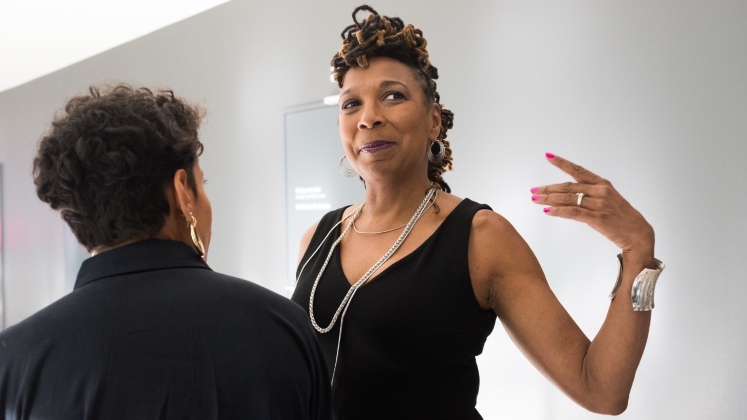
Kimberlé Crenshaw is a legal scholar, feminist theorist, co-founder of critical race theory and the thinker behind “intersectionality.” Her new memoir, Backtalker, describes the experiences that have shaped her intellectual life. The result is a masterful narrative about learning how power works and finding the courage to fight it, and essential reading on resistance in our current moment, write Clare Hemmings and Aiko Holvikivi.
Backtalker: An American Memoir. Kimberlé Crenshaw. Simon & Schuster. 2026.
Kimberlé Crenshaw’s Backtalker: an American Memoir (Simon & Schuster 2026) has been long awaited. Crenshaw is a legal scholar whose work has profoundly shaped feminist theorising and activism across the world. She was one of the founding thinkers of critical race theory, and famously coined a concept (intersectionality) that would be discussed throughout the field of gender studies as well as circulated through activist and social spaces in speech, on t-shirts and other merch, and discussed in innumerable social media posts. A professor at UCLA and Columbia, her work spans a range of genres: Crenshaw is also the Executive Director of the African American Policy Forum, and host of the podcast Intersectionality Matters!.
Learning to backtalk
One of Crenshaw’s unique strengths as scholar and activist is her remarkable ability to employ metaphor and storytelling to illuminate the complexities of the workings of power in law, governance, and everyday life. Backtalker offers an important lesson in its very form about the ability to work across genres and with different audiences. What may have started as a traditional academic book morphed into a political memoir, with a title that traces Crenshaw’s own trajectory of “backtalking” – refusing to quietly accept injustice. While the book delivers on the expectation to help its reader recognise and think through the workings of gender and race in political life, it does so in the form of autobiographical storytelling to unpack these complex questions.
Crenshaw was forced to learn as a five-year-old that white promises are not only not kept, but are never intended to be kept. […] She only needs to learn that lesson once, impressively, supported by family who affirm the pain of both the experience and the realisation of its significance.
Backtalker begins with Crenshaw’s memory of being repeatedly promised and then denied the role of Thorn Rosa in a primary school game. Her white teacher keeps telling her she’ll have the role she’s been preparing for tomorrow, tomorrow, and when tomorrow comes, it is too late. The scene shows how Crenshaw was forced to learn as a five-year-old that white promises are not only not kept, but are never intended to be kept. Recognition within a racist America can never be the aim for Black people. Crenshaw only needs to learn that lesson once, impressively, supported by family who affirm the pain of both the experience and the realisation of its significance. It is a story of hurt, then, but also of collective reparation and recognition as deeply affective.
A commitment to disruption
Crenshaw’s gift is her refusal to accept injustice, and in Backtalker that commitment is laid out across the phases of her life. Whatever the cost, Crenshaw talks back to power, insisting it has no right to wield its violence. And while this frequently results in punishment or marginalisation, Crenshaw’s story is one of investment in other contexts to sustain her: histories of Black rights thinking and action, familial affirmation, collective visions for transformation. With allies or alone, Crenshaw sets out to transform Harvard Law School (Chapter 29, Welcome to Harvard Law 218), generate new concepts to help understand Black women’s needs (most famously “intersectionality”, 261-263), and refuse false oppositions between Black and feminist thinking [285-286]. Backtalker is in part then the story of late 20th and early 21st century anti-racist struggle in America, and the importance of centring feminist analysis in order to create resilient institutional and policy for lasting political change. Anyone familiar with Crenshaw’s work will see the campaign SayHerName as evidence of how her interventions have been game-changing.

There is a current of disappointment, though, that bubbles up at different points throughout the book. While Backtalker is a plea for community and solidarity, this call leaves itself open too: when others fail to step up, or when people remain silent. The book could be read then as both a searing critique of racism and misogyny in US institutions, but also as an indictment of the bystander and the political coward, the ones who leave others in the lurch. The loneliness of the task Crenshaw sets herself over her lifetime seeps through the pages as surely as her bravery in refusing to be silent.
A toolkit for resistance
In Backtalker, resistance thrums like blood. For Crenshaw, resistance is a conversation among those who want change, among those who are disadvantaged by the powers that be, by racism, sexism, homophobia and transphobia, who need to work out what tactics to hold onto, and which to ditch in any given moment. Which battles one will fight to the end and which can be bracketed for later, are judgments that Crenshaw insists have to be made in the moment for resistance to have a future rather than only a present. It is also a deeply affective process, felt in the body, learned through experience, and shared as knowledge.
The importance of feeling for knowledge and politics runs through Backtalker: from the grief Crenshaw experiences when her father dies – a grieving ten-year-old girl thrown out of her known universe by a thunderbolted, soul-shattering, life-altering loss – to rage at all the timesthey stood silently by. There are plenty of good times too, and these often take place in spaces in between – trips in the car, celebrations of successes at people’s houses, musical immersion and dancing, holidays, caucuses, protests, pizza parties, swimming pools. “C’mon, sis. Swim to me,” says her brother, Mantel,in a rare moment of pure connection. Backtalker is also peppered with laughter among Black friends who reclaim the horrors of racism through refusals again and again. Crenshaw draws a portrait of her mother’s formidable determination, too. She says to a teacher who has sought to humiliate her daughter: Every day I wake up with one mission, and that mission is to ensure that no one and nothing gets in [my daughter’s] way. Her mother passed Crenshaw many legacies, and refusal of authority as survival is surely one of them.
Crenshaw’s methods have always been translatable – universal even.
These feelings that bubble through Backtalker conjure Crenshaw as a Black feminist in becoming. These are affective methods crafted for a Black feminist toolkit in a specific context, but they are surely translatable to so many other contexts. As readers, those feelings brought to our minds the joy and laughter on the marches against the far-right in the UK through 2026, and the community rage and heartbreaking grief expressed in the ongoing actions for an end to the genocide in Palestine over the last years. Crenshaw’s work reminded us of the determination in the civil disobedience movements that have emerged in response to craven flaunting of ethics and law transnationally, too. Crenshaw’s methods have always been translatable – universal, even.
We had questions, too. Feminist and anti-racist work is increasingly under attack, both in the United States where Crenshaw’s experience draws from, but also at the transnational scale, with anti-gender, racist and anti-democratic forces staging different forms of political attacks in many places across the world. Backtalker offers insight into how the failures to defend and extend civil rights brought the United States to this moment. While working in our different contexts, the task that extends to readers is to parse what lessons can be learned from this work to understand our historical present and, crucially, how to backtalk to the moment.
Note: This review gives the views of the interviewer and author, not the position of the LSE Review of Books blog nor of the London School of Economics and Political Science.
Image: Kimberlé Crenshaw by Mohamed Badarne via Heinrich-Böll-Stiftung on Flickr. License: CC-BY-SA-4.0.
Enjoyed this post? Subscribe to our newsletter for a round-up of the latest reviews sent straight to your inbox every other Tuesday.