Salih Çakar won a Guest Judge’s Choice Award, selected by Deborah Smith, in Jackson’s Art Prize 2026 with his work Savaş Ve Göç (War and Migration). In this interview, he discusses how observing village life has become part of his process, thinking directly on the canvas, and what it was like to enter the prize from a ‘distant place’.
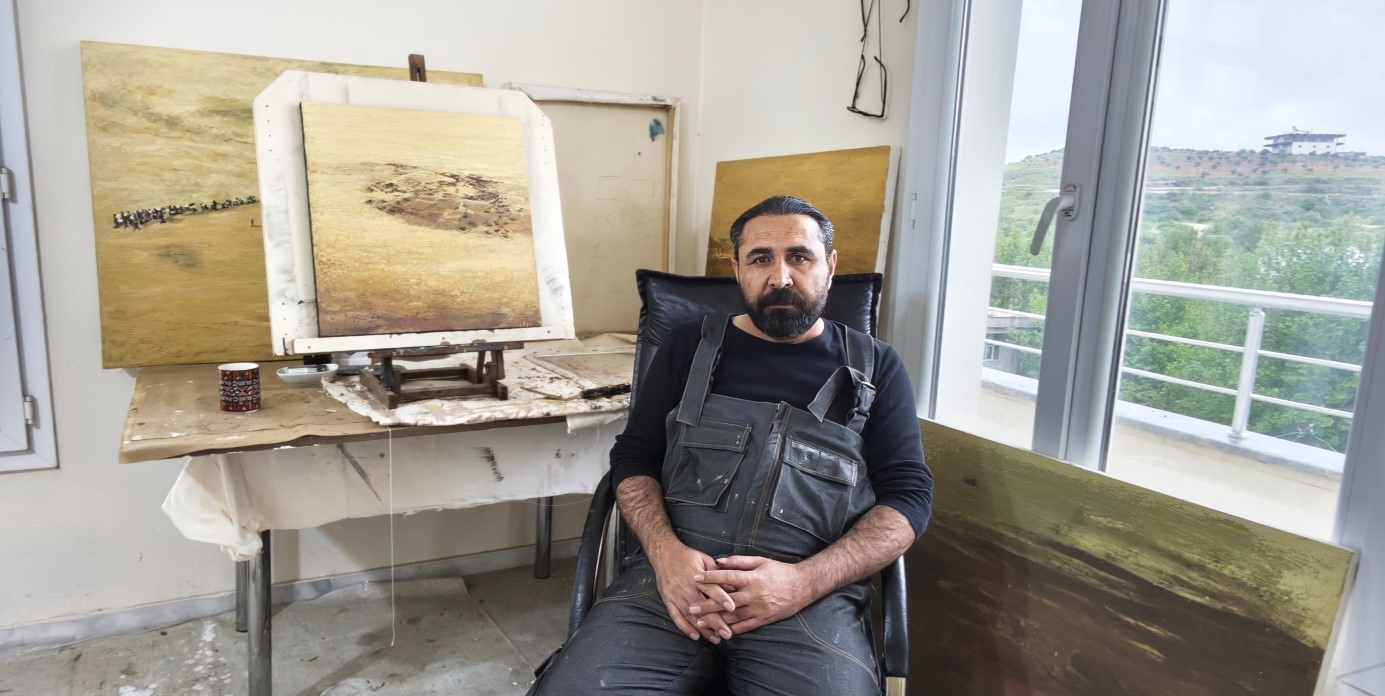
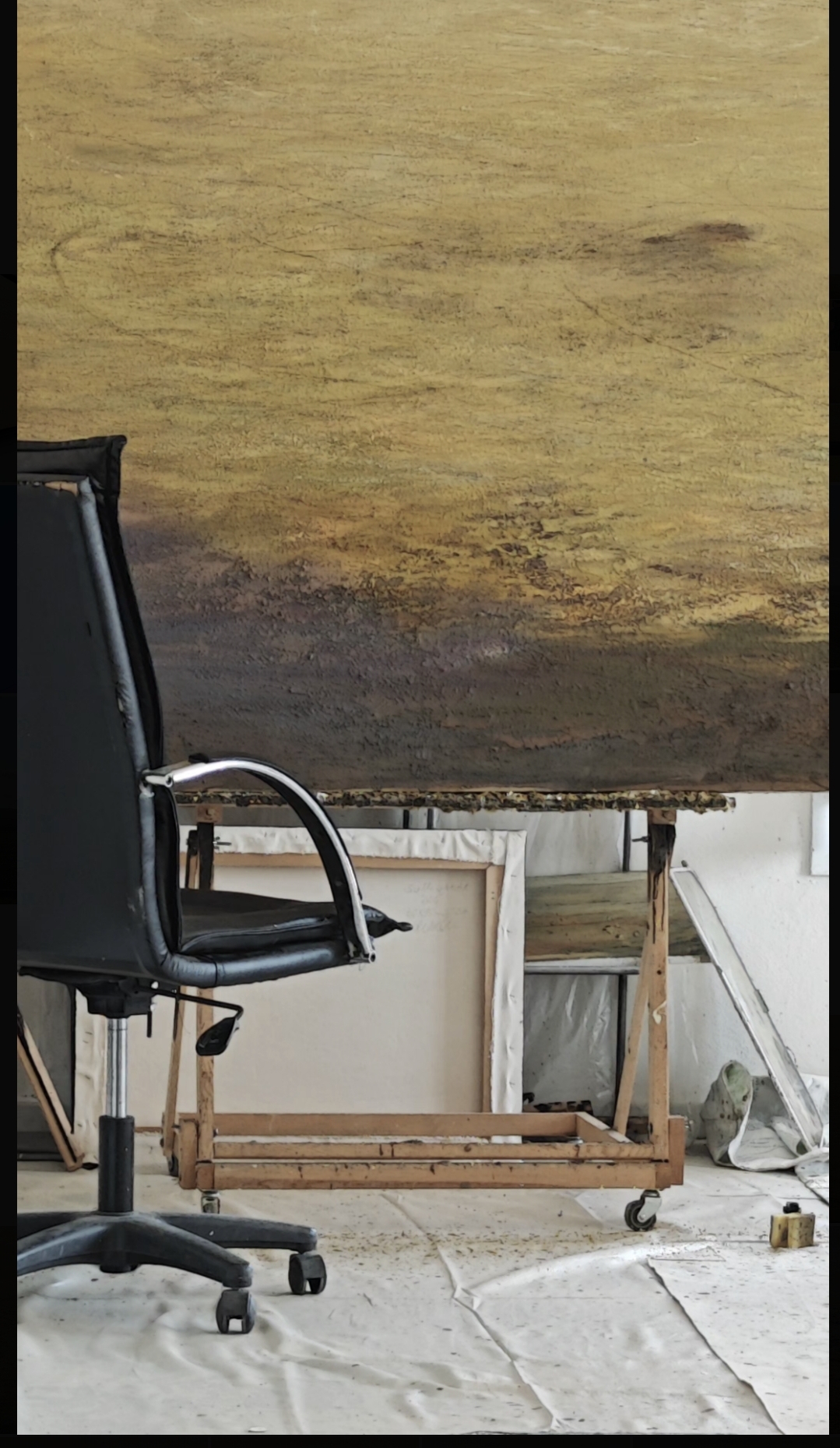
Above image: Salih in the studio

Salih Çakar,
Acrylic on canvas, 60 x 80 cm | 23.6 x 31.4 in
Josephine: Could you share the story of how you became an artist and tell us more about your artistic background?
Salih: Since originality is the most crucial criterion in art, this question is usually answered through childhood memories. This is because the only thing that sets us apart from one another is life itself and our lived experiences. I suppose our experiences are the only treasure we possess. Although painting started as an enjoyable game during my high school years, it gradually grew more serious, and as it deepened, I strove to find solutions. First, I tackled technical issues during my academy years, then form and content problems during my master’s degree, and finally, I continue to solve form and content challenges in my doctoral studies. In this journey of experience, you first learn a language and its grammar, and later, you begin to speak. That is, of course, if you have something to say! My own concern is the events I bear witness to in the geography where I live.

Salih Çakar
Acrylic on canvas, 50 x 50 cm | 19.7 x 19.7 in
Josephine: What does a typical working day in the studio look like for you? Do you have any important routines or rituals?
Salih: Because I live in a village, my studio practice is a more physical process that includes every stage of production. I produce many of the things I use myself; I prepare most materials myself, from the canvas to the frame. After making my canvases, I begin creating textures unique to myself on the surface. This preparation process is an important stage for me in establishing the atmosphere of the painting.
I generally do not make detailed sketches beforehand. The painting transforms throughout the process. There are many times when I destroy what I have done and work over it again. I am in a constant state of struggle and reconstruction with the painting. I work until an atmosphere emerges that evokes a memory or feeling from the past. The moment I capture that feeling, I understand that the painting is complete.
Sometimes, however, my whole day passes simply by looking at the painting. I stand in front of it without intervening and spend time with it. There are also days when I return home without doing anything at all. For me, this too is an important part of the production process.

Josephine: Which materials or tools could you not live without?
Salih: One of the most important tools I could never give up is my palette knives. I use them not only for mixing paint, but also for directly transferring my reflexes onto the surface, scraping, drawing, and physically feeling the painting. Most of the time, I think they leave a more honest trace than brushes.
Besides that, texture is very important to me in painting. Without texture, I cannot feel the space within the painting. The layers and traces formed on the surface become one of the fundamental parts of establishing the atmosphere. Of course, I should not disregard the value of other materials either; every material I use has its own place and contribution within the process. I feel a sense of gratitude toward all of them.

Josephine: Do you work from a reference? Tell us more about your process.
Salih: My relationship with references actually goes back to my childhood. My childhood years passed in a rural area that almost resembled a desert. During those times, my family and I were engaged in agriculture and animal husbandry within village life. The dirt roads where we played games, the mountainous areas where we hid, and many places that were part of everyday life carry completely different meanings today. Some of those roads have now become routes used by people fleeing war, while some areas have turned into shelter centres.
In my works, the relationship between the past and current issues constitutes a fundamental problem area. I use references not only as visual sources but also as a conceptual field. When I stand before the canvas, a journey into the past begins for me. When a memory, or a feeling from my memory, reappears, the process slows down; at the point where I capture that feeling, I try to relate the work to today’s reality.

Salih Çakar
Acrylic on canvas, 60 x 80 cm | 23.8 x 31.5 in
Josephine: Do you regularly draw or keep a sketchbook? If so, how does this inform your work?
Salih: I am not someone who makes sketches very regularly. I usually think directly on the canvas and search for the painting within the process. Sometimes there are moments when I struggle in front of the canvas or when nothing emerges at all. At such times, instead of forcing the work, I prefer to go outside and observe.
Observing village life, people, places, and daily movements is an important part of the process for me. As if preparing for the painting I want to create, I sometimes imagine small dramatic situations; I try to wander within an atmosphere or emotion. In fact, this process resembles building a drama a little. The painting often first forms in my mind and emotional memory, and then transforms onto the canvas.

Josephine: Have you ever had a period of stagnation in creativity? If so, what helped you overcome it?
Salih: For me, creative stagnation is often the beginning of a new leap. During such periods, I definitely feel that something changes in my paintings. It is as if the works I previously made never existed, and I find myself in a completely reset place. Although it seems challenging at first, this situation actually creates space for me to rethink my way of producing.
During these periods, rather than forcing myself, I wait for the transformation to arrive. After a while, both the language of the painting and my approach begin to change. When I look back, I see that those stagnant periods were generally the most necessary turning points. The result is often satisfying for me.

Salih Çakar
Mixed media on canvas, 100 x 120 cm | 39 x 47 in
Josephine: Are there any specific artists or mentors who have inspired you?
Salih: During my student years, I was more interested in the technical aspects of painting. Over time, I realised how important not only technical skill but also content and intellectual depth are to me. Therefore, I have always felt close to artists who carry a strong narrative and subject matter.
Among the old masters, Vincent van Gogh was one of the names who influenced me greatly. Today, artists such as Anselm Kiefer and Mona Hatoum are among the figures who strengthen my motivation to produce and give me hope. I especially feel close to the language they establish around memory, geography, trauma, and the human condition.

Salih Çakar
Acrylic on canvas, 60 x 80 cm | 26 x 31 in
Josephine: What were you thinking about or exploring at the time you made Savaş Ve Göç (War and Migration)? What inspired it, and how did it come to be?
Salih: As part of my doctoral research thesis, I conduct both theoretical research and painterly studies on migration. The work titled War and Migration also emerged as part of this research process. When I saw the competition announcement, I decided to submit this painting, which I was already working on at that time. Because it aligned thematically with the context of the competition and was a natural extension of my ongoing research.

Salih Çakar
Acrylic on canvas, 50 x 50 cm | 19.7 x 19.7 in
Josephine: What made you submit this piece to Jackson’s Art Prize?
Salih: I felt that this work truly represented the point where my practice currently stands. It contained both a completed aspect and a side that was consciously left open, and this was important to me. Since it carried many of the themes I have been interested in recently, submitting it felt very natural.

Josephine: How long does a painting like this take you to complete?
Salih: The completion time of a painting like this, if the technical conditions are ready – canvas, surface, texture and so on – actually changes entirely depending on my mood and inner process at that moment. Sometimes it is completed in a very short time, within two days; sometimes the process lasts much longer. Some works may even never emerge at all.
For me, painting is the result of an emotional and mental flow rather than a controllable timeline. When I capture that atmosphere, the painting progresses; when I cannot capture it, it may wait or completely transform into something else.
Josephine: If you had the chance to experiment with a new technique or idea without any limitations, what would you like to try?
Salih: I would very much like to work on a larger scale and combine painting with spatial elements. Thinking about sound, space, and narrative together with painting interests me. The idea of painting extending beyond the canvas and transforming into an experiential space excites me.

Salih Çakar
Acrylic on canvas, 100 x 100 cm | 39.4 x 39.4 in
Josephine: Are there any new techniques or ideas you’re excited to explore using the materials from your prize?
Salih: First of all, I would like to thank the Jackson’s Art Prize team. This award is extremely valuable to me, both materially and spiritually, but above all, for what it means to me personally.
I tend to use a considerable amount of materials – well above average – on a single painting. I believe this prize will give me much greater freedom and ease in this respect, and I am very grateful for your contribution and support.
I would also like to take this opportunity, through this interview, to express my sincere thanks to Deborah Smith.
Josephine: How did it feel to move through the stages of the competition and win Deborah Smith’s Choice Award?
Salih: I participated in the competition from quite a distant place. And honestly, while participating, I did not think much that I could receive a positive result because of the disadvantage the distance might create. Therefore, when I learned about the award, the strongest feeling was seeing that the evaluation had truly been made fairly. This was even more valuable to me than the award itself.
Of course, the award itself also holds a very valuable place for me. On this occasion, I would like to express my respect and thanks to the entire jury. I also think I owe thanks to Jackson Art, who organised the competition. I especially want to emphasise that they created a field of hope for many more invisible artists like us, ‘waiting in solitude.’

Josephine: What’s coming up next for you?
Salih: The new works I am currently working on deepen even further the themes I have been interested in recently. I want to push emotional intensity and compositional structure further, and make the works more ambitious in terms of scale and atmosphere. I am excited to see where the process will take me.
In addition, the exhibition that will take place at Jackson’s Art carries special importance for me. I am curious about how my works will be received at this exhibition and what kind of reactions I will get from viewers. I feel that this process will be an important threshold both for my production and for my future directions.

Further Reading
Meet Angela Lizon, Winner of Jackson’s Art Prize 2026
Jackson’s Art Prize 2026 First Prize Winner Announced
How We Collaborate With Artists
Expert Advice on Making Your Way as an Artist
Shop Oil Painting on jacksonsart.com